

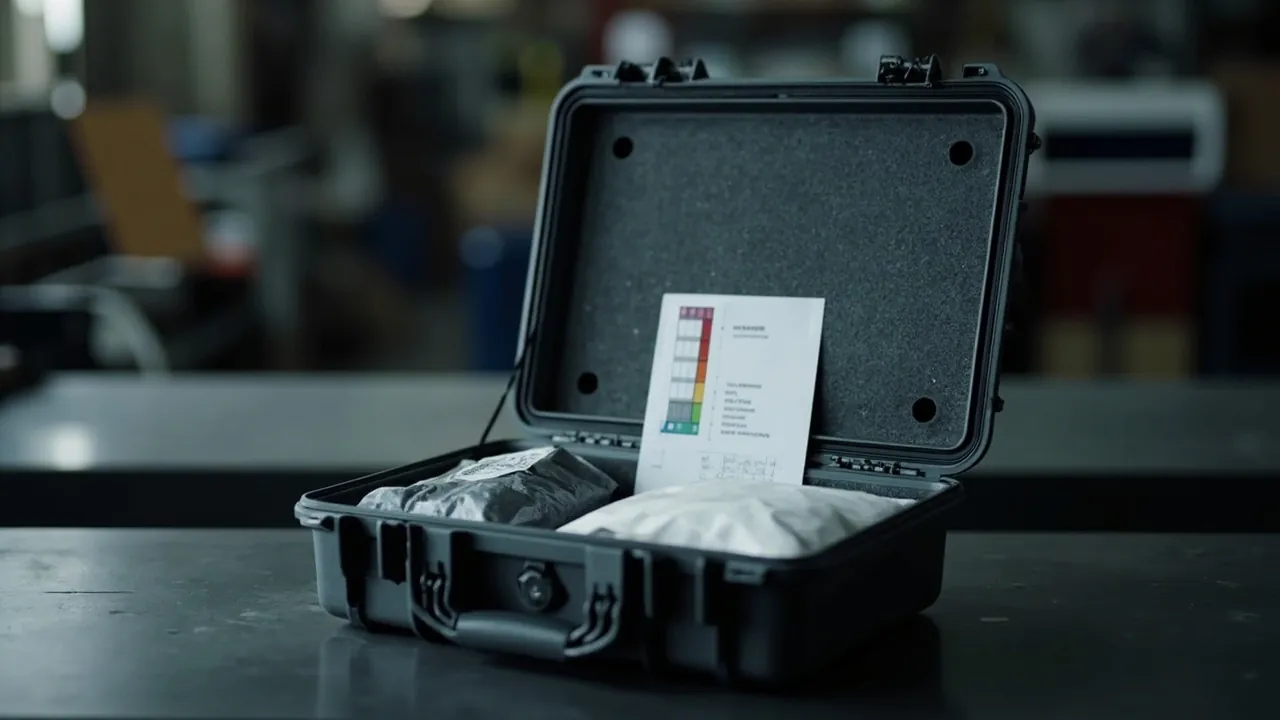
Condensation is not a leak. Nothing failed. Water simply condensed out of the air inside the case because a surface got cold enough — and a sealed case is the perfect place for that to happen, because it holds the same air for days.
What Actually Happens
Air holds water vapour, and how much it can hold falls as temperature drops. When a surface reaches the temperature at which the surrounding air is saturated — the dew point — water condenses onto it. That is why a cold case brought into warm humid air collects moisture on the outside, and why a case that cools overnight collects it on the inside.
The Three Situations That Cause It
| Situation | Mechanism | Result |
|---|---|---|
| Wet equipment packed too soon | Moisture evaporates inside a sealed case and has nowhere to go | Humidity rises, then condenses on the coolest surface — often the equipment |
| Cold case, warm humid air | Case and contents are below the dew point of the new air | Moisture condenses on cold metal and optics |
| Overnight cooling in the field | Radiative cooling drops the shell below the internal dew point | Water forms on the inside of the shell and drips |
Why Sealing Makes It Worse
A well-sealed case does two things: it keeps water out, and it keeps water in. Once moisture is inside, there is no exchange with the outside air, so it stays there and redistributes to the coldest surfaces. This is not a design fault — it is the same property that makes the case protective.
Control Measures
- Dry equipment before packing. This is the single most effective step, and the one most often skipped at the end of a long day.
- Use desiccant, and manage it. Silica gel absorbs moisture up to its capacity; use enough for the case volume, and regenerate or replace it on a schedule. Indicating desiccant tells you when it is spent.
- Let a cold case acclimatise before opening. Opening it in warm humid air floods the interior with moisture-laden air that then condenses on cold contents.
- Store cases open in a dry room between deployments so any residual moisture can escape.
- Insulate where practical. An insulated liner slows the temperature change that drives condensation.
Where the Water Does Damage
Optics are the classic victim: moisture on lens coatings supports fungal growth that permanently marks glass. Electronics suffer corroded contacts and short circuits. Steel tools and fasteners rust. And foam interiors hold moisture against contents long after the case looks dry — which is why a damp liner should be dried properly rather than closed up.