

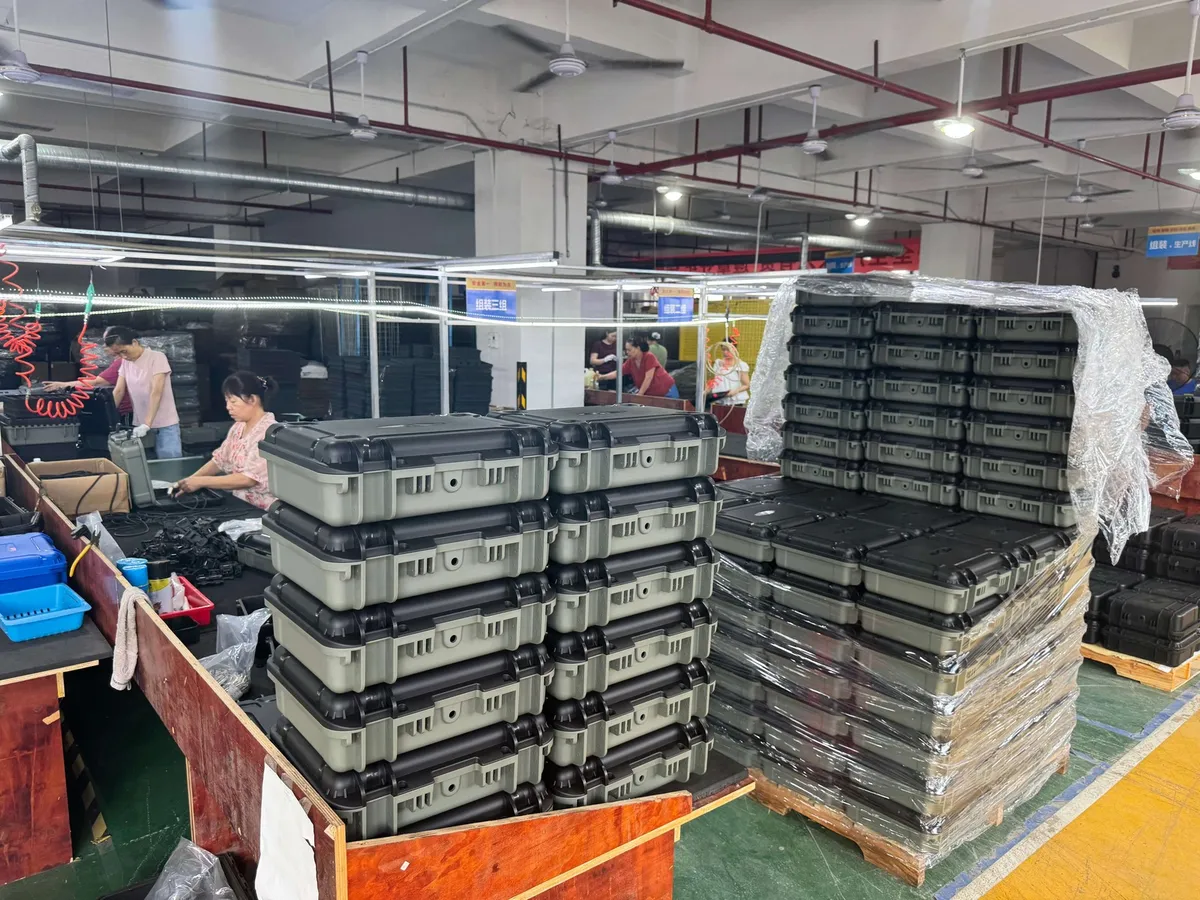
IK codes appear on more and more protective case specifications, usually as a single number with no context: IK08, IK10. The number is meaningful, but only if you know what it was measured on, at what temperature, and what it does not cover.
What IK measures
The IK code is defined by IEC 62262 (published as EN 62262 in Europe). It classifies the degree of protection an enclosure provides against external mechanical impact, expressed as impact energy in joules. The test delivers a defined energy through a defined striking element at defined points, and the enclosure must survive it.
| IK code | Impact energy | Equivalent impact | Typical situation |
|---|---|---|---|
| IK07 | 2 J | 0.5 kg from 400 mm | A hand tool slipping and striking the case; a cable drum bumping into it |
| IK08 | 5 J | 1.7 kg from 300 mm | Trolleys and moving equipment hitting the case; moderate impacts in transit |
| IK09 | 10 J | 5 kg from 200 mm | Heavy tool impacts; rough handling in industrial and public environments |
| IK10 | 20 J | 5 kg from 400 mm | Deliberate abuse, heavy tool blows, impacts from moving vehicles |
Lower codes - IK01 to IK06 - cover progressively lighter impacts below one joule up to one joule. The scale is not linear: IK07 to IK08 is two and a half times the energy, and IK08 to IK10 is four times. Each step up is a substantially more robust shell, not a marginal one.
IK is not IP
The two codes address completely different threats and are frequently confused because they sit next to each other on a datasheet.
| IK | IP | |
|---|---|---|
| Standard | IEC 62262 | IEC 60529 |
| Protects against | Mechanical impact from outside | Ingress of solids and liquids |
| Expressed as | Two digits after IK, mapped to joules | Two digits: solids, then liquids |
| Independent? | Yes - a case can be IP67 and IK07, or IP20 and IK10 | Same - neither implies the other |
| Where they meet | After the impact test, the enclosure must still deliver its rated IP protection | Same test sequence |
That last row matters. A cracked or deformed shell loses its seal, so impact damage and ingress protection are coupled. It is also why a case that has taken a heavy knock should be re-checked for sealing, not just looked at.
The rating applies to the shell, not the contents
This is the single most important thing to understand. IK tells you whether the enclosure survives and continues to seal. It does not tell you what shock reached the equipment inside - that depends entirely on the foam interior, the support geometry and the clearance. A shell can pass IK10 and still transmit a shock pulse that destroys a calibrated instrument.
- Shell rating and content protection are two separate specifications. Ask for both.
- The foam is a shock absorber, not a filler. Its density, thickness and support points set the transmitted pulse.
- Isolation matters more than hardness. A very stiff shell with no isolation transfers more, not less.
- Verify at system level. The meaningful test is a drop test with the actual payload instrumented or inspected, not the shell rating alone.
Three limits of the rating
The number is measured under defined conditions, and your conditions are probably different. Three gaps come up repeatedly in practice.
- Temperature. Polymers stiffen and become more brittle as temperature falls. A shell rated at laboratory conditions can behave very differently in a cold winter environment. If cold service matters, ask for impact behaviour at your service temperature.
- Repetition. The classification is a defined energy at defined points. It is not a statement about surviving that impact hundreds of times in the same place over a service life.
- Where the impact lands. Impacts are applied at prescribed points and avoid edges and hardware. Real impacts do not - a corner or a latch is a very different event from the centre of a flat face.
Material behaviour
Different shell polymers reach the same rating by different routes, and they degrade differently. A material that absorbs impact by flexing needs room to flex and can be sensitive to temperature and to notches; a material that absorbs it by distributing load through a thicker section tends to be heavier. Neither is universally better - the right choice depends on whether the case will be dropped in the cold, dragged over gravel, or stacked under load.
How to verify a report
An IK claim is only as good as the document behind it. When a supplier quotes a rating, ask for the report and check these points.
- Which standard and which edition - IEC 62262 or EN 62262, with the year.
- The striking element: mass, material, radius, and the energy delivered.
- The number of impacts and the points at which they were applied.
- How the sample was conditioned before testing, especially temperature.
- Confirmation that the rated IP protection was retained after impact.
- Whether the sample was a production moulding from the actual production tool.
Specifying IK without over-specifying
A higher code costs more and usually weighs more. Match the rating to the actual impact risk rather than defaulting to the maximum: light handling and indoor storage rarely justify the top of the scale, while public spaces, industrial floors, vehicle transport and abusive handling often do.
| Use environment | Risk profile | Reasonable starting point |
|---|---|---|
| Office, studio, controlled storage | Accidental knocks, light tools | Lower half of the scale |
| Workshop, service van, field survey | Tool drops, equipment striking the case | IK07 to IK08 |
| Industrial floor, warehouse, logistics | Trolleys, moving equipment, stacking | IK08 to IK09 |
| Public space, military, heavy site use | Deliberate abuse, heavy impacts | IK09 to IK10 |
A rating is an input to a decision, not the decision itself. Combine it with a drop test on the real payload, an ingress check, and a look at how the interior is supported - then you have a specification worth writing into a purchase order.
Related Products
- 8 Series — Gun Cases; Military Equipment Cases; Camera Equipment Cases; Drone Cases; Watch Cases; Knife Cases; First Aid Cases; Electronics Equipment Cases
- WL8-2812 PP Gun Case — model WL8-2812
- All protective cases and toolboxes: 7 series, 158 models