

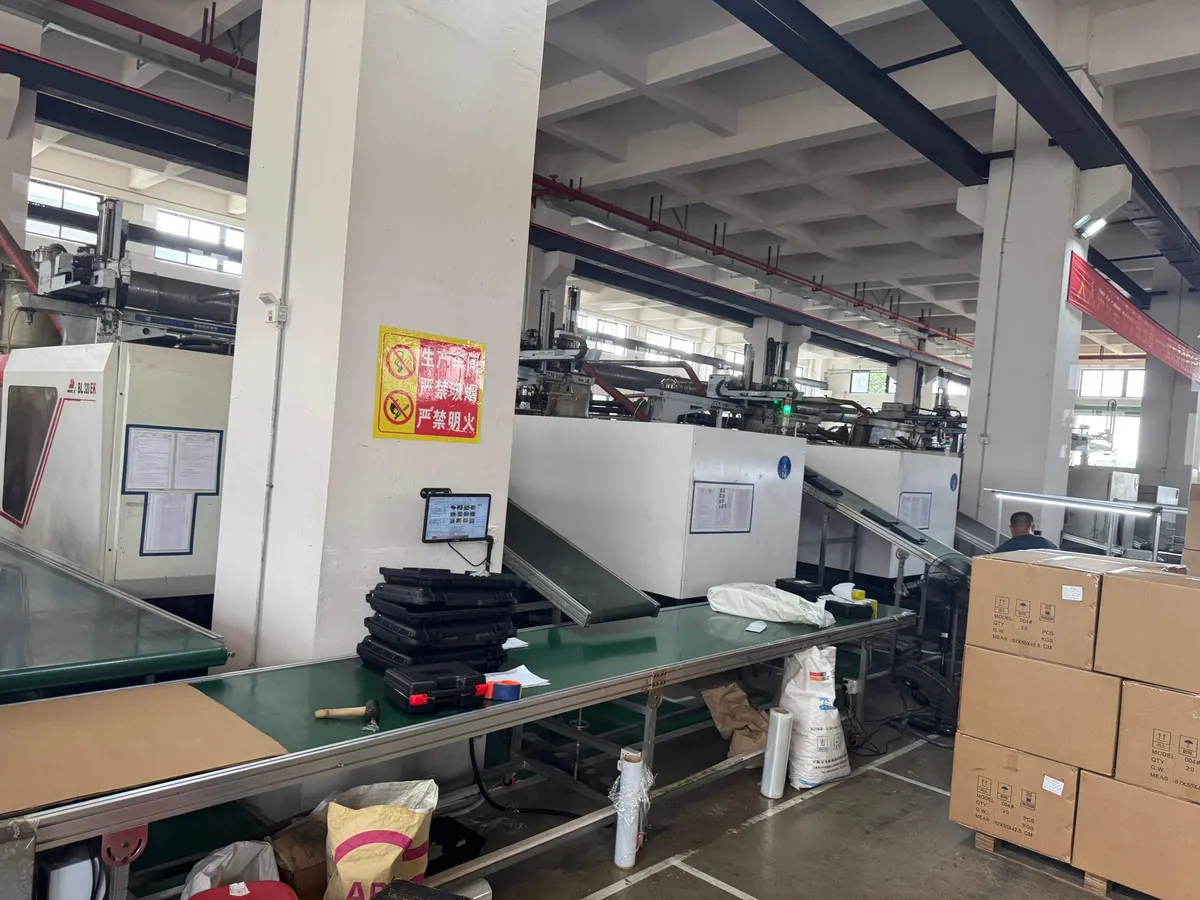
A rating is a statement about a sample. Incoming inspection is how you turn it into a statement about the delivery in front of you. The sequence below runs from checks that take seconds to checks that take minutes, so the cheap ones can stop the process before you spend time on the rest.
Sequence: dry checks first
- Exterior and structure. Shell damage, cracks, deformed corners, and anything that suggests the case was dropped in transit.
- The gasket. Seated evenly in its groove the whole way round, with no twists, no gaps at the corners, and no debris in the groove.
- The mating face. The surface the gasket presses against must be clean, undamaged and free of deep scratches.
- Latches and hinges. Every latch opens and closes through full travel and engages positively. No play at the pivot, no cracking at the housing.
- The seam. With the lid closed, sight along the lid-to-base joint. Unevenness means the lid is not seating - which no amount of water testing will fix.
- Any vent. Present, undamaged, and not covered by a label or paint.
- Interior. Foam correctly fitted and adhering, no loose debris, and no sharp objects left inside from the manufacturing process.
Most failures are found in the first four checks, before any water is involved. If a case fails a dry check, do not proceed to wet testing - you already know the answer.
The dry-paper test
A quick intermediate step between looking and submerging. It catches the marginal case - the one that seals well enough to survive handling but not well enough to be called waterproof.
- Lay strips of dry paper towel around the interior perimeter, just inside the seal line, and one across the centre.
- Close the lid and latch fully. Leave the case undisturbed for as long as you would leave it in a wet environment.
- Open and inspect the paper. Any dampness indicates moisture is crossing the seal under static conditions, which is a worse result than a splash failure because it means the seal is not compressed evenly.
Shallow submersion, done safely
| Step | How | Why |
|---|---|---|
| Prepare | A container deep enough to cover the case; the case empty and dry inside | You need to be able to detect ingress, so the interior must start dry |
| Close | All latches fully engaged, on a level surface | Uneven closure mimics a gasket failure and produces a false reject |
| Weight it | Add weight if the case floats; do not hold it down by hand | Hand pressure varies and masks the slow leak you are looking for |
| Wait | Leave it for the duration you intend to test - do not lift it out early to peek | Repeated lifting changes the pressure on the seal and invalidates the result |
| Dry before opening | Thoroughly dry the entire outside, especially the seam | Water on the outside running in when you open is the most common false positive |
| Open away from water | Open over a dry surface, lid up | Any ingress becomes visible rather than draining away |
| Inspect | Dry cloth or paper over the interior, paying attention to corners | Water enters at the weakest point, which is almost always a corner or the seal joint |
What you are testing is this specific case, in this condition, at this moment. That is the correct question at goods receipt. It is not the same question as whether the design is rated, which is what a laboratory report answers - and both questions are worth asking, at different times.
Sampling: how many to test
- For a first delivery from a new supplier, or after any specification change, test more aggressively - a higher proportion than you would for a routine repeat.
- For a routine repeat from a supplier with a clean history, a defined sample per delivery is enough, provided you record it.
- Always test at least one case from each production batch if batch identification is available; a batch-level problem is invisible in a single-unit check.
- Test additional cases whenever anything changes: a new colour, a new foam design, a new hardware supplier, or a new production run after a tooling change.
Recording so it is worth something
- Log date, model, batch or serial, which checks were done, the result, and who did it.
- Photograph failures before touching anything, including a wide shot showing the case and a close-up showing the defect.
- Keep the failed unit in the failed state until the supplier has seen the evidence.
- Review the log periodically. A single failure is an incident; two failures of the same type is a trend, and a trend is a conversation worth having before the next order.
Incoming inspection costs minutes per case and converts a claim into a fact. On JUNZHIJIA deliveries, the checks above are the ones we would run ourselves; if you tell us at enquiry which acceptance tests you will perform and at what sampling level, that can be agreed up front so both sides are testing the same thing and reading the result the same way.
Related Products
- 8 Series — Gun Cases; Military Equipment Cases; Camera Equipment Cases; Drone Cases; Watch Cases; Knife Cases; First Aid Cases; Electronics Equipment Cases
- WL8-2812 PP Gun Case — model WL8-2812
- All protective cases and toolboxes: 7 series, 158 models