

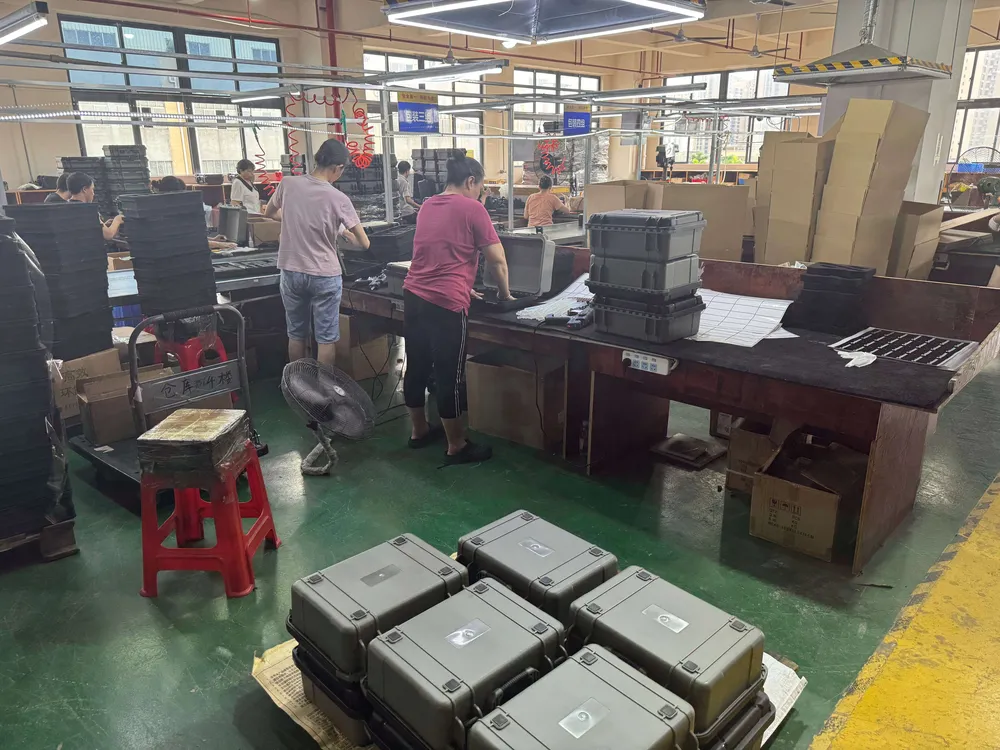
IP67 and IP69K are often treated as if one were simply a stronger version of the other. They are not. IP67 describes survival in still water at a shallow depth; IP69K describes survival against a hot, high-pressure jet fired from close range. A case can pass one and fail the other, which is why the two codes must be read as separate answers to separate questions.
The Two Standards Behind the Codes
IP67 comes from IEC 60529, the international standard for enclosure ingress protection. The first digit 6 means dust-tight; the second digit 7 means the enclosure withstood 30 minutes of immersion in 1 metre of still, fresh water at room temperature without harmful ingress.
IP69K originated in DIN 40050-9 and is now published as ISO 20653, a standard written for electrical equipment on road vehicles. The "9K" refers to high-pressure, high-temperature water jets — the kind a vehicle meets during steam cleaning or a pressure wash.
Side-by-Side Test Parameters
| Parameter | IP67 (IEC 60529) | IP69K (ISO 20653) |
|---|---|---|
| Water condition | Still, fresh water | Pressurised jet, heated |
| Pressure | Hydrostatic only (1 m head) | High pressure delivered by nozzle |
| Water temperature | Ambient | Elevated (typically 80 °C) |
| Duration | 30 minutes | Short exposure per nozzle angle |
| Nozzle geometry | None (immersion tank) | Fixed spray angles, short standoff |
| First digit (dust) | 6 — dust-tight | 6 — dust-tight |
The practical reading: IP67 answers "will it survive being dropped in water?", while IP69K answers "will it survive being blasted with hot water at close range?". Neither answers "can it be taken diving?", because long-term submersion under pressure is outside both tests.
Why One Rating Does Not Imply the Other
The failure modes are different. Immersion loads a seal slowly and evenly, giving water time to find any capillary path. A high-pressure jet does the opposite: it concentrates force on one spot, and if the shell flexes or a latch gaps open under that load, water is driven straight through.
This is why a genuinely washdown-rated case is an engineering package rather than a thicker gasket. Three things have to work together:
- Shell stiffness — the wall must not deform enough to open a gap at the seal line.
- Latch retention — latches must hold clamping force when the jet pushes against the lid.
- Gasket recovery — the seal must return to shape after compression and after heat cycling.
Choosing the Code You Actually Need
Start from the harshest water event the case will meet in service, not from the highest number on the datasheet.
- Rain, splashes, wet ground, temporary shallow immersion — IP67 is the meaningful target.
- Routine pressure washing, steam cleaning, food or pharmaceutical washdown — ask specifically for IP69K evidence.
- Both, at different times — require both codes explicitly, tested separately, rather than assuming coverage.
- Prolonged submersion or diving — neither code applies; look for a depth-and-duration rating instead.
What to Ask a Supplier
Because "waterproof" is not a test result, ask for the specifics: which standard, which edition, which digits, and whether the tested unit was the same size and configuration you are buying. A seal that passes on a small case does not automatically pass on the largest shell in the same family, since the lid spans further and flexes more.