

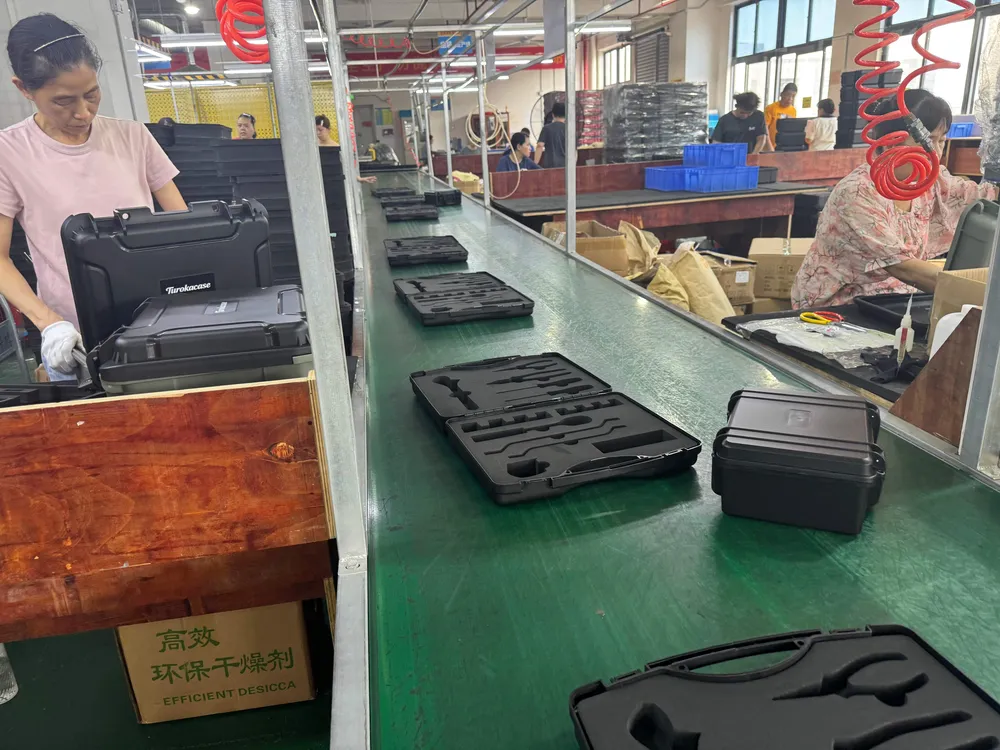
Drop testing asks whether a case survives one big event. Vibration testing asks whether it survives thousands of small ones — which is closer to what actually happens in a truck, an aircraft hold or a shipping container over several days.
Sine vs Random
| Type | What it does | Best for |
|---|---|---|
| Sine, fixed frequency | Shakes at one frequency | Finding a specific resonance and dwelling on it |
| Sine sweep | Sweeps across a frequency range | Identifying where resonances occur |
| Random | Excites all frequencies simultaneously with a defined spectrum | Representing real transport, where excitation is broadband |
Real vehicle vibration is broadband and constantly changing, which is why random testing generally represents transport better. Sine sweeps remain valuable for diagnosis: they tell you where a resonance sits, which is the first step to fixing it.
How Standards Frame It
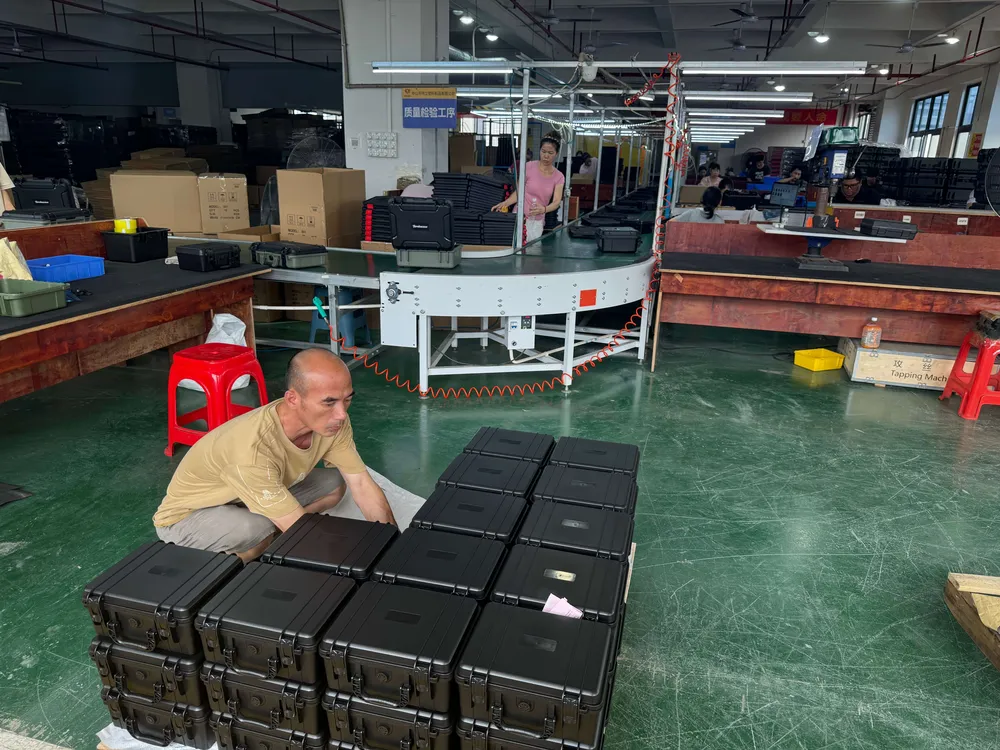
Transport simulation standards — such as ASTM D4169 for performance testing of shipping containers and the ISTA series — package vibration together with drop, compression and atmospheric conditioning into a sequence that represents a distribution cycle. The value is repeatability: two labs following the same procedure should produce comparable results.
Choose the procedure that matches your actual distribution mode. A parcel shipment, a full truckload and an air freight journey produce very different vibration environments.
What Vibration Actually Finds
- Resonance. When the excitation frequency matches a natural frequency of the case, payload or interior, movement amplifies dramatically. That is when parts start hitting each other.
- Loosening. Fasteners, latch adjustments and friction fits work loose under sustained shaking.
- Fatigue. Repeated small stresses grow cracks at stress concentrators — sharp corners, hole edges, abrupt section changes.
- Fretting and abrasion. Parts that move slightly against each other wear, and the debris causes further problems.
- Interior failure. Foam that is slightly too loose becomes much too loose as it works against the payload.
Reading the Results Honestly
Vibration testing is a comparison tool, not a prediction of exact service life. Its real value is comparative and diagnostic: run candidate A and candidate B through the same profile and you will see which loosens, cracks or wears first. Then fix the specific failure — add restraint, change the interior fit, round a corner, specify a locking fastener — and test again.