

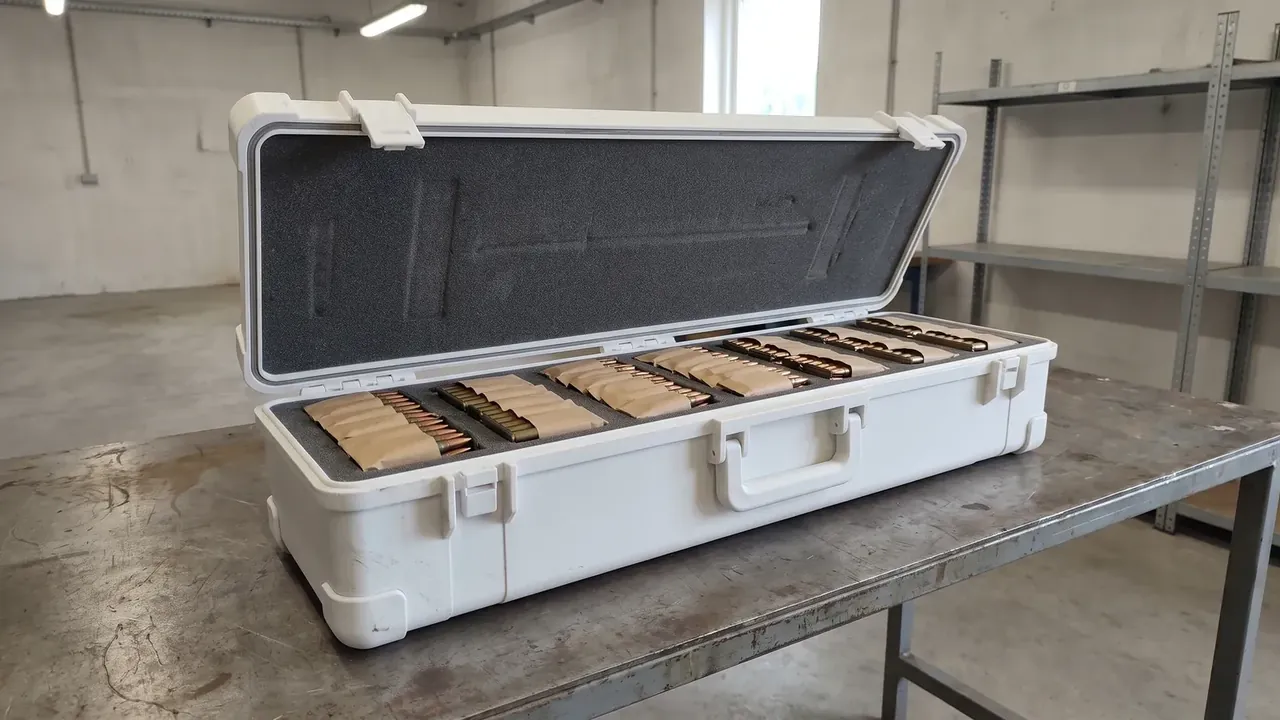
Quick answer: An ammunition box quote splits into resin, moulding time, hardware, assembly and packing. Order size decides how much machine time each unit carries, tooling is bought outright or amortised, and lead time starts at sample approval.
Table of contents
- What a Quote for an Ammunition Box Is Made Of
- MOQ Tiers and How Tooling Cost Is Amortised
- Scheduling from Sample to Mass Production
- Inspection Gates and Release Conditions
- Packing, Volumetric Weight and Landed Cost
- FAQ
1. What a Quote for an Ammunition Box Is Made Of
A rotationally moulded ammunition box is billed by machine time, not by gram. An 800 mm body uses 7.2 kg of powder, roughly 86 yuan, but also holds a machine for 22 minutes, about 15 yuan at 45 yuan per hour. That is why two plants quote a third apart on the same drawing.
Three details make replies comparable: size with wall thickness, latch count and type, and annual volume.
| Cost block | Share of price | What moves it |
|---|---|---|
| Resin | 26%–32% | Wall thickness, size |
| Moulding | 30%–38% | Cavities, batch size |
| Hardware | 12%–18% | Latch count, material |
| Packing | 6%–9% | Export or domestic |
Without volume a plant quotes a range, and without latch detail the hardware list defaults to the cheapest option.
2. MOQ Tiers and How Tooling Cost Is Amortised
Tooling comes in two grades. A steel mould costs 30,000 to 80,000 yuan at the 800 mm class and lasts 20,000 cycles; an aluminium tool costs 12,000 to 20,000 yuan and covers up to 500 units. Buy it outright and it is yours to move; amortise it and the first invoice carries the cost, refunded pro rata once volume is reached. Check the storage clause, since many plants hold customer tools free for twelve months only.
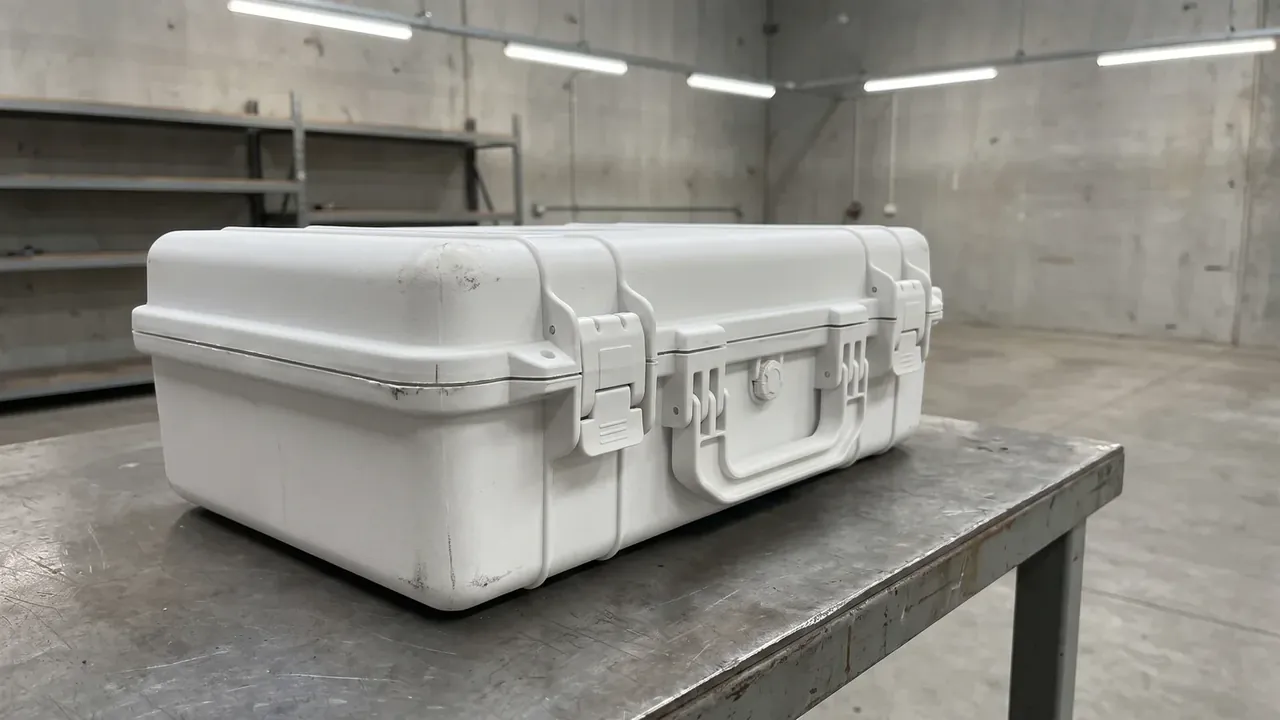
| Batch | Tooling | Relative price |
|---|---|---|
| 100 | Charged in full | 100 |
| 300 | Half charged | 92 |
| 1,000 | Amortised | 86 |
| 3,000 | Waived by contract | 80 |
The curve flattens past 2,000 units, where only machine time, labour and hardware remain.
3. Scheduling from Sample to Mass Production
Four stages set the calendar: a five-day prototype proving proportion and lid angle, a 12 to 15 day sample on a light tool, 20 to 25 days of mould machining, and 25 to 35 days of production.
Capacity is calculated, not accepted. Daily output is 1,440 minutes divided by cycle time, times cavities, times yield. Two cavities at 22 minutes and 92 percent yield give 120 units a day; at 28 minutes, 94, and delivery slips two weeks.
Lock powder batch and masterbatch ratio at sample approval, or the second shipment arrives looking grey.
4. Inspection Gates and Release Conditions
Three gates catch most problems: the first ammunition box from a new mould, a mid-run check at 30 percent completion, and a final check before packing.
Measure thickness, not outline. Five positions with three readings each: mid-wall, base, corner, lid rim and rib root. The minimum stays above 3.5 mm within plus or minus 0.8 mm, or the batch bulges once stacked.
Mid-run loads 40 kg for 24 hours, then freezes at minus 20 °C for two hours and drops from 1.2 m: no sag, no cracked corner, no popped latch. Hardware takes 48 hours of salt spray, and final inspection follows AQL 2.5.
5. Packing, Volumetric Weight and Landed Cost
One ammunition box carton measures 1,200 × 450 × 330 mm, or 0.178 m³, which converts at 1:6,000 to 29.7 kg volumetric weight against 9.5 kg actual.
| Packing | Units per 40 ft high cube | Freight index |
|---|---|---|
| Loose cartons | 330 | 100 |
| Palletised, wrapped | 240 | 118 |
| Pallet, corner boards | 216 | 126 |
Palletising forgoes a third of the load but cuts transit damage. Landed cost is FOB price plus freight calculated on volumetric weight, duty, and inland haulage with unloading.
Conclusion
Read an ammunition box quote in four layers: cost blocks, tooling recovery against order size, lead time counted from sample approval, and inspection built on wall thickness and loaded stacking. Put all four into the contract and the unit price becomes something you can compare instead of trust. Structure first and price second is the cheapest way to buy an ammunition box.
This article discusses only the container (case body) side of specifications and design intent, and does not cover any handling, loading or use of the contents.
Related Reading
- What an ammunition box is: four generations
- How rotational moulding samples are run
- Export packing and pallet options
- How to answer an enquiry with a quote sheet
Related Products
- 8 Series — Gun Cases; Military Equipment Cases; Camera Equipment Cases; Drone Cases; Watch Cases; Knife Cases; First Aid Cases; Electronics Equipment Cases
- WL8-2812 PP Gun Case — model WL8-2812
- All protective cases and toolboxes: 7 series, 158 models