

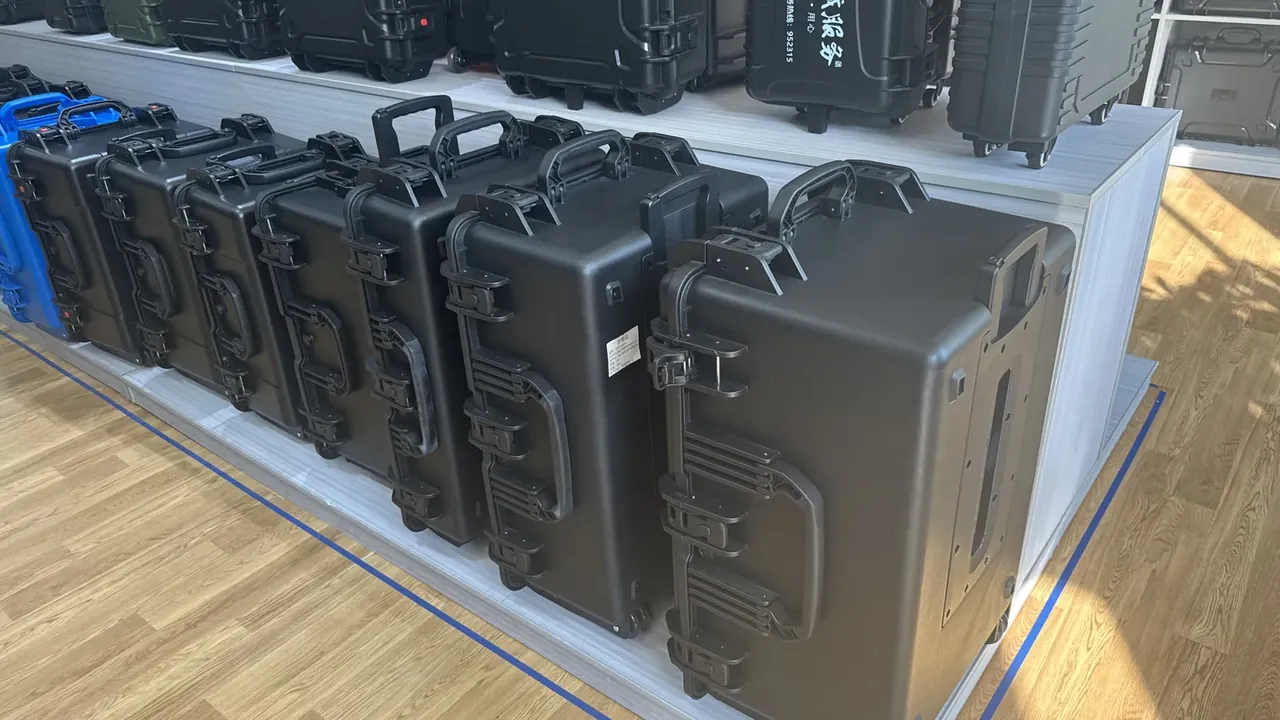
Quick answer: Buying a cartridge safety case comes down to three numbers: a quote split into six cost blocks, a minimum order quantity set by tooling and resin batch size, and a lead time split into sampling, tooling, production and freight.
Table of contents
- What a Cartridge Safety Case Quote Contains
- Where the Minimum Order Quantity Comes From
- Volume Tiers and Tooling Amortisation
- Splitting Lead Time into Four Stages
- Four Clauses to Fix in the Contract
- FAQ
1. What a Cartridge Safety Case Quote Contains
A buyer opens with the unit price, yet that price is six cost blocks added together: resin, moulding time, tooling amortisation, insert, packing and inspection, freight. Squeeze the total without splitting it and the supplier recovers it in wall thickness.
Ask for the blocks in writing. On a cartridge safety case, resin is billed on net weight plus 3 percent regrind and moulding on machine rate times cycle, so two units that look alike can differ by 0.6 CNY on cycle time alone.
| Cost block | Basis | Typical share |
|---|---|---|
| Resin | Net weight per unit, 3 percent regrind | 28 to 34 percent |
| Moulding | Machine rate times cycle, 55 s on a 250-ton press | 20 to 26 percent |
| Tooling | Tool cost divided by amortised volume | 3 to 8 percent |
| Insert | EVA or XPE by volume and die-cutting | 12 to 20 percent |
| Packing and inspection | Carton, label, seal sampling | 6 to 10 percent |
| Freight and duty | Volumetric weight, trade term | 8 to 15 percent |
Confirm VAT: at 13 percent, a 12 percent gap between quotes is often one net price against one gross.
2. Where the Minimum Order Quantity Comes From
For a cartridge safety case, an MOQ of 200 units is not a courtesy. It is where three constraints cross: the smallest economical clamping run, the smallest resin batch, and changeover loss at about 4 hours on a 250-ton press.
Resin is the harder limit. A batch runs 500 kg, a bare case weighs 1.4 kg, so one batch yields roughly 350 units; split the bag and colour and shrinkage drift. An MOQ of 200 on a cartridge safety case means one press run that uses most of a batch.
Room to negotiate sits in scheduling, not in forcing the number down: two colours back to back, changing masterbatch but not the mould, removes one changeover.
3. Volume Tiers and Tooling Amortisation
Tiers sit at 200, 500 and 1000 units, taking the price from 86 to 74 to 66 CNY. The curve is not linear: the early steps recover changeover and setting time, the last recovers resin purchasing and yield, so another doubling rarely clears 60 CNY.
Tooling is paid one of two ways: 18,000 CNY up front for the lowest unit price, or amortised, where a tool rated at 300,000 shots over 60,000 units adds 0.3 CNY per case.
| Tier | Unit price | Tooling | Production lead time |
|---|---|---|---|
| 200 units | 86 CNY | Paid up front, 18,000 CNY | 25 days |
| 500 units | 74 CNY | Up front or amortised | 25 days |
| 1000 units | 66 CNY | 0.3 CNY per case | 30 days |
Write ownership in. Paid up front, the tool is yours to move; amortised, it transfers once the agreed volume is reached.
4. Splitting Lead Time into Four Stages
One total lead time tells you nothing. Split it: sampling 7 days, tooling 15 days, production 25 days, freight by lane.
Quote production on effective capacity. A line rated at 800 cases a day runs nearer 600 once changeover and first-off approval are counted, and a cartridge safety case order usually stalls on insert and colour approval, not on pressing.
Freight runs on volume: one case is 0.062 cubic metres, a 20GP holds 480 at an 85 percent load. A thousand units is one container plus a remainder, and LCL on that remainder adds 7 to 10 days.
5. Four Clauses to Fix in the Contract
Four clauses decide a cartridge safety case order. Quote validity at 30 days, because resin and exchange rates move; payment at 30 percent deposit and 70 percent against the bill of lading copy; inspection before loading, pulling 5 units for size, air decay and latch force.
Delay liability runs 0.3 percent a day capped at 5 percent, counted from the day after the agreed date, with extensions only by written change. A cartridge safety case contract that says delays will be settled amicably has no clause at all.
Conclusion
Leverage comes from turning three vague sentences into three tables: a quote split six ways, an MOQ tied to tooling and resin batch, a lead time split into stages with stated start dates. Settle those before signing, and the cartridge safety case order stays under control.
This article discusses only the container (case body) side of specifications and design intent, and does not cover any handling, loading or use of the contents.
Related Reading
- What to put in a protective case quotation
- How the protective case sales process runs
- How to calculate line capacity before promising a date
- Scheduling and picking for mixed orders
Related Products
- 8 Series — Gun Cases; Military Equipment Cases; Camera Equipment Cases; Drone Cases; Watch Cases; Knife Cases; First Aid Cases; Electronics Equipment Cases
- WL8-2812 PP Gun Case — model WL8-2812
- All protective cases and toolboxes: 7 series, 158 models