

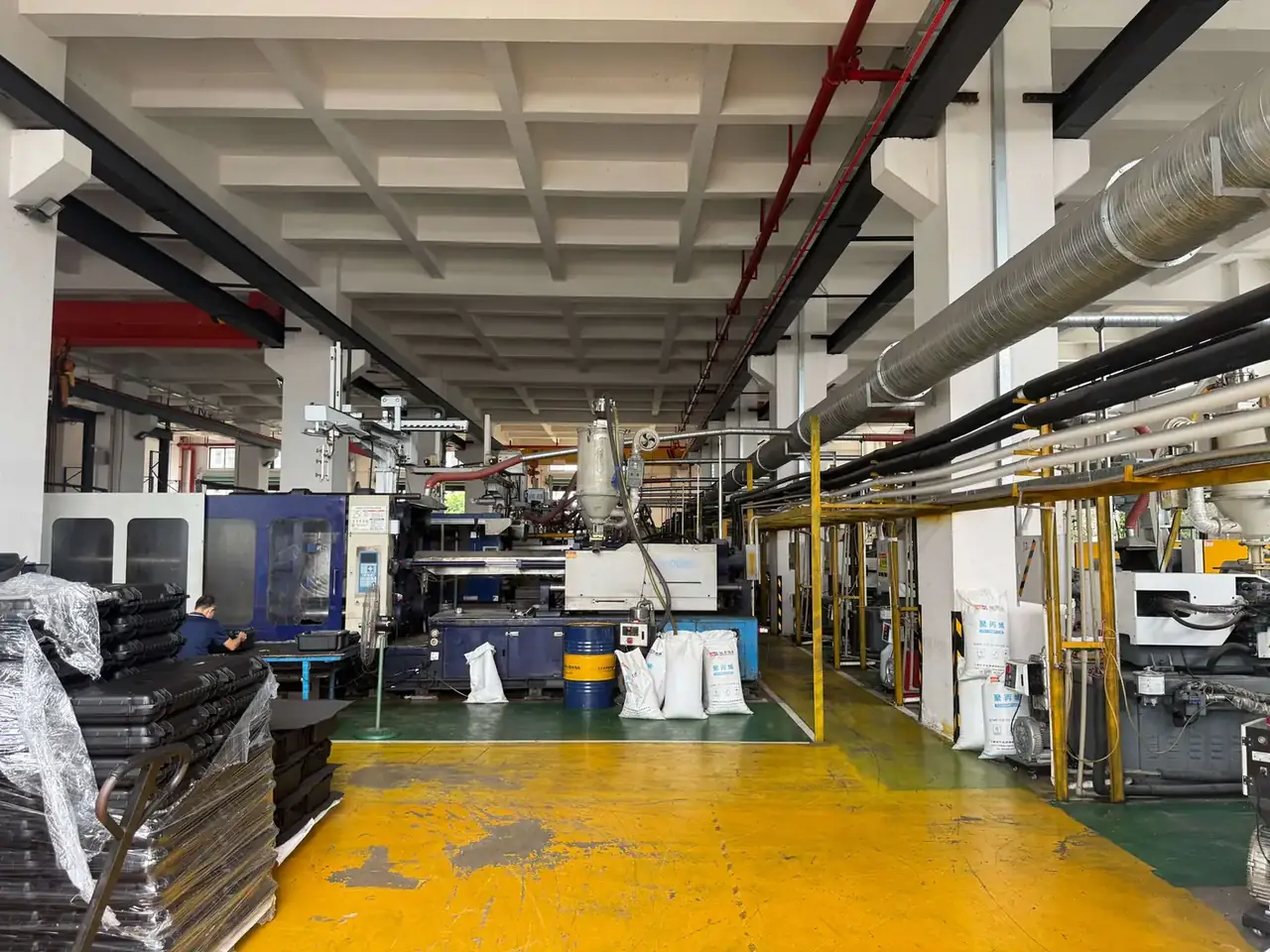
Quick answer: Capacity on a Case Production Line is set in three steps: clamping force picks the machine, cavity count sets output, changeover and OEE take it down. A 500 × 350 mm case needs 665 t, so an 800 t press; at 90 s, 84.8% OEE and two 90-minute changeovers, it yields 407 cases a day.
Table of contents
- The Capacity Formula for a Case Production Line
- Matching Tonnage to Projected Area
- How Many Cavities per Mold
- Breaking the Cycle into Seconds
- OEE and Changeover Losses
- FAQ
1. The Capacity Formula for a Case Production Line
Capacity is a product of factors. A Case Production Line produces:
Daily output = ((shift seconds − breaks − changeovers × changeover minutes × 60) ÷ cycle) × cavities × OEE
An 800 t machine on two shifts has 57600 seconds; breaks take 3600, two 90-minute changeovers 10800, leaving 43200. That is 480 shots at 90 s, or 407 cases from one cavity at 84.8% OEE — the number to plan with.
2. Matching Tonnage to Projected Area
Clamping force is F = A × P ÷ 1000, A the projected area in cm² and P the cavity pressure. A 500 × 350 mm case projects 1750 cm²; at 380 kg/cm² that is 665 t, so a 15% margin lands on 800 t.
| Case (mm) | Area (cm²) | Pressure | Force | Machine |
|---|---|---|---|---|
| 400 × 300 | 1200 | 380 | 456 t | 530 t |
| 500 × 350 | 1750 | 380 | 665 t | 800 t |
| 600 × 400 | 2400 | 350 | 840 t | 1000 t |
| 700 × 500 | 3500 | 350 | 1225 t | 1600 t |
Pressure runs 420 to 480 for thin long-flow walls and 300 to 340 for thick; fifty kilos of assumption moves the machine up a size. Shot weight matters too: 5.8 kg for two cavities.
3. How Many Cavities per Mold
Doubling cavities doubles clamping force and pushes the machine up a size; hanging slows from 60 minutes to over 90. Under 1.5 times monthly demand, add cavities; above 2.5, add machines, so one stoppage does not idle the Case Production Line.
| Option | Machine | Cavities | Cycle | Output | Mold |
|---|---|---|---|---|---|
| Large case | 800 t | 1 | 90 s | 407 | 24k |
| Small case | 1000 t | 2 | 105 s | 697 | 38k |
| Small case | 530 t | 1 | 78 s | 470 | 18k |
| Oversize | 1600 t | 1 | 130 s | 282 | 52k |
Two cavities win per case; two presses win on volume.
4. Breaking the Cycle into Seconds
Four segments: injection 9 s, packing 22 s, cooling 47 s, clamp and ejection 12 s. Cooling scales with the square of wall thickness: 30 s at 2.5 mm, 47 at 3.5, 58 at 4.0, each extra 0.5 mm costing a tenth of the day. Packing ends at gate freeze, near 22 s.
One second off the cycle is 1200 cases over 300 days. Mold temperature is the lever: 50 °C to 40 °C cuts cooling 8%, though below 35 °C weld lines show.
5. OEE and Changeover Losses
OEE multiplies availability 94%, performance 96% and yield 94% into 84.8%; yield on a Case Production Line is lost to sink marks, warp and weld lines.
| Changeovers a day | Time each | Lost | Share |
|---|---|---|---|
| 1 | 60 min | 3600 s | 6.7% |
| 2 | 90 min | 10800 s | 20.0% |
| 3 | 90 min | 16200 s | 30.0% |
| 4 | 120 min | 28800 s | 53.3% |
A 90-minute changeover is 25 minutes stripping, 30 hanging, 20 for lines, 15 for approval. Quick couplers, hydraulic clamps and off-machine preheating halve it, recovering 60 cases a day.
The liner is the stage most sums miss: at 150 s a case, one operator on two shifts makes 360 against 407, so the Case Production Line is capped at the bench. At 20000 cases a month, two 800 t presses give 20350, steadier than one double-cavity mold.
Conclusion
Estimate a Case Production Line in five moves: tonnage, cavities, cycle, OEE, changeover. One 800 t press with a single cavity gives 407 cases a day, a 1000 t double-cavity mold 697, two single presses 814. Put the liner bench in the table and take the smallest number, so the Case Production Line shows its bottleneck before the order does.
This article discusses only the container (case body) side of specifications and design intent, and does not cover any handling, loading or use of the contents.
Related Reading
- How a custom case mold quote is built
- Case MOQ and lead time
- Setting safety stock for cases
- Building a case supplier scorecard
Related Products
- 8 Series — Gun Cases; Military Equipment Cases; Camera Equipment Cases; Drone Cases; Watch Cases; Knife Cases; First Aid Cases; Electronics Equipment Cases
- WL8-2812 PP Gun Case — model WL8-2812
- All protective cases and toolboxes: 7 series, 158 models