

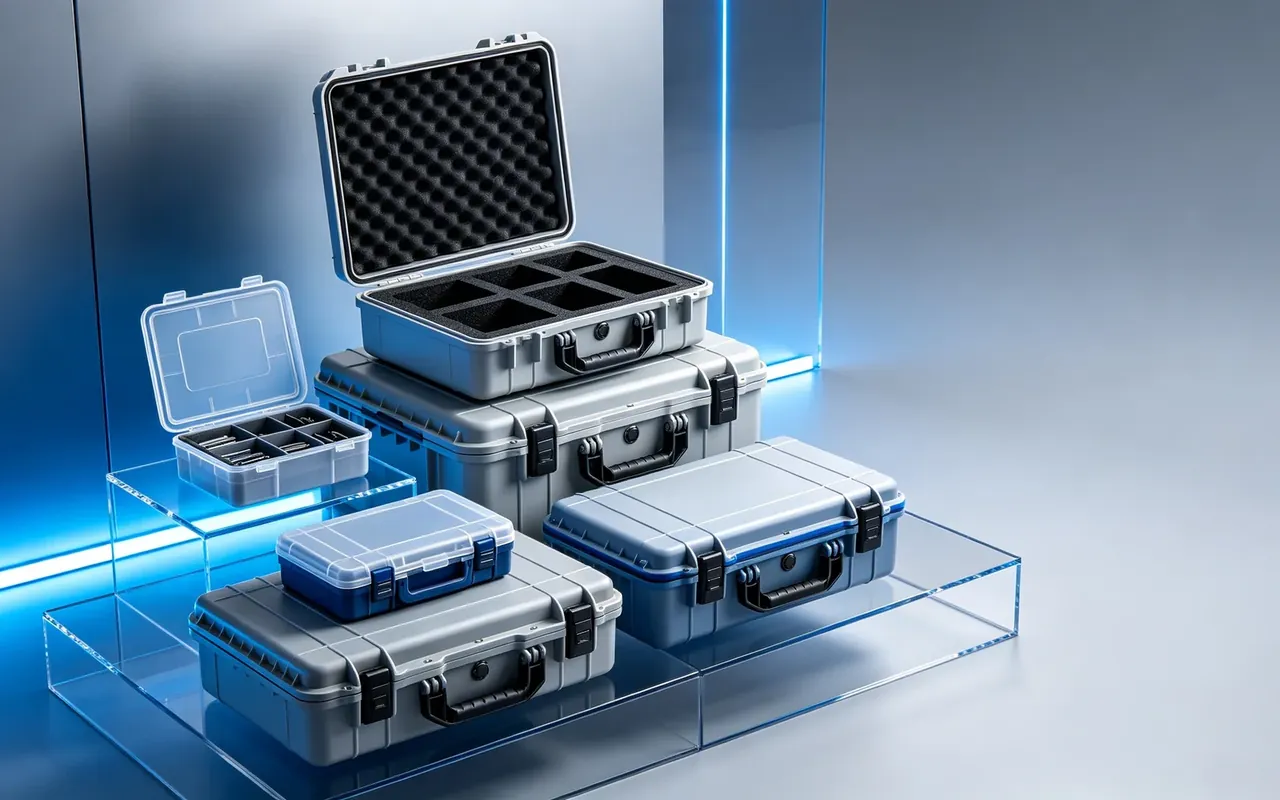
Quick answer: Case warpage control: fix the flatness rule, split the shrinkage difference, zone the tool, fixture the part. An 800 mm lid is judged at 1.0 mm.
Table of contents
- Quantifying case warpage before controlling it
- Uneven shrinkage: where the bow comes from
- Zoned mould temperature and three-stage packing
- Cooling fixtures and the straightening sequence
- Allowable warpage scaled to case length
- FAQ
1. Quantifying case warpage before controlling it
An 800 mm lid laid free on a plate bows 4 mm at the centre, the gasket compresses only 25% across the middle 300 mm, and a 10 min spray test puts water through the overlap. That 4 mm is residual stress from unequal cooling on the two faces, released after ejection; pressing it flat holds 2 days before 1.2 mm returns.
Fix the reading rule first. The same lid gives opposite verdicts: 2.1 mm free on granite, 3.8 mm with 50 mm packed at each end, a 1.7 mm spread that passes one inspector and scraps another. The drawing must state support points, reading pitch and settling: 23 °C ±2 °C, 50% RH, 24 h after ejection.
Read with a 0.05 mm feeler gauge, one point every 100 mm, so an 800 mm lid takes 9 readings; under 7 points you miss the centre crest. Self-weight adds 0.3 mm of sag when 200 mm overhangs each end, so support states are never mixed.
| Method | Resolution | Length range | Time per part |
|---|---|---|---|
| Granite plate with feeler gauge | 0.05 mm | 300–1200 mm | 3 min |
| Height gauge points | 0.01 mm | 200–600 mm | 8 min |
| Laser scan comparison | 0.02 mm | Any length | 45 s |
2. Uneven shrinkage: where the bow comes from
Three sources drive the difference: a wall step, ribs on one face, and packing pressure that stops short of the far end. The outer face is flat at 3.0 mm; the inner face runs 1.6 mm at the rib root and 2.2 mm between ribs, an 0.8 mm step leaving a 35 °C skin-to-core gap at 6 s.
PP shrinks 1.2%–1.8% and ABS 0.4%–0.7%, and either grade differs 0.3–0.6 points between flow and cross-flow. At 0.4 points over 800 mm that is 3.2 mm of length difference, the bow ceiling; a measured 4 mm means short packing adds to it.
With the ribs inside, the inner skin freezes first and the plate moves towards them.
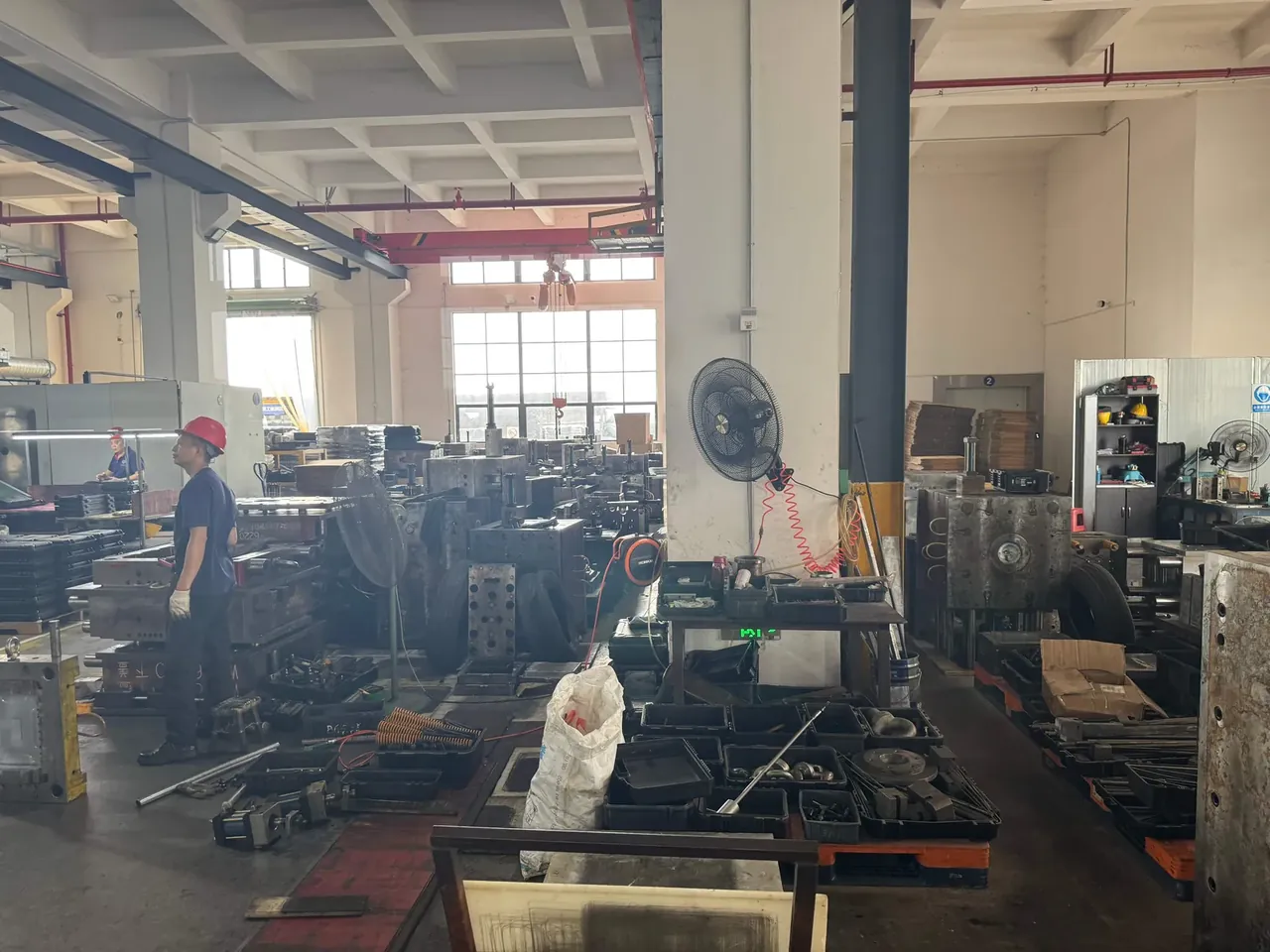
The workshop shows the mechanism in reverse: steel mould blocks stand in rows in the aisle, couplings still fitted after trials, and the press log records 3.6 mm with walls untouched. Raising the fixed half from 45 °C to 65 °C cut it to 2.4 mm, but cooling time went from 22 s to 28 s: six seconds buys 1.2 mm.
3. Zoned mould temperature and three-stage packing
Zoning is not even heating. It builds an 8–12 °C difference, 55 °C moving half and 65 °C fixed half, so the heavier shrinking side freezes later and the gradient cancels part of the shrinkage. Four circuits serve centre, corners, long edges and gate, with the centre 5 °C cooler, worth 0.8 mm.
Packing runs three stages: 55 MPa for 3 s, 40 MPa held 5 s, then 28 MPa until the gate freezes at 8 s, so total packing sits at 8–10 s. Below 8 s the bow grows 0.6 mm; above 12 s internal stress climbs. Accept the profile only when part weight holds within ±0.5%.
| Parameter | Baseline | Range | Effect on the bow |
|---|---|---|---|
| Fixed-half temperature | 65 °C | 55–75 °C | 0.3 mm less per 5 °C |
| Fixed-to-moving difference | 10 °C | 6–14 °C | Gain lost below 6 °C |
| First-stage packing | 55 MPa | 45–65 MPa | 0.2 mm less per 10 MPa |
| Cooling time | 28 s | 24–32 s | 0.9 mm more below 24 s |
4. Cooling fixtures and the straightening sequence
The first 30 s out of the tool is the only effective window; press after 90 s and spring-back climbs above 60%. The fixture is a conformal support with 6 pressure points at the 1/4, 1/2 and 3/4 marks, 0.3 MPa air, 15 °C water and a 90 s hold. Overshoot 20% and the part settles at 1.0 mm.
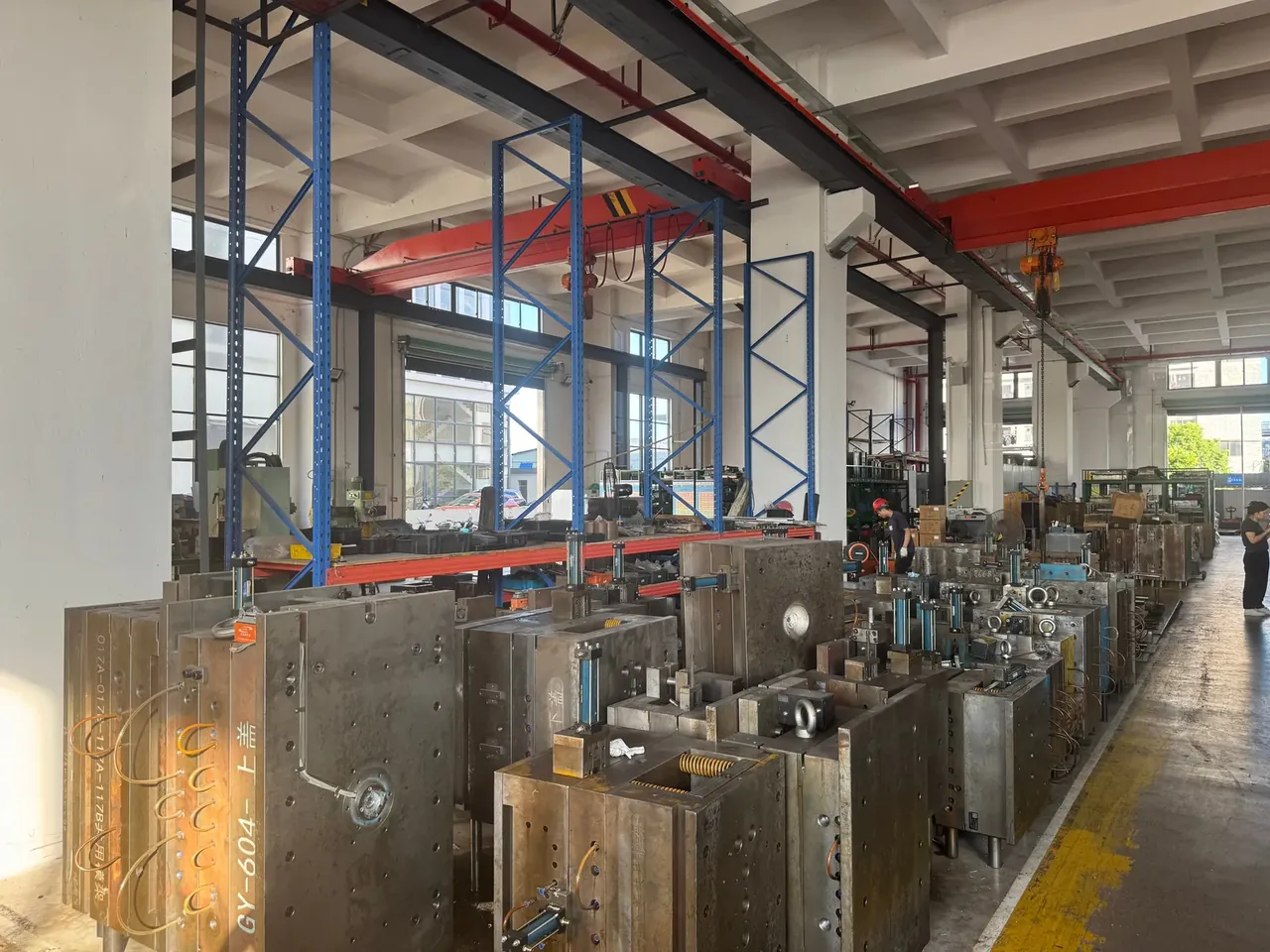
A cheaper route is counter-curvature: raise the cavity centre 0.8 mm so the part springs back to 0.9 mm alone, leaving the fixture for sampling. Set it at 20%–25% of the measured bow, or a reverse dish that is harder to fix.
Re-check at 24 h is mandatory: in trials 15% of parts that pass on the day fail the next morning. Inspect the fixture face every 5000 cycles, since 0.2 mm of wear removes half the capacity.
5. Allowable warpage scaled to case length
No absolute number works. Scale to length, then tighten for sealing: unsealed cases take 0.2% of length, sealed 0.12%, because gasket compression is only 30%–40% and a 4 mm groove leaves under 1.2 mm of gap. At 6 mm by 4 mm, 1.0 mm of flatness error costs 25% of compression and a 30 min spray test leaks.
| Case length | Unsealed | Sealed | Groove run |
|---|---|---|---|
| Up to 300 mm | 0.6 mm | 0.4 mm | 0.3 mm |
| 300–500 mm | 1.0 mm | 0.6 mm | 0.4 mm |
| 500–800 mm | 1.6 mm | 1.0 mm | 0.6 mm |
| 800–1200 mm | 2.4 mm | 1.4 mm | 0.8 mm |
The 800 mm lid sits in the 1.0 mm band, so 4 mm is four times tolerance; 1.4 mm stays inside 1.5 times, where a 90 s press brings it to 0.9 mm.
Conclusion
Case warpage control needs a drawing with a fixed reading rule and a process step with a clock on it. State length, flatness and the tighter groove-run limit: 1.0 mm for an 800 mm sealed case, 0.6 mm along the groove. Require the fixture within 30 s of ejection, a 90 s hold, and re-checks at 24 h and 72 h. Keep two decision lines: a reading under 1.5 times tolerance goes to straightening, anything beyond returns to the tool. Log temperatures, packing stages and the bow reading on every first article; once the three line up, flatness becomes repeatable. Sampling closes the loop: three parts from a twenty-piece lot, two inside tolerance, or the tool returns to the temperature bench.
This article discusses container-side specifications and design implications only, and does not cover any handling, loading or use of the contents.
Related Reading
- How wall thickness drives case strength
- Gasket groove section and compression
- Process parameters to confirm at trial moulding
Related Products
- 8 Series — Gun Cases; Military Equipment Cases; Camera Equipment Cases; Drone Cases; Watch Cases; Knife Cases; First Aid Cases; Electronics Equipment Cases
- WL8-2812 PP Gun Case — model WL8-2812
- All protective cases and toolboxes: 7 series, 158 models