

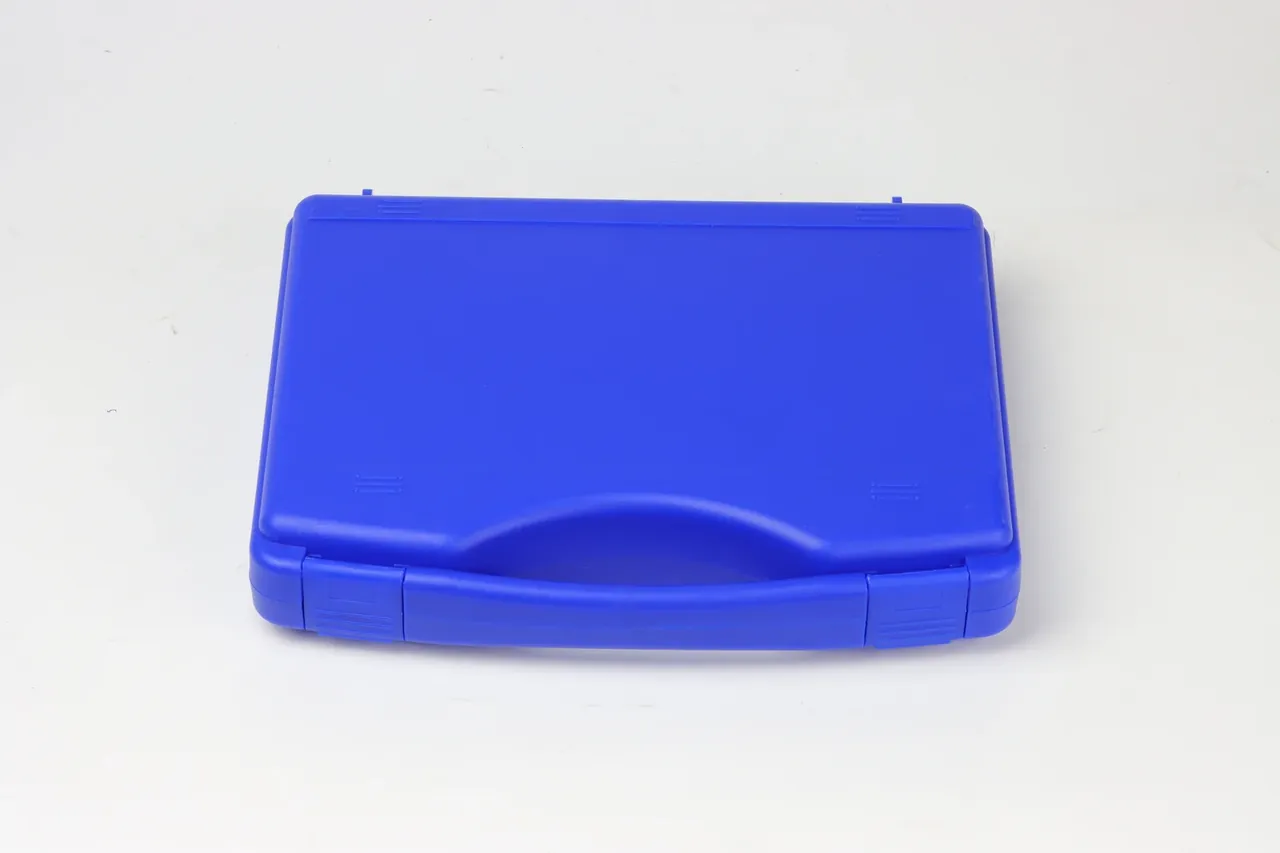
Quick answer: Taking case wall thickness from 3 mm to 5 mm raises bending stiffness by the cube of the ratio, so the part becomes 4.63 times stiffer while gaining only 66.7% in weight; the bill arrives as 2.78 times the cooling time and 1.1 kg more material. On a 460 × 330 × 190 mm PP body, 3 mm covers everyday handling and 5 mm belongs to drops over 1 m.
Table of contents
- Six Things Move at Once
- Thickness Cubed: 4.63 Times the Stiffness
- Ribs or a Thicker Wall
- Where Each Wall Cracks
- Measuring Wall Thickness
- Writing the Clause
- FAQ
1. Six Things Move at Once
Shrinking the core by 2 mm a side leaves the outside of the case untouched while the wall goes from 3.0 mm to 5.0 mm, and six figures move together. On a 460 × 330 × 190 mm PP body the developed wall area is about 0.604 m², so at 0.91 g/cm³ the thin wall uses 1.65 kg of compound and the thick one 2.75 kg.
| Figure | 3 mm | 5 mm | Change |
|---|---|---|---|
| Unit weight | 1.65 kg | 2.75 kg | +66.7% |
| Bending stiffness | baseline 1 | 4.63× | cube of ratio |
| Cooling time | 18 s | 50 s | 2.78× |
| Material cost | 15.7 | 26.1 | +10.4 |
| 1.0 m six-face drop | corner crack, 2 of 3 | no crack, latch ear whitens | failure moves |
| Sink depth | 0.1 mm | 0.2 to 0.4 mm | holding pressure |
Cost uses PP at 9.5 per kilogram, resin only. The drop row comes from the same tool and lot, six faces at 1.0 m once each, three cases per set.
2. Thickness Cubed: 4.63 Times the Stiffness
A plate in bending carries a second moment of width times thickness cubed over twelve, so stiffness follows the cube while weight follows the first power. At 5 mm the bending capacity is 4.63 times that of 3 mm, for 1.67 times the weight.
| Nominal wall | Relative stiffness | Relative weight | Body size it suits |
|---|---|---|---|
| 3.0 mm | 1.00 | 1.00 | under 400 mm, light load |
| 3.5 mm | 1.59 | 1.17 | 400 to 500 mm |
| 4.0 mm | 2.37 | 1.33 | 500 to 600 mm |
| 5.0 mm | 4.63 | 1.67 | over 600 mm, three-high stacks |
The cube has a ceiling. Cooling grows with the square of thickness, 18 s becoming 50 s on this body, and PP shrink of 1.5% to 2.0% leaves a sink 0.2 to 0.4 mm deep behind each rib that reads as a groove under a thumb.
3. Ribs or a Thicker Wall
Material everywhere is not the only answer. A rib at 0.6 times the wall for root width, 3 times for height and 0.5° draft recovers local stiffness for about 30% of the weight.
- 3.0 mm wall plus six vertical ribs: 2.2 kg, about 1.8× stiffness, low sink risk
- 4.0 mm wall plus three horizontal ribs: 2.3 kg, about 2.4× stiffness, extra cooling
- 5.0 mm wall with no ribs: 2.75 kg, 4.63× stiffness, holding pressure re-set
| Route | Weight | Stiffness | Sink risk | Use |
|---|---|---|---|---|
| 3.0 mm + 6 ribs | 2.2 kg | 1.8 | low | medium handling |
| 4.0 mm + 3 ribs | 2.3 kg | 2.4 | medium | two-high stacks |
| 5.0 mm, no ribs | 2.75 kg | 4.63 | high | heavy load, drops |
Ribs stop paying past a point. Above three times the wall the tip freezes first and dimples the show face; below 40 mm pitch the flat between ribs turns into a thin panel that cracks first in a drop.
4. Where Each Wall Cracks
A 3 mm body fails at the corner, where two ribs meet: the crack runs 45° for 20 to 40 mm. A 5 mm body rarely cracks there, so the energy reaches the latch seat and hinge ear instead.
Cold widens the gap. Notched impact on homopolymer PP falls from 6 kJ/m² at 23 °C to 2.5 kJ/m² at -20 °C, and in the cold a 3 mm wall cracks at the corner more often while a 5 mm wall loses the whole ear, because the ear root still sits at 2.5 mm.
Thickening therefore has to happen as a set. Once the wall reaches 5 mm, the latch seat, hinge ear and handle boss roots need 3.5 to 4 mm, or the stiffest body carries the softest ears.
Stack load follows the same logic. Three tiers at 25 kg bulge a 5 mm wall about 1.5 mm at the base of the side, and a 3 mm wall 4 mm; past 3 mm of bulge the wall presses on the equipment inside. At 55 °C in a van, PP loses roughly 30% of its modulus and the bulge doubles.
5. Measuring Wall Thickness
Points go five per face, four corners and centre, with the smallest value deciding. A nominal 3.0 mm body usually measures 2.7 to 3.2 mm, so 2.7 mm is the acceptance line worth writing.
- Micrometer: 0.01 mm, needs a sectioned sample
- Ultrasonic gauge: 0.05 mm, non-destructive, needs couplant
- Caliper jaws: 0.02 mm, open edges only, reading includes draft
The rib root is skipped most often. At 0.6 times the wall it measures 1.8 mm on a section, while an ultrasonic gauge reads 2.4 mm there because two flow fronts meet, and 0.6 mm is enough to flip a lot.
6. Writing the Clause
A wall clause holds five items: nominal, minimum, datum, grade, ribs included. One workable line reads: case wall thickness 3.0 mm, minimum 2.7 mm, five points per face, homopolymer PP, rib root at 0.6 times the wall.
The change carries a price. Going to 5 mm adds 1.1 kg of compound, 10.4 at 9.5 per kilogram, and a cycle stretched from 55 s to 87 s takes a two-cavity press from 65 shots an hour to 41, so roughly 15 more per unit.
Thinning needs the same sum. Dropping to 2.7 mm saves a tenth of the weight but leaves 73% of the stiffness, so a 1.0 m rating becomes 0.7 m.
Conclusion
Half the difference between 3 mm and 5 mm case wall thickness is stiffness, half is where the crack appears. Stiffness climbs with the cube to 4.63 times, yet the break moves to the latch ear, so thickness without matching roots only relocates it. Under 1.0 m and two tiers, 3 mm with ribs holds; above 1.2 m or three tiers, 5 mm earns its 1.1 kg.
This article discusses only the specification and design intent on the container (case) side, and does not cover any handling, loading or use of the contents.
Related Reading
- Impact resistant plastic case: what a 1.8 m drop showed
- Structure and moulding of injection-moulded cases
- Dimensions to check at trial moulding
- Custom molded plastic case: why a thickness-first spec fails
Related Products
- 8 Series — Gun Cases; Military Equipment Cases; Camera Equipment Cases; Drone Cases; Watch Cases; Knife Cases; First Aid Cases; Electronics Equipment Cases
- WL8-2812 PP Gun Case — model WL8-2812
- All protective cases and toolboxes: 7 series, 158 models