

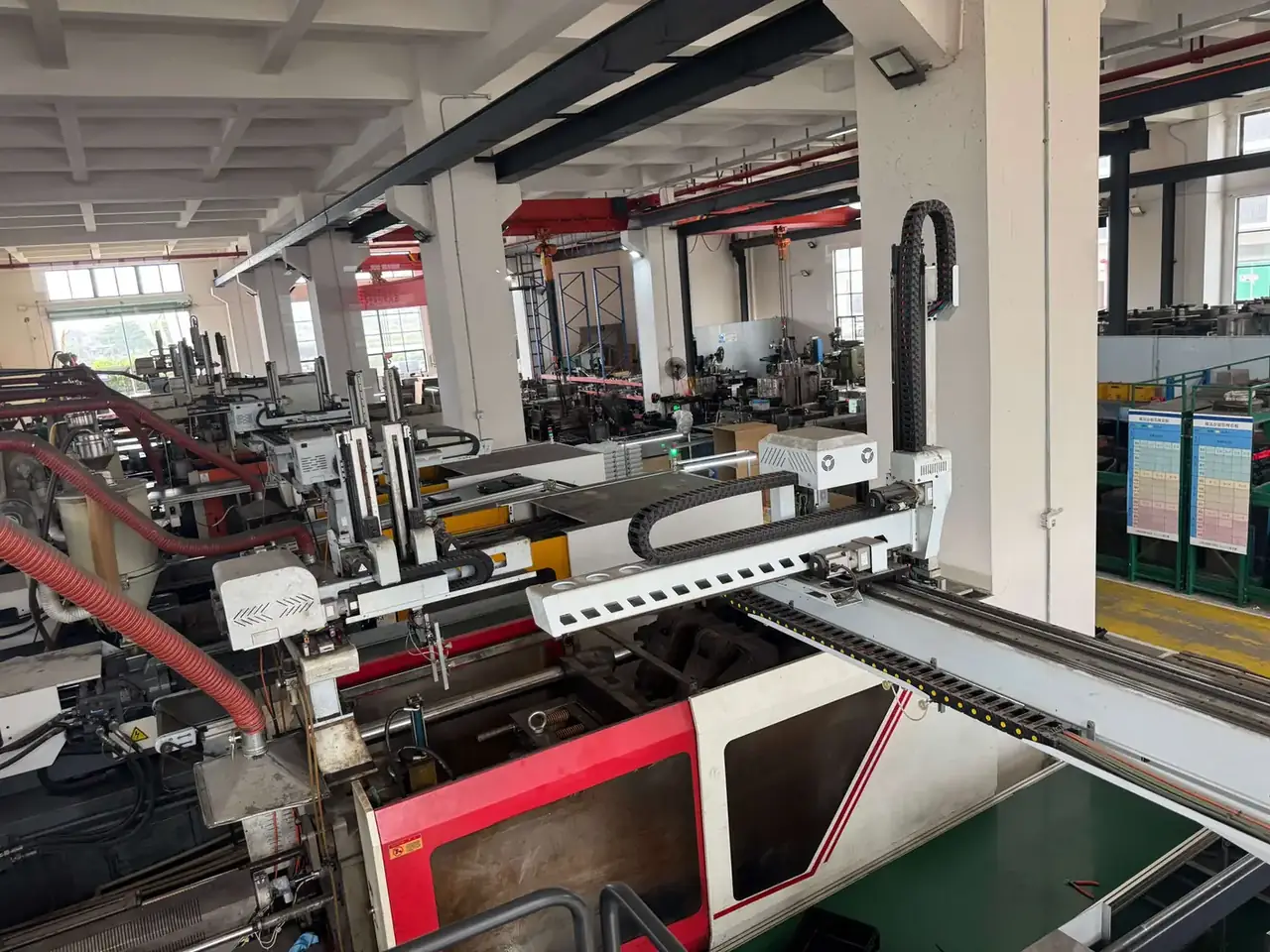
Quick answer: An injection molded protective case is formed in one shot: melt is forced into a steel tool, packed to offset shrinkage, then cooled until it is stiff enough to eject. What decides the result is not press size but how four stages agree — draft, clamp force from projected area, packing at gate freeze, and cooling by wall squared.
Table of contents
- How an Injection Molded Protective Case Is Built
- Clamp Force: Tonnage from Projected Area
- Packing: Pressure and Time
- Cooling and Ejection: Wall Sets the Cycle
- Reading Defects on the Part
- FAQ
1. How an Injection Molded Protective Case Is Built
A cycle starts when the moving half locks against the fixed half. Melt enters at 80 to 140 MPa, then the machine packs, cools and ejects. A case body runs 60 to 120 seconds, cooling included.
Draft is where deep cases fail: 1 to 2 degrees per vertical wall, the upper end for deep cavities, or ejection leaves white marks and torn walls. Vents 0.02 to 0.03 mm deep on the parting line keep the last corner from scorching. PP, ABS and PC/ABS melt at 220 to 260 °C.
| Stage | Controlled variable | Typical setting | What you check |
|---|---|---|---|
| Clamp | Clamp force | Area × cavity pressure, plus 1.2 | Flash on the parting line |
| Pack | Packing pressure, time | 60%–80% of injection pressure | Sink depth, part weight |
| Cool | Tool temperature, time | 40–80 °C tool, time by wall squared | Warpage, ejection marks |
2. Clamp Force: Tonnage from Projected Area
Clamp force holds the halves shut while melt pushes them apart. In kilonewtons it equals projected area in square centimetres times cavity pressure in bar, divided by 100.
A 600 by 400 mm case projects about 2400 cm². At 400 bar that gives 9600 kN, roughly 980 tonnes, and 1.2 for safety pushes the choice to a 1200 tonne press. Count area on the parting plane, so lid flanges count and side walls do not; thin ribbed cases run 450 to 500 bar.
3. Packing: Pressure and Time
Packing answers shrinkage. A 3 mm PP wall shrinks about 1.5 to 2.0 percent, and without make-up melt the core voids while the surface sinks.
Packing pressure sits at 60 to 80 percent of injection pressure. Below it, ribs sink on the reverse face; above it, flash and residual stress climb. Time follows gate freeze: a 3 mm gate freezes in 3 to 6 seconds, so packing slightly longer is enough. Weigh ten parts; a 0.3 percent spread means stability.
4. Cooling and Ejection: Wall Sets the Cycle
Cooling scales with wall squared, so 2 mm to 4 mm nearly quadruples the time rather than doubling it. Shaving 0.5 mm often buys more cycle than a faster machine.
Tool temperature is 40 to 60 °C for PP and up to 80 for PC/ABS. Uneven beats hot or cold: a 10 °C split between halves bows a flat base. Core lines sit 10 to 15 mm from the surface, and ejection force belongs on blocks, not pins.
| Wall (mm) | Cooling (s) | Estimated cycle (s) | Where it fits |
|---|---|---|---|
| 2.0 | 9–11 | 35–45 | Small light cases, cycle first |
| 2.5 | 13–15 | 45–55 | General storage and transfer |
| 3.5 | 27–30 | 70–85 | Transport cases that survive drops |
| 5.0 | 56–58 | 105–125 | Heavy loads and stacking |
5. Reading Defects on the Part
Read location before shape. Sink behind a rib means short packing or a thick rib root; flash on the parting line means low clamp force or a dirty shut-off; a case that rocks means uneven cooling. Weld lines sit where two fronts meet, usually behind handles, and moving the gate downstream pushes them out of the load path. Silver streaks mean moisture, so ABS and PC/ABS need 2 to 4 hours at 80 to 100 °C.
Conclusion
Taken apart, an injection molded protective case is not mysterious: the tool gives melt a clean path and enough draft, clamp force holds the cavity shut, packing replaces the volume lost before the gate seals, and cooling follows the square of wall thickness. Compress any stage and it returns as sink, flash or warpage. Written as a process card, those stages make batches repeatable for an injection molded protective case.
This article discusses only the container (case body) side of specifications and design intent, and does not cover any handling, loading or use of the contents.
Related Reading
- How an injection molded case is built, step by step
- Injection molding versus rotational molding for cases
- What wall thickness does to case strength and weight
- Rib layout that avoids sink marks
Related Products
- 8 Series — Gun Cases; Military Equipment Cases; Camera Equipment Cases; Drone Cases; Watch Cases; Knife Cases; First Aid Cases; Electronics Equipment Cases
- WL8-2812 PP Gun Case — model WL8-2812
- All protective cases and toolboxes: 7 series, 158 models