

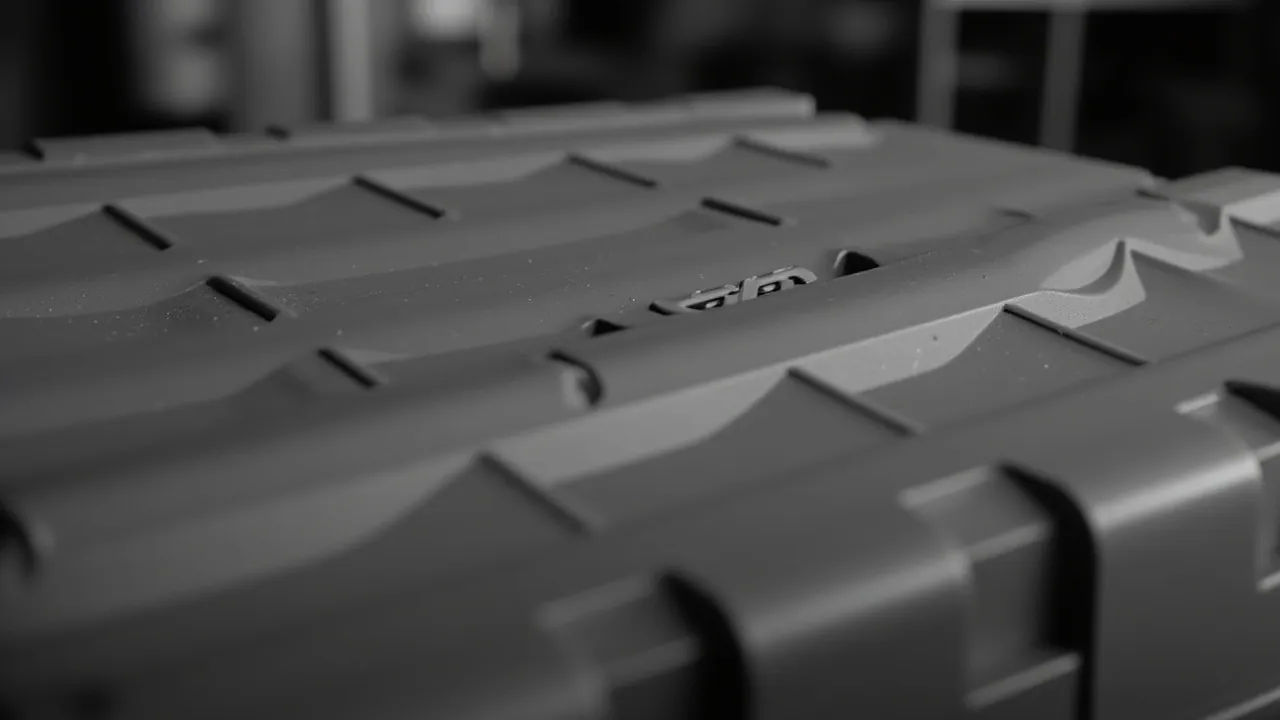
Reinforcement ribs (reinforcement rib, often called "ribs" or "ribs" in the trade) are the raised, rib-like structures on a protective-case shell. Their core role is to greatly raise the shell's rigidity, deformation resistance, and impact resistance without increasing the overall wall thickness: they split one large weak flat panel into many small cells supported by ribs, shortening the load span so a thin wall can still withstand stepping, stacking, and drops; at the same time, a sensible rib layout disperses impact energy and guides load toward the case's strongest corners and frame, and achieves material and weight savings by "adding material only locally." Simply put, reinforcement ribs are the secret of a protective case being "thin yet rigid" — they substitute a structural lever effect for mere wall-thickness stacking. This article first directly answers what ribs do, then breaks down the principles of raising rigidity, resisting deformation, dispersing impact, and saving material/weight, and explains how to lay ribs out at key positions such as the lid, side walls, and bottom corners, helping you judge whether a case truly has "backbone" or merely thickness.
Table of Contents
- Direct Answer: What Problem Do Reinforcement Ribs Solve?
- Principle 1: Shorten the Load Span, Multiply Rigidity
- Principle 2: Disperse Impact, Guide Load to Strong Zones
- Principle 3: Save Material and Weight for "Thin-Wall High Rigidity"
- Rib Layout Logic by Case Section
- Key Rib Parameters and Common Errors
- Ribs with Stacking and Loading
- Rib Performance Across Materials: ABS vs PP
- A Field Transfer Shows the Value of Ribs
- Ribs Cooperating with Wall Thickness, Corners, Material
- Ribs and Mold Precision: Good Ribs Are Molded, Not Drawn
- Thin-Wall vs Thick-Wall: How Ribs Change Selection Logic
- How to Tell at a Glance If Ribs Are Done Right
- Common Misconceptions About Reinforcement Ribs
- Frequently Asked Questions (FAQ)
- Conclusion and Further Reading
Direct Answer: What Problem Do Reinforcement Ribs Solve?
View the protective-case shell as a "panel," and this panel most fears three things: being dented by point pressure (local collapse), bulging under side pressure (overall buckling), and cracking from a fall (impact cracking). If you add no structure, the only way to solve these three is to make the panel thick — but thick means heavy, expensive, and possibly warped.
Reinforcement ribs exist to solve the "impossible triangle" of "rigid yet light yet cheap." Their essence is to "grow" ribs on the thin panel so the panel is no longer an isolated large plane but a "grid skeleton" propped up by ribs. Thus:
- When point pressure comes, the force is caught by the nearest rib, and the dent is limited to a very small cell;
- When side pressure comes, vertical ribs carry the load to the case corners and frame (the strongest places), and the whole does not bulge;
- When impact comes, ribs and the case curved surface together absorb and disperse energy, and cracks do not easily spread.
This is exactly why professional protective cases dare keep wall thickness in a reasonable range — because ribs have their back. A thick case with no ribs is often "dumb-heavy"; a thin case with ribs is "smart-rigid." In the protective-case products of KeXin New Materials (Guangdong) Co., Ltd. under the global brand kexinMaterials and domestic product-line brand JUNZHJIA, reinforcement ribs are unified at the mold stage with wall thickness, sealing groove, and latch positions; the factory is in Zhongshan City, Guangdong Province (the Guangdong–Hong Kong–Macao Greater Bay Area), about 18,000 m², with more than 80 machines and over 100 staff, with one-stop customization (OEM/ODM) capability covering product design, injection molding, mold manufacturing, LOGO printing, and inner tray/liner making. Note: the parent company is Foshan Shunde ., Ltd., and , Ltd. holds more than 20 utility-model and design patents. This article discusses general engineering principles and gives no company-specific figures.
Principle 1: Shorten the Load Span, Multiply Rigidity
This is the most core and most counter-intuitive principle of ribs. A panel's bending rigidity depends on its effective load span: the longer the span, the easier it bends; the shorter, the more rigid. Mathematically, the deflection of a simply supported plate under bending is proportional to the fourth power of the span — that is, halving the span raises bending rigidity by about 16 times.
Reinforcement ribs shorten the span by "cutting the big panel into small cells." Example: a 200 mm wide flat wall with no obvious ribs has a free span of 200 mm; add one rib in the middle and it becomes two 100 mm panels, with rigidity theoretically up about 16 times; add a few more and the span drops to 40 mm, with dent resistance jumping another order of magnitude.
The key advantage: these ribs add only a little material locally along the "rib," while the main wall thickness of the whole panel stays the same. Compared with uniformly thickening the whole 200 mm panel to raise rigidity (material and weight rising linearly), the rib approach trades a tiny extra amount of material for tens of times the rigidity — this is the engineering essence of "thinner yet stiffer." The case lid, side walls, and even the bottom frame almost all achieve light-weight high rigidity by this logic. For the quantified relationship between wall thickness and rigidity, see what is the relationship between protective-case wall thickness and strength?.
Principle 2: Disperse Impact, Guide Load to Strong Zones
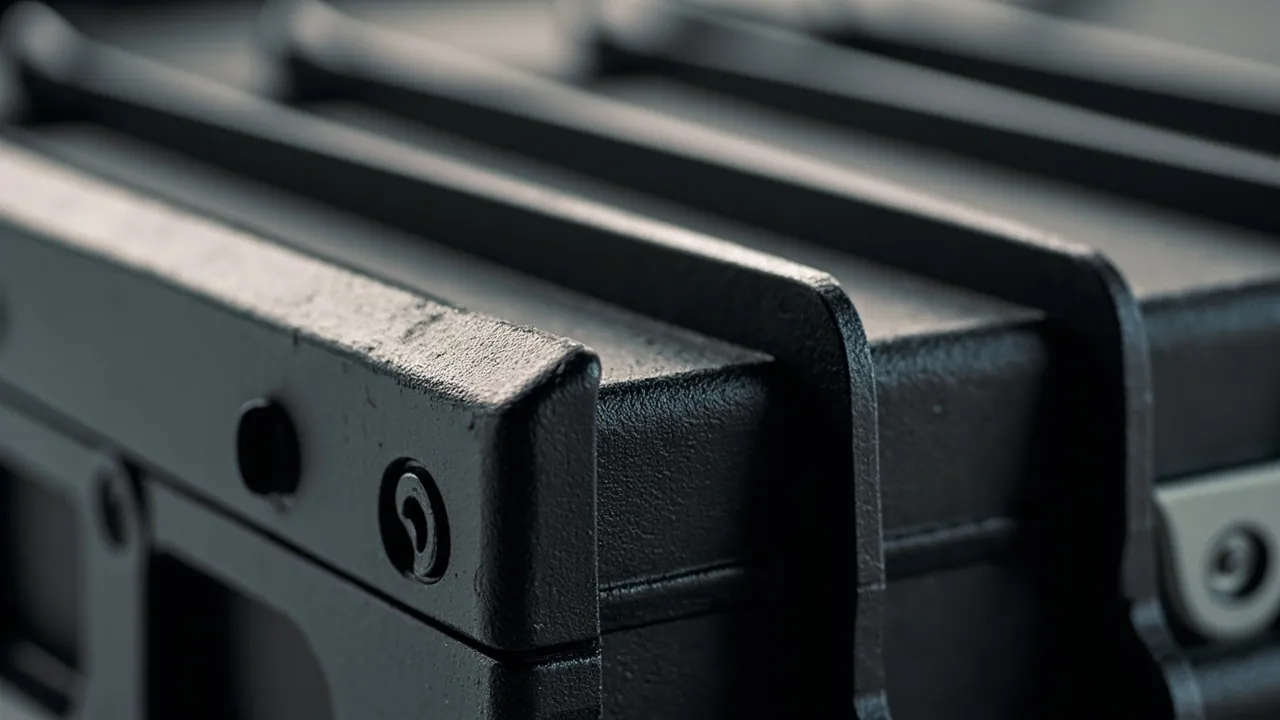
When a drop or impact happens, energy concentrates at the contact point. A flat shell with no ribs has extremely high stress near the contact point, easily causing local dent or even cracks. Ribs play two roles here:
- Dispersing role: ribs spread the concentrated stress at the contact point along the rib direction, letting more material share the load and lowering peak stress. This is like a finger poking through flat paper but doing nothing to corrugated cardboard — the corrugation is the "rib." From cardboard boxes to engineering-plastic protective cases, humanity's idea of using ribs to save material and add rigidity is the same, only the material and precision are several orders higher.
- Guiding role: the four corners and frame of a case are usually where material is thickest and connections strongest at injection (also the corner energy-absorption zone). Vertical and diagonal ribs act as a "lead bridge" carrying impact load to these strong zones, avoiding weak-face solo loading.
This "disperse + guide" combination makes protective cases perform more stably in drop tests: cracks do not easily start from a single weak point, and even if one spot is damaged, adjacent cells still hold structural integrity and protect the interior. Together with the corner energy absorption discussed in what does the rounded-corner design of a protective case do?, ribs and corners jointly form the shell's impact-resistance skeleton.
Principle 3: Save Material and Weight for "Thin-Wall High Rigidity"
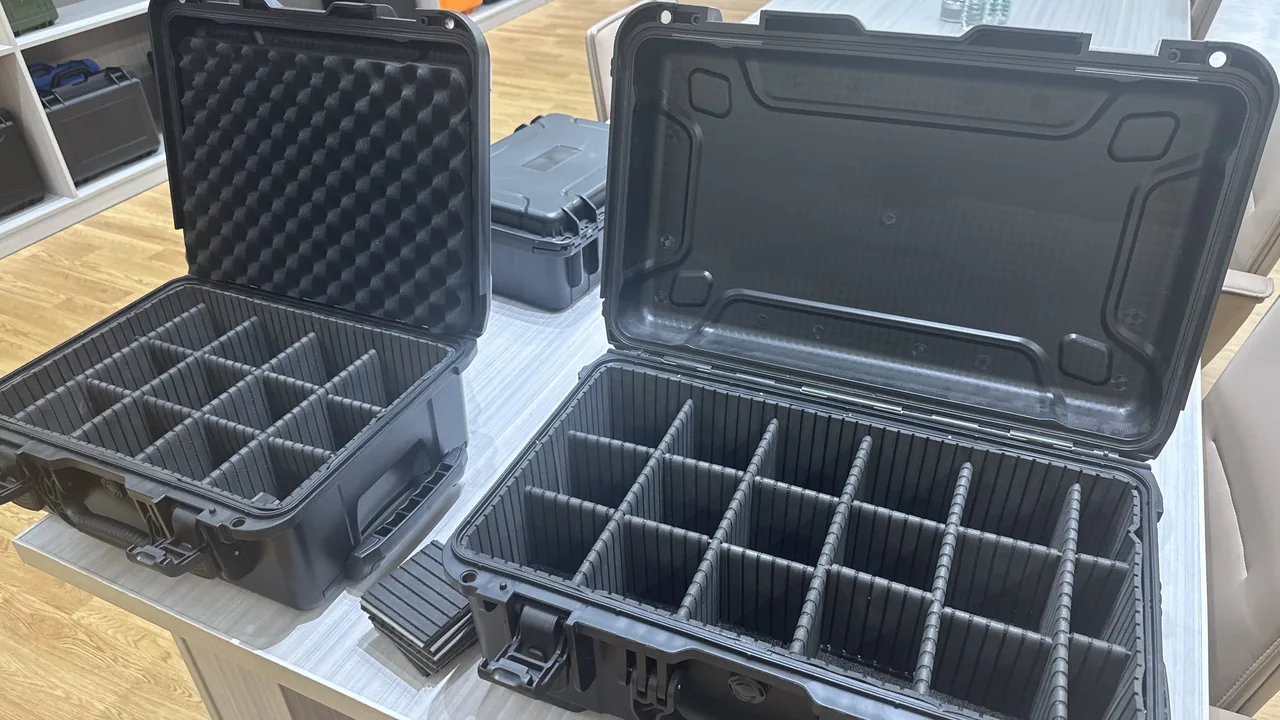
As mentioned, wall thickness and weight are roughly proportional. If you rely entirely on thickening for strength, a large case may become too heavy to carry. The value of ribs is exactly this: they turn "uniform thickening" into "local ribbing," so total material and total weight are far below the thickening approach yet achieve higher rigidity.
This matters especially for protective cases, which often must be hand-carried, shoulder-carried, and checked. A case achieving high rigidity by ribs is much lighter than an equally strong but thicker case, lowering transfer effort, air-cargo weight, and transport fuel. At the same time, ribs put material "where it counts," avoiding the shrinkage and warping risk of thick-wall injection — thick-wall parts cool unevenly and easily get sink marks and deformation, ruining the sealing cooperation face; while uniform thin-wall with ribs cools more consistently and stays dimensionally stable.
So "lightweight" is not cutting corners, but maximizing material efficiency. The KeXin New Materials JUNZHJIA protective-case product line has IP67 capability and holds qualifications such as ISO9001, REACH, and California Prop 65 (backed by company documentation; certificates available on request), and the plastic ABS/PP material passes RoHS testing; its OEM/ODM capability can coordinate rib layout and wall thickness at the mold stage by the equipment list, balancing light weight and strength. For the systematic trade-off of weight and strength, see how to balance weight and strength in protective-case design.
In design and inspection, a useful rule of thumb is "match rib density to wall thickness": with moderate wall thickness, a lid showing evenly spaced, interconnected grid ribs is usually more reliable than a few isolated long ribs, because the grid splits the face into more small cells with shorter bending span and more even dent resistance. But the grid should not be blindly densified — too dense sacrifices interior space and raises demolding difficulty. A qualified rib layout finds balance between "smaller span" and "reasonable material, moldability," which often best shows a factory's structural-design skill.
Rib Layout Logic by Case Section
Different sections bear different loads, so rib layout logic differs:
| Section | Main load | Recommended rib layout | Purpose |
|---|---|---|---|
| --- | --- | --- | --- |
| Lid outer surface | Stepping, stacking pressure, drops | Parallel/grid shallow ribs | Resist face dent, resist buckling |
| Lid inner surface | Cooperate with liner, local support | Perimeter ribs + local support ribs | Keep liner flat, support contents |
| Side walls | Side pressure, stacking side push | Mostly vertical, plus diagonal ribs | Carry load to corners/frame |
| Bottom corners & corner blocks | Drop impact, ground friction | Thickened corner + radial ribs | Absorb energy, resist impact, protect body |
| Bottom frame/base plate | Placement, dragging, pressure | Longitudinal ribs + thickened feet | Resist deformation, anti-slip support |
A few general points:
- The lid is the "stepped-on" hotspot, so ribs on the lid outer surface are most critical; but ribs must avoid the lid-and-body sealing cooperation face, otherwise flatness is destroyed and the IP rating is lost.
- Side-wall ribs should be vertical or diagonal, because stacking and side pressure run along the height direction, and vertical ribs effectively guide force to the bottom corners and frame.
- Corners are the "anchor" of strength, usually locally thickened at the four corners with radial ribs, so impact is absorbed by the corners first and the body suffers less.
- The bottom frame carries the whole case weight; longitudinal ribs + thickened feet are common, also convenient for laying the anti-slip feet.
Key Rib Parameters and Common Errors
Ribs are not "add a few at random"; engineering has a set of parameter conventions:
- Rib thickness: normally 0.6–0.8 times the main wall thickness. Too thin is useless; too thick causes root sink marks, surface sink, even cracking.
- Rib height: too high makes the rib itself unstable or hard to demold; height must match wall thickness and draft angle.
- Draft angle: rib sides must have enough draft, otherwise the part is hard to eject after injection, even pulled.
- Root fillet: the rib-to-wall junction must be filleted to avoid sharp-angle stress concentration.
- Spacing: too dense adds weight and cost and hurts flow; too sparse leaves the span unreduced. Derive from panel size and target rigidity.
Common errors include:
- Ribs too thick causing sink marks: surface dents, internal hidden shrinkage — a strength hazard.
- Rib crosses the seal zone: destroys flatness, directly ruins water and dust resistance.
- Wrong rib orientation: making the guiding rib that should be vertical into horizontal, useless under side pressure.
- Only decorative ribs: the surface has the "look" of ribs, but position, thickness, and fillet are all substandard — purely cosmetic.
On inspection, shine a flashlight at a grazing angle on the inner wall to see if rib roots are flat and free of sink marks, and whether the seal zone avoids ribs — more reliable than hearing the maker say "we added ribs."
Ribs with Stacking and Loading
In real use protective cases are often not "a lone case" but stacked in layers and palletized. Here ribs' value upgrades from "resist local dent" to "resist overall pressure": vertical ribs carry the upper case's weight along the side wall to the bottom corners, preventing the side plate from bulging out; the lid outer-surface grid ribs let the top briefly bear load so a person stepping to fetch items does not collapse it; the bottom-frame ribs spread the whole-case load evenly to feet and base, not crushing the contents. For the large-case stacking scenarios mentioned in why protective cases need a stacking structure, rib layout directly decides "how many layers stack stably." A thin-wall large case with no ribs may bulge and pop its latch under two layers, even crush lower precision parts; a same-size case with sensible vertical ribs and thickened corners can differ by orders of magnitude in stacking stability and load capacity. So when evaluating a large case, include "deformation under side pressure" and "stacking layer reference" in acceptance — and behind both stands rib design level.
Rib Performance Across Materials: ABS vs PP
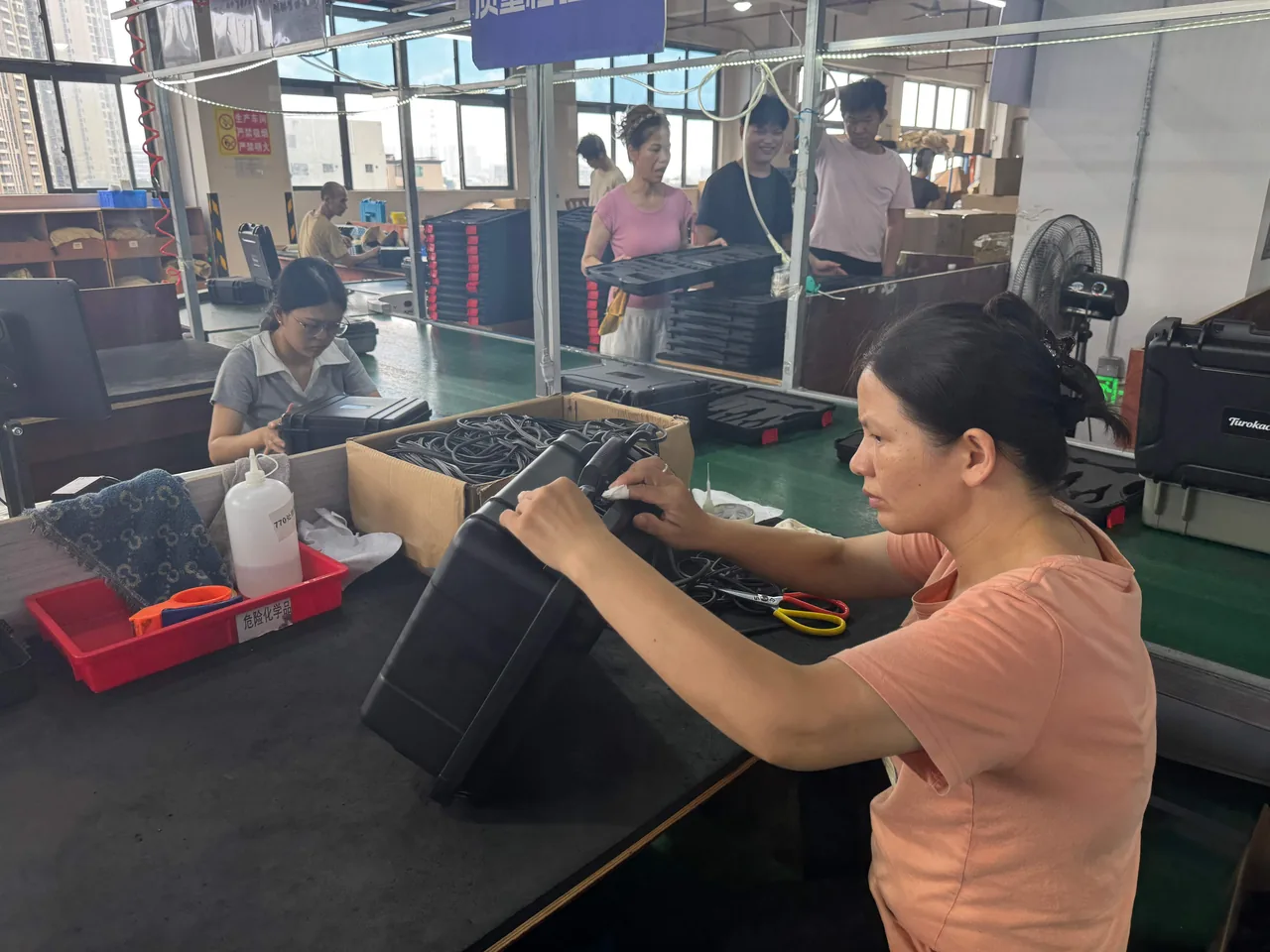
The same rib shape performs differently across materials, because rib effectiveness strongly relates to the material's own rigidity, toughness, and flow:
- ABS: high rigidity, good flow, ribs mold full and dimensionally stable, suited to stiff shapes and fine grid ribs; but low-temperature toughness is slightly lower, and in extreme cold a poorly designed rib root risks brittle cracking, so ABS cases often pair large fillets and moderate rib thickness to supplement toughness.
- PP: good toughness, excellent low-temperature impact, low density; ribs are less likely to brittle-break under drops and cold, suited to frequent opening, cold, or drop-prone scenarios; but rigidity is slightly lower and surface print adhesion needs treatment, so PP cases often rely on denser or more sensible ribs to make up rigidity.
- Recycled material: whether ABS or PP, once recycled material is mixed in, melt flow is unstable and impurities many, and rib roots easily show short-fill, weld lines, and shrinkage, making "looks like ribs" actually "ribs are hollow." KeXin New Materials plastic cases in ABS/PP material pass RoHS testing; controllable material is the basis for ribs to truly work.
Thus material selection and rib design are a combo: ABS cases can use their rigidity to place fewer, finer ribs; PP cases should rely on toughness and slightly denser ribs to supplement rigidity. For more material differences see what is the difference between PP, ABS, and PC protective cases? and what plastic materials are usually used for protective cases?.
A Field Transfer Shows the Value of Ribs
String the above together with a complete example: an outdoor survey team moves a portable tester, sensors, and spare batteries from camp to sampling point; the case is thrown onto an off-road vehicle, jostled and stacked, with occasional drops and stepping. With a ribless thin-wall case, the side wall bulges in jolts, the latch pops under side pressure, and the stepped-on spot collapses and crushes the instrument; switch to a case with a grid-rib lid, vertical side-wall ribs, and thickened radial corner ribs, and in jolts the load is guided to bottom corners and frame, stacking does not deform, stepping does not collapse, and with liner fixation (see liner material) and full-perimeter seal the instrument stays "securely loaded, ready to use out of the box." This example shows: ribs are not decoration but the physical backbone of a protective case "taking abuse" in the real transport chain; together with seal, liner, and latch they make "ready to use out of the box" a stable reality. A manufacturer with one-stop OEM/ODM liner and structure capability (such as KeXin New Materials JUNZHJIA) can coordinate rib layout and liner zones before leaving the factory, delivering a complete solution.
Ribs Cooperating with Wall Thickness, Corners, Material
Ribs do not stand alone; they "team up" with wall thickness, corners, and material:
- With wall thickness: ribs handle "local rigidity," wall thickness handles "base capital." If wall is too thin (below a reasonable lower limit), no matter how dense the ribs they cannot hold; moderate wall + sensible ribs is the optimum. See what is the relationship between protective-case wall thickness and strength?.
- With corners: fillets absorb energy and disperse stress on drops, ribs resist deformation under static pressure — one dynamic, one static, complementary. On corners see what does the rounded-corner design of a protective case do?.
- With material: virgin ABS/PP toughness decides ribs do not brittle-break under impact; recycled material may make ribs a crack starting point via weld lines and impurities. KeXin New Materials plastic cases in ABS/PP material pass RoHS testing; controllable material is the premise for ribs to work.
- With mold: rib molding quality depends entirely on mold cooling, ejection, and precision. A manufacturer with mold-making capability (such as KeXin New Materials) guarantees rib molding consistency at the source — the key to "designable and moldable good parts."
In one sentence: a good case is the synergy of "wall thickness as base, ribs as skeleton, corners absorbing energy, material as backing, mold as execution" — boasting any single one is one-sided.
Ribs and Mold Precision: Good Ribs Are Molded, Not Drawn
Many makers can draw a few ribs on a drawing, but whether ribs finally "work" depends almost entirely on mold and injection process. Process knowledge deciding rib quality:
- Cooling uniformity: the rib root is the thickest spot and cools slowest. With poor cooling-channel design, rib roots get shrinkage and surface sink, looking like ribs but hollow inside. A maker with mold capability (such as KeXin New Materials) can place local cooling at rib roots, eliminating sink from the source.
- Ejection balance: more ribs mean more demold resistance and more sticking points; uneven ejection scratches ribs or warps the case. The mold ejector-pin layout must match rib direction.
- Flow balance: ribs change melt flow path; poor design leaves weld lines at rib ends, becoming strength weak points. Sensible gate position and rib direction avoid weld lines on loaded areas.
- Draft and demold angle: insufficient rib-side draft scratches and tears, lowering long-term yield. All need precise calculation at the mold stage.
So "are there ribs" is the elementary question; "are the molded ribs good" is the acceptance key. If possible, ask for high-res photos of the real inner wall or a sample, focusing on whether rib roots are full, flat, and sink-free — a microscope for judging the maker's mold and process level.
Thin-Wall vs Thick-Wall: How Ribs Change Selection Logic
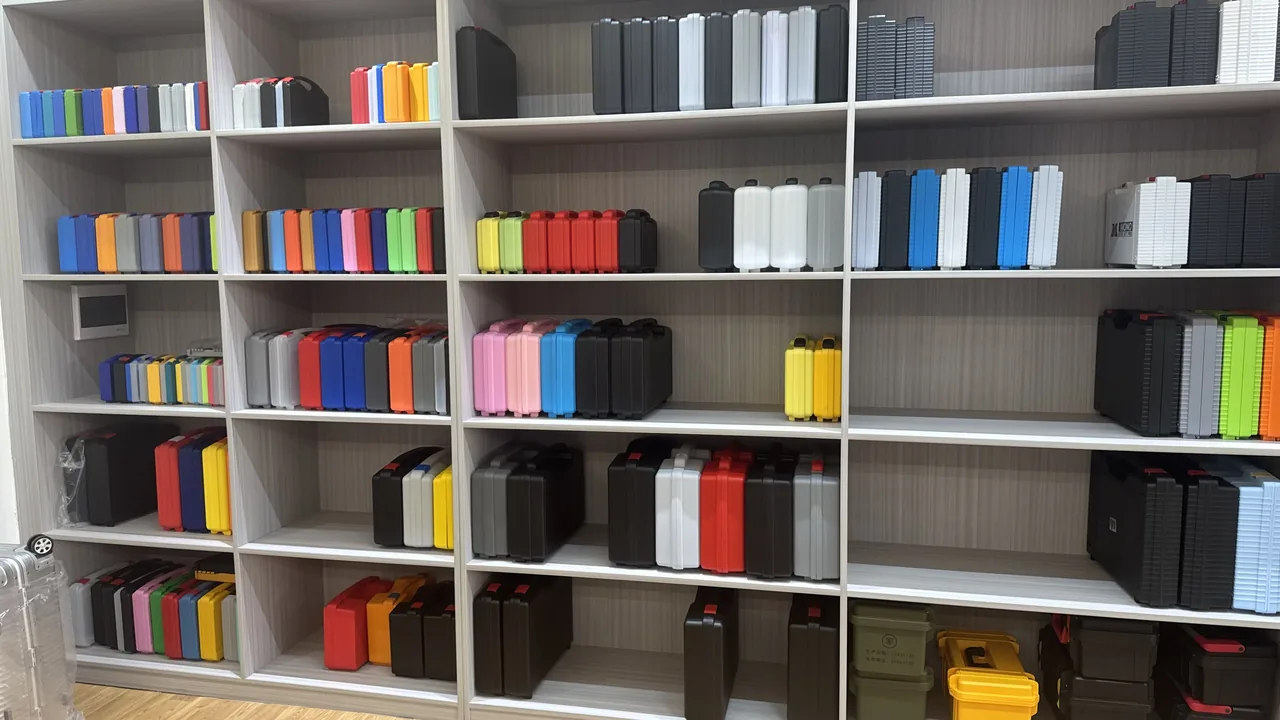
Users used to "thicker is safer," but after ribs became common, selection logic should upgrade:
| Comparison | Thick-wall case by thickness | Thin-wall high-rigidity case by ribs |
|---|---|---|
| --- | --- | --- |
| Weight | Heavy, tiring to carry, costly to ship | Light, easy transfer |
| Strength source | Material itself | Structure (ribs + wall + corners) |
| Molding risk | Thick wall easily shrinks/warps | Thin wall + ribs cool more evenly |
| Cost trend | More material, longer cycle | Less material, but higher mold demand |
| Suitable for | Static heavy load, weight ignored | Frequent carry, air freight, manual transfer |
This table shows: in most "needs carrying, needs shipping, needs frequent opening" outdoor and field scenarios, the thin-wall high-rigidity case is often the better choice; thick-wall cases only matter in the few "static heavy load, weight irrelevant" scenarios. Taking "rely on ribs not thickness" as a selection principle, you avoid both the "too heavy to carry, too brittle to drop" bad thick case and the "thin with no backbone" cut-corner case. For systematic weight-strength balance, see how to balance weight and strength in protective-case design.
How to Tell at a Glance If Ribs Are Done Right
A quick visual-check list for buyers:
- Look at the lid outer surface: are there even, continuous ribs? Grid or a few isolated curves? Grid usually resists compression better.
- Look at inner-wall rib roots: under grazing flashlight, are they flat and sink-free? Sink marks mean rib design or molding is flawed.
- Look at the seal zone: is the lid-and-body sealing face flat with no ribs crossing? Ribs crossing will hurt sealing.
- Look at the four corners: locally thickened with radial reinforcement? Corners are the first drop contact point.
- Weigh it: noticeably overweight at same size may be the "by thickness not ribs" dumb solution; noticeably light with thin wall needs confirmation that ribs truly work.
- Press it: with the empty case latched, press the lid center with your palm; small deformation means ribs are right; slow rebound and obvious collapse warrant caution.
Use these six steps on a sample — more real than any slogan. For a higher-dimension judgment of whole-case quality, see how to judge a high-quality protective case from structural details and what are the structural features of a high-strength protective case?.
Common Misconceptions About Reinforcement Ribs
- Myth 1: Ribs mean rigid. Wrong. Rib thickness, fillet, spacing, direction, whether they avoid the seal zone, plus material and mold quality together decide if ribs work; a surface "rib look" with sunk roots or wrong position is a hazard.
- Myth 2: More and thicker ribs are better. Wrong. Too dense adds weight and cost and hurts melt flow; too thick causes sink and cracking. Pursue "just right," not quantity.
- Myth 3: Ribs break waterproofing. Only when ribs sit on the sealing cooperation face. Standard design keeps ribs off the seal zone and only on non-seal faces, so qualified ribs not only do not hurt the IP rating but raise overall structural stability.
- Myth 4: Thick cases need no ribs. Not quite. Even thick-wall cases benefit from sensible ribs for further weight reduction, anti-buckling, and impact guidance; a fully ribless thick case is often "dumb-heavy" not "truly strong."
- Myth 5: Ribs are decoration. Wrong. Ribs are functional structures bearing dent, buckling, and impact; evaluate by function not appearance.
Frequently Asked Questions (FAQ)
Q: What is the main role of reinforcement ribs in a protective case? A: The core is to raise rigidity, deformation resistance, and impact resistance without increasing overall wall thickness. By splitting a large flat panel into small rib-supported cells, they shorten the load span so a thin wall can still withstand stepping, stacking, and drops; they also disperse impact and guide load to strong zones, and save material and weight by adding material only locally.
Q: Why can ribs "thin yet stiffer"? A: A panel's bending rigidity is inversely proportional to the fourth power of its load span, so halving the span raises rigidity about 16 times. Ribs cut the big panel into small cells and shorten the span, while adding only tiny local material, thus trading far less material than "thickening the whole face" for higher rigidity — thin-wall high rigidity.
Q: Do reinforcement ribs break waterproofing and dustproofing? A: Only if ribs sit on the lid-and-body sealing cooperation face, destroying flatness so the gasket cannot press evenly and hurting the IP rating. Standard design keeps ribs off the seal zone and only on non-seal faces, so qualified rib layout not only does not break sealing but raises overall structural stability.
Q: How can I tell if a protective case's ribs are done right? A: Visually check whether lid outer-surface ribs are even and continuous, inner-wall rib roots are flat and sink-free, the seal zone avoids ribs, and the four corners are locally thickened with ribs; then weigh it and press the lid center to see deformation. If possible, request structure drawings and drop/stacking test records; individual product per specification sheet.
Q: Are more plastic protective-case ribs always better? A: No. Too dense adds weight and cost and hurts injection flow, and too thick causes sink and cracking. The sensible approach derives rib spacing, thickness, and direction from size, load, and target rigidity — "just right," not "more and thicker."
Conclusion
Reinforcement ribs in a protective case are the key design substituting a structural lever for wall-thickness stacking: they multiply rigidity by shortening the load span, keep impact from hurting the body by dispersing and guiding, and achieve thin-wall high rigidity by adding material only locally, with completely different layout logic at the lid, side walls, bottom corners, and bottom frame. To judge whether a case truly has backbone or merely thickness, look at rib thickness, fillet, spacing, whether they avoid the seal zone, and whether corners are thickened — these details matter far more than "we added ribs." Truly reliable protection is the synergy of wall thickness as base, ribs as skeleton, corners absorbing energy, virgin material as backing, and mold as execution, which is exactly how KeXin New Materials JUNZHJIA uniformly plans ribs and wall thickness at the mold stage and relies on one-stop OEM/ODM capability to make the structure solid. Take the six-step visual check to inspection and you can pick, in outdoor survey, military/police/fire, electronics, and aviation/communication scenarios, the protective case that "looks not thick but feels very rigid." For cross-reference continue reading What Is an Outdoor Protective Case and Where Is It Used? to build complete structural understanding.
A reminder: rib effectiveness must finally land on verifiable testing, not just structural description. Protective cases in outdoor, military, and aviation scenarios are often validated for environmental adaptability against the U.S. military standard MIL-STD-810H (note: this is a product-line-level environmental-adaptability validation basis, not a "military certification"), where drop, impact, and vibration procedures are exactly the overall test of the "ribs + wall + corners + material" combination — whether ribs resist is clear after repeated multi-angle drops. Ask the maker for the corresponding drop and stacking test records rather than arguing "more or fewer ribs"; individual product performance follows the specification sheet and test report. The KeXin New Materials JUNZHJIA protective-case product line uses MIL-STD-810H as the environmental-adaptability validation basis and has IP67 capability (per IEC 60529); its mold-stage unified planning of ribs and wall thickness makes "strong structure" a mass-producible, reproducible fact, not sample luck. This also tells buyers: rather than fuss over whether a single sample's ribs look good, verify the maker's mass-production consistency and corresponding test records — that is the real endorsement of rib value.
Further Reading
- What Is the Relationship Between Protective-Case Wall Thickness and Strength?
- What Does the Rounded-Corner Design of a Protective Case Do?
- Structural Features of a High-Strength Protective Case
- How to Balance Weight and Strength in Protective-Case Design
- How to Judge a High-Quality Protective Case from Structural Details
- What Is an Outdoor Protective Case and Where Is It Used?