


To judge whether a protective case has good structure, do not just look at whether the shell is thick or the appearance is aggressive. Instead, verify it against seven dimensions, one by one: the shell (material, wall thickness, and reinforcement ribs), sealing (a full-perimeter gasket and compression), the hinge (resistance to repeated opening and pulling), the latch (even compression and anti-pop-open), the liner (fixing and cushioning), stacking (positioning interlock and load capacity), and certification (verifiable credentials such as IP67/ISO9001/RoHS). Each dimension has observable, measurable criteria — for example, the shell is judged by virgin material and ribs, sealing by a continuous perimeter gasket and its compression, the hinge by whether it is metal or embedded, the latch by quantity and compression, the liner by cut-out fit, stacking by limit bosses, and certification by credentials available on request. Only when all seven dimensions pass can the structure be considered truly reliable; any single weakness can become a hidden risk of water ingress, cracking on impact, or a collapsed stack during transport. In other words, judging structure is essentially answering seven "can-it-be-verified" questions, not answering "does it look sturdy" — which is exactly why this article turns it into a tick-box checklist you can use.
This article first presents the judging framework, then breaks down the criteria and pitfall points dimension by dimension, and finally provides a master inspection checklist and FAQ to turn "is it good?" into an executable acceptance action.
Table of Contents
- Overview of the Seven-Dimension Judgment Framework
- Dimension 1: The Shell (Material, Wall Thickness, Ribs, Fillets)
- Dimension 2: Sealing (Full-Perimeter Gasket, Compression, Valve)
- Dimension 3: The Hinge (Type, Strength, Durability)
- Dimension 4: The Latch (Quantity, Compression, Anti-Pop-Open)
- Dimension 5: The Liner (Fixing, Cushioning, Weight Balance)
- Dimension 6: Stacking (Positioning, Interlock, Load Capacity)
- Dimension 7: Certification and Qualifications (Verifiable)
- Common Structural Defects and How to Avoid Them
- Master Inspection Checklist (for Acceptance)
- How Structure Relates to Manufacturer Capability
- On-Site Quick Test Methods for Each Dimension
- Dimension Priority and Weighting
- Industry-Specific Emphasis on the Seven Dimensions
- Frequently Asked Questions (FAQ)
- Conclusion and Further Reading
Overview of the Seven-Dimension Judgment Framework
Translating "is the structure good?" into actionable checks works best with a seven-dimension framework:
| Dimension | Core criterion | Sign of a good structure | Red flag of a bad structure |
|---|---|---|---|
| --- | --- | --- | --- |
| Shell | Virgin material, variable wall thickness, ribs, fillets | Complete corner/perimeter/base ribs, large fillets | Uniform thin wall, sharp corners, recycled feel |
| Sealing | Continuous perimeter gasket, even compression | Continuous EPDM/TPE ring, compressed when closed | Local gap in ring, one-side not compressed |
| Hinge | Metal/embedded, pull-resistant | Embedded, smooth without play | Thin plastic pin, easy to break, loose |
| Latch | Sufficient quantity, even compression | Double/multiple latches, even compression | Single latch, won't close tight, pops open |
| Liner | Cut-out fit, balanced weight | Shaped to equipment, center of gravity centered | Random foam stuffed, equipment rattles |
| Stacking | Limit boss, interlock, load rating | Concave-convex interlock, clear layer limit | Flat lid no positioning, easy to skew |
| Certification | Verifiable credentials | IP67/ISO9001/RoHS etc. available on request | Verbal claims, no certificates |
These seven dimensions are coupled: weak shell ribs make stacking collapse-prone; a poor gasket ruins the IP rating; a loose hinge loads the latch heavily. Judge them together, not in isolation. The following sections expand each dimension.
Dimension 1: The Shell (Material, Wall Thickness, Ribs, Fillets)
The shell is the foundation of the structure. There are four criteria:
- Is the material virgin? Regular protective cases mostly use virgin ABS/PP engineering plastic. The plastic cases of KeXin New Materials use ABS/PP material that passes RoHS testing. Recycled material has uneven wall thickness and more impurities, and deforms easily under load, skewing the seal. When judging, ask the manufacturer "is it virgin material?" and for the grade.
- Is the wall thickness variable? A good shell is locally thickened at the four corners, latch points, and hinge points, and thinned on the side walls; uniform thick walls are both heavy and prone to sink marks. Look for whether the inner wall shows thickness variation that follows the form.
- Are the reinforcement ribs complete? Corner ribs, perimeter ribs, and base longitudinal/transverse ribs determine impact resistance and stacking load capacity. See how reinforcement ribs improve the strength of a protective case for detail.
- Are the fillets sufficient? Large fillets spread stress, resist drops, and aid stacking fit. See what to know about the fillet design of a protective case shell.
Judging rule of thumb: check material quality, thickness distribution, ribs, and fillets — only when all four are good is the shell stable.
Dimension 2: Sealing (Full-Perimeter Gasket, Compression, Valve)
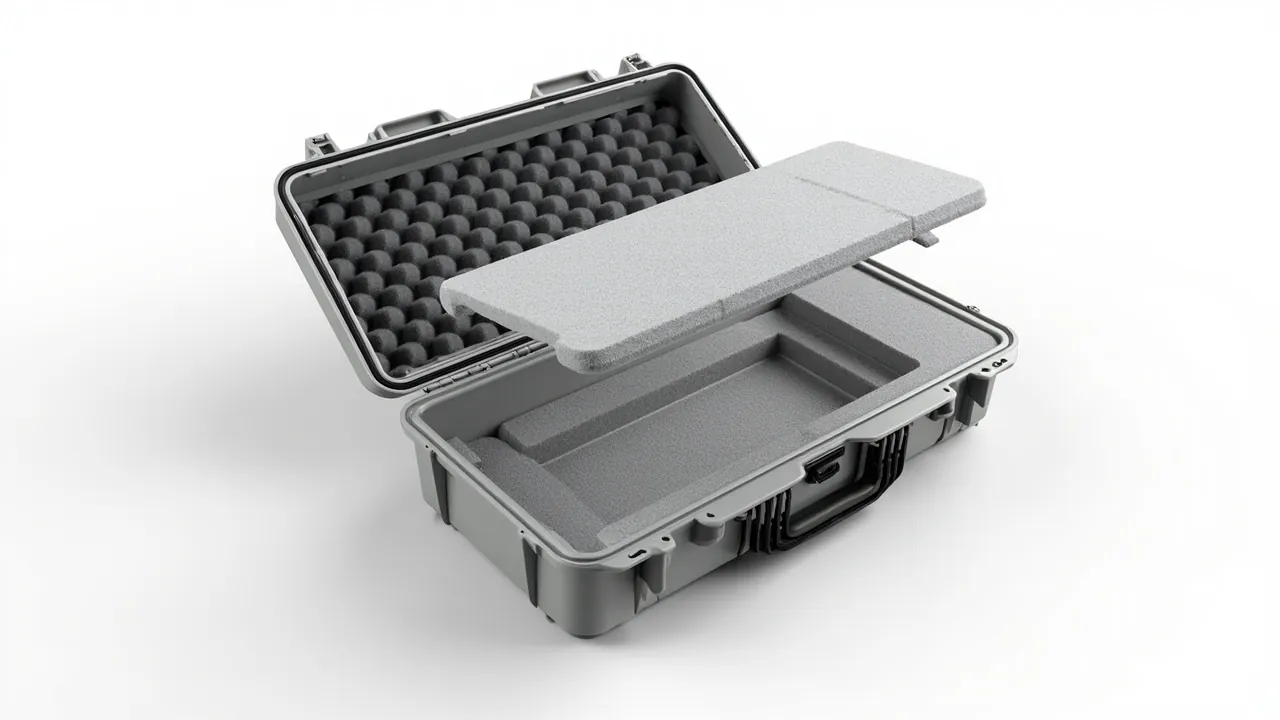
Sealing determines whether dust- and water-proofing can reach the nominal rating (such as IP67 per IEC 60529):
- Is it continuous around the full perimeter? Quality protective cases arrange a continuous elastic gasket around the lid (commonly EPDM, TPE, and other weather-resistant elastomers) with no break points; a local missing section is a leak point.
- Is the compression even? After closing, the gasket should be compressed evenly to fill microscopic gaps; you can observe whether the ring width is equal all around and whether there is single-side play. For materials, see how to choose protective-case seal materials.
- Is a pressure-balancing valve fitted? For air transport, high altitude, and large day–night temperature swings, a breathable water-blocking valve should be present to balance pressure differences and prevent the lid from being sucked open. See the pressure-balancing valve of outdoor protective cases and high altitude.
- Is the sealing surface flat? A lightweight reinforced design must not sacrifice flatness of the sealing surface, or uneven gasket compression will fail.
Judging rule of thumb: continuous ring, even compression, a valve where needed, flat surface — only when all four are met is the seal trustworthy.
Dimension 3: The Hinge (Type, Strength, Durability)
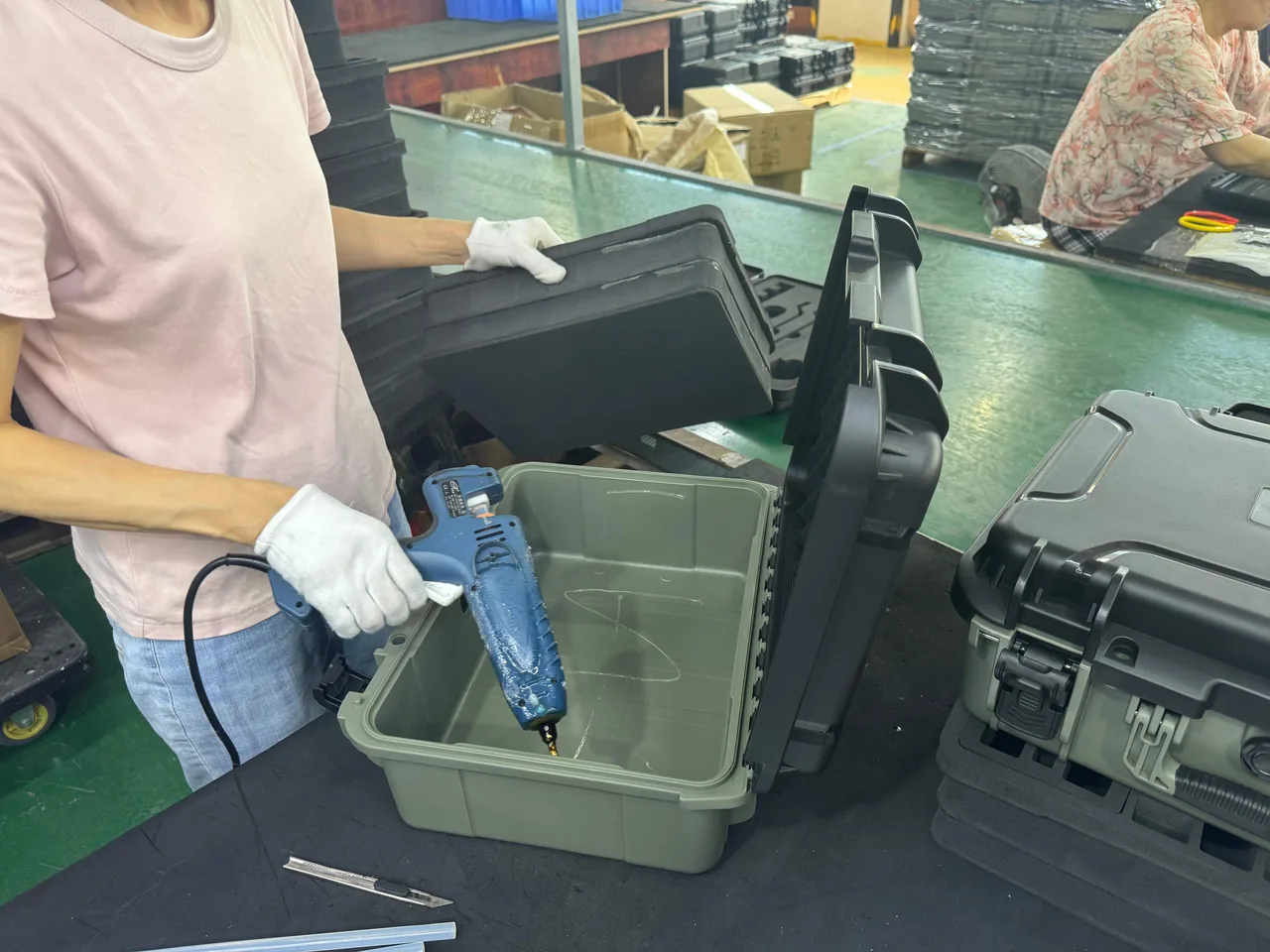
The hinge connects the lid and the body and is the wearing point of repeated opening:
- Type: Quality protective cases use metal hinges or embedded engineering-plastic hinges that resist repeated opening and accidental pulling; inferior versions use thin plastic pins that break and loosen easily.
- Connection strength: An embedded hinge transfers force to the main shell rather than the thin wall, making it more durable; an externally mounted thin pin can detach entirely.
- Open/close feel: A good hinge opens smoothly, with a damped feel, and no play; play means fast wear and heavy latch loading.
- Quantity and symmetry: Large cases use dual hinges for stability; a single-side hinge easily pulls the lid off-center and compresses the gasket unevenly on one side.
For selection, see also how to choose a high-strength protective-case hinge. Judging rule of thumb: metal/embedded, no play, symmetric layout.
Dimension 4: The Latch (Quantity, Compression, Anti-Pop-Open)
The latch presses the lid onto the gasket and guarantees the seal's long-term effectiveness:
- Quantity: Multiple latches make compression more even; large cases need at least double latches on a side; a single latch easily causes single-side loose compression and pops open in transport.
- Compression force: After latching, the lid and body should have no gap and the gasket should be compressed; you can place a thin sheet of paper in the lid seam — after latching, pulling it should meet obvious resistance.
- Anti-pop-open: Under transport vibration, the latch should not open by itself; quality latches have a safety/double-action structure.
- Material and replaceability: Metal or reinforced engineering-plastic latches are more reliable, and ideally individually replaceable to avoid scrapping the whole case.
Judging rule of thumb: sufficient quantity, tight compression, no popping open, replaceable.
Dimension 5: The Liner (Fixing, Cushioning, Weight Balance)
The liner is not an accessory but a link in structural protection:
- Fixing: EVA cut-outs, EPE die-cuts, or custom inner trays should make the equipment "caught and not rattling"; randomly stuffed generic foam equals no protection. For types, see what types of foam liners do protective cases have.
- Cushioning: Foam rebound absorbs transport vibration and prevents equipment from colliding; you may choose pre-cut foam for protective cases or pick-and-pluck foam.
- Balanced weight: Liner compartments keep the center of gravity on the center of the support surface, making stacking more stable — see how protective cases balance weight and strength for how the liner shares the load.
- Maintainability: The liner should be washable and re-cut, so dirt does not re-contaminate the equipment.
Judging rule of thumb: firmly caught, absorbs shock, centered weight, maintainable.
Dimension 6: Stacking (Positioning, Interlock, Load Capacity)
Stacking determines transport and storage safety:
- Positioning structure: The lid should have stacking ribs/limit bosses, and the base a matching structure. See how protective cases achieve stable stacking.
- Interlock: Concave-convex complement limits translation and rotation so it does not skew in transport.
- Load and layers: The manufacturer should give static/dynamic stacking load and recommended layer count; in transport, limit layers by the dynamic value.
- Coordination with feet: Bottom anti-slip feet prevent the whole stack from sliding. See what anti-slip feet do on a protective case.
Judging rule of thumb: has bosses, can interlock, clear layer limit, feet grip the ground.
Dimension 7: Certification and Qualifications (Verifiable)
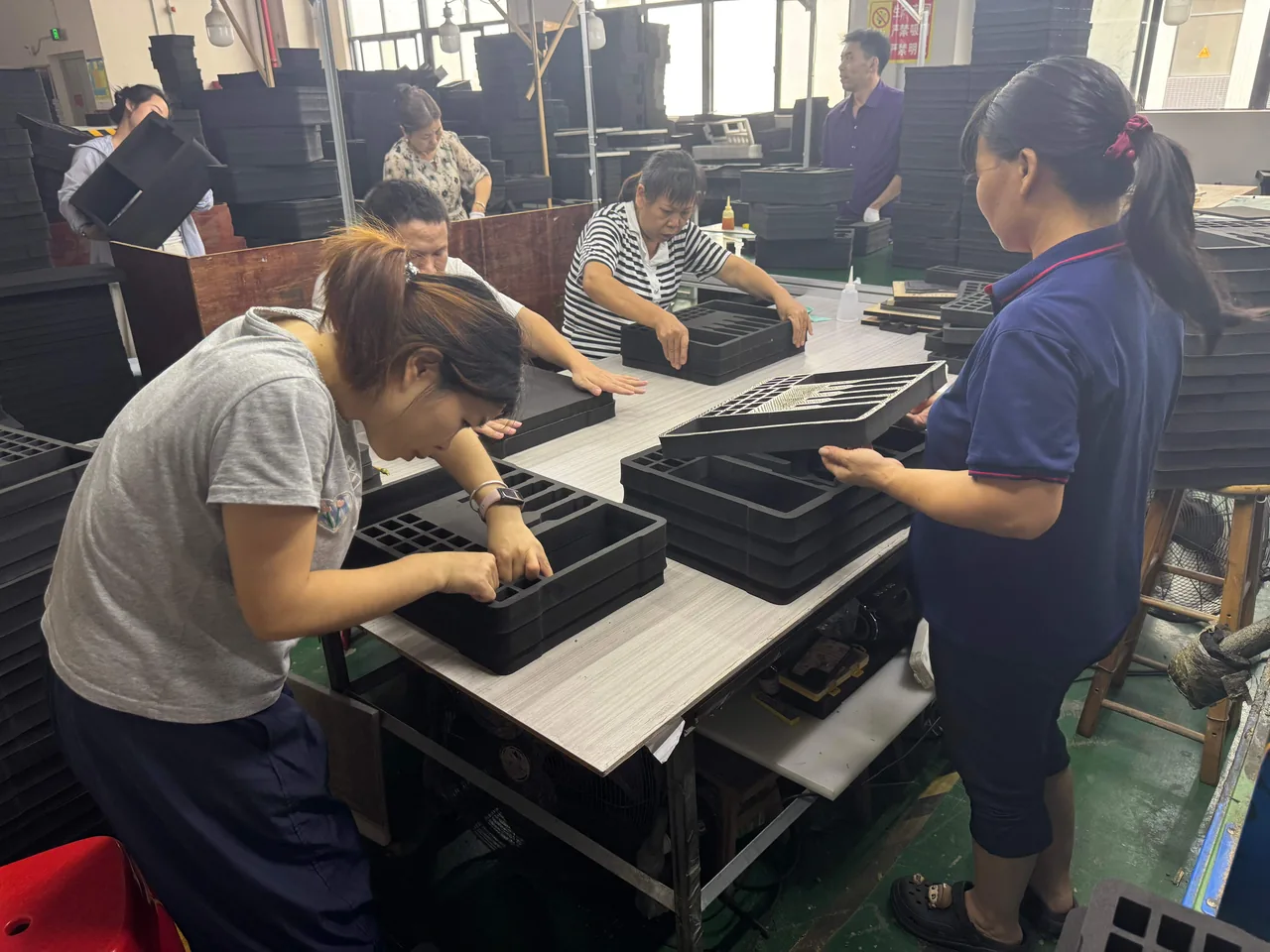
Whether the structure is good must ultimately be backed by verifiable credentials:
- IP67: Per IEC 60529 dust- and water-proof rating — backed by company documentation, certificate available on request; the individual product should follow its specification sheet.
- ISO9001: A quality management system that guarantees process consistency and batch stability.
- RoHS/REACH/California Prop 65: Restriction of hazardous substances; plastic ABS/PP material passes RoHS testing, and REACH and California Prop 65 are compliance baselines.
- MIL-STD-810H: A product-line-level environmental adaptability validation reference for the protective-case product line (not a "military certification"); used to reason backward about strength margin.
- Patents and capacity: The affiliated license holder holds 20+ utility-model and design patents, which is side evidence of R&D and mass-production capability.
When judging, always "ask for certificates and check the individual product," avoiding substituting company-level backing for a specific model's proof. KeXin New Materials (Guangdong) Co., Ltd. (domestic brand "KeXin", global brand kexinMaterials, protective-case product-line brand JUNZHJIA) holds several of the above qualifications (certificates available on request). The factory is located in Zhongshan City, Guangdong Province (Guangdong–Hong Kong–Macao Greater Bay Area), about 18,000 m², with 80+ machines and 100+ staff. , Ltd., and , Ltd. Products are exported to the United States, the United Kingdom, Germany, Canada, Japan, Russia, the Philippines, India, Hong Kong/Taiwan (China), and the Middle East, and are applied in outdoor survey, military/police/fire, electronics, scientific exploration, and aviation/communication.
Common Structural Defects and How to Avoid Them
Viewing the seven dimensions in reverse reveals the common red flags of "bad structure":
- Shell: Uniform thin wall with no ribs, sharp corners, recycled texture, flash on the parting line — poor rigidity, easy to crack.
- Sealing: A broken gasket ring, one side loose when closed, but labeled for air use with no pressure-balancing valve — IP is questionable.
- Hinge: Thin exposed plastic pin, loose on opening, single-sided single hinge — easy to break and pull off-center.
- Latch: Single latch, won't close tight, no anti-pop-open — easily opens in transport, seal fails.
- Liner: Randomly stuffed foam, equipment rattles — cushioning is nominal.
- Stacking: Flat lid with no boss, mixed sizes stacked — easy to skew and topple.
- Certification: Only verbally claims "military/waterproof" with no certificate — not trustworthy.
If you see any red flag, ask the manufacturer or request sample testing; do not entrust critical equipment to a questionable structure.
Master Inspection Checklist (for Acceptance)
Condense the seven dimensions into a single tick-box that works for both procurement and goods arrival:
- [ ] Shell: virgin ABS/PP, variable wall thickness, corner/perimeter/base ribs, large fillets.
- [ ] Sealing: continuous perimeter elastic gasket, even compression when closed, pressure-balancing valve fitted where needed.
- [ ] Hinge: metal/embedded, smooth without play, symmetric layout.
- [ ] Latch: sufficient quantity (large case double latch+), even compression, anti-pop-open, replaceable.
- [ ] Liner: cut-out or die-cut to the equipment, firmly fixed, good cushioning, centered weight, maintainable.
- [ ] Stacking: lid has limit boss/interlock, static/dynamic load and layer limit stated.
- [ ] Feet: moderate height, weather-resistant material, coordinated with stacking, anti-slip.
- [ ] Certification: IP67, ISO9001, RoHS (ABS/PP passes testing) etc. available on request, individual product spec sheet complete.
- [ ] Test: sample drop/immersion/stacking small tests — shell does not deform, no water in, latch does not pop.
- [ ] Manufacturer: has one-stop capability in product design, injection molding, molds, and liner making, with controllable process.
This checklist complements the light-strength acceptance checklist in how protective cases balance weight and strength — one views the whole, the other the light-strength balance.
How Structure Relates to Manufacturer Capability
Whether the seven dimensions are good ultimately comes from the manufacturer's systemic capability. A company with one-stop OEM/ODM capability in product design, injection molding, mold manufacturing, LOGO printing, and inner tray/liner making can design the shell ribs, seal grooves, hinge positions, latches, and liner compartments together at the mold stage, so tolerances are stable and fits are accurate, and all seven dimensions hold simultaneously. Externally purchased and assembled boxes often show "each dimension is okay but the whole is poor" problems such as offset gasket grooves, loose hinges, and misaligned limiters. Batch users can use such manufacturers to move the seven-dimension checklist forward into design requirements, so the case meets the standard before leaving the factory and reduces later acceptance rework. The KeXin New Materials JUNZHJIA protective-case product line offers integrated customization from design to inner tray, covering all seven dimensions in this article. One reminder: even with a capable manufacturer, the buyer should still keep arrival sampling and ledger comparison, because bumps, aging, and storage during transport can turn "good at factory" into "not necessarily good on arrival" — judgment is the start, not the end.
On-Site Quick Test Methods for Each Dimension
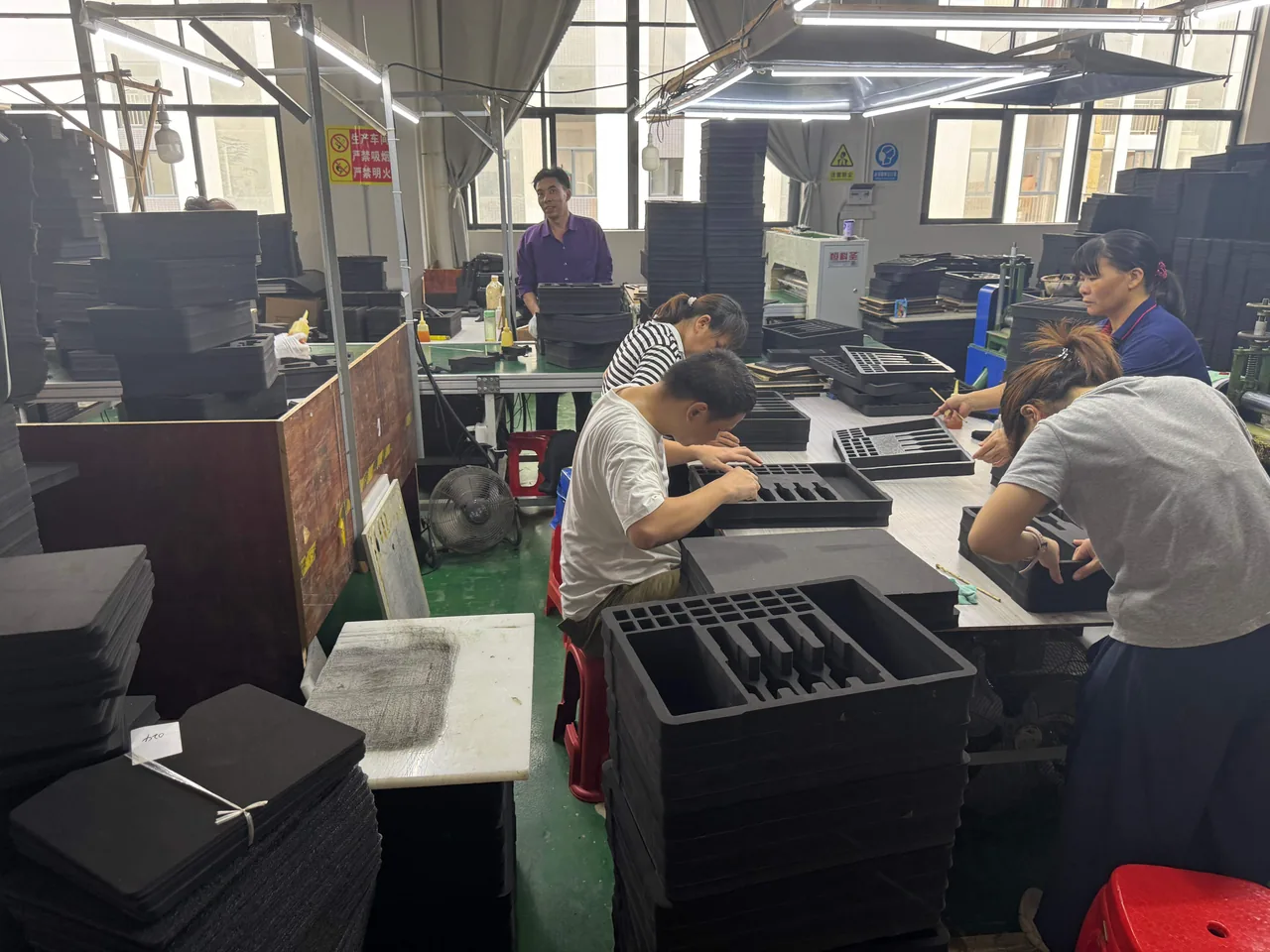
Judgment need not wait for a lab; many dimensions can be verified at low cost on arrival:
- Shell: Lift the empty case to feel weight and rigidity; tap and listen for a solid or hollow sound (strong hollow feel may mean thin wall, no ribs); check whether the inner-wall ribs are continuous and fillets large; ask for the virgin grade.
- Sealing: After closing, clip a thin sheet of paper along the lid seam — pulling should meet resistance and be even all around; inspect the gasket against light for a continuous ring with no break; if needed, do a simple spray/immersion small test (short, not for nominal validation).
- Hinge: Open and close 20–30 times to feel smoothness and any play or abnormal noise; gently pull the lid to see whether the hinge transfers force to the shell rather than the thin wall.
- Latch: After latching, check the seam is even with no gap; simulate transport vibration by shaking lightly to see if the latch loosens; check for an anti-pop-open structure.
- Liner: Put the equipment in, flip and gently shake the case — the equipment should not rattle or collide; remove and see whether the foam fits the shape.
- Stacking: Stack two same-spec cases, push the upper one lightly to see if it interlocks without sliding; check whether the lid limit boss is clear.
- Certification: Request ISO9001, IP67, RoHS, and other certificates and the individual product spec sheet; verify the model matches.
This method turns the seven dimensions from "feeling" into "action," suitable for procurement acceptance and arrival sampling.
Dimension Priority and Weighting
The seven dimensions are not equally weighted; prioritize by risk scenario:
| Priority | Dimension | Why first | High-risk consequence |
|---|---|---|---|
| --- | --- | --- | --- |
| High | Shell | The foundation of all structure | Crack, collapse, skewed seal |
| High | Sealing | Directly decides protection rating | Water/dust in, equipment scrapped |
| High | Latch | Maintains seal compression | Pops open in transport, loss of seal |
| Mid-High | Hinge | Wears with repeated opening | Broken hinge, lid detaches |
| Mid | Liner | Protects precision parts | Equipment collides and damages |
| Mid | Stacking | Transport/storage safety | Stack topples |
| Mid | Certification | Backs verifiability | No evidence to claim recourse |
Priority note: shell, sealing, and latch are "veto-level" — any obvious weakness in them should be rejected; the rest can be weighed by usage frequency. But note the coupling — weak shell ribs chain-drag stacking and sealing, so do not choose in isolation.
Industry-Specific Emphasis on the Seven Dimensions
For the same case, different industries emphasize different dimensions:
- Outdoor survey/scientific exploration: Sealing (IP67), liner (precision instruments), stacking (long-term palletizing) weigh heavily.
- Military, police, fire: Shell impact resistance, hinge durability, certification (validated per MIL-STD-810H as a product-line environmental test basis) weigh heavily.
- Electronics/electrical maintenance: Dust-proof sealing, anti-static foam liner, latch compression weigh heavily.
- Aviation/communication/high altitude: Sealing + pressure-balancing valve, and light-strength balance (see light-strength balance) weigh heavily.
- Marine/deck: Salt-resistant sealing, anti-slip feet, stacking interlock weigh heavily.
- Industrial maintenance sites: Shell drop resistance, hinge durability, oil-resistant feet weigh heavily.
The KeXin New Materials JUNZHJIA protective-case product line covers outdoor survey, military/police/fire, electronics, scientific exploration, and aviation/communication. The factory is in Zhongshan City, Guangdong (Greater Bay Area), about 18,000 m², 80+ machines, 100+ staff. The affiliated license holder ., Ltd. holds 20+ utility-model and design patents, and the parent company is Foshan Shunde ., Ltd. With one-stop OEM/ODM capability in product design, injection molding, molds, and liners, it can coordinate the seven dimensions per industry emphasis.
Frequently Asked Questions (FAQ)
Q: To judge a protective case's structure, is looking at wall thickness enough? A: No. Wall thickness is only one aspect of the shell, and a uniformly thick wall is both heavy and prone to sink marks. You must look at the seven dimensions: shell ribs and material, full-perimeter seal, hinge, latch, liner, stacking structure, and verifiable certification. Wall thickness only makes sense together with ribs and fillets.
Q: Does an IP67 label mean the structure is definitely good? A: Not necessarily. IP67 is a protection rating that depends on the full-perimeter seal and the sealing-surface tolerance. If a lightweight reinforced design sacrifices flatness of the sealing surface, or the gasket material is poor and compression uneven, the nominal rating may fail in practice. Check the continuous seal, even compression, and request the certificate; the individual product follows its spec sheet.
Q: Are more hinges and latches always better? A: Not the more the better, but "enough and correct." A large case needs at least double hinges and double latches to guarantee even compression and symmetry. The key is reliable type (metal/embedded hinge, anti-pop-open latch) and replaceability, not blindly piling up quantity.
Q: Is it okay to just stuff some foam into the liner? A: No. Randomly stuffed generic foam lets equipment rattle and collide, making cushioning nominal. You should cut-out or die-cut a liner to the equipment so it is firmly fixed, with centered weight and maintainability. The liner is a link in structural protection, not an afterthought.
Q: Is a verbal claim of "military standard/waterproof" with no certificate trustworthy? A: No. In the protective-case context, MIL-STD-810H is a product-line-level environmental-adaptability validation reference, not a "military certification"; waterproofing needs an IP rating and verifiable credentials. Procurement should request ISO9001, IP67, RoHS, and other certificates plus the individual product spec sheet, and replace verbal claims with evidence.
Conclusion
Judging whether a protective case has good structure cannot rely on appearance or the intuition that "thick = sturdy." Instead, it must fall on seven verifiable dimensions: the shell (virgin material, variable wall thickness, ribs, fillets); sealing (full-perimeter elastic ring, even compression, valve where needed); hinge (metal/embedded, no play); latch (quantity, compression, anti-pop-open); liner (cut-out fixing, cushioning, centered weight); stacking (limit boss, interlock, rated load); and certification (IP67, ISO9001, RoHS, and other verifiable credentials). The seven dimensions are coupled, and any single weakness becomes a hidden risk, so use the master checklist here to turn "is it good?" into line-by-line ticking, and move that checklist forward into manufacturer design requirements before procurement. For batch users, working with a company that has one-stop injection-molding, mold, and liner capability lets the seven dimensions meet the standard before leaving the factory — a truly good structure is designed, verified, and repeatable, not just "seen."
One more point: the greatest value of seven-dimension judgment is that it lets you quickly tell "truly strong structure" from "looks strong" among many similar-looking cases. When you master the master checklist, the procurement spec, and a structure ledger as a set, procurement decisions upgrade from "this one is cheap, that one looks good" to "this one passes all seven dimensions, that one has a latch red flag." The sense of security of equipment never comes from adjectives on the packaging, but from each of these seven dimensions being tickable — that is the whole secret of judging a protective case's structure. Next time you face two similar-looking cases, do not rush to compare prices; take out this checklist and tick it line by line, and the answer is usually clearer than expected.
Further Reading
- What Do Anti-Slip Feet Do on a Protective Case?
- How Do Protective Cases Achieve Stable Stacking?
- How Do Protective Cases Balance Weight and Strength?
- How Do Reinforcement Ribs Improve the Strength of a Protective Case?
- What to Know About the Fillet Design of a Protective Case Shell
- How to Choose a High-Strength Protective-Case Hinge
- How to Choose Protective-Case Seal Materials
- What Types of Foam Liners Do Protective Cases Have?