

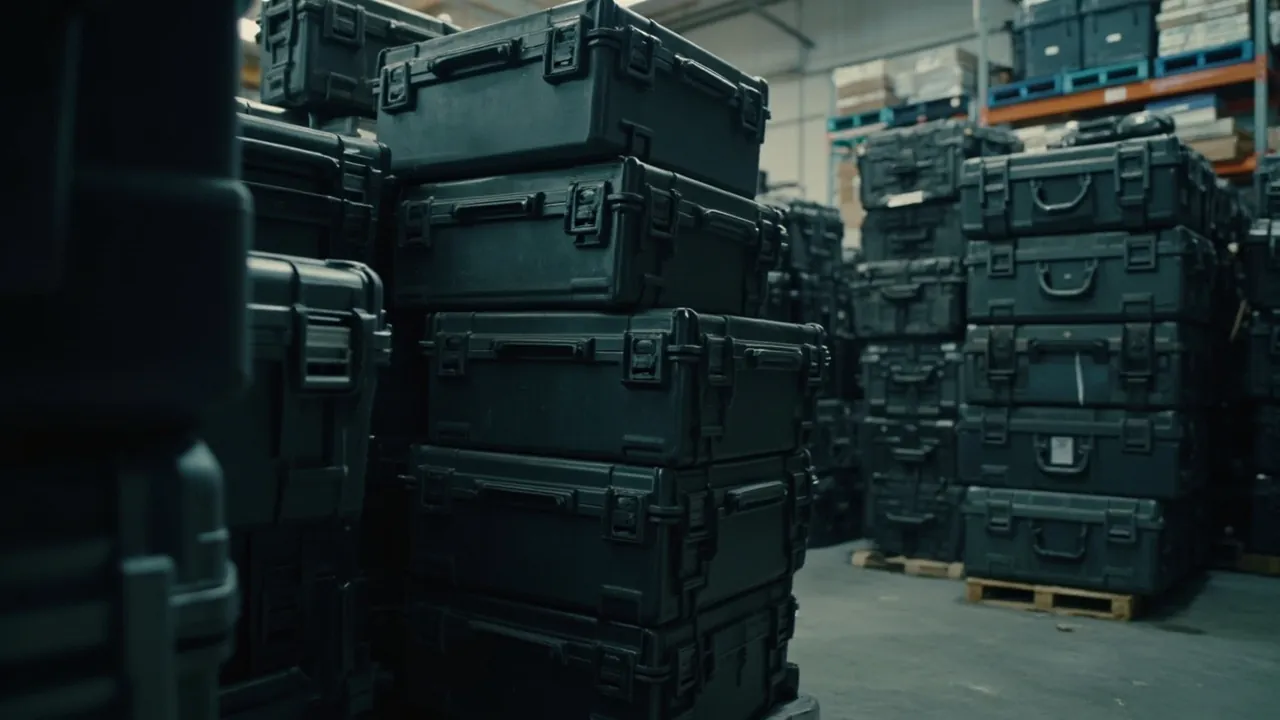
A protective case achieves stable stacking through a set of physical locating and load-bearing structures distributed on the lid and the body: the top of the lid is designed with recessed stacking ribs (locators) or locator bosses, and the bottom of the body (or the feet) has corresponding raised locating structures. When stacked in multiple layers, the bottom of the upper case fits exactly into the recess of the lower case's lid, forming a "male-female interlocking" relationship; at the same time, the reinforcement ribs around the shell and at the four corners provide the rigidity needed for stacking load, the latches keep each layer pressed tight so it does not pop open, and the bottom anti-slip feet prevent the whole stack from sliding on a surface. In other words, stable stacking = locating structure (no skew) + rigid structure (no collapse) + compression structure (no scattering) + anti-slip structure (no sliding), working together — not simply "one box on top of another." The most practical way to judge whether stacking is reliable is to break it into these four things and check each: is there male-female interlocking, are the rib positions sufficient, are the latches tight enough, do the feet grip — only when all four pass is it truly a transportable stack, not a "fake stack" that only looks neat in a warehouse.
This article gives the conclusion first, then breaks down the composition of the stacking structure, the force principles, stacking load and safety, transport stacking practice, a selection checklist, and pitfalls to avoid, to help you judge whether a protective case's stacking is "truly stable."
Table of Contents
- What Structures Make Stacking Stable
- Principles of Stacking Ribs and Locator Bosses
- How the Interlocking Structure Prevents Misalignment
- Why Reinforcement Ribs and Shell Rigidity Matter for Stacking
- Stacking Load and Load Distribution
- The Role of Latches and Feet in Stacking
- Practical Points for Transport Stacking
- Stacking Requirements by Scenario
- Common Misconceptions and Pitfalls
- Selection Checklist
- Relationship with Manufacturer Structural Capability
- Frequently Asked Questions (FAQ)
- Conclusion and Further Reading
What Structures Make Stacking Stable
A protective case that can be safely stacked in multiple layers does not get its stacking ability merely from "a hard enough shell"; it is guaranteed by four types of structures together:
- Locating structure (anti-misalignment): Stacking ribs/locator bosses on the top of the lid + corresponding recesses on the bottom of the body, so the upper case "locks" onto the lower case, with no horizontal slip or rotation.
- Rigid structure (anti-collapse): Reinforcement ribs on the shell wall, the four corners, and the perimeter provide load-bearing capacity, transmitting the upper layer's weight evenly to the lower layer and avoiding local collapse.
- Compression structure (anti-scatter): After the latches close the lid, they press the lid down; when multiple layers stack, the whole stack becomes one unit. If the latches do not pop open, the layers do not loosen.
- Anti-slip structure (anti-whole-stack-slide): The bottom feet grip the ground so the whole stack does not shift on vehicle, ship, or bench surfaces.
If any one of these four is missing, the stacking has a hidden risk: inaccurate locating means skew, insufficient rigidity means collapse, loose latches mean scatter, and slippery feet mean drift. Designing the four within the same mold logic is what makes "truly stable" stacking.
Principles of Stacking Ribs and Locator Bosses
Stacking ribs are raised edges or rib positions arranged along the edge of the top of the lid, usually trapezoidal or rounded-rectangle in cross-section; a locator boss is a more prominent locating block used to hard-limit the landing point and sliding range of the upper case. The working principle is:
- When the bottom of the upper case (or its feet, or the corresponding recess) lands, it slides into the correct position along the lower case's stacking ribs; the two sides of the ribs block horizontal displacement, and the boss blocks excessive sliding.
- Multiple parallel ribs form a "guide rail," letting the case align only along the set direction, auto-centering on landing and reducing manual-positioning error.
- The rib height and width determine the engagement depth: the deeper the engagement and the larger the contact area, the stronger the resistance to horizontal shear and torsional displacement.
Geometrically, stacking ribs turn "point contact" into "line/face contact," distributing the upper case's weight and possible lateral force onto a longer, more stable contact band, significantly improving stacking stability without increasing wall thickness. This is why a manufacturer with mold-design capability can "reduce cost and increase efficiency" structurally — solving the problem with ribs rather than thickening.
How the Interlocking Structure Prevents Misalignment
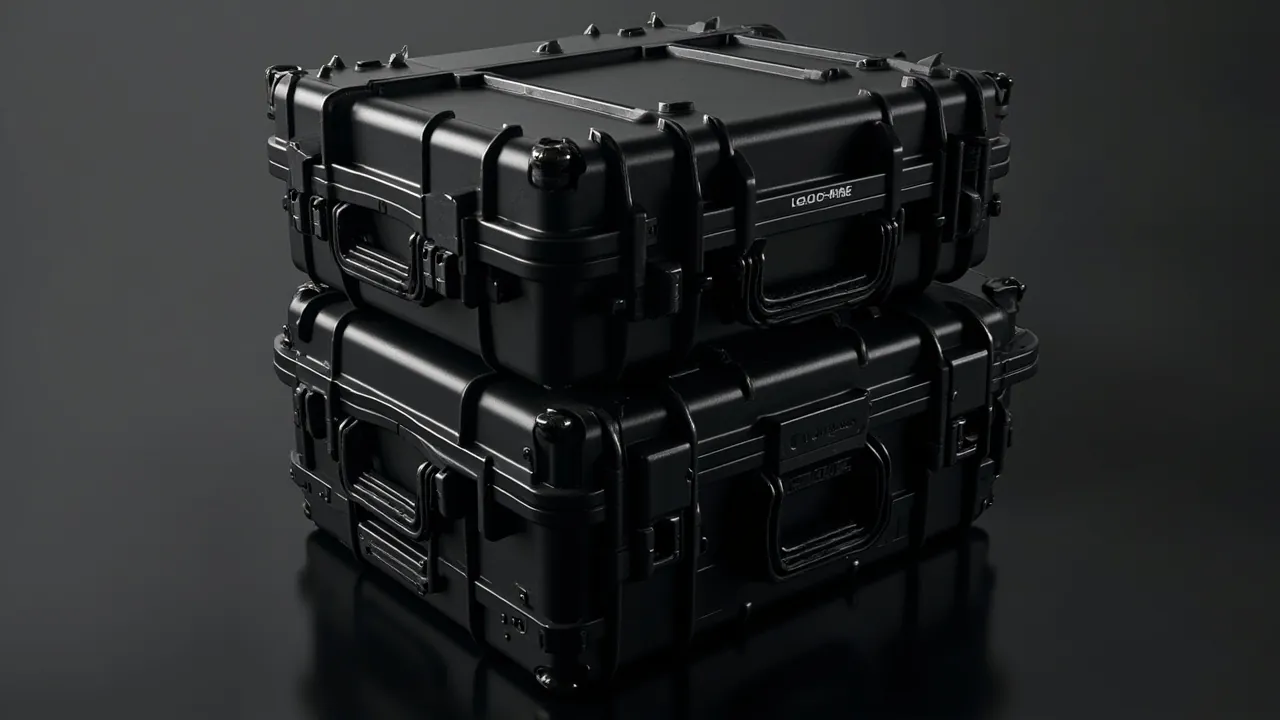
Evolving from stacking ribs is the interlocking structure: the recess of the lower lid and the protrusion of the upper bottom are complementary in shape (e.g., concave trapezoid with convex trapezoid, round head with round groove), and once closed they are male-female to each other, limiting not only translation but also relative rotation. The benefits of interlocking:
- Anti-side-slip: During emergency braking or ship rolling, the layers do not shift horizontally.
- Anti-torsion: During forklift bumps or oblique force, the layers do not rotate relative to each other and cause the whole stack to topple.
- Auto-centering: The complementary male-female shape lets cases self-locate almost with a "click," fast and accurate on-site.
- More direct load transfer: Weight transfers vertically along the interlocking face, reducing the bending moment on the shell from eccentricity.
Note that the precision of the interlocking structure depends on mold and injection tolerances: if the fit clearance between boss and recess is too large it will not lock, and if too small it is hard to assemble. So whether stacking is stable traces back to the mold — exactly where a manufacturer's injection and mold capability adds value.
Why Reinforcement Ribs and Shell Rigidity Matter for Stacking
During stacking, the entire weight of the upper case is ultimately carried by the lower case's shell; shell rigidity directly decides "whether it collapses":
- Four-corner reinforcement: The four corners of the body are stress-concentration zones; thickening or adding corner ribs lets the corners withstand stacked corner loads without cracking.
- Perimeter reinforcement ribs: Ring ribs along the body and lid edges resist overall flattening and deformation during stacking.
- Bottom support ribs: Longitudinal and transverse ribs on the body bottom distribute the upper layer's weight across the whole bottom instead of point loading; this also aligns with the foot landing points — feet should ideally press above the bottom rib positions.
- Wall thickness and topology: Reasonable wall thickness (rather than blindly thickening) combined with rib topology achieves the needed rigidity under controlled weight; the related weight-reduction logic extends to how protective cases balance weight and strength.
A counter-example: a thin-wall case without sufficient ribs can have its lower lid pressed into a permanent dent after just two layers, making the sealing face uneven and even preventing the lid from closing tightly. Stacking ability is essentially a by-product of shell rigidity and rib design.
Stacking Load and Load Distribution
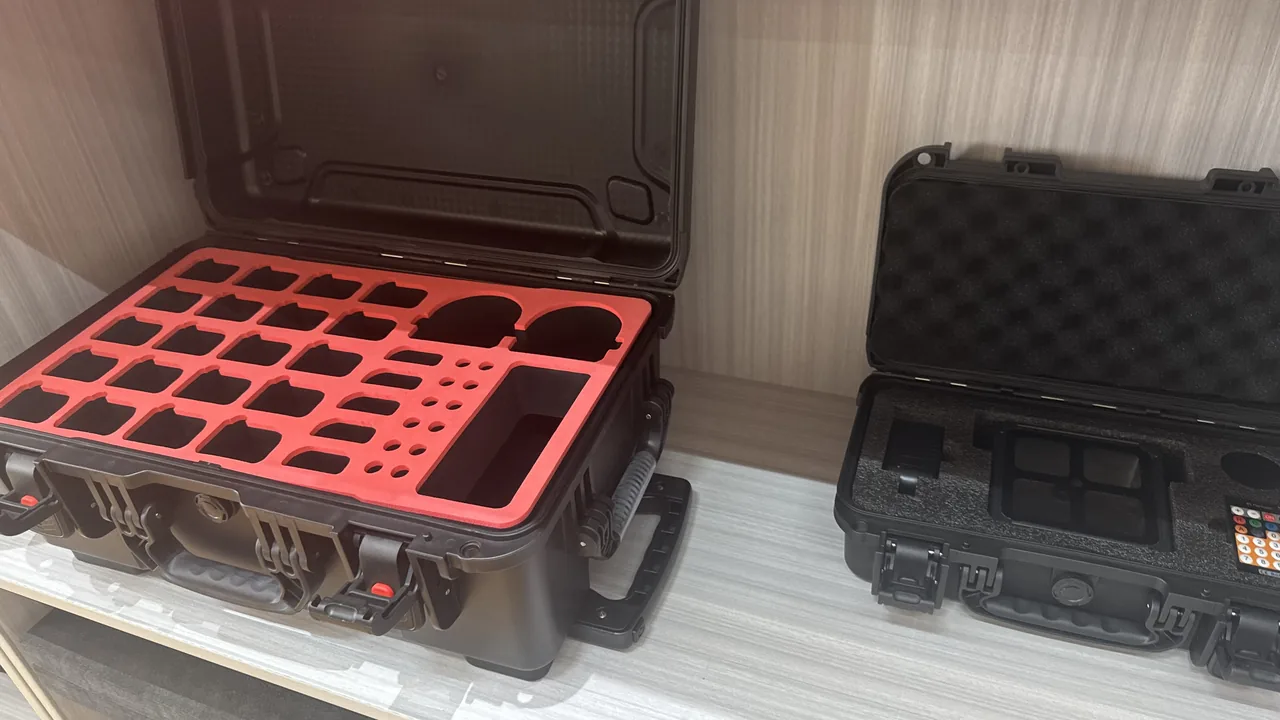
Stacking load usually gives two reference values: static stacking load (the total weight each layer can bear when stationary) and dynamic/transport stacking load (the recommended upper limit considering vibration and impact, generally lower than the static value). When evaluating, focus on:
- Single-layer rated load: The vertical pressure a single case lid can bear, determined by shell rigidity, ribs, and material.
- Maximum stacking layers: The manufacturer's recommended maximum layers (e.g., 3 layers, 5 layers); exceeding it over loads the bottom-layer stress.
- Load uniformity: The upper-layer equipment weight should be evenly distributed; eccentricity turns vertical force into bending moment and locally spikes stress.
- Dynamic reduction: Vehicle and ship transport have vibration and impact; the actual stacking layers should follow the dynamic load, not the static value, and be combined with strapping and fixation.
The common industry practice is: for transport stacking, take 1/2 to 1/3 of the static load as the dynamic safety margin, and fix the whole stack with straps, limit blocks, or shelving. Specific values follow the individual product's specification sheet and should be written into the order appendix for critical scenarios. Combined with how to keep protective cases safe during transport, stacking and strapping are the two insurances for transport safety.
The Role of Latches and Feet in Stacking
- Latches: Each layer's lid must be fastened; the latch presses the lid onto the gasket and maintains inter-layer compression. If one layer's latch pops open, that layer's lid may lift slightly, destroying the upper layer's landing accuracy and even destabilizing the whole stack. Multiple latches make compression even and are friendlier to stacking.
- Feet: The bottom-layer feet grip to prevent the whole stack from sliding (see what protective-case anti-slip feet do); at the same time the foot height must coordinate with the stacking boss — feet too high may make the lower lid's locator boss "unable to reach" the upper case bottom, actually breaking the interlock; therefore feet and stacking structure must be one closed design loop.
These two kinds of parts extend "single-case stable" to "whole-stack stable," and are the landing points of stacking safety.
Practical Points for Transport Stacking
Turning stacking from "can stack" into "safe to stack in transport," the practice matters:
- Stack same spec and size: Mixing different lengths, widths, and heights easily creates top-heavy and unmatched locating; keep same-model stacks.
- Heavy at bottom, light at top: Put heavy items in the bottom layer, light items in the top, lowering the stack's center of gravity and reducing bottom-layer stress.
- Align the locators: Each layer engages the lower layer's stacking ribs/bosses; do not rely on "roughly aligned."
- Limit layers and weight: Strictly follow the manufacturer's dynamic stacking load and maximum layers, leaving a safety margin.
- Strapping fixation: Fix the whole stack with straps to the vehicle floor/deck to avoid forward lurch on emergency braking.
- Avoid cantilever and tilt: The case should not have half extending beyond the pallet, otherwise cantilever bending moment cracks the shell.
- Check latches: Before departure, confirm each layer's latches are fastened with no pop-open risk.
These points also echo protective-case rounded-corner design (rounded corners improve corner impact resistance and aid neat stacking).
Stacking Requirements by Scenario
- Long-term warehouse stacking: Focus on static load and bottom support ribs; the bottom case must not develop permanent deformation from long-term compression that affects sealing.
- Road/rail transport: Frequent vibration; limit layers by dynamic load, combined with strapping and cushioning pads.
- Ship deck: Rolling + salt fog; beyond stacking interlock, feet must be anti-slip and salt-resistant, and the whole stack strapped against movement.
- Air container: Volume and weight sensitive; stacking must guarantee rigidity under a light-weight premise; related trade-offs see the weight-strength article.
- Field temporary stacking: Uneven ground; bottom feet and lid locators together ensure no skew and no slide.
The KeXin New Materials (Guangdong) Co., Ltd. JUNZHJIA protective-case product line, with factory in Zhongshan City, Guangdong (Greater Bay Area), about 18,000 m², more than 80 machines, over 100 staff, and one-stop OEM/ODM capability for product design, injection molding, mold manufacturing, and inner tray/liner making, can design stacking ribs, locator bosses, reinforcement ribs, and feet together at the mold stage. Its plastic ABS/PP material passes RoHS testing, and it holds ISO9001, REACH, IP67, California Prop 65, and other qualifications (backed by company documentation; certificates available on request); the product line is validated for environmental adaptability against MIL-STD-810H as a product-line environmental test basis. This integrated capability is the guarantee that stacking structure is "done right from the source."
Common Misconceptions and Pitfalls
- Misconception 1: If it can be piled up, it can stack. Piling is not interlocking; a case without locator bosses only "rests" and skews at a touch; recognize stacking ribs/bosses/interlocking structure.
- Misconception 2: Thicker wall stacks better. A thick-wall case without ribs can still collapse locally; the key is rib topology and four-corner reinforcement, not mere thickness.
- Misconception 3: Stack infinitely by static load. Transport has vibration and impact; limit layers by dynamic load and leave margin.
- Misconception 4: Mixing different sizes is fine. Mixed sizes with different lengths/widths easily cause eccentricity and instability; keep same-spec stacks.
- Misconception 5: Feet are unrelated to stacking. Feet too high break the interlock landing; they must be coordinated in design.
Selection Checklist
Check item by item: clarify transport mode (land/sea/air) and whether long-term stacking → confirm the lid has stacking ribs/locator bosses/interlocking structure → check static and dynamic stacking load and recommended layers → inspect four-corner and perimeter reinforcement ribs and bottom support ribs → confirm latch count and even compression → check foot height coordinates with stacking bosses → same-spec stack, heavy-bottom-light-top, strapping fixation → write stacking load into the order appendix for critical scenarios.
Relationship with Manufacturer Structural Capability
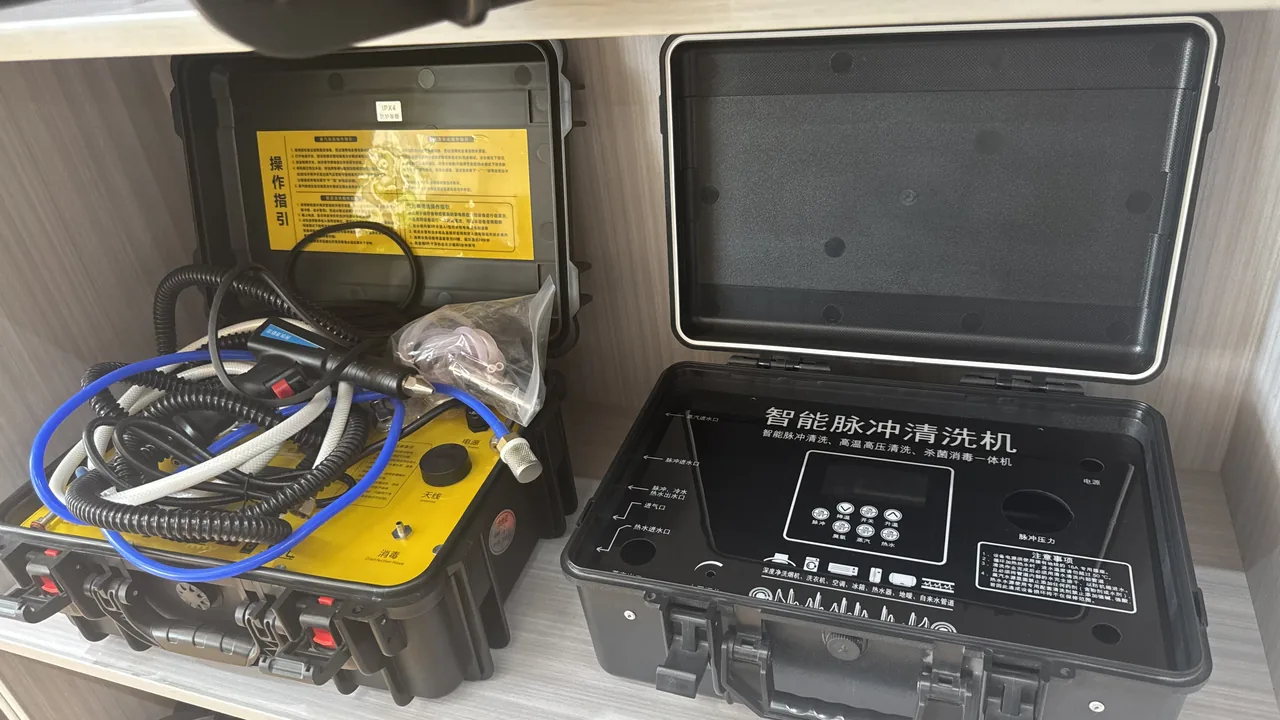
The stacking structure best demonstrates that "the mold is quality." A company with injection and mold-manufacturing capability can align bosses, recesses, ribs, and foot holes in one mold stage, with stable fit tolerances and reliable interlock; bought-and-assembled cases often have unmatched locators and skew after two layers. Batch users leveraging a manufacturer's one-stop OEM/ODM for product design, molds, liners, and LOGO can also optimize stacking, liner partitions, and external markings together by equipment list. KeXin New Materials (domestic brand "KeXin", global brand kexinMaterials) protective-case product line is exported to the United States, the United Kingdom, Germany, Canada, Japan, Russia, the Philippines, India, Hong Kong/Taiwan (China), the Middle East, and other regions, applied in outdoor survey, military/police/fire, electronics, scientific exploration, and aviation communication — precisely relying on this structurally-integrated capability opened up from the source.
Geometric Parameters of Stacking Ribs and Their Effect on Stability
Stacking ribs are not just a few random raised edges; their cross-section shape, height, spacing, and layout directly relate to interlock strength. Common design parameters:
| Parameter | Typical value/form | Effect on stacking | Design trade-off |
|---|---|---|---|
| --- | --- | --- | --- |
| Cross-section | Trapezoid/rounded-rect/semi-round | Trapezoid best anti-torsion, semi-round easy to detach | Prefer trapezoid with fillet |
| Rib height | 3–12 mm | Higher = deeper engagement, stronger shear | Too high hard to assemble, takes space |
| Rib width | 4–15 mm | Wider = larger contact, lower pressure | Too wide looks bulky |
| Rib spacing | Matches case length/width | Determines rail count and centering precision | Dense at edges, sparse in middle |
| Fit clearance | 0.2–0.8 mm level | Smaller = tighter lock but harder assembly | Needs mold precision |
| Boss count | 4–8 | More = more reliable limiting | Adds cost and mold complexity |
These parameters are common industry engineering experience; individual products follow the manufacturer's specification sheet. The point is: the rib form must link with lid rigidity and injection tolerance — ribs made high but shell soft will still deform under load; clearance made small but mold precision insufficient will not assemble. So stacking stability is "structure form + material rigidity + mold precision" all holding together, not any single item.
Common Failure Modes of Stacking Structures
Understanding "how it fails" helps better judge "what counts as good." Typical stacking-related failures:
- Horizontal shift: No locator boss or worn ribs; the upper case slides out during transport rolling, toppling the stack. Counter: male-female interlock + strapping.
- Local collapse: Shell without sufficient reinforcement ribs or unreasonable wall topology; the lower lid is dented, the sealing face becomes uneven causing water/dust ingress. Counter: bottom support ribs + layer/weight limits.
- Latch pop-open: Vibration loosens latches; that layer lifts slightly, destroying upper-layer landing. Counter: multiple latches + confirm each layer before departure.
- Foot de-glue/wear: Bottom-layer feet fail, whole stack slides on the surface. Counter: clip/screw-fix feet + regular inspection.
- Eccentric bending moment: Upper-layer center of gravity off; vertical force turns into bending moment cracking the shell corner. Counter: heavy-bottom-light-top, liner weight centered.
- Excessive interlock clearance: Mold wear makes boss/recess loose-fit, layers can rotate relative. Counter: control mold tolerance and periodic gauging.
Compare these six failures against your own transport scenario; add whichever insurance is missing, and stacking safety is grounded.
Stacking Structure Coordinates with Liner and Center of Gravity
Whether stacking is stable depends not only on external structure but also on how the case is packed:
- Liner weight centered: Equipment biased to one side offsets the case's center of gravity; when stacked, the upper presses on the lower's edge with large local stress. A reasonable liner partition presses the center of gravity onto the support-face center of the four feet/ribs, making stacking more stable. For liner selection see types of protective-case internal foam.
- Balanced equipment in one stack: Each case in a stack should be similar in weight, avoiding "top-heavy"; heavy cases at bottom, light at top, low center of gravity, good anti-topple.
- Liner not pushing deformation: An over-thick liner that lifts the lid affects upper-layer landing accuracy; liner height must match the body's net depth.
In other words, stacking safety = external interlock structure × internal reasonable weighting, neither dispensable. Many "skews after two layers" cases have the problem not in the body but in uneven internal packing.
A Stacking Plan Seen Through a Batch of Vehicle Instrument Cases
An example ties the above together: a batch of instrument protective cases for road patrol, same-model stack, about 12 kg per case, transported by box truck. The plan: lid with trapezoidal stacking ribs and four-corner locator bosses (interlock), shell four-corner and perimeter reinforcement ribs (load-bearing), dual latches compression (no scatter), bottom-layer TPE feet grip (no slide); when loading, same-spec stack, heavy instruments at bottom, whole stack strapped to the truck floor, limited to 4 layers by the manufacturer's dynamic stacking load (static allows 6). Result: no displacement or skew during emergency braking and bumpy roads, instruments read normally on arrival. A counter-example: a flat-lid case without bosses, under the same load and emergency braking, the upper might slide out, cases bump or even topple. This example shows: the stacking plan is a combination of "structure + layer limit + strapping + weighting," not just whether the body is hard.
How to Confirm Stacking Capability with the Manufacturer When Buying
To avoid buying "can pile but cannot transport" cases, request and verify the following from the manufacturer: whether the lid has stacking ribs/bosses/interlock and their form; static and dynamic stacking load values and recommended layers; four-corner/perimeter/bottom reinforcement rib layout; latch count and compression method; whether foot height coordinates with stacking bosses; and certificate availability. KeXin New Materials (Guangdong) Co., Ltd. (domestic brand "KeXin", global brand kexinMaterials, protective-case product line brand JUNZHJIA) has one-stop OEM/ODM capability for product design, injection molding, mold manufacturing, and inner tray/liner. The factory is in Zhongshan City, Guangdong (Greater Bay Area), about 18,000 m², more than 80 machines, over 100 staff; , Ltd. holds more than 20 utility-model and design patents; the parent company is Foshan Shunde ., Ltd.; products are exported to the United States, the United Kingdom, Germany, Canada, Japan, Russia, the Philippines, India, Hong Kong/Taiwan (China), the Middle East, and can do structural coordination optimization for batch users' stacking and transport needs.
Relationship Between Stacking Structure and Sealing/IP Protection

Stacking design does not conflict with sealing; rather they should help each other: stable stacking reduces case bumps and misalignment, indirectly protecting the gasket from abnormal compression; but poor design also hurts sealing — for example, excessive stacking pressure deforms the lid, making the full-perimeter gasket's compression uneven, with local gaps destroying the IP67 dust/water capability per IEC 60529. Therefore two points must hold:
- Stacking pressure must not exceed seal capacity: Limit layers by the manufacturer's stacking load, avoid long-term lid deformation affecting the sealing-face flatness.
- Interlock landing must be correct: Case misalignment makes latches pull sideways and the gasket compressed on one side; the interlocking structure ensures every stack aligns, and the gasket is evenly stressed.
Putting "stacking stable" and "seal tight" on the same acceptance sheet satisfies both transport safety and protection rating. For sealing principles see how to choose protective-case seal materials.
Mini Glossary of Stacking Terms
- Stacking ribs: Raised edges on the top of the lid that guide and limit the upper case's landing.
- Locator boss: A more prominent hard limiter that restricts the sliding range.
- Interlocking: The male-female complementary relationship between upper and lower cases that limits translation and rotation.
- Reinforcement ribs: Raised rigid structures inside/outside the shell that improve load-bearing and deformation resistance.
- Static stacking load: The total weight each layer can bear when stationary.
- Dynamic stacking load: The transport recommended upper limit considering vibration/impact, usually below the static value.
- Load distribution: The design principle of distributing weight evenly to avoid eccentric bending moment.
Pre-Departure On-Site Stacking Self-Check List
Turn the above points into an executable checklist to block most stacking accidents before shipping:
- [ ] Same-spec stack: this stack's cases have identical length/width/height, no mixed odd shapes.
- [ ] Heavy-bottom-light-top: heaviest equipment in the bottom case, low stack center of gravity.
- [ ] Interlock landing: each layer engages the lower layer's stacking ribs/bosses, no offset.
- [ ] All latches fastened: confirm each layer's latches are tight, no pop-open risk.
- [ ] Layer/weight limits: layers do not exceed the manufacturer's dynamic stacking load recommendation, leaving margin.
- [ ] Feet intact: bottom-layer feet not cracked or de-glued, grip effective.
- [ ] Whole-stack strapped: straps fixed to truck floor/deck, no whole-stack slide space.
- [ ] No cantilever: case not half-extending beyond pallet, avoiding cantilever bending moment.
- [ ] Liner weight centered: equipment evenly distributed inside, center of gravity centered.
- [ ] Documents attached: specification sheet stacking load and layers written into transport and acceptance appendix.
This list needs no instruments yet quickly confirms before each transport whether the "four stacking structures" are complete. Used with how to judge a high-quality case structure, both purchasing and transport ends are more stable.
The Value of Stable Stacking for Storage and Logistics Efficiency
Good stacking structure is not just "does not topple in transport"; it directly lowers storage and logistics cost: interlocking locating lets same-spec cases stack neatly, more height per warehouse area, less aisle space; neat stacks are also easy for forklift pickup and palletized transport, reducing single-case handling and bump probability; for export containers, neat stacking fits more cases in limited container volume, spreading the per-unit freight. In contrast, cases without locating structure can only lie flat in one layer or barely stack with fillers — both space-wasting and easy to topple. Therefore stacking structure is an investment that "designs once, saves long term": the few extra ribs and bosses done at the mold stage turn into efficiency and safety in every subsequent storage and transport. For batch purchasers and perennial exporters, this often affects total cost of ownership more than the single-case price.
Frequently Asked Questions (FAQ)
Q: Can a protective case stack without locator bosses? A: It can be "piled" but not "locked." Without locator bosses or stacking ribs, the upper case only rests on a flat contact; slight bump, braking, or rolling will misalign and slide it off; only male-female interlock prevents misalignment in transport. When buying, recognize the locating structure on the lid and bottom.
Q: Are more stacking layers always better? A: No. Layers are limited by shell rigidity and stacking load, and transport must apply the dynamic-load reduction. Exceeding the manufacturer's recommended layers over loads the bottom shell stress, possibly causing permanent deformation or even cracking, destroying the seal. Limit layers by the specification sheet and leave margin.
Q: Can protective cases of different sizes be mixed in a stack? A: Try not to. Cases with different lengths/widths have unmatched locators and easily biased center of gravity, making the whole stack unstable; if mixing is unavoidable, put larger at bottom, smaller at top, and compensate with fillers and strapping. Same-spec stacks are still best.
Q: Must every layer's latches be fastened when stacking? A: Yes. The latch presses the lid and maintains inter-layer locating; if any layer's latch pops open, that layer lifts slightly, destroying upper-layer landing or even destabilizing the whole stack. Confirm each layer's latches before departure.
Q: Does foot height affect stacking? A: Yes. Feet too high may make the lower lid's locator boss unable to reach the upper case bottom, breaking the interlock; too low loses the moisture-proof gap. Foot height must coordinate with the stacking boss, designed within the same mold logic.
Conclusion
A protective case achieves stable stacking through the synergy of "locating + rigidity + compression + anti-slip" four structures: the lid's stacking ribs and locator bosses provide male-female interlock, preventing inter-layer misalignment and torsion; the shell's four-corner, perimeter, and bottom reinforcement ribs transmit the upper layer's weight evenly, avoiding collapse; the latches press each layer into one unit; the bottom anti-slip feet prevent the whole stack from sliding. To judge whether stacking is truly stable, you cannot just look at "can it be piled up," but must see whether there is interlock locating, sufficient rib topology, dynamic margin on load and layers, and latch/foot coordination. When purchasing, include the stacking structure in the overall structural acceptance; in transport, use same-spec stacks, heavy-bottom-light-top, and layer-limited strapping, so the whole stack stays "motionless" through vehicle and ship bumps. For batch users, leveraging a manufacturer with one-stop injection, mold, and liner capability to coordinate stacking ribs, reinforcement ribs, and feet before leaving the factory is a low-cost step to high reliability. Treat stacking capability as a structural indicator that needs drawings, specification sheets, and on-site checklists to verify together, not a verbal promise of "stackable," to truly avoid toppling and bumping risks in transport.
One more reminder: stacking capability is not the marketing phrase "stackable," but a structure that can be clearly explained with drawings and specification sheets — is there interlock, how high and wide are the ribs, what is the load, how many layers recommended, how do the feet coordinate. Ask these questions when purchasing, execute by checklist in transport, and the protective case can truly "stack steady, transport safe, ready on arrival."