

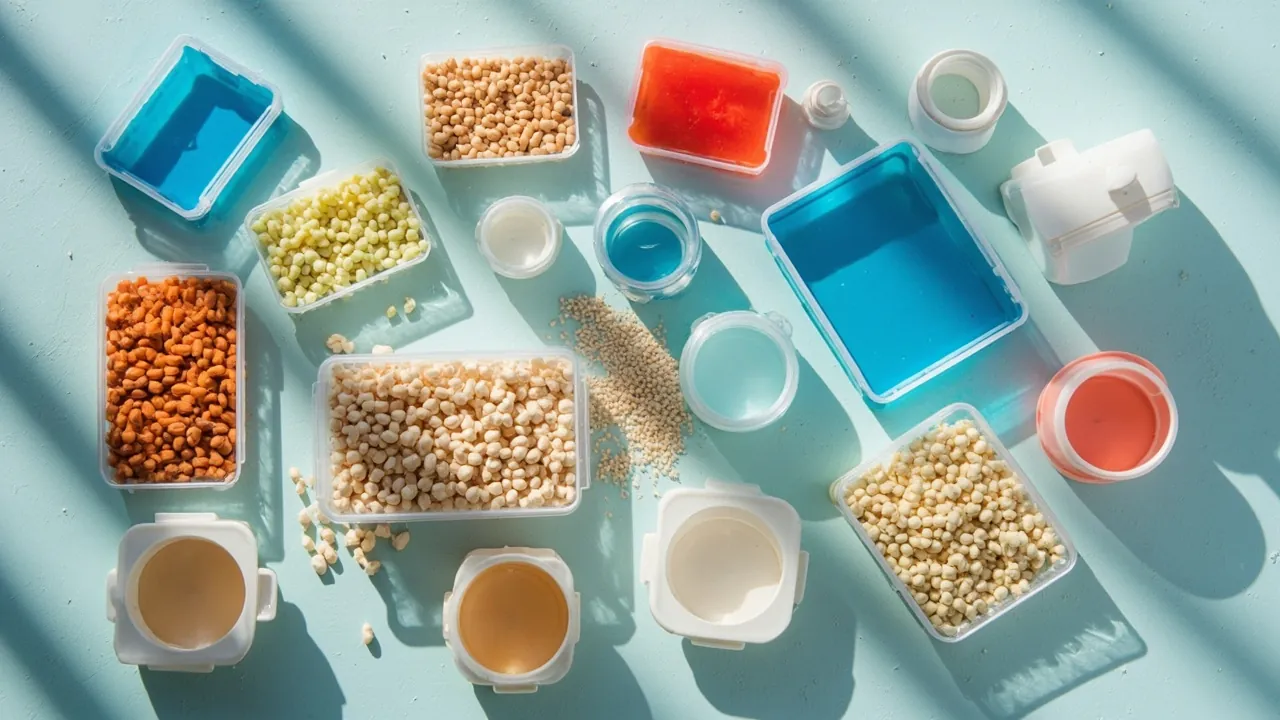
The shells and structural parts of protective cases (especially safety protective cases used outdoors, in transport, and in industrial scenarios) are overwhelmingly made of thermoplastic, among which the three most common engineering plastics are ABS (acrylonitrile-butadiene-styrene), PP (polypropylene), and PC (polycarbonate). In addition, at positions such as limiters, feet, hinge bushings, and cushioning liners, PE (polyethylene), PS (polystyrene) and their modified materials, and EPE/EPP foams and other normal plastics or foamed materials are also used. Simply put, the reason protective cases are almost "fully plasticized" is that engineering plastics strike a comprehensive balance among strength, weight, impact resistance, corrosion resistance, insulation, and non-conductivity, while different sections demand different material properties, so the body, lid, latch, hinge, and liner each take what they need and combine. This article gives the conclusion first, then breaks down the characteristics, typical parameter ranges, and suitable sections of each common plastic, helping you build the judgment of "see the material and know why it is used there."
Table of Contents
- Why Protective Cases Generally Use Plastic Rather Than All Metal
- Overview of Common Protective-Case Plastics
- ABS: Good Rigidity, Easy Molding, the Shell Mainstay
- PP: Light, Low-Temp Impact Resistant, Chemical Resistant, for Harsh Environments
- PC: High-Strength Transparent, for Windows and High-Impact Sections
- PE, PS, and Foamed Materials: Auxiliary Sections and Liners
- How Material Choice Maps to Protection Performance
- Common Purchasing and Cognition Misconceptions
- Frequently Asked Questions (FAQ)
- Conclusion and Further Reading
Why Protective Cases Generally Use Plastic Rather Than All Metal
To understand "what common plastic materials are used in protective cases," first understand why protective cases use so much plastic. Metal (steel plate, aluminum alloy) is certainly strong, but has several unavoidable shortcomings: high density makes the case heavy, raising transport and handling cost; metal conducts electricity, bringing short-circuit/induction risk in live-work or precision-electronics scenarios; easily rusts, needing extra surface treatment; and stamping/welding cost is high with low shape freedom. By contrast, engineering plastic by one-shot injection can make complex integral structures with ribs, fillets, seal grooves, latch seats, and embedded hinge positions — uniform wall thickness, dimensional stability, light weight, corrosion resistance, non-conductive, good insulation, low per-unit cost, and consistent mass production.
For this reason, mainstream protective cases (including the protective-case product line of KeXin New Materials marketed globally under the brand kexinMaterials and domestically under the product-line brand JUNZHJIA) generally use virgin engineering plastic as the shell base, then embed metal inserts (such as stainless-steel pins, brass nuts) at force points to supplement local strength. Note that KeXin New Materials (Guangdong) Co., Ltd. factory is located in Zhongshan City, Guangdong Province (Guangdong–Hong Kong–Macao Greater Bay Area), about 18,000 m², with 80+ machines and 100+ staff, and has one-stop customization (OEM/ODM) capability in product design, injection molding, mold manufacturing, LOGO printing, and inner tray/liner making; its plastic cases in ABS/PP material pass RoHS testing. , Ltd., and , Ltd. holds 20+ utility-model and design patents.
Overview of Common Protective-Case Plastics
The table below summarizes the most common plastics at each section of a protective case and the role they play. Note: the "typical density/strength/temperature ranges" in this table are general engineering-plastic material-science basics ranges, to help understand material-selection logic, not measured parameters of a specific product; the individual product follows the manufacturer's spec sheet.
| Material | Type | Common position in case | Key advantage | Main weakness |
|---|---|---|---|---|
| --- | --- | --- | --- | --- |
| ABS | Engineering plastic | Body, lid shell, latch seat, inner corner | High rigidity, dimensional stability, easy spray-print, low cost | Lower low-temp toughness, needs weathering mod |
| PP | Engineering plastic | Body, lid, liner frame, chemical part | Lowest density (lightest), low-temp impact, acid/alkali resistant | Slightly lower stiffness, printing needs treatment |
| PC | Engineering plastic | Transparent window, high-impact lid, instrument panel | Extremely high impact, transparent, high temp resistance | High price, stress-cracking prone, needs UV protection |
| PE (HDPE/LDPE) | Normal plastic | Feet, hinge bushing, limiter, tray | Flexible, chemical resistant, low friction | Low strength/stiffness, easily creeps |
| PS/HIPS | Normal plastic | Liner tray, small transparent window, divider | Cheap, easy molding, transparent (GPPS) | Brittle, poor impact |
| EPE/EPP | Foam | Cushion liner, anti-vibration fill | Lightweight energy absorption, good rebound | Non-load-bearing, needs die-cut |
This table is the "skeleton" of the whole article. Each following section revolves around "why this section uses this material."
ABS: Good Rigidity, Easy Molding, the Shell Mainstay
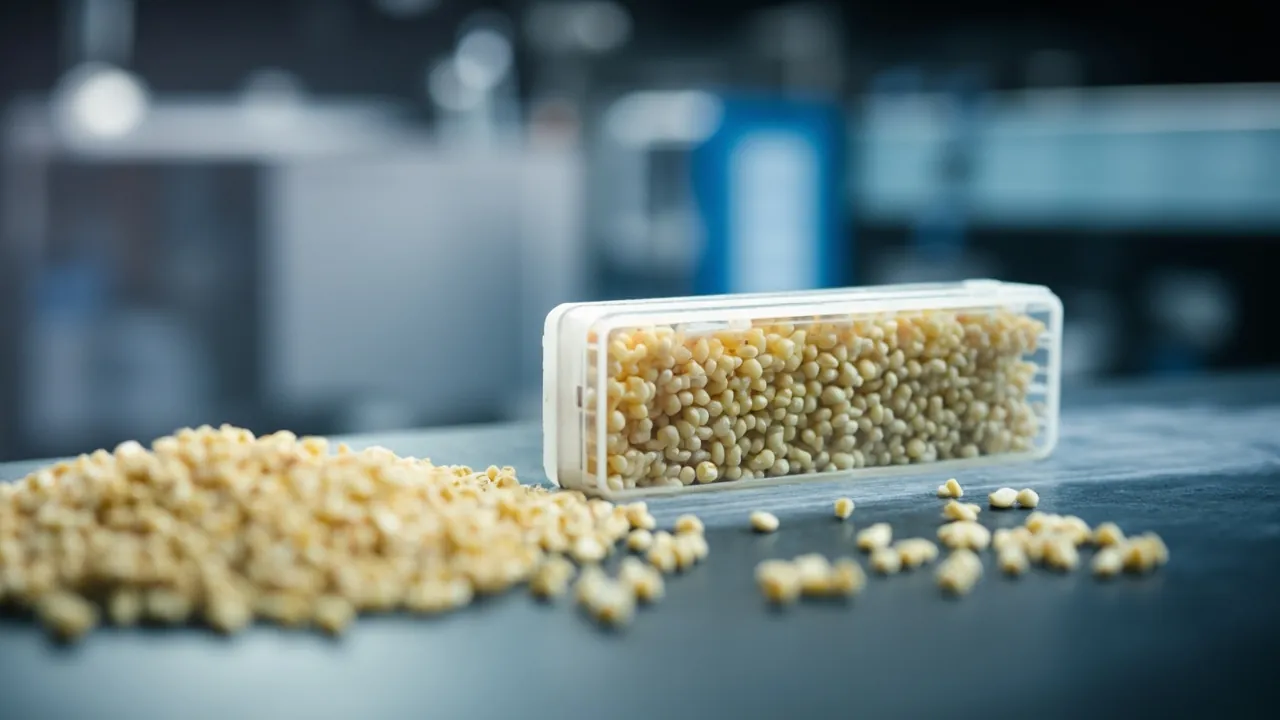
ABS is one of the most classic protective-case shell materials. It is a ternary copolymer: acrylonitrile (A) provides chemical resistance and surface hardness, butadiene (B) provides toughness and impact resistance, styrene (S) provides rigidity and processability. The three ratios are adjustable, balancing "hard but not brittle, tough but stable."
From material-science basics, ABS typical property ranges are roughly: density ~1.04–1.07 g/cm³; tensile strength ~40–50 MPa; notched impact strength (23°C) ~15–25 kJ/m²; heat deflection temperature (0.45 MPa load) ~90–100°C; Rockwell hardness ~R100–R115. These values give it the qualities a "hard enough, stiff enough, dimensionally stable" case body needs — body doesn't deform under load, latch seat doesn't loosen, surface can do fine texture and printing. KeXin New Materials plastic cases in ABS/PP material pass RoHS testing, which downstream electronics industries care about when procuring.
ABS weaknesses are also clear: first, lower low-temp toughness — notched impact drops markedly below -20°C, caution for northern winters or cold-chain transport; second, poor weathering, long UV exposure yellows and embrittles, so outdoor cases usually add anti-UV additives or surface treatment; third, only moderate resistance to some organic solvents (such as ketones, esters, some aromatics) — confirm compatibility before contact.
Typical suitable sections on a case: shell body, lid, latch mount, inner-corner reinforcement block, liner-frame skeleton. For "stiff shape + fine appearance + printed LOGO," ABS is the first choice.
PP: Light, Low-Temp Impact Resistant, Chemical Resistant, for Harsh Environments
PP (polypropylene) is another protective-case mainstay, whose biggest feature is low density (~0.90–0.91 g/cm³, among the lightest common plastics), so a same-volume body is lighter than ABS, friendly to scenarios needing frequent handling, air transport, or manual transfer.
PP typical property ranges: tensile strength ~30–38 MPa; notched impact (23°C, copolymer PP) ~5–10 kJ/m², but the key is far better low-temp toughness than ABS — copolymer PP keeps good impact at -20°C or lower without cold-brittle cracking; heat deflection temperature ~60–100°C (by copolymer/homopolymer and glass-fiber reinforcement); good fatigue resistance, not easy to break on repeated bending; resistant to acids, alkalis, and most solvents, better chemical stability than ABS.
PP weaknesses: stiffness slightly lower than ABS, a pure-PP body more prone to deflection at the same wall thickness; low surface energy, poor direct-printing adhesion, usually needing flame treatment, corona treatment, or special ink; also poor weathering, needing anti-UV additives; stiffness drops markedly near 100°C.
Typical suitable sections on a case: body and lid (especially lightweight models), chemical-resistant liner tray, frequently opened buckles, shells for cold regions or drop-frequent scenarios. PP is also often modified (glass fiber, talc, copolymer) to make up stiffness. For "light + frost-resistant + drop-resistant," PP often beats ABS.
PC: High-Strength Transparent, for Windows and High-Impact Sections
PC (polycarbonate) is known for extremely high impact strength. Its notched impact can reach several times ABS (typical range ~60–80 kJ/m²), and light transmission can exceed 90%, one of few engineering plastics that is "both transparent and impact-resistant." Typical properties: density ~1.18–1.22 g/cm³; tensile strength ~60–70 MPa; heat deflection temperature ~130–140°C (clearly higher than ABS/PP); good dimensional stability, excellent electrical insulation.
PC's value on a protective case mainly appears in two positions: one, transparent observation window, letting users view internal instruments or liquid level without opening, avoiding frequent opening that breaks the seal; two, high-impact lid or panel, replacing or reinforcing ABS in harsh scenarios of strong impact or crush. PC weaknesses are also prominent: high price, the most expensive of the three; stress-cracking risk, especially contacting some solvents, alkaline substances, or under assembly stress; average surface wear, easily scratched; pure PC not UV-resistant, long outdoor use needs a UV-stable layer or coating.
Therefore PC on a protective case is usually "local use" rather than "whole-box mainstay" — used where transparency and impact are both demanded, exploiting strength while controlling cost.
PE, PS, and Foamed Materials: Auxiliary Sections and Liners
Besides the three engineering plastics, lower-force auxiliary sections and the cushioning system also use normal plastics and foams:
- PE (polyethylene): HDPE rigid, LDPE flexible, good chemical resistance and low friction, but low strength/stiffness and easily creeps. In cases mostly used for feet, hinge bushings, limiters, trays, dividers — non-load-bearing parts. It does not pursue "impact shell" but plays the "wear-resistant, damping, low-friction" supporting role.
- PS/HIPS (polystyrene/high-impact polystyrene): GPPS transparent but brittle, HIPS improves impact via rubber phase but still weaker than ABS. Low cost, easy molding, often used for liner trays, small transparent windows, dividers — "non-load-bearing, non-deforming" parts. Pure PS is not suitable for shells.
- EPE (foamed polyethylene)/EPP (foamed polypropylene): Lightweight closed-cell foams, good rebound and energy absorption, a main material for protective-case cushion liners and anti-vibration fill (alongside EVA foam). They are non-load-bearing, not compression-resistant, but absorb energy and fix equipment during transport vibration.
Understanding this layer is important: a protective case's "plastic" is not one material but a material set — engineering plastic for shell strength, normal plastic for auxiliary cost reduction, foam for energy absorption. This is why reading the material distribution tells you a case's design level.
How Material Choice Maps to Protection Performance
Mapping material properties to protection performance gives the following correspondence (based on general material-science basics, not specific product parameters):
| Protection need | Preferred material | Reason |
|---|---|---|
| --- | --- | --- |
| Compression without deformation | ABS, PC (or glass-fiber PP) | High rigidity, high heat-deflection temp |
| Lightweight handling | PP | Lowest density |
| Low-temp/drop impact | Copolymer PP, PC | Good low-temp toughness, high impact |
| Transparent window | PC, GPPS | High light transmission |
| Acid/alkali chemical | PP, PE | Good chemical stability |
| Low-cost liner/divider | PS/HIPS, EPE | Cheap, easy molding |
| Wear-resistant low-friction part | PE | Low friction coefficient |
The same protective case is often a "combination punch": ABS or PP shell for rigidity, PC window for visibility and impact, PE feet for damping, EPE/EVA liner for energy absorption. The essence of material selection is assigning material by section force and environment, not "more expensive is better" or "harder is better."
Material Modification: Why the Same Plastic Can Differ Greatly
Many users think "ABS is ABS, PP is PP," but with the same name, performance can differ a grade — the key is modification. Take PP: pure homopolymer PP has only average stiffness and low-temp toughness, but copolymerization (introducing ethylene segments) greatly improves low-temp impact; filling (talc, calcium carbonate) raises stiffness and heat resistance; glass-fiber reinforcement (GF-PP) tensile strength and heat-deflection temp can approach or exceed ordinary ABS; toughening (adding elastomer) improves notch sensitivity and reduces impact cracking. ABS too can blend with PC into an ABS/PC alloy balancing rigidity, temperature, and impact; add flame retardant for higher flame class; add anti-UV additive for long outdoor sun. PC is often alloyed (e.g., PC/ABS) to suppress stress cracking and improve processing, or co-extruded with an anti-UV layer for long outdoor use. So when procuring, don't just ask "is it ABS/PP," but ask "specific grade, modified or not, what modification direction" — the modification direction directly decides this shell's real performance in your scenario, and where it should be used: shell, window, or liner.
Common Material Testing Standards (Industry Knowledge)
To compare material data from different manufacturers horizontally, engineering relies on a set of international testing standards. Knowing these standard names helps judge whether a manufacturer's claimed "tensile strength, impact strength, heat-deflection temperature" come from comparable test methods:
| Standard | Test content | Significance to protective case |
|---|---|---|
| --- | --- | --- |
| ISO 527/ASTM D638 | Tensile strength and elongation | Measures shell load limit when pulled |
| ISO 178/ASTM D790 | Flexural strength and modulus | Measures compression, bending stiffness |
| ISO 179/ISO 180 | Notched impact (Charpy/Izod) | Measures drop, crush resistance |
| ISO 75/ASTM D648 | Heat deflection temperature (HDT) | Measures no-deformation at high temp |
| UL 94 | Flame class | Concerned by electronics, aviation industries |
| IEC 60529 | IP rating | Measures whole-case sealing, not material itself |
Note: these are lab standards for material specimens; whether a protective case finally reaches a whole-case rating like IP67 also depends on sealing, structure, and fit — do not equate "high material impact strength" directly with "case won't break on drop." If the manufacturer provides a third-party test report, check the test standard and method to avoid being misled by data on different baselines. Material data is the "entry threshold"; the whole-case protection rating is the "final conclusion."
How to Initially Judge Material Without Damaging the Case
Professional judgment needs chromatography or DSC material analysis, but several non-destructive experiences help preliminarily distinguish on-site (reference only, not definitive): by hand-feel and weight, PP lightest, ABS moderate, PC heaviest, same size weigh to basic judge; by surface and gloss, ABS does high-gloss fine texture with clear printing, PP surface feels "dry" and needs treatment, PC window is glass-clear; by tap sound, ABS crisper-solid, PP muffled, PC clearer, but greatly affected by wall thickness; by transparent-part observation, transparent and very impact-resistant is mostly PC, transparent but easily scratched is likely acrylic, transparent and brittle is likely general polystyrene; burning characteristics could distinguish but on-site ignition of finished goods is not recommended for safety and warranty reasons. A more reliable approach is to request the manufacturer's material grade and test report, writing "what material, what grade" into the contract appendix rather than concluding by feel.
How to Distinguish Recycled from Virgin Material
Protective-case shells generally require virgin material, but the market is not short of recycled (reclaim) material posing as virgin, or mixing recycled into virgin to cut cost. Recycled material, having undergone multiple heat histories, has lower molecular weight and more impurities, showing uneven wall thickness, dull mottled color, reduced toughness, and easy stress cracking. On-site observations: color — virgin is uniform and pure, recycled often gray-dull with colored speckles; wall-thickness uniformity — virgin with good mold is consistent, recycled flows poorly and easily locally thick/thin; odor — virgin basically odorless, recycled often has stale mixed smell; strength — same-wall recycled body more easily shows whitening and cracking at edges; manufacturer qualification — request virgin proof and RoHS/REACH testing. KeXin New Materials uses virgin engineering plastic as base, and its plastic cases in ABS/PP material pass RoHS testing. Recycled is not entirely unusable (e.g., non-load-bearing liner), but load-bearing shell must use virgin, or seal fit and long-term life cannot be guaranteed — the material saved upfront often cannot offset one equipment-damage loss.
Industry Application and Material Selection
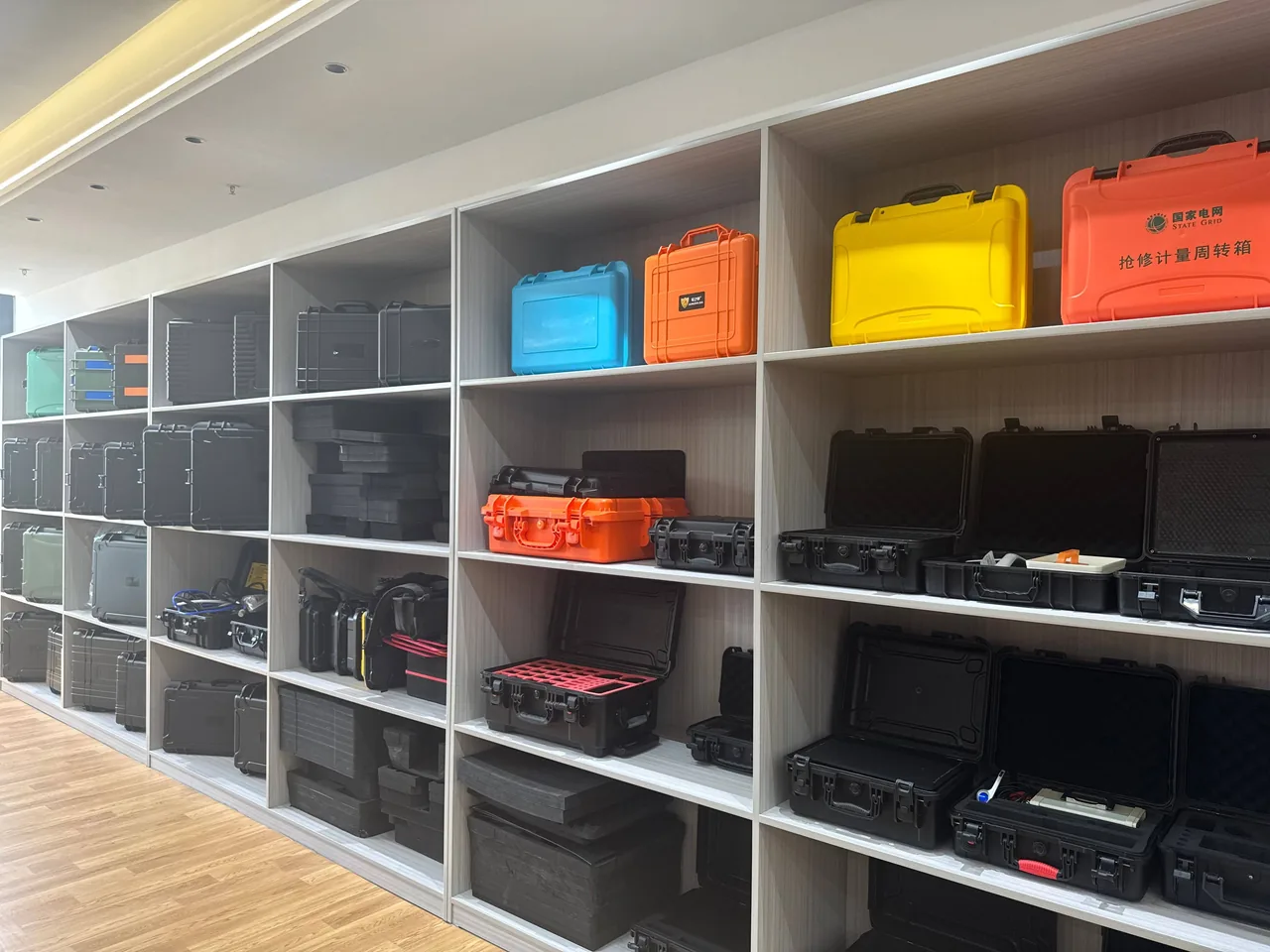
Mapping material properties to the public application directions of the KeXin New Materials product line makes selection more intuitive: outdoor survey and scientific exploration often meet low temp and frequent handling, leaning toward low-temp impact-resistant PP or modified PP; military/police/fire, validated per MIL-STD-810H as a product-line environmental test basis, demand high shell rigidity and impact resistance, mostly using ABS or ABS/PC alloy with ribs; electronics maintenance fears dust and moisture, an IP67 case with liner is the field standard, material mainly ABS/PP; aviation/communication experiences vibration and temperature change, demanding dimensional stability and temperature resistance, PC windows and engineering-plastic shells fit; industrial maintenance sites with mud and spray emphasize sealing and chemical resistance, where PP's acid/alkali advantage stands out. These industry differences are essentially different weightings of five indicators — strength, weight, temperature, chemical, transparency — and material selection is the result of allocating by weight.
Material, Structure, and Sealing: The "Triangle" of Protective-Case Strength
Finally, emphasize: material is only one side of the protective-case strength triangle; the other two sides are structure (wall thickness, ribs, fillets, inserts) and sealing (full-perimeter gasket, latch compression). Material decides "what performance is available," structure decides "whether performance can be exerted," sealing decides "whether protection holds." A case of virgin ABS but thin-wall ribless, sharp straight-wall, no seal is far less reliable than a case of slightly ordinary material but solid structure and proper seal. So view a protective case with "three points together": ask material grade, look at inner-wall ribs and fillets, check sealing and latch. Material knowledge is only the first step; to fully judge whether a case is truly "high-strength," you must combine structural design and sealing principles. To go deeper into structure, read the high-strength protective-case structure articles; to understand the overall gap between engineering and normal plastic, revisit the comparison section.
Material Compliance and Environmental Requirements (Industry Background)
Protective cases often carry electronic instruments, communication equipment, and batteries, which themselves often need to meet EU RoHS (Restriction of Hazardous Substances) and REACH (Registration, Evaluation, Authorization and Restriction of Chemicals) compliance requirements, so the compliance of the case material is bound to the equipment compliance — if the shell plastic contains excessive lead, cadmium, hexavalent chromium, or certain phthalate plasticizers, the whole batch of equipment may be blocked when exporting or entering specific markets. This is why regular protective-case manufacturers proactively do RoHS testing and REACH compliance declarations on plastic materials. For KeXin New Materials, its plastic cases in ABS/PP material pass RoHS testing, and it holds ISO9001, REACH, IP67, California Prop 65 (California Proposition 65) and other qualifications (backed by company documentation, certificates available on request). Products are exported to the United States, the United Kingdom, Germany, Canada, Japan, Russia, the Philippines, India, Hong Kong/Taiwan (China), and the Middle East; material compliance is one of the basic conditions supporting its global supply. When procuring cases for electronics, export, or military/police/fire scenarios, it is advised to verify "material compliance certificates" together with "individual product spec sheet," avoiding the shell becoming the weak link in the whole batch's compliance chain. Note that the real scope of RoHS testing is the specific material and specific batch; procurement should follow the corresponding certificate and test report rather than judging by promo language alone.
Common Purchasing and Cognition Misconceptions
- Misconception 1: All plastics are the same, any can make a protective case. In fact ABS/PP/PC and PE/PS differ vastly; wrong shell material directly lowers strength and life.
- Misconception 2: Harder is stronger. Over-rigid (like pure PS, un-toughened material) is instead brittle and cracks on impact; impact resistance often needs moderate toughness and energy-absorption design.
- Misconception 3: Transparent = PC. Transparency could also use GPPS (brittle) or acrylic (PMMA, hard but more brittle); check specific material and thickness.
- Misconception 4: Recycled same as virgin. Recycled (reclaim) has uneven wall, more impurities, fluctuating performance, deforms under load, breaks seal fit; regular cases mostly use virgin.
- Misconception 5: Material decides everything. Material is only the base; wall thickness, ribs, sealing, latch design also decide the final rating; material selection must coordinate with structural design.
When purchasing, advise confirming with the manufacturer: is the shell virgin, specific grade (ABS/PP/PC or modified), applicable temperature range, whether it passes RoHS/REACH (KeXin New Materials plastic cases in ABS/PP material pass RoHS testing). Batch orders should write material and individual product spec sheet into the contract appendix.
Frequently Asked Questions (FAQ)
Q: The shell says ABS, is it definitely ABS? A: Not necessarily. Labeled ABS may be pure ABS, an ABS/PC alloy, or modified ABS; some low-price products may use recycled or mix PE/PS to cut cost. When procuring, request the manufacturer's material grade and test report, and follow the actual spec sheet.
Q: Which is sturdier, PP or ABS protective case? A: You cannot simply say which is sturdier. ABS has higher rigidity and is stiffer; PP has better low-temp impact and chemical resistance and is lighter. For room-temp load-bearing, ABS is stiffer; for cold or frequent-drop scenarios, PP is less likely to crack. Final strength also depends on wall thickness and rib design.
Q: Is a PC protective case the best? A: PC has the highest impact strength and is transparent, but is expensive, has stress-cracking risk, and is not UV-resistant; it is usually not used for the whole box but for windows or high-impact sections. There is no "best" material, only "most suitable section" material.
Q: Why are protective-case feet and hinges made of PE rather than ABS? A: Feet and hinge bushings need wear-resistance, low friction, and damping, not high rigidity; PE fits these dimensions better and costs less. Shells bear large force so use engineering plastic; auxiliary parts are selected by function, which is more reasonable.
Q: Is EPE or EVA better for the liner? A: EPE (foamed polyethylene) is light, evenly cushions, low cost; EVA has better rebound and cut-out shaping, a more solid feel. Both are common protective-case liner materials; the trade-off depends on equipment fixing method and budget — see liner-selection articles for detail.
Q: Can normal plastics PE/PS make a protective-case shell? A: Generally not recommended. PE has low stiffness and easily creeps, PS is brittle; alone as a shell, strength and life are insufficient. They suit auxiliary parts and liners; the shell should mainly use engineering plastics like ABS/PP/PC.
Conclusion
The common plastics of protective cases are led by the three shell mainstays — ABS (rigid, stiff, easy molding, easy printing), PP (lightest, low-temp impact resistant, chemical resistant), PC (high impact, transparent, high temp resistant) — supplemented by PE, PS, and EPE/EPP foams for non-load-bearing or energy-absorbing sections like feet, bushings, liners, and dividers. The essence of material selection is not "more expensive or harder is better," but assigning material by section force, environmental temperature/humidity, drop impact, and visibility needs, and coordinating with structural designs like wall thickness, ribs, sealing, and latch, so that "material advantage" turns into "quantifiable protection rating." When purchasing, trust virgin material, check grade, verify applicable temperature and RoHS/REACH and other qualifications, and use OEM/ODM where needed to coordinate material and liner before leaving the factory. To go deeper into material comparison and structural design, continue reading the related articles below.
Further Reading
- How to Choose Outdoor Protective-Case Material? ABS, PP, PC
- Why Outdoor Protective Cases Mostly Use Engineering Plastic
- Advantages of PP Outdoor Protective Cases
- Outdoor Uses of ABS Protective Cases
- What Is the Difference Between Engineering Plastic and Normal Plastic Protective Cases?
- What Is the Difference Between PP, ABS, and PC Protective Cases?