


An injection-molded protective case is a hard case made by heating thermoplastic pellets such as polypropylene (PP) or acrylonitrile-butadiene-styrene (ABS) until molten, then injecting the melt under high pressure into a mold cavity, cooling and ejecting the finished part. Unlike rotomolded cases that rely on powder rotation or aluminum cases that rely on sheet-metal welding, the core advantage of an injection case is "the mold defines precision and volume amortizes cost": from one mold come thousands or millions of identical cases with highly consistent dimensions, a clean surface and a unit price that drops fast with volume. Thus injection cases are widely used for batch-issued and standard-turnover instruments, test gear, tools and consumer electronics. JUNZHJIA builds injection-molded cases from portable instrument boxes to medium transport cases. This article explains the key technology and fit of injection cases material, structure, dimensional precision, tooling and volume cost, sealing and protection, and selection so users make the right trade between precision, cost and protection.
What Is an Injection-Molded Protective Case
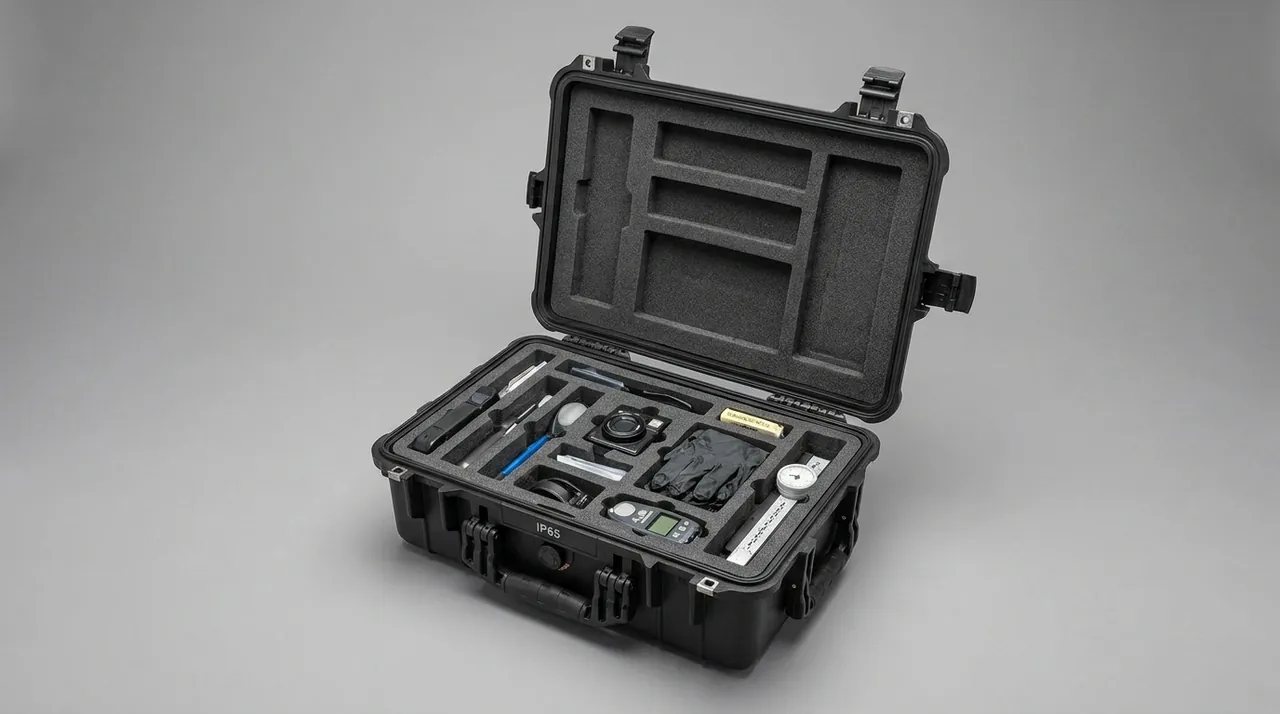
An injection-molded protective case consists of lid, body, gasket, latches and hinges; the body and lid are both molded parts, with interiors configurable with EVA, pearl cotton or vacuum-formed trays. The forming logic is "one mold sets the shape": the mold decides the outline, wall thickness, ribs and tolerance, the machine fills the cavity with melt, then packs and cools and ejects. So injection cases beat manual or semi-auto processes on individual consistency, suited to scenes with tight fit requirements.
Compared with rotomolded cases, injection cases have more uniform walls, smoother surfaces and tighter dimensions, but the single projected area is limited by the machine and mold, so very large cases need bigger equipment and higher tooling. Compared with aluminum cases, injection cases are light, cheap and non-shielding, but lower in load and temperature than metal. When selecting, first clarify "precision or drop resistance, large or cheap". For single-case protection basics, see the rotomolded case forming principles.
In the JUNZHJIA range, injection cases run alongside rotomolded, aluminum and foldable cases, targeting "standard volume, precise size, light and cheap". Users needing shielding choose aluminum, those needing collapsibility choose foldable. For general protective case knowledge, see the plastic protective box overview.
Selection should start from the scenario, not from shape or unit price. For PP/ABS , first define the size, weight, vibration sensitivity and environment of the payload, answer what is carried, where it is used, how it moves and what protection grade is needed, then decide material, structure and accessories. For injection molded casetooling costdimensional accuracymass production, a requirements list before comparing options avoids rework and a second purchase later. Many projects fail not because the product is poor but because the need was never clarified before ordering, so load, size or protection ends up wrong and the rework costs far more than a day or two of early study. Have the using department and procurement confirm the list together and write the key parameters into the specification.
Main Materials: PP vs ABS Properties
Injection cases commonly use PP, ABS, also PC/ABS alloy and modified PP. PP has good toughness, low-temperature resistance, low density and low cost, suited to most instrument and tool cases; ABS is rigid, hard-surfaced and easy to paint but brittle in cold and slightly costlier; PC/ABS combines both with high impact and good looks for demanding cases. The table gives typical ranges; follow the compounder's data sheet.
| Material | Density (g/cm³) | Notch impact (kJ/m²) | HDT (C) | Feature | Use |
|---|---|---|---|---|---|
| --- | --- | --- | --- | --- | --- |
| PP | 0.90–0.91 | 5–10 | 80–110 | Light, tough, cheap | General instr./tool |
| ABS | 1.04–1.06 | 10–20 | 90–105 | Hard, paintable | Cosmetic, display |
| PC/ABS | 1.12–1.18 | 25–45 | 110–130 | High impact | Demanding equip. |
| Mod. PP | 0.91–0.95 | 8–15 | 100–125 | Glass-filled | Vehicle, field |
Material choice follows condition: room-temp indoor PP is enough; hard cosmetic look chooses ABS; vehicle and field temperature swing chooses PC/ABS or modified PP. Recycled content ratio affects strength and appearance; military and cosmetic parts should cap regrind and write it into the technical agreement. For temperature and flame needs, pick the modified grade and ask for reports.
Material sets the performance ceiling. Frame and shell material directly drives load capacity, corrosion resistance and service life: steel is cheap and tough but rusts in damp areas, stainless steel resists corrosion and cleans well but is heavier and pricier, and aluminium profiles are light and reconfigurable but softer. Choose by environment and load, not by price, and use protective treatment or stainless hardware in salt-spray, cleanroom or medical settings. Material also affects total weight and pushing feel, so using steel for light loads wastes effort while using aluminium for heavy loads may deform. Weigh material, load and environment together rather than deciding on one dimension.
Five Stages of the Injection Process
Injection molding splits into clamp, inject, pack, cool, and eject. Clamping seals the cavity against injection pressure; injecting pushes melt to fill; packing compensates shrinkage and consolidates; cooling solidifies; ejecting opens and pushes out. Pressure, temperature, time and speed at each stage together decide size, sink marks and internal stress.
A narrow process window causes defects: short shot gives missing material, insufficient pack gives sink and undersize, uneven cool gives warp, high melt gives degradation yellowing. JUNZHJIA does mold-flow analysis (Moldflow) at the development stage to predict fill and warp, then tunes process so first pieces near target. For size-sensitive parts, agree first-article full measurement and batch sampling, avoiding "looks same, measures off". Related selection ties to the size and stack needs in the protective case selection standard.
Understanding process helps communicate acceptance: do not only ask "can you make it" but "what tolerance, how to inspect first piece, how to control batch". This avoids surprises at volume. The table below maps common defects to causes and countermeasures for on-site reference.
| Common Defect | Main Cause | Countermeasure |
|---|---|---|
| --- | --- | --- |
| Short shot (missing fill) | Low injection speed/pressure, low melt | Raise injection speed and melt, optimize gate |
| Sink and undersize | Insufficient pack, uneven wall | Raise pack, balance wall and gate |
| Warp | Uneven cooling, asymmetric ribs | Balanced cooling, symmetric ribs, mold-flow |
| Yellowing degradation | High melt, long residence | Control melt and residence, purge regularly |
| Ejector white and scuff | Low draft, poor ejection | Increase draft, optimize ejector and polish |
Calculate load with a safety margin. The rated load of PP/ABS should cover the fully loaded weight of tools or equipment with headroom, and mobile units usually rate at least 1.5 times the actual total. Place heavy items low and centred to lower the centre of gravity and prevent heavy pushing or tipping. Write the rated load and its test basis into the contract instead of judging by outer dimensions. Where thresholds, ramps or lifts are crossed often, add the dynamic shock load, a factor that is commonly ignored yet directly shortens castor and frame life.
Structure, Wall Thickness and Rib Design
Injection case rigidity comes from wall thickness, ribs and corner radius. Too thin warps and shorts; too thick sinks and slows cycle; common uniform wall 2–4 mm, local ribs at load not overall thicken. Ribs symmetric to avoid one-side warp; large corner radius lowers stress concentration and ejection white marks.
Lid and body mate by tongue and gasket, latches give compression. Because the mold sets the shape, tongue and ribs are fine, seal face flatter than rotomolded. Review: does the parting line avoid the watertight face, are ejector marks off the cosmetic and seal zones, do ribs show white. For large flats, add micro-crown or ribs against warp. Related damping ideas are in the seal and shock case.
Castors determine the moving experience and life. Castors are the life-critical part of a mobile unit: PU wheels are quiet and protect epoxy floors, rubber wheels damp vibration on uneven outdoor ground, and stainless or nylon wheels resist chemicals. Braked wheels allow positioning, and dual-brake wheels suit ramps and lifts. Rate castors above the total weight, replace worn wheels promptly and lubricate axles regularly. Wheel diameter also affects capability: small wheels are nimble but struggle over gaps, while large wheels cross gaps well but raise the centre of gravity, so choose by ground conditions rather than by appearance alone.
Dimensional Precision and Tolerance Control
Injection case precision comes from mold accuracy, material shrinkage and process stability. Thermoplastics have molding shrinkage (PP about 1.0%–2.5%, ABS about 0.4%–0.7%); the mold must scale the cavity by shrinkage; batch-to-batch and humidity also vary slightly. Ordinary key tolerance reaches ±0.3–0.8 mm, precise mating faces tighter.
Three things secure precision: quality steel and fine machined mold; first-article CMM full check and mold correction; batch process-window and material-batch control. For "multi-case stack alignment, liner interchange" projects, consistency matters more than one absolute value injection cases win on consistency. Acceptance: sample three to five for fit and stack test, not just one show piece.
On tolerance allocation, give the tightest tolerance to the critical mating faces (tongue, seal groove, latch mounts) and relax the non-mating cosmetic faces, lowering mold and process difficulty and controlling cost. For multi-case stacking projects, also control the parallelism of bottom and top and the fit clearance of the stacking locating feature, avoiding "wobble at the third layer". If the project involves automated feeding or robotic pick-and-place, separately agree the tolerance and repeat-positioning accuracy of the outer locating faces. All tolerance requirements should be marked on the drawing with datums and tolerance zones, with the gauge and sampling frequency defined, avoiding "verbal promise, no one inspects". JUNZHJIA can provide mold-flow analysis and a first-article CMM report at the development stage, moving size risk ahead of tooling so procurement has verifiable evidence before volume.
Divided storage speeds up access. Good zoning follows the rule of similar items on the same layer, frequently used items in the middle and heavy items at the bottom: small parts in compartment trays, long items in slots, rolling items restrained, and clear boxes for easy identification of consumables. For injection molded casetooling costdimensional accuracymass production, fixed zoning rules and adjustable dividers cut retrieval time and form the base of 5S and shadow management. Once zoning is set it should be fixed and labelled to avoid constant change that forces staff to re-adapt, and for multi-shift use a common zoning also lowers handover communication cost.
Sealing and Ingress Protection (mostly IP65)
Injection case dust and water resistance relies on the lid gasket and latch compression, commonly IP65; IP67 needs tighter seal-face flatness and even latch torque, raising cost. Per IEC 60529 (GB/T 4208), IP first digit is solids, second is liquid. Injection cases, with mold-set flat seal faces, easily reach IP65 steadily; immersion IP67 needs seal-structure and latch-torque review.
| IP code | First (solid) | Second (liquid) | Injection reach |
|---|---|---|---|
| --- | --- | --- | --- |
| IP54 | Dust (limited) | Splash all dir. | Basic seal |
| IP65 | Fully dust-tight | Low-pressure spray | Easy, flat seal |
| IP67 | Fully dust-tight | Immersion 1 m 30 min | Tight seal + latch |
Injection cases cannot shield like aluminum; for shielding use aluminum or a metal-bag liner. Deeper waterproof theory is in the protective case IP rating analysis. Vented interfaces still need device-level waterproofing.
Sealing is the most common specification behind an injection case, so it deserves a closer look. The gasket is usually EPDM or silicone closed-cell foam; silicone tolerates a wider temperature band and is preferred for wide-swing or cold scenarios, while EPDM is cost-effective for general indoor use. Compression should sit around 25-35 percent of the cross-section height — too little leaks, too much accelerates aging and raises opening force. The seal face must be flat and free of the parting line, ejector marks or weld lines left by gating. Latch count and spacing should follow case size: a long case with two latches may bow in the middle and leak, so three or four evenly spaced latches are often needed to keep compression uniform. For IP67, a double seal (two concentric gasket paths) or a tongue-and-groove seal greatly reduces the chance of a single leak path. A pressure equalization valve with a waterproof breathable membrane helps a sealed case open after temperature or altitude change while keeping the IP rating, and it must be cleaned so sand and dust do not block it. Finally, verify with an immersion or spray test on acceptance and record the result, because an IP grade is a verified property, not a marketing claim.
Shadow management is the most effective error-proofing. Cutting or outlining the contour of tools and equipment makes missing items obvious at a glance, which sharply cuts search time and reduces loss and mis-installation. The practical route is to photograph the outline, CNC-cut or blade-cut the liner, then place each tool in its slot. For multiple identical units, a common liner simplifies rotation and spares. Liner material matters too: EVA and pearl foam differ in resilience, oil resistance and cost, so high-frequency settings should use a material that resists compression and recovers well, otherwise it collapses over time and loses locating ability.
Impact and Stacking: Standards and Tests
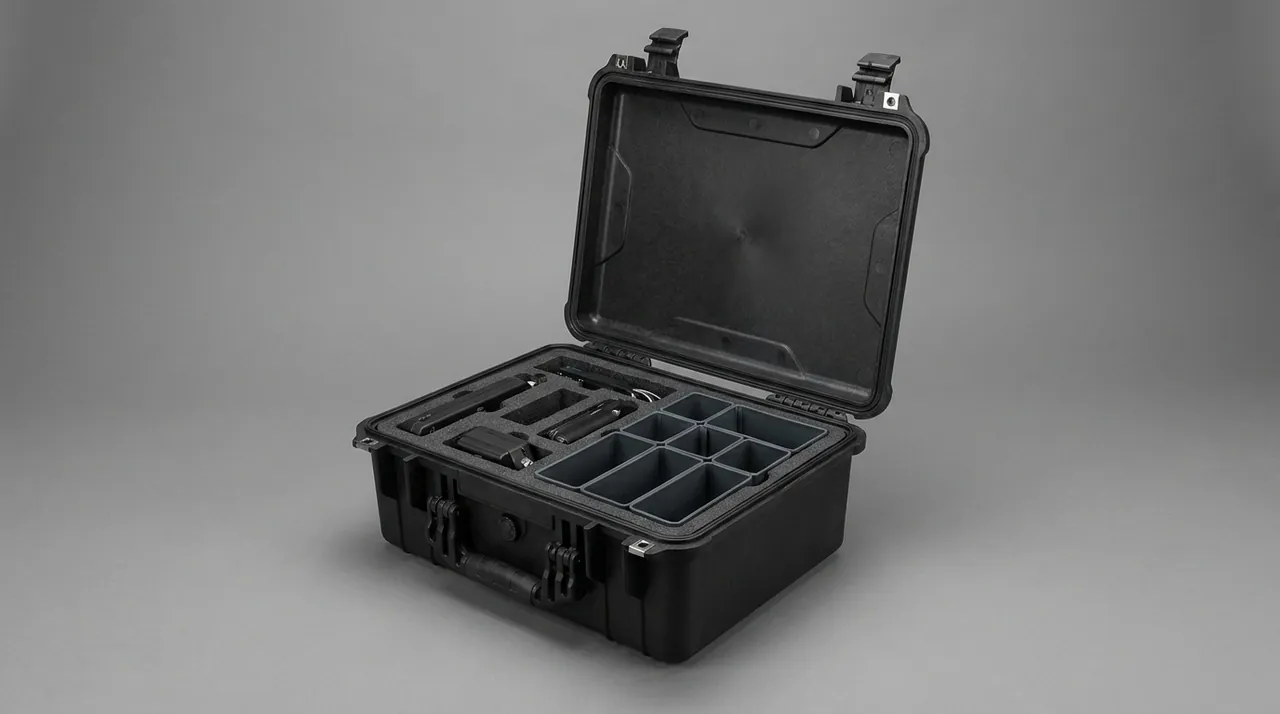
Injection case impact uses ball drop, free drop and stacking. Common bases are MIL-STD-810H drop and vibration procedures, ISTA 3E simulated transport, and in-house drop and stack tests. Drop uses corner, edge, face from 0.5–1.2 m several times then checks deformation; stack holds a uniform top load, but injection cases, wall-limited, stack fewer layers than aluminum or rotomolded.
For instrument-loaded cases, the liner decides acceleration on the device; combine with the buffer design of the precision instrument case to keep acceleration within tolerance. Acceptance checks both case deformation and device integrity. Note: injection cases fear long heavy press and sharp puncture; heavy stacking goes to aluminum or rotomolded.
Testing method matters as much as the claimed standard. A drop test should define the drop height, the drop orientation (corner, edge and face), the number of drops and the floor surface (concrete or steel), because a corner drop is far more severe than a face drop. For instrument-loaded cases, it is not enough to check that the case survives; the acceleration transmitted to the device should be measured with an accelerometer and compared against the device tolerance, which is where the liner design proves itself. Stacking should specify the top load, the layer count and the hold time, and record permanent deformation after unloading rather than only the peak displacement. A well-run verification often combines MIL-STD-810H drop and vibration procedures with ISTA 3E simulated transport and an in-house stack test, so the case is proven against the real logistics chain instead of a single bench check. Remember that an injection case is wall-limited: it performs well for light and medium loads but should not be pushed into heavy stacking, where rotomolded or aluminum cases are the right answer.
ESD depends on what is serviced. Electronics and semiconductor settings need anti-static measures: an anti-static work surface, conductive wheels and a grounding chain, with surface resistance usually held at 10^4 to 10^9 ohms to bleed charge while limiting current. Choose by the object being serviced: repairing boards requires it, general measurement can be simpler. Verify with a surface-resistance meter and check grounding continuity. Also watch the durability of anti-static materials, since some coatings fail as they are wiped and age, so re-test resistance on a fixed cycle and put that cycle into the maintenance plan to sustain protection.
Hardware: Latches, Hinges, Handles
Injection case hardware is mostly plastic inserts or small steel parts: press or butterfly latches, integral molded or metal-pin hinges, fold plastic or webbing handles. Since the body is plastic, hardware fixes by embedded inserts that must resist pull-out (knurl, undercut). In salt spray choose stainless inserts or anti-corrosion.
Casters and rods on injection cases must control load to avoid insert pull-out; heavy load should use aluminum. JUNZHJIA offers stronger mobility on the tool cart and cabinet and instrument cart and lab trolley. For labeling, injection surfaces suit screen print and stickers, easing asset management.
Hardware is where many injection cases fail in the field, so inserts deserve attention. Because the body is plastic, every threaded or load-bearing metal part is held by an embedded insert, and insert pull-out is the classic failure mode under repeated load or over-torque. Good practice uses knurled or undercut inserts, adds a boss with adequate wall thickness around the insert, and avoids placing inserts where the wall is thin or where a rib would create a weld line. Hinges can be integral molded living hinges for light lids or metal-pin hinges for heavy lids; a living hinge needs the right material (PP works well) and a design that avoids sharp notches so it does not crack after many cycles. Handles should spread load across a wide footprint and, for heavy cases, be a separate metal or reinforced part rather than a thin molded loop. Casters and telescopic rods multiply the load on inserts, so for heavy transport the right move is an aluminum case or a dedicated cart. In salt-spray environments, choose stainless inserts or anti-corrosion plating, and for asset management, the flat injection surface is ideal for screen print, laser marking or stickers.
Precision equipment demands vibration control. Precision instruments are sensitive to high-frequency vibration and shock, so damping comes from elastic castors, a damping mat on the work surface, shelf cushioning and strap restraint, with isolators added where needed. For vehicle or long-distance transport, apply two-stage protection plus foam restraint. Verify a smooth push and a no-spill emergency stop, and use a fixed bench rather than a cart for the most delicate devices. Separate floor-running vibration from transport shock, because the first is handled by elastic wheels and damping while the second needs cushioning and restraint, and one measure cannot simply cover both.
Liner and Cushion (EVA / Vacuum Tray)
Injection case liners use EVA, pearl cotton or vacuum-formed (thermoform) trays. Vacuum trays heat sheet sucked onto a mold, fit the case wall well with clear shadow, suited to batch-fixed devices; EVA CNC-mills to hold irregular parts; pearl cotton layers are cheap. Design: 10–20 mm buffer to wall, heavy low and centered, fragile separated, cables in own cell.
For multi-device cases use shadow management so deployment shows missing parts. JUNZHJIA customizes liners or see the cushion liner case for self-mod. Liners should be washable, long-term no mold no powder.
Match the protection grade to the environment. The protection level of PP/ABS should follow the exposure: indoor workshops mainly need swarf and spill resistance, while outdoor transit needs a higher grade. Dust protection comes from lips, seals and door panels, and moisture protection from surface treatment and off-ground storage. Put the target grade and its standard into the specification so claims can be proven at acceptance. Note that a higher grade usually means higher cost and more open-close effort, so chasing the highest rating wastes budget and hurts daily convenience; set the grade by the real exposure instead.

Tooling, Volume and Unit Cost
Injection case cost is "high tooling + low piece": a mold costs tens of thousands to hundreds of thousands, but per-case price drops from tens to teens of yuan with volume. So injection suits "high volume, fixed type, long issue"; small non-standard batches are cheaper by rotomold or sheet metal. Quote depends on mold complexity, cavity count (multi-cavity lowers unit), material and finishing.
Cost cuts: multi-cavity for efficiency; standard modules to cut new molds; shared fixtures and liners; controlled regrind to cut material. When pricing, see "who pays mold, who owns it, MOQ, step price" to avoid later mold-change shock. For export confirm restricted substances (RoHS, REACH). JUNZHJIA supports from prototype to volume, with matching hardware toolbox series and parts box series.
For cost breakdown, the total cost of an injection case is usually composed of tooling, per-piece material, processing (molding time and energy), finishing (screen print, assembly, liner) and logistics. The main battlefield for lowering unit price is per-piece material and processing: more cavities amortize per-piece cycle time, optimized wall and ribs cut material and shorten cycle, controlled regrind stabilizes cost but trades off strength. Tooling is a one-time investment that should be spread over expected total volume to see the true unit price, not just the first-order quote. In quotation negotiation, ask for itemized pricing (tooling, per piece, liner, packaging) to compare across suppliers and spot hidden cost; also agree mold maintenance, life (a common experience value above 100,000 shots) and wear-repair responsibility. For long-issue projects, agree a step price that declines with cumulative volume, writing the scale benefit into the contract so a one-off quote does not lose competitiveness after ramp-up. These clauses look trivial but turn "volume amortizes cost" from a slogan into an executable mechanism.
Power and cable routing affect site efficiency. Equipment carriers often need on-site power, typically via multi-socket outlets, cable ducts, pass-through holes and grounding. The routing rule is to separate high and low voltage, split long and short runs, and label clearly, with switched and overload-protected outlets. Check outlet polarity, grounding continuity and duct clearance at acceptance to avoid temporary cabling that harms safety and signals. Where devices are plugged and unplugged often, use locking outlets or magnetic retention to reduce contact faults caused by vibration, which matters especially in precision measurement.
Injection vs Rotomolded vs Aluminum
The three have boundaries; the table compares precision, cost, protection, load and custom to aid selection. Injection wins on precision and volume unit price; rotomolded on drop and size; aluminum on load and shielding.
| Dimension | Injection | Rotomolded (PE) | Aluminum |
|---|---|---|---|
| --- | --- | --- | --- |
| Dim. precision | High, consistent | Medium, wider | High (sheet) |
| Volume unit | Low (volume) | Medium | Medium-high |
| Ingress | IP65 common | IP67 easy | IP67 easy |
| Load/stack | Medium | Medium-high | High |
| EMI shield | None | None | Excellent |
| Custom/non-std | Mold-dependent | High mold cost | Flexible (sheet) |
| MOQ | High (amortize) | Low | Low |
In short: high-volume fixed chooses injection, drop and large chooses rotomolded, shielding and heavy choose aluminum. Details of rotomolded and aluminum are in the links above. Mixed practice is common: outer injection light, inner aluminum shielding.
Maintenance decides real service life. Daily care means clearing debris from slides and castors, wiping the work surface to prevent corrosion, clearing cable ducts and checking locks, and in ESD settings verifying that the grounding chain conducts. In salt-spray areas maintain stainless parts and touch up steel parts against rust. Keep a log of maintenance and replacement and fold the unit into asset management to extend life and cut total cost. Maintenance should not rely on personal experience but on an executable checklist with cycles, owners and pass criteria, so it does not lapse when staff change.
Typical Application Scenarios
Injection cases suit "same-type equipment batch issue, size must match": instrument factory standard cases, test gear turnover, tool and spare cases, consumer electronics and light medical devices, teaching training cases. For military users include in the military security case system; for medical combine with medical box series labeling; for industrial inspection pair with industrial detection case carrying calibration parts.
In volume delivery, injection cases, with strong consistency, ease multi-case stacking, liner interchange and asset management; for drone carriers see drone carry case dividers; for IT moves see IT carry case cable management.
Selection Parameter Checklist
Before procurement confirm: outer and inner dimensions (with liner); target material and regrind ratio; key tolerance; ingress rating (IP65/IP67); stack and drop needs; temperature range; liner form; latch and lock; MOQ, mold cost and ownership; certification (RoHS, REACH, if needed MIL-STD-810H, ISTA 3E). Hand the list to JUNZHJIA engineering for quick quote.
The list states acceptance: first-article full check plus batch sampling, sample several for stack-fit test. For military export, certification and material declaration matter more than unit price and go in the contract. Avoid "only one show piece"; control batch consistency.
Also state consistency clauses in the contract: key-dimension range within a batch, color difference if needed (compared by color card), weight variation range, and the handling and replenishment of non-conforming goods. For long-repeat projects, agree drawing-version freeze and change flow; any structure or material change needs written confirmation and re-validation of the first article, preventing "this batch differs from the last". For liners, if the device updates, assess the re-tooling cost of the vacuum mold or EVA die in step, avoiding runaway second investment. Putting these clauses up front significantly lowers post-volume disputes and gives procurement, engineering and supplier one shared ruler for "qualified".
Daily Maintenance and Care
Injection case care is simple: clear gasket and latch sand, check inserts loose, clear caster wire, dry liners against mold. Avoid long sun and heat sources that deform; heavy press and sharp poke leave dents, store flat. Loose inserts fix promptly; small cracks glue but load parts replace. Build ledger and periodic check recording drops and repairs, rotating at point. Maintenance in asset management extends life and lowers cost.
Injection cases are low-maintenance, but a simple routine extends life and keeps the IP rating intact. Clean sand and grit from the gasket and latch area regularly, because trapped grit prevents full compression and causes leaks; a wipe with mild soap and water is enough, avoiding solvents that attack the plastic. Check embedded inserts for looseness and tighten or replace them before they pull out; check casters for wound wire and debris. Let the liner dry before closing so it does not mold, and avoid long sun exposure or proximity to heat sources that soften and deform the shell. Store the case flat and avoid stacking sharp or very heavy objects on it, which leave dents. Small cracks can be glued for non-structural use, but any load-bearing part should be replaced. Keep a simple ledger of drops, repairs and re-inspection dates and rotate cases at the point of wear, so maintenance becomes part of asset management and lowers total cost.
Procurement and Cost Mistakes
Mistake one: molding for small batch volume cannot amortize tooling, use rotomold or sheet. Mistake two: comparing unit price only and ignoring mold ownership mold change can bind you. Mistake three: ignoring shrinkage causing size off need first-article full check and mold correction. Mistake four: stacking heavy loads in injection wall-limited, use aluminum or rotomolded. Mistake five: unclear regrind ratio affects strength and look, write into agreement. Mistake six: parting line on watertight face leaks, avoid. Including these in review lowers risk.
Frequently Asked Questions (FAQ)
Question: How to choose injection vs rotomolded? Answer: High volume fixed, size-consistent, unit-cost control chooses injection; drop-proof, large, small non-standard chooses rotomolded. Both reach IP65/IP67; injection leads on precision and volume unit price.
Question: Which is better, PP or ABS? Answer: General light chemical-resistant chooses PP; hard cosmetic and paint chooses ABS; vehicle-field temperature swing chooses PC/ABS or modified PP. By condition, not price.
Question: How precise can an injection case be? Answer: Key tolerance commonly ±0.3–0.8 mm, precise mating faces tighter; it wins on batch consistency, acceptance samples several for stack-fit test.
Question: Can an injection case reach IP67? Answer: Yes, but needs tighter seal-face flatness and even latch torque, costing more than IP65; pick by condition, not blindly high.
Question: Is custom injection worth it for small batch? Answer: Usually not, mainly because tooling cannot amortize. The cost structure of an injection case is "high tooling plus low per piece": a mold ranges from tens of thousands to hundreds of thousands, and only with sufficient volume does the per-case cost drop from tens to teens of currency units. If MOQ is only tens to hundreds, the tooling spread over each case becomes very expensive, making rotomold or sheet metal more flexible instead. Judge the break-even with a simple estimate: divide tooling by expected total volume, then see whether the amortized unit price beats the alternative process. Generally, once same-type demand reaches several thousand units and is a long-term stable issue, an injection mold becomes clearly worthwhile. For small non-standard trial, transition with rotomold, sheet metal or a generic standard case first, then invest in the injection mold after demand stabilizes and the drawing freezes. A "standard modular case plus custom liner" strategy also works, using a generic body to cut tooling and opening a new mold only for structures that truly cannot be standardized. Multi-cavity and shared liner fixtures further cut cost, turning cost pressure into structure optimization.
Question: Can an injection case shield electromagnetically? Answer: No. The body of an injection case is plastic (PP, ABS and the like), a non-conductive insulator with almost no shielding effect on electromagnetic waves, so it cannot form a Faraday cage the way an aluminum case does. If the device needs electromagnetic shielding (EMC) or electromagnetic-compatibility protection, there are two paths: first, switch to an aluminum case whose metal shell naturally offers shielding and heat conduction; second, add a metallized liner, conductive cloth or metal bag inside the injection case, achieving shielding through a conductive layer and grounding, but the seam conduction must be continuous and the shielding effectiveness measurable. Shielding effectiveness should be supported by third-party data (for example an experience-value attenuation of 30 MHz-1 GHz in dB) written into the delivery file, avoiding a "has shielding" claim without evidence. Beyond shielding, an injection case also lacks the high load and high temperature resistance of a metal case, so heavy-load and high-temperature scenes should likewise prefer aluminum or rotomolded cases. When selecting, first separate "shielding or light and cheap", then decide the process route, avoiding rework and second investment.
Question: Who pays the mold and who owns it? Answer: It depends on the contract, with two common models. In the first, the buyer funds the mold and owns it, giving autonomy over changes and transfer without being held by a supplier, suited to a long-term flagship product; the drawback is a large up-front investment. In the second, the supplier waives or shares the tooling in exchange for an agreed purchase quantity (MOQ) and step price, with ownership usually with the supplier, so the buyer must watch the clauses on change, supply stop and transfer. Either way, the contract should state clearly: tooling amount and payment milestones, mold ownership, MOQ, step price, change cost and lead time, mold care and maintenance responsibility, and how the mold is handed over on supply stop or transfer. Many disputes stem from "talking only price, not mold ownership", then being charged a high mold-change fee for one structural change. It is wise to write the case drawing version, material grade, key tolerance and inspection method into the technical agreement, freeze the drawing after first-article approval, and run any change through a written process with re-validation.
Question: Vacuum tray or EVA for the liner? Answer: It depends on device form and volume. A vacuum-formed tray is made by heating sheet and drawing it onto a mold, fitting the case wall well with a clear shadow, light weight and low volume unit price; it suits fixed-shape, batch-consistent devices such as same-model instruments and standardized tool sets, but changing the device layout needs a new vacuum mold. EVA foam can be CNC-milled into complex slots, hold irregular parts and cushion well, suiting high-value precision parts, irregular shapes or small multi-variety batches, at the cost of slightly higher weight and unit price. If only simple layering and separation are needed, pearl cotton (EPE) is cheapest but offers only basic cushioning and shadow management. Design points also include: 10-20 mm buffer to the wall, heavy items low and centered, fragile parts separated, cables in their own cells, and shadow management so deployment reveals missing parts. The liner should be removable and washable, not molding or powdering long-term; for anti-static scenes choose conductive EVA or foam. In practice, "vacuum tray for shape plus EVA local reinforcement" is common.
Question: Is an injection case good for extreme cold or heat? Answer: It depends on the material; overall the case is limited by the upper temperature bound of plastic. PP resists low temperature well, keeping some toughness in cold environments, and is the general cold-region first choice; but its heat-deflection temperature is about 80-110 C, so long high heat or sunlight softens and deforms it. ABS is cold-brittle and cracks easily in cold regions, though it looks good at room temperature, with HDT about 90-105 C. PC/ABS and modified PP resist temperature and impact better, with HDT about 110-130 C, suiting vehicle and field scenes with large temperature swings. If the condition involves high heat (sun-heated vehicle, near a heat source) or extreme cold (high latitude or altitude), state the working temperature range on the drawing, choose the matching grade and check the heat-deflection temperature (HDT) and low-temperature impact data, adding UV stabilizers for aging if needed. An injection case is not suited to long exposure near strong heat or open flame. Write the temperature band into the technical agreement and verify with high-low temperature cycling and drop, avoiding the hidden risk of "fine at room temperature, cracked in cold". In engineering, do not invent specific numbers; follow the material data sheet and actual condition tests.