

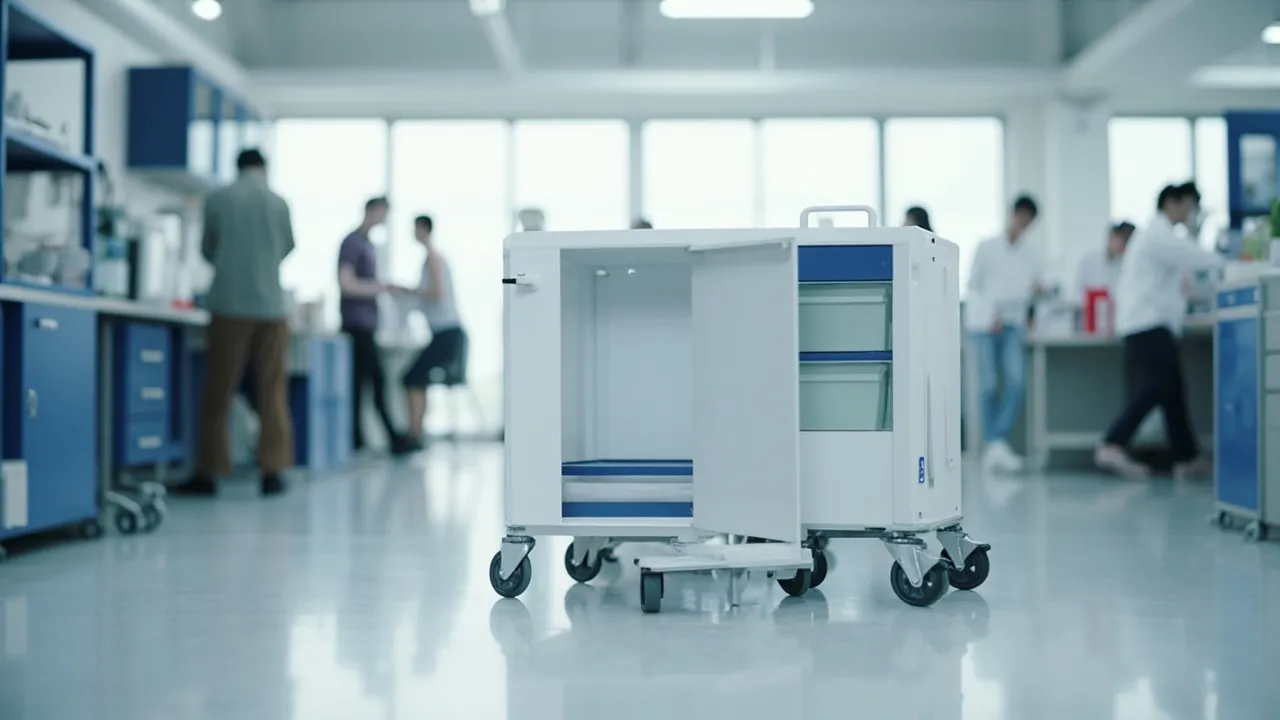
An instrument cart and lab trolley is a carrier that gathers test instruments, lab equipment and sampling devices onto a movable frame, letting precision gear move steadily between labs, shops and sites. Unlike a tool cart that stresses "tool storage and return", an instrument cart stresses "equipment steady, damped, powered and cabled": it uses a level top, damped casters, cable channels and optional power so oscilloscopes, spectrometers and calibration parts are not shaken, tangled or de-energized in move. JUNZHJIA builds instrument carts from light lab trolleys to heavy test carts. This article explains the key technology of instrument carts - structure, top, damping, leveling, power, ESD and selection - so labs, QC and field test move equipment safely and efficiently. The single most important conclusion: define the class first from three inputs - device weight, vibration sensitivity, and whether power and cable management are needed - and only then choose material, casters and damping. Reversing that order always ends in rework.
What Is an Instrument Cart and Lab Trolley
An instrument cart is a mobile instrument carrier; a lab trolley leans lighter for teaching and sampling. Typical parts are frame, top, shelves, damped casters, cable channel, handle and optional outlet. Core value: "equipment centralized, steady move, push and use": gather scattered instruments on a shop-grade mobile table, deploy measurement at the bench, collapse and go.
Versus a tool cart, an instrument cart weights "equipment safety": level top, damping, cabling, power are key; versus a protective case, a cart manages in-shop and site move, a case manages single-device transport. For single transport still use the rotomolded case forming principles or aluminum alloy case. In the JUNZHJIA range, instrument carts run alongside the tool cart and cabinet, serving equipment move and tool flow.
Selection first asks: what instrument, how heavy, vibration-shy or not, power and cable need. Then top, damping and casters. For general storage knowledge, see the plastic protective box overview.
By load and use, instrument carts fall into three classes: light lab trolleys (whole cart 50-100 kg, carrying teaching instruments and sampling items), medium test carts (100-250 kg, carrying portable testers, spectrometers and matching parts), and heavy instrument carts (250-400 kg and above, carrying rack-style test equipment and calibration benches). A mobile instrument cart and an equipment trolley are two names inside the same family: the first stresses instruments that follow the person, the second stresses devices moved as a batch; a medical trolley adds clean-room, disinfectant-resistant and quiet-running requirements on top, and is often used to move monitors, ultrasound units and lab analyzers. The point of the classes is that frame section, caster rating, damping grade and power configuration differ completely between them, so fixing the class before the configuration avoids both a light cart carrying heavy gear and a heavy cart that cannot be pushed.
One boundary is often missed: the split between cart and bench. Any application that demands an absolutely level and absolutely undisturbed surface - analytical balances, optical interferometry, precision metrology comparison - should use a fixed anti-vibration bench, not any kind of cart. The cart moves the device safely to the bench; the bench performs the measurement. Writing that boundary into the selection file prevents the later argument about drifting data measured on a cart.
Selection should start from the scenario, not from shape or unit price. For an instrument cart and lab trolley that carries mobile lab equipment and test instruments, first define the size, weight, vibration sensitivity and environment of the payload, answer what is carried, where it is used, how it moves and what protection grade is needed, then decide material, structure and accessories. A requirements list built before comparing options avoids rework and a second purchase later.
Structure and Top
An instrument cart is frame, top, shelves and cable system. Top holds host and sample, shelves hold accessories and consumables, cable channel gathers wires. Good structure keeps loaded top level, roll steady, cables off floor. Top is steel, ESD or lab corrosion-proof board, edge lips against roll-off; shelves adjust height to devices.
JUNZHJIA uses profile frames on medium-large carts with corner reinforcement and top damping pad. Review: top level, shelf load, cable smooth, handle handy. Top can carry positioning marks for consistent return. Related fix thinking is in the cushion liner case device hold.
Top dimensions must match the device envelope. A single instrument commonly uses a 600 x 450 mm or 750 x 500 mm top, while grouped testing often uses 900 x 600 mm and above. A working height of 750-900 mm suits standing operation and keeps the moving center of gravity reasonable. Set shelf spacing with a 50 mm clearance above the tallest accessory, keep heavy items on the lower shelf to lower the center of gravity, use a 15-30 mm edge lip that stops roll-off without blocking loading, and provide a cable channel at least 40 mm wide so two or three power and signal cables run side by side. Set handle height at 900-1000 mm for the operator and use a rubberized grip.
Top details decide daily experience. Turn up the front edge by 5-10 mm so screws, washers and calibration blocks cannot roll off; cut a 40-60 mm cable pass-through and fit a grommet so cables are not chafed by the hole edge; mount shelves on adjustable brackets rather than welding them, so the cart adapts when equipment is replaced. If devices need frequent re-cabling, hang a cable basket under the top to collect adapters and power supplies. A top is not better because it is thicker; it is better when rigidity is sufficient and damping is sensible. An over-thick steel plate raises the center of gravity and increases the risk of tipping.
Material sets the performance ceiling. Frame and shell material directly drives load capacity, corrosion resistance and service life: steel is cheap and tough but rusts in damp areas, stainless steel resists corrosion and cleans well but is heavier and pricier, and aluminium profiles are light and reconfigurable but softer. Choose by environment and load, not by price, and use protective treatment or stainless hardware in salt-spray, cleanroom or medical settings.
The table below adds a load-and-accessory view for quick selection:
| Tier | Typical rated load | Suggested material | Accessory set | Typical use |
|---|---|---|---|---|
| --- | --- | --- | --- | --- |
| Light | <= 60 kg | aluminium / steel | single surface + PU wheels | instruments & light tools |
| Medium | 60-150 kg | steel / stainless | multi-tier + central lock | workshop repair & assembly |
| Heavy | 150-400 kg | reinforced steel | dual-brake wheels + damping top | heavy inspection & lines |
Body Material and Load
Instrument cart bodies are aluminum profile, stainless or steel. Aluminum profile is light and reconfigurable for line-side and field; stainless resists corrosion for pharma and clean; steel is cheap and load-bearing for heavy test. Load follows frame section and caster rating, common whole cart 100-400 kg.
Material by environment and load: precise light chooses aluminum profile; wet-clean chooses stainless; heavy test chooses steel. JUNZHJIA matches frame and wheels to load, avoiding weak wheels hard to push. For shielding inner layer, device in aluminum case first, see aluminum alloy case material and shielding.
Calculate load in two steps, static then dynamic: take the static figure as the total weight of devices and accessories, then multiply by a 1.3-1.5 impact factor, because thresholds, elevators and potholes amplify the load instantly. When choosing casters, whole-cart rating equals single-wheel rating multiplied by the number of wheels and divided by a 1.5 safety margin. A four-wheel cart that must stay stable on three points is best fitted with two swivel and two fixed wheels, plus diagonal brakes for heavy loads.
Material must also align with cleanliness and corrosion requirements. For pharma, food and biology labs, choose 304 or 316 stainless with ground welds and no hygiene dead corners, able to tolerate alcohol and chlorine-based disinfectants. For coastal and chemical sites, choose 316 or an applied surface treatment. For ordinary workshops and teaching labs, aluminum profile or powder-coated steel is enough. On export orders JUNZHJIA can supply material declarations and common test documents so buyers can file them for compliance.
| Material | Advantage | Disadvantage | Use |
|---|---|---|---|
| --- | --- | --- | --- |
| Aluminum profile | Light, reconfig. | Soft, costly | Line-side change |
| Stainless | Corrosion-proof | Costly, heavy | Pharma clean |
| Steel | Cheap, load | Rusts if wet | Heavy test |
Calculate load with a safety margin. The rated load should cover the fully loaded weight of tools or equipment with headroom, and mobile units usually rate at least 1.5 times the actual total. Place heavy items low and centred to lower the centre of gravity and prevent heavy pushing or tipping. Write the rated load and its test basis into the contract instead of judging by outer dimensions.
Casters and Brakes
Instrument cart casters decide move and stop. PU wheels silent and floor-friendly for labs; rubber dampens for uneven; dual-brake wheels lock on ramps and elevators. Rating above 1.5x total weight. JUNZHJIA matches wheel to floor and load, heavy carts get big wheels to cut push force.
Caster choice by four: floor, load, brake, chemical. Lab epoxy chooses PU; outdoor chooses rubber; clean chooses conductive or stainless. Maintain by lubricating axles and clearing wire. Related mobility is in the tool cart and cabinet caster design.
Wheel diameter relates directly to push force: the larger the wheel, the easier it crosses joints and thresholds, so heavy carts should use wheels of 125 mm or more while ordinary carts use 75-100 mm. Brakes split into total-lock (wheel plus swivel) and edge-lock (wheel only); ramps and elevator doors always need total-lock. The swivel-to-fixed ratio affects tracking: two swivel at the front and two fixed at the rear is the most common layout, stable when rolling and flexible when turning. Four swivel wheels turn more freely but can drift at speed, so use them cautiously on heavy carts.
Castors determine the moving experience and life. Castors are the life-critical part of a mobile unit: PU wheels are quiet and protect epoxy floors, rubber wheels damp vibration on uneven outdoor ground, and stainless or nylon wheels resist chemicals. Braked wheels allow positioning, and dual-brake wheels suit ramps and lifts. Rate castors above the total weight, replace worn wheels promptly and lubricate axles regularly.
Daily care is simple: clear wound thread and hair, add a little grease to the axles, and check that the brake spring returns. The cost is minimal and the wheel life gain is large.
Damping and Vibration Isolation
The key of an instrument cart is damping: precision instruments (oscilloscope, spectrometer, balance) hate high-frequency vibration and shock. Damping comes from elastic casters, top damping pad, shelf buffer and straps, optionally air spring or rubber isolator. JUNZHJIA stresses two-stage damping on instrument carts: caster first, top second.
Design points: device in place with straps and foam limit, fragile in own cell, top damped pad; for vehicle long haul, use the isolation thinking of the seal and shock case as second protection. Accept by smooth roll and no spill or skip on hard stop. For ultra-precise (balance level) prefer fixed bench not cart.
In principle, isolation depends on the ratio between the system natural frequency and the excitation frequency: gain only appears when the natural frequency is clearly below the excitation frequency, so rubber isolators must be selected by device weight, not simply made softer. An overly soft isolator lets the device sway widely while rolling, which actually increases collision risk. A common engineering split is: casters handle travel, isolators handle high frequency, the top damping pad handles mid frequency, and straps plus foam handle low frequency with large displacement. Each layer does its own job.
If the cart will travel by vehicle, evaluate the whole cart using the logic of ISTA transport testing for vibration and drop simulation, and assess device fixing against the shock thinking of MIL-STD-810H method 516.8. JUNZHJIA can supply a structural description and a liner proposal for custom carts, including CNC-cut foam pockets shaped to the device, so the on-cart second layer of protection is just as solid as the first.
Divided storage speeds up access. Good zoning follows the rule of similar items on the same layer, frequently used items in the middle and heavy items at the bottom: small parts in compartment trays, long items in slots, rolling items restrained, and clear boxes for easy identification of consumables. Fixed zoning rules and adjustable dividers cut retrieval time and form the base of 5S and shadow management.
Leveling
Some instruments (optical bench, balance, some calibration parts) need a level top. Instrument carts fit adjustable feet or bubble level, level after stop then measure. JUNZHJIA fits adjustable feet on heavy carts, retract when moving, deploy and level when stopped.
Leveling points: read bubble first, then adjust diagonal feet, avoid one foot floating; load centered lowers overturn. For optics and metrology, let cart settle before measuring to exclude wheel bounce. Pick cart by bubble and adjustable feet as needed.
Leveling can be standardized into four steps. First, push the cart to the final measuring position and lock all brakes. Second, deploy the adjustable feet until they carry load without lifting the cart. Third, read the bubble or electronic level and adjust in diagonal order until the bubble centers. Fourth, wait one or two minutes and check again for slow drift before placing the sample. Adjustable feet usually travel 15-30 mm, enough to compensate common floor slope; if site level differences exceed 30 mm, use shim blocks rather than forcing the feet. For metrology-grade use, mark a level-before-measuring prompt on the cart so different shifts operate the same way.
Shadow management is the most effective error-proofing. Cutting or outlining the contour of tools and equipment makes missing items obvious at a glance, which sharply cuts search time and reduces loss and mis-installation. The practical route is to photograph the outline, CNC-cut or blade-cut the liner, then place each tool in its slot. For multiple identical units, a common liner simplifies rotation and spares.
Power and Cable Management
Instrument carts often need field power and signal. Config includes multi-outlet, cable manager, pass-through and ground. Cable channel gathers power and signal, off floor and untangled; outlet with switch and overload; ground chain drains static. JUNZHJIA optionally fits power module and cable bridge.
Cable rules: strong and weak separated, long and short split, labels clear. For IT moves, see the IT carry case cabling. Accept by outlet polarity, ground and channel smooth.
Power configuration must match total draw: sum the rated power of every device on the cart, then add 30 percent headroom before choosing outlets and conductor size. A common fit is six to eight outlets rated 10 A or 16 A with individual switches and overload protection, plus residual-current protection where needed. Use drag-chain or highly flexible cable that tolerates repeated bending, and label both ends with device name and destination so faults can be located at a glance. Good cable management halves the cost of acceptance and maintenance: a cart with smooth channels and clear labels is usually diagnosed in a fraction of the time taken by a tangle.
ESD depends on what is serviced. Electronics and semiconductor settings need anti-static measures: an anti-static work surface, conductive wheels and a grounding chain, with surface resistance usually held at 10^4 to 10^9 ohms to bleed charge while limiting current. Choose by the object being serviced: repairing boards requires it, general measurement can be simpler. Verify with a surface-resistance meter and check grounding continuity.
ESD Protection
Electronics and semiconductor test carts need ESD: ESD top, conductive wheels, ground chain, top resistance 10^4-10^9 ohm. JUNZHJIA offers ESD config with wrist interface and ground outlet. Accept by surface resistance meter on top and wheels, check ground continuity.
Selection by object: repairing boards needs ESD, ordinary measure can simplify. Related precision env. is in the precision instrument case ESD liner. Military users include in the military security case system.
An ESD scheme can be organized along the lines of IEC 61340 and ANSI/ESD S20.20: use an ESD laminate or conductive-layer top with surface resistance held at 10^4-10^9 ohm; use conductive or dissipative casters so the discharge path from cart to ground stays continuous; provide a wrist-strap interface at the operating position so operator and top are at equal potential; add an ionizer at critical stations to neutralize charge on insulators. Accept by measuring the top and casters with a surface resistance meter, then measuring continuity from the ground chain to earth, and keep the record. Ordinary measurement may need only an ESD top, so grade the investment by actual risk instead of buying the full package everywhere.
Precision equipment demands vibration control. Precision instruments are sensitive to high-frequency vibration and shock, so damping comes from elastic castors, a damping mat on the work surface, shelf cushioning and strap restraint, with isolators added where needed. For vehicle or long-distance transport, apply two-stage protection plus foam restraint. Verify a smooth push and a no-spill emergency stop, and use a fixed bench rather than a cart for the most delicate devices.
Protection and Dust Resistance
Instrument cart dust resistance by top lips, shelf rails and lockable doors. Clean env. uses easy-clean stainless; dusty env. doors block chips. Protection includes theft: valuable devices in locked shelf or case. For outdoor transfer, rain cover or box per the protective case IP rating analysis. Clear cable channel debris regularly.
Match the protection grade to the environment. The protection level should follow the exposure: indoor workshops mainly need swarf and spill resistance, while outdoor transit needs a higher grade. Dust protection comes from lips, seals and door panels, and moisture protection from surface treatment and off-ground storage. Put the target grade and its standard into the specification so claims can be proven at acceptance.
If a site requires spray or wash-down, evaluate the cart body against IEC 60529 and GB/T 4208 thinking, meaning the two digits of dust and water protection must be stated clearly rather than a vague claim of waterproof. An instrument cart body normally is not sealed to a high rating, because it needs ventilation and open access, so the more sensible approach is cart dust protection plus a case for the device: when not in use, the device goes into a protective case with the required IP rating and then is fixed to the cart. For impact, reference IK grades (IK08-IK10) to assess how exposed parts tolerate impact.
Typical Application Scenarios
Instrument carts suit "equipment must move steadily between sites": in-lab transfer, QC inspection, industrial test, medical test, semiconductor repair, field service. Common is valuable, vibration-shy, power-cabled equipment. For military and aviation, the cart is a line-test mobile station; for medical, a test and monitor cart (with medical box series).
In environmental and food safety, carts carry portable test gear field; in industrial detection case scenes, the cart is the mobile bench. For drone field work, see the drone carry case on-cart idea.
Finer segments include an in-line sampling cart in an electronics plant, needing ESD and quiet running; a clean-area sampling cart in a pharma plant, needing stainless and easy disinfection; a module test cart in a new-energy battery plant, needing load capacity and insulation; a field sampling cart at a third-party lab, needing folding and vehicle fixing; and a teaching lab trolley in a university, needing light weight and multi-level storage. Each scenario ranks damping, cleanliness, load and power differently, so first list the two rigid requirements of the scene, then decide which of the rest can be traded away.
Power and cable routing affect site efficiency. Equipment carriers often need on-site power, typically via multi-socket outlets, cable ducts, pass-through holes and grounding. The routing rule is to separate high and low voltage, split long and short runs, and label clearly, with switched and overload-protected outlets. Check outlet polarity, grounding continuity and duct clearance at acceptance to avoid temporary cabling that harms safety and signals.
Difference from Tool Carts and Working with Protective Cases
An instrument cart serves "equipment steady move and damping"; a tool cart serves "tool storage and return". Instrument carts stress top level, damping, power cable; tool carts stress drawer capacity, shadow, load. Select by load: valuable vibration-shy equipment chooses instrument cart, many mixed tools choose tool cart.
They combine: instrument cart with test gear, tool cart with disassemble tools, together field overhaul. For IT moves see the IT carry case damping and cable.
Maintenance decides real service life. Daily care means clearing debris from slides and castors, wiping the work surface to prevent corrosion, clearing cable ducts and checking locks, and in ESD settings verifying that the grounding chain conducts. In salt-spray areas maintain stainless parts and touch up steel parts against rust. Keep a log of maintenance and replacement and fold the unit into asset management to extend life and cut total cost.
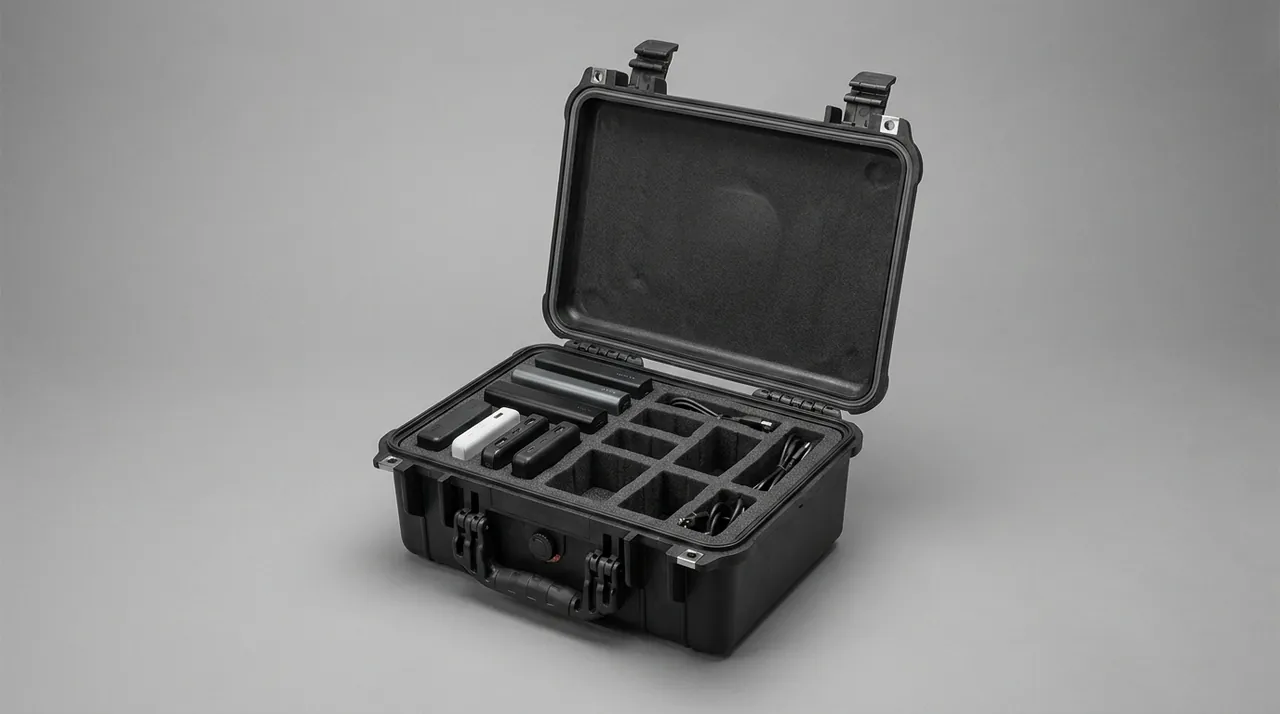
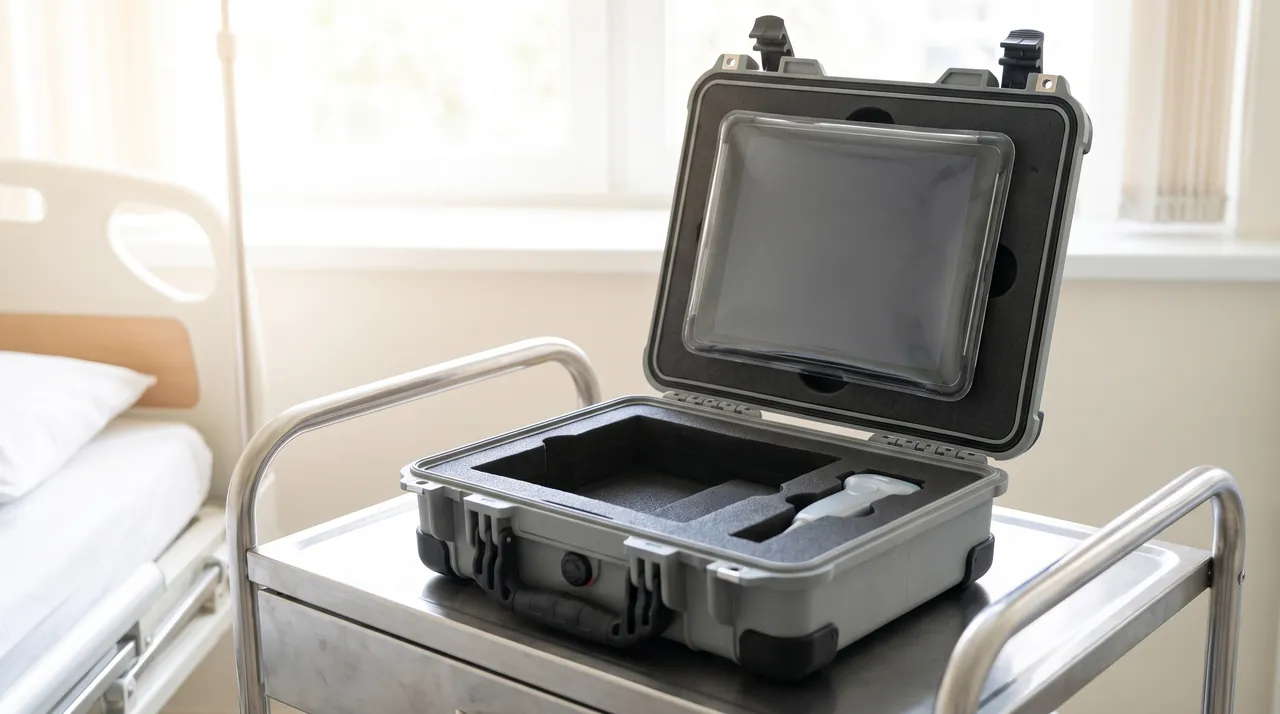
Instrument carts and cases complement: cart manages site move, case manages single transport. Common puts valuable instruments in a rotomolded case or aluminum case then fixes to cart, taking whole cart or single case out. JUNZHJIA supplies cart fixings to lock cases without sliding.
Fit is dimensional and damping-stacked: case bottom fits door layer or top, foam on cart for double protection; latch matches cart fixing point. This gives site convenience and transport protection.
The fit depends on dimensional mating and stacked damping: the case bottom enters a door layer or the top, foam on the cart adds a second layer of protection, and the latch aligns with the cart fixing point. This gives both site convenience and transport protection, and it is the most economical way to combine an instrument cart with protective cases.
Procurement and acceptance should focus on the essentials. Weigh the total load first to set frame and castor ratings, then choose material by environment, and finally configure storage, locks and accessories. The contract should state material, load, castor spec and brake type, ESD requirement and spare supply. Verify acceptance by a fully loaded push and an emergency stop, checking wobble, shifting and wheel wear rather than a single sample.
Selection and Procurement
Procurement in four steps: list devices and weight, set floor and damping need, pick material and casters, fit power cable and ESD. First weigh total for frame and wheel rating; then damping grade by vibration-shy; then material by env.; last outlet, cable and lock. Contract states: material, load, damping method, caster spec and brake, power params, ESD or not, spares.
Do not be led by "more features better"; land on load, damping and level. Accept by loaded roll, hard stop and level test, check sway, slide, wheel wear. Military export confirm material declaration.
Turn the procurement list into a checklist and tick each item: first, the load list (device name, unit weight, total weight, center-of-gravity height); second, the moving conditions (floor type, ramps and thresholds, whether the cart enters an elevator); third, the damping grade (isolators or not, vehicle transport or not); fourth, the electrical configuration (total power, outlet count, ESD and grounding or not); fifth, the delivery documents (material declaration, structural description, liner proposal, spare parts list). The more of these five items that are written down early, the less rework later. JUNZHJIA supports OEM and ODM, and can customize the main structure and liner pockets against a customer device list while supplying the technical documents needed for acceptance.
Assess whole-life cost, not unit price. The evaluation should count the whole-life cost including maintenance, spares, downtime and replacement. Products that are repairable, have replaceable parts and share standard components cost less over time. Putting spare availability and maintenance convenience into the tender is often more economical than pressing the unit price.
Use and Maintenance
Daily: clear caster wire and check brake, wipe top against corrosion, clear cable channel, check lock, ESD ground chain continuity. Salt spray: stainless shine, steel repaint. Check: top level, shelf firm, wheel wear, ground continuous.
Long storage: avoid light, off ground, feet retracted, drawers half-open against damp. Ledger records maintenance and wheel life, rotate at point. Maintenance in asset management extends life and lowers cost.
| Interval | Check item | Criterion |
|---|---|---|
| --- | --- | --- |
| Each shift | Brakes, top, straps | No looseness, no shifting parts |
| Weekly | Caster windings, cable channel | No blockage, cables smooth |
| Monthly | Wheel wear, bolt torque | No wheel flats, nothing loose |
| Quarterly | Ground continuity, leveling accuracy | Resistance passes, bubble centers |
| Yearly | Frame distortion, coating protection | No twist, no corrosion |
Keep OEM/ODM customization on standard parts. JUNZHJIA offers OEM/ODM services, customizing color, silkscreen and liners to brand standards and configuring whole units to an equipment list. Customization should stay close to standard parts for spares, while non-standard sizes and special functions are quoted to drawings. For volume projects, sample first, lock process and material, then release volume runs.
Sustainability and Customization
Instrument carts last long, repairable, liners and wheels interchangeable. Aluminum profile reconfigurable, steel stainless recyclable. JUNZHJIA keeps standard wheels, cable parts and liner spares, small repairs extend life. Custom includes non-standard size, power, ESD and level, but prefer standard parts for spares.
Procurement can require material declaration and restricted-substance list, important for export. Include cart in asset management with labels and lists, extend life and lower total cost. Standard beats non-standard for spares and expansion.
Across the full life cycle, a well-designed instrument cart usually serves eight to ten years or more, and the parts replaced during that time are mainly casters, liners and cable parts, while the body itself rarely needs replacement. So putting budget into body rigidity and standardization pays better than piling on one-time features. A good rule for customization is non-standard main structure with standard functional parts: build the body to the site dimensions, but choose common-spec casters, outlets, cable parts and foam liners, so spares remain easy to buy years later and the cart is not scrapped because one special part is discontinued.
Standards and certification are the basis for acceptance. Performance should rest on citable standards: protection grades map to GB/T 4208 and IEC 60529, shock to MIL-STD-810H and ISTA, flammability to UL94, and export projects to RoHS and REACH. Put the standard numbers and test methods into the contract so vendors cannot replace test reports with verbal promises.
Frequently Asked Questions (FAQ)
Question: Aluminum profile or steel for an instrument cart? Answer: Decide from the load and the environment, not the unit price. Precise light devices such as oscilloscopes, portable testers and teaching instruments choose aluminum profile, which is light, easy to add shelves to and easy to reconfigure later, so it pushes with less effort. Wet or corrosive environments such as wash areas, pharma plants and food labs choose 304 or 316 stainless, which resists corrosion, tolerates disinfection and has no hygiene dead corners. Heavy test equipment such as rack instruments and calibration benches chooses powder-coated steel, which costs less and carries heavy load with high rigidity. After choosing material, re-check the frame section and caster rating so the dynamic load, static load times 1.3-1.5, still sits inside the caster safety margin. JUNZHJIA matches frame and wheels to load, avoiding the common problem of weak wheels on a heavy cart.
Question: How does an instrument cart damp vibration? Answer: Use a tiered approach: casters provide first-stage elastic isolation, a damping pad on the top provides the second stage, devices are limited with straps and foam, and fragile parts get their own cells. If the cart travels by vehicle, add rubber isolators or air springs. The key is that isolator hardness must be selected by device weight; softer is not better, because an overly soft isolator increases sway while rolling. Accept the result by rolling a fully loaded cart and checking steadiness, then hard-stopping to confirm nothing shifts and no needle jumps. For extremely precise equipment such as analytical balances, use a fixed anti-vibration bench instead of a cart, and let the cart only deliver the device safely to the bench.
Question: Need a leveling function? Answer: Optical benches, analytical balances and some metrology calibration parts have explicit top-level requirements, so those scenes need a bubble level and adjustable feet, and the operator locks the brakes, levels the top and then measures. Ordinary electrical measurement, appearance inspection and sampling transfer can drop leveling to reduce cost and weight. When choosing a cart, first read the instrument manual for its installed-level requirement, then decide whether to configure the function. A cart with leveling should have the procedure written into the operating instructions and the bubble re-checked periodically, so data does not drift because different shifts operate differently.
Question: Does an instrument cart need ESD? Answer: Board repair, semiconductor testing and electronics assembly always need ESD: an ESD top with surface resistance of 10^4-10^9 ohm, conductive or dissipative casters, a ground chain, and a wrist-strap interface at the operating position to form a continuous discharge path. Ordinary electrical measurement and mechanical inspection can be simplified to an ESD top only. The scheme can follow the thinking of IEC 61340 and ANSI/ESD S20.20. Accept by measuring top and caster resistance with a surface resistance meter and measuring continuity from the ground chain to earth, keeping the record for audit traceability.
Question: Can it load protective cases for off-site work? Answer: Yes, and it is recommended. Place valuable instruments in a rotomolded case or aluminum case with the required IP rating and damping liner, then fix the whole case to the instrument cart, so short moves roll the whole cart and long moves take a single case. The keys are dimensional mating and stacked damping: the case bottom must fit a door layer or the top with limits, foam on the cart adds a second layer, and latches or fixings must align with cart fixing points. This keeps site convenience while gaining transport protection, and it is the most economical way to combine an instrument cart with protective cases.
Question: Hard to push the casters? Answer: Check four causes first: one, the caster rating is below the total cart weight including the dynamic factor; two, the wheel face is worn or deformed; three, the frame or wheel bracket is distorted so wheels no longer share one plane; four, the floor is too soft or too rough. The matching actions are to fit larger or higher-rated wheels, replace worn wheels, straighten or reinforce the frame, and use floor protection mats where needed. Heavy carts are best fitted with wheels of 125 mm or more and a two-swivel plus two-fixed layout, which clearly lowers push force. Centering the load and lowering the center of gravity also improve the pushing feel.
Question: How to arrange power and cable? Answer: First sum the rated power of every device on the cart and add 30 percent headroom, then set outlet count and conductor size, commonly six to eight outlets rated 10 A or 16 A with individual switches and overload protection, plus residual-current protection where needed. Separate strong and weak current into different channels, split long and short runs, and label both cable ends with device and destination. Outlets need reliable grounding, and ESD areas add a ground chain. The cabling requirements of an IT carry case are a useful reference. At acceptance, check outlet polarity, ground continuity and channel smoothness; in daily use, simply clear debris from the channels.
Question: How long for a custom instrument cart? Answer: It depends on the depth of customization. A dimensional combination of standard frame, standard wheels and standard cable parts has a short lead time and low minimum order. Non-standard power modules, non-standard leveling structures or CNC-cut liner pockets need drawing confirmation first and usually run to a matter of weeks. The advice is to start with the standard configuration that meets the current need, then extend functional parts later, so spares stay available and scaling is fast. JUNZHJIA supports OEM and ODM and can help optimize structure and liner during the drawing stage.
Question: How to extend instrument cart life? Answer: Follow a tiered maintenance ledger: each shift check brakes, top and straps; weekly clear caster windings and the cable channel; monthly check wheel wear and bolt torque; quarterly measure ground continuity and leveling accuracy; yearly check frame distortion and coating protection. In salt-spray environments, maintain stainless parts and repaint steel parts on schedule. Liners and casters are common parts, so small repairs and replacements extend life. For long storage, keep the cart away from light and off the ground, retract the feet and leave drawers half-open. Registering the cart as a fixed asset and recording maintenance and rotation clearly extends life and lowers total cost of ownership.
Conclusion and Related Reading
The essence of an instrument cart and lab trolley is treating the movement of precision equipment as an engineering task: first define the class from weight, vibration sensitivity and power or cable needs, then choose material and casters, configure damping and leveling, organize power and ESD, and finally use tiered maintenance to stretch the service life. Get the order right and the cart becomes the most worry-free mobile workbench in the lab; get it wrong and no amount of stacked features will prevent drifting data and damaged equipment. For a main structure and liner customized to a device list, plan the cart together with the JUNZHJIA protective case and tool cart lines.
Related reading