


An aluminum alloy protective case is a rigid transport and storage enclosure built from aviation-grade aluminum sheet, engineered to protect sensitive instruments, test equipment, communication modules and military payloads from shock, vibration, dust, moisture and electromagnetic interference. Unlike plastic boxes that rely on a single molded wall, a well-made aluminum case uses a framed panel structure with reinforced edges, so it stays square under stacked loads and resists the fatigue cracks that eventually appear in polymer housings. This article explains the materials, weight trade-offs and shielding principles behind professional aluminum cases, and it compares them with rotomolded and injection-molded alternatives so engineers and procurement specialists can specify the right enclosure for the job.
What Is an Aluminum Alloy Protective Case
At its core, an aluminum alloy protective case is a box whose walls and lid are formed from aluminum sheet, usually between 1.0 mm and 2.5 mm thick depending on size, with an extruded or welded frame that carries the load. The panel is the cosmetic and protective skin; the frame is what keeps the box from racking when it is dropped or stacked five high on a pallet. JUNZHJIA builds case panels from 5052 and 6061 sheet, then ties them to corner castings and edge rails so the corners absorb impact instead of the flat faces. The result is a container that survives field handling yet stays light enough to carry by hand.
The defining difference from a plastic case is structural predictability. Aluminum has a well-documented modulus of elasticity and yield strength, so a designer can calculate how much a panel will deflect under a given load and choose a thickness with confidence. Polymers vary more with temperature and age, and their flexural modulus drops sharply in heat. For instrument cases that must hold calibration or stay sealed at altitude, that predictability matters more than the lower sticker price of a plastic box.
A typical aluminum case also integrates features that plastic molding struggles to match: a continuous tongue-and-groove lid seal, through-bolted handles rated for the full case weight, and a conductive path from lid to base that supports electromagnetic shielding. When the application calls for EMI shielding, the entire enclosure becomes a Faraday cage rather than a painted shell with a hoped-for gap. That is why avionics, radar frontend and medical imaging modules are almost always shipped in metal rather than plastic.
Why Choose Aluminum Over Plastic and Rotomolded Cases
Procurement teams often start with cost, but the lifetime cost of a case is dominated by what it protects. A plastic case that fails once and lets water reach a sonar front end can destroy a budget many times the price of the box. Aluminum cases cost more up front, yet they survive repeated deployments, can be repaired by re-riveting a panel, and hold resale value because the alloy itself is reusable. For equipment that ships across continents or sits in unconditioned storage, the metal case is usually the cheaper option per protected unit-year.
Thermal behavior is the second reason. Aluminum conducts heat, so a case with internal heat sources can shed warmth through its walls or through bonded heat spreaders, whereas a plastic box insulates the electronics and forces active cooling. In desert or enclosed-rack conditions, that conduction keeps components inside their rated temperature band without fans. The same conduction helps in cold environments, where a metal case reaches ambient quickly instead of trapping condensation against a cold inner skin.
The third reason is shielding. Plastics are transparent to radio frequency energy, so a plastic enclosure needs a conductive coating, a metal liner or a sprayed layer to block EMI, and every seam in that coating is a potential leak. Aluminum is already conductive, so the shielding problem reduces to keeping the lid seam continuous. That single architectural advantage removes most of the failure modes that plague shielded plastic boxes. The trade-off is weight, which the next sections address directly.
Aluminum Alloy Grades: 5052, 6061 and 7075
Three tempers cover nearly all professional aluminum cases. 5052-H32 is the workhorse for formed panels: it bends cleanly, resists corrosion in marine and humid air, and welds without cracking. 6061-T6 is the structural choice for frames and load-bearing rails because it machines and welds predictably and accepts anodizing for wear resistance. 7075-T6 is the high-strength option used where wall thickness must stay minimal yet survive high g loads, such as airborne and pyrotechnic-handling cases, though it costs more and is less forgiving to form.
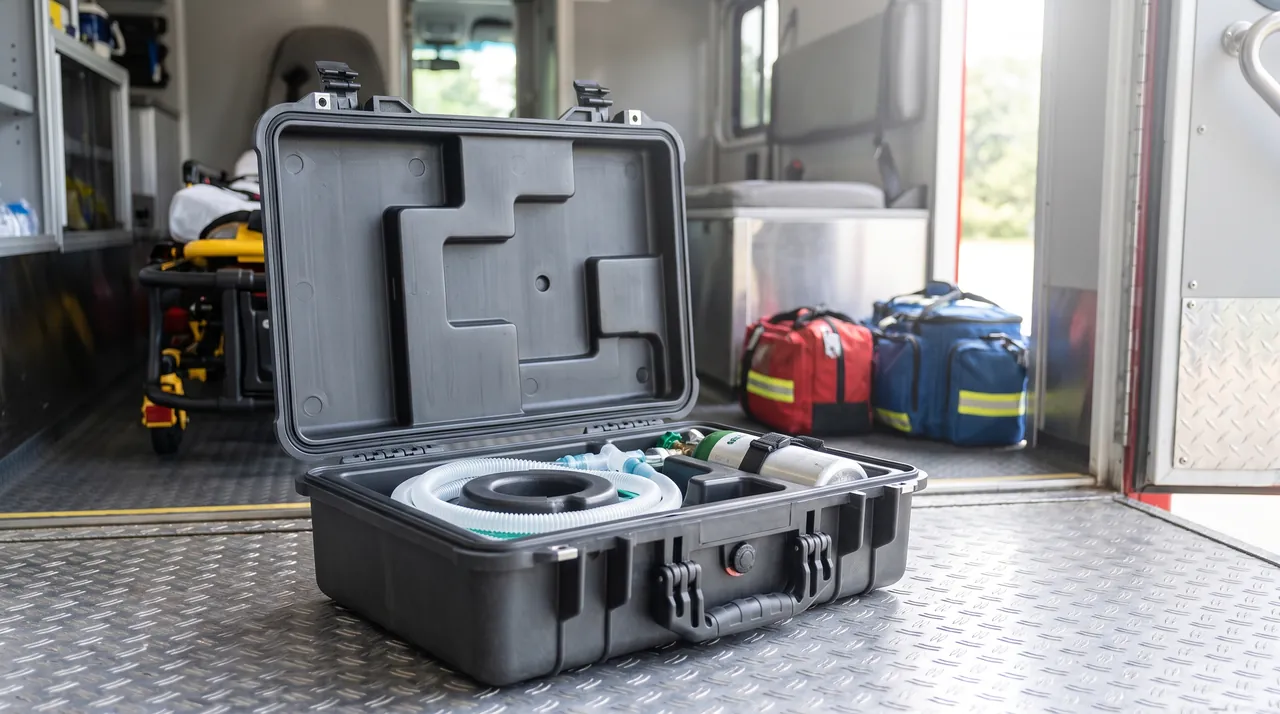
The grade choice is a weight-versus-strength decision. A 5052 panel at 1.5 mm gives plenty of stiffness for a bench instrument case that is never stacked, while a 7075 rail at 2.0 mm lets a large transit case keep its shape under a stacked load that would bow 6061. JUNZHJIA selects grade per panel: corrosion-exposed outer skins in 5052, structural frames in 6061, and only the most demanding airborne members in 7075. This mix keeps mass down while meeting the mechanical spec.
Corrosion resistance deserves a separate note. 5052 and 6061 both form a stable oxide layer that tolerates salt spray far better than bare steel, which is why aluminum cases are standard on ships and coastlines. Where abrasion is expected, a clear or black anodize adds a harder ceramic surface without adding measurable weight. For cases that touch dissimilar metals, insulated washers break the galvanic path so the aluminum is never the sacrificed electrode.
Double-Wall Structure and Stiffener Design
A flat aluminum panel is surprisingly flexible, so real cases avoid large flat spans. The standard solution is a double-wall or hat-section stiffener: a shallow channel bonded or riveted to the inside of the skin that turns a floppy sheet into a beam. With stiffeners spaced every 100 to 150 mm, a 1.5 mm panel behaves like a much thicker plate for the same mass, and it resists the oil-canning wobble that signals a cheap box. JUNZHJIA bonds stiffeners with structural adhesive and backs them with rivets at the ends, so the joint survives vibration even if one bond line ages.
Corner construction is where cases live or die. Extruded corner extrusions let the skin tuck into a pocket and the load transfer through a continuous rail instead of through a spot weld. When a case is dropped on a corner, that rail distributes the impact into the frame rather than peeling the skin. Stacking balls or feet on the corners keep the load on the strong axis and protect the seal from being crushed by the case above. These details are invisible in a photo but decide whether a case lasts one trip or one hundred.
Lid design follows the same logic. A flat lid is stiffened by an inward flange and, on larger cases, by a perimeter channel that mirrors the base frame. The lid-to-base interface is a tongue-and-groove joint: the tongue on the base slides into the groove on the lid, so even before the latch closes, the seal line is already aligned and the EMI gasket is compressed evenly. Misalignment is the enemy of both water sealing and shielding, and the tongue-and-groove joint removes most of it by geometry rather than by operator care.
Weight Advantages and Lightweight Engineering
Aluminum's density is about one third that of steel, so replacing a steel transit case with an aluminum one cuts mass dramatically for the same strength. Compared with a rotomolded plastic case of equal size, aluminum is often heavier per empty box, but it carries a far higher payload-to-weight ratio because the walls can be thinner and the frame carries load that plastic spreads poorly. For air-shipped equipment, the saving is the total of case plus contents, and a lighter, stronger aluminum case frequently wins once you account for the gear it protects.
Lightweight engineering is mostly about removing material where it does no work. Stiffeners let you thin the skin; pocketed lids remove metal from low-stress areas; hollow handles and extruded rails trade solid section for shaped section. A well-designed 600 x 400 x 300 mm case in 1.5 mm 5052 with 6061 frame typically lands near 4.5 to 6.5 kg empty, against 7 to 11 kg for a comparable rotomolded box that offers none of the shielding. The exact number depends on hardware, foam and seal, which is why quotes should always state the empty mass.
Weight also affects the seal and the latch. A lighter lid needs less clamp force to compress the gasket to its design thickness, so the latches last longer and the user closes the case with one hand. A heavy steel lid fights the gasket and eventually distorts the frame, which is why old steel cases leak. Aluminum hits the sweet spot: rigid enough to hold the seal line, light enough to close easily, and strong enough to stack.
EMI Shielding Principles and Materials
Electromagnetic interference shielding works by surrounding the protected circuit with a continuous conductive surface. Incident energy is either reflected at the conductive boundary or absorbed as it travels through the metal; the thicker the wall relative to the skin depth at the frequency of interest, the more is absorbed. Because aluminum conducts well, even a thin wall reflects most energy, and the practical problem becomes the seams, the lid gap and any penetrations for cables or vents, where the cage is interrupted.

The shielding effectiveness of a case is quoted in decibels at a reference frequency, often 1 GHz, with a typical aluminum enclosure reaching 60 to 90 dB when the seam is done right. That number collapses if the lid gasket has a gap or if a cable penetrates the wall without a filtered connector, because the wire acts as an antenna that re-introduces the very noise the box was meant to block. JUNZHJIA treats every penetration as a shielding event: each one gets a bonded gasket or a feed-through filter so the cage stays closed.
Material choice for the conductive path matters less than continuity. Bare aluminum oxidizes, and the oxide is an insulator, so where two aluminum surfaces meet they must be cleaned and either bonded with conductive adhesive, held by conductive gasket, or backed by an EMI fingerstock strip of springy beryllium copper or steel. The goal is a metal-to-metal contact every few millimeters around the entire seam. When that is achieved, the alloy grade barely changes the result; when it is not, no grade saves you.
Conductive Gaskets and Seam Treatments
The lid seam is closed by a gasket that is both water-sealing and conductive. The common solution is a silicone gasket with a woven or foil mesh of tinned copper or monel knitted into its core, so the same part blocks water and carries the shield current. Knitted mesh conforms to uneven surfaces and survives repeated compression better than a flat foil tape, which is why it is the default for field cases that are opened daily. The gasket must touch bare aluminum on both sides, so the contact lands are stripped of paint and anodize before assembly.
Where the seam must be near-invisible or the compression is low, EMI fingerstock is used instead. Fingerstock is a row of tiny spring fingers that wipe against the mating surface and keep contact even as the case flexes in flight. It is more delicate to install than mesh gasket but gives lower contact resistance and better high-frequency performance. JUNZHJIA specifies fingerstock on cases that must hold shielding above 10 GHz, and mesh gasket on general-purpose cases below that band.
Bonded seams deserve the same care. Riveted joints that pierce the frame can interrupt the shield if the rivet head is insulated by paint, so the contact zones are deburred and the fastener is either conductive or backed by a star washer that bites the oxide. Welded seams are continuous by nature but need the weld spatter cleaned so the gasket seat is flat. The rule is simple: anywhere two panels meet, the shield must meet too, or the dB number on the datasheet is a dream.
IP67 and Ingress Protection Sealing
Ingress protection ratings from IEC 60529 describe how well a case resists solids and water. IP67 means the case is dust-tight and can survive immersion to 1 m for 30 minutes, which covers rain, spray, puddle and brief submersion during a flooded loading dock. The rating is earned by the gasket and the compression system, not by the metal, so an aluminum case is only as waterproof as its seal. JUNZHJIA validates IP67 by dunk testing sample cases and by checking gasket compression with feeler gauges on the production line.
A water seal and an EMI seal share the lid line but solve different problems, and a good case does both with one gasket that is conductive on the outside and closed-cell silicone on the inside. The silicone blocks water; the mesh carries the shield. If the two are split into separate parts, the installer can seat them in the wrong order and ruin both, so integrated gaskets are preferred. The tongue-and-groove joint keeps the gasket aligned so compression is even around the whole perimeter and no low spot lets water weep in.
Penetrations are the weak point of any IP rating. Pressure-relief valves equalize altitude without letting water in, but a cheap valve is a leak path, so JUNZHJIA uses a Gore-type membrane or a filtered breathable port that passes air and blocks droplets. Cable glands must be rated to the same IP as the case, and connectors that penetrate the wall need O-rings under their mounting flanges. A case rated IP67 with an IP54 gland is, in practice, an IP54 case at that point, so the whole envelope has to match the weakest part.
Impact, Drop and Random Vibration Standards
Rugged cases are proven against MIL-STD-810H, the U.S. defense method for environmental engineering, which includes drop, shock, random vibration, humidity, altitude and fungal resistance among its procedures. A transit case rated to Method 516.8 drop and Method 514.8 random vibration has been shown to survive the handling a parcel sees in air and truck transport, including being dropped on a corner from a defined height. The standard is a test method, not a pass line, so a credible supplier states the exact procedure and the achieved result rather than just naming the number.
Beyond MIL-STD, ISTA 3E covers unit-load and individual-parcel transit simulation for packaged products, which is useful when the case is part of a larger distribution chain rather than a military shipment. IK ratings from IEC 62262 describe impact energy resistance of the enclosure surface, useful when the case may be struck by tools or debris. For flammable environments, UL 94 classifies the flammability of any non-metal parts such as handles and foam, and a case that mixes metal walls with plastic fittings should list the flammability class of those fittings so the whole assembly is understood.
Vibration is where aluminum earns its keep. Random vibration at 0.04 g squared per hertz across a broad band loosens poorly fastened parts and cracks brittle panels; aluminum's stiffness lets the case move as one structure and push the resonance above the test band, so the foam and the contents see less motion than they would in a flexible plastic shell. JUNZHJIA tunes the foam and the case resonance together, because shielding the box from the world does little if the circuit board rattles inside it. The case and the liner are one system, not two products.
Internal Foam Liners and Cushioning
The foam inside an aluminum case is not padding, it is a suspension system. Its job is to keep the contents within a shock and vibration envelope the equipment can survive, which means choosing density and thickness for the mass of the item and the drops it will see. Pick the foam too soft and the item bottoms out on the case floor; too hard and the shock passes straight through. JUNZHJIA cuts custom-cut liners by CNC from polyethylene or polyurethane plank, then profiles the cavity to the exact outline of the instrument so it cannot shift during transit.
A two-layer scheme works best: a firm base plank that defines the shape and a softer top layer that closes over the item and holds it down when the lid is shut. The lid usually carries a thin layer so the contents are squeezed gently between top and bottom, removing rattle without over-compressing. For delicate optics or sensors, a convoluted anti-static foam wraps the item, and for electronics a conductive foam version drains static charge so the case is safe for boards as well as shielded from radio noise.
Foam also affects sealing and weight. Closed-cell foam does not wick water, so a small leak in the field stays local instead of soaking the contents, and it sheds dust on the line. It adds mass, though, so the foam spec is part of the empty-weight budget discussed earlier. When the case is opened daily, re-cuttable plank foam lets the user add dividers as the kit changes, which keeps one case useful across several configurations instead of buying a new box per payload.
Latches, Handles and Stacking
Hardware is the part users touch, and it is where cheap cases betray themselves. A good latch is a draw latch with a padlock hasp, rated for thousands of cycles, that pulls the lid down to a repeatable compression so the gasket seats the same way every time. Butterfly latches are fast but wear; for cases opened constantly, a quarter-turn with a steel cam lasts longer. JUNZHJIA fits latches through-bolted to the frame, not screwed to the skin, because the skin will eventually pull out of a screw but the frame will not.
Handles follow the same rule. A comfortable handle rated for the full case weight, mounted to the frame and wrapped in a non-slip grip, turns a heavy box into a carryable one. Stacking feet or balls on the corners let cases lock together in a column so a stack of five does not slide, and they keep the seal of the lower case off the floor of the upper one. For large transit cases, recessed handles and ramps protect the user's knuckles and let the box slide on a cart instead of being lifted.
Hinges are often overlooked. A piano hinge spreads the lid load along the whole edge and is far more durable than two small butt hinges that concentrate stress at two points. Stainless or anodized pivot pins resist corrosion, and a hinge that is through-bolted to the frame survives the lid being dropped open. When the case is used as a work surface or a step, the hinge and the frame behind it must be specified for that load, not just for opening and closing.
Comparison with Rotomolded and Injection Cases
The three common case types each have a place. Rotomolded plastic is cheap, thick-walled and dent-resistant but heavy, non-conductive and weak on shielding. Injection-molded plastic is lighter and tighter-toleranced but brittle under point impact and also non-conductive. Aluminum sits between them on cost, beats both on shielding and thermal conduction, and beats rotomolded on weight per payload. The table below summarizes the trade for a typical 600 x 400 x 300 mm instrument case.
| Property | Aluminum alloy case | Rotomolded plastic | Injection plastic |
|---|---|---|---|
| --- | --- | --- | --- |
| Empty weight (typical) | 4.5 to 6.5 kg | 7 to 11 kg | 3 to 5 kg |
| EMI shielding | 60 to 90 dB possible | None without liner | None without liner |
| IP67 sealing | Yes with gasket | Yes | Yes |
| Heat conduction | High | Low | Low |
| Repairability | Panel re-riveted | Poor | Poor |
| Relative cost | Higher | Low | Medium |
Choosing among them is a function of what the contents fear most. If the enemy is radio noise or heat, aluminum wins by default. If the enemy is a tight budget and the gear is rugged, rotomolded is fine. If the gear is light and the trip is gentle, injection plastic is the smallest and cheapest. For mixed fleets, JUNZHJIA often supplies aluminum for the sensitive payloads and plastic for the rugged tools, so the buyer pays for shielding only where it is needed. Our plastic protective case line covers those non-shielded roles.
The decision also depends on lifecycle. Plastic cases that yellow, crack and shed latches after a few years cost more in replacement than one aluminum case that is re-foamed and re-riveted. For equipment with a long service life, the metal case tracks the life of the instrument instead of the life of the box. That alignment is why defense and medical programs standardize on aluminum even when the first article costs more.
Typical Applications Across Industries
Aluminum cases show up wherever the payload is valuable and the environment is unkind. In defense, they carry radios, batteries, optics and test sets that must survive airdrop and dust. In broadcasting, they hold transmitters and recorders wheeled into the field. In medical, they move imaging modules and analyzers between sites without losing calibration. In research, they protect lab instruments shipped to remote stations where a failure means a lost season, not a late delivery. See our military security case range for defense-grade builds.
Test and measurement is the largest quiet market. Calibrators, spectrum analyzers and reference standards leave the lab and must return still calibrated, which demands a case that holds the instrument still and keeps it dry and shielded. Utility and energy crews use aluminum cases for fault finders and thermal cameras exposed to rain and EMI from switchgear. Our waterproof case IP range explains the sealing methods that keep these field kits dry, and our seal shock case line covers the cushioning side of the same problem.
Another growing use is secure transport of controlled items, where the case doubles as a chain-of-custody container with locks, tamper tags and foam cut to show missing parts at a glance. Here the rigidity of aluminum matters because a soft case can be squeezed to hide a gap. For cross-border shipping, the case is often the only thing customs and carriers see, so its build quality signals the value inside and the seriousness of the sender.
How to Specify and Select the Right Case
Specification starts with the contents, not the box. List the item mass, its outer dimensions, the shock it can survive, the temperature band, the ingress risk and whether it needs shielding, then let those numbers drive the case. A common mistake is buying a size and hoping the foam fixes a wrong choice; foam cannot add stiffness or shielding the case lacks. The table below gives a quick selection path from requirement to case feature.
| If your payload needs | Specify | Avoid |
|---|---|---|
| --- | --- | --- |
| EMI quiet operation | Conductive gasket, filtered ports | Painted seam, unfiltered cable pass |
| Outdoor rain or spray | IP67 gasket, IP-rated glands | Open vents, screw-only lid |
| Air shipment, weight limited | 5052 thin skin, 6061 frame | Thick steel or solid plastic |
| Rough handling, drops | Through-bolted latches, piano hinge | Screwed skin, butt hinges |
| Long service life | Repairable panel, re-cut foam | Bonded non-serviceable shell |
Request the test evidence early. Ask for the MIL-STD-810H procedure and result, the IP67 dunk record, and the shielding dB at the frequency your equipment cares about, not a generic claim. Our transport case line is built and tested to these same procedures, so the spec sheet matches the shipped unit. When comparing quotes, ask each supplier for the same test standard and the same frequency band so the numbers are truly comparable, because a dB at 1 GHz is not a dB at 10 GHz and a case that is silent at one band can be loud at another.
Finally, think about the whole kit. The case, the foam, the labels, the spares pouch and the cable management are one product, and a supplier who cuts the foam to the instrument and routes the cables cleanly saves more field time than a slightly cheaper empty box. JUNZHJIA treats the liner as part of the mechanical design, modeling the drop and vibration with the foam in place, so the delivered case is proven as a system rather than as a shell with hopes inside it.
Certification, Quality Control and FAQ
A credible aluminum case supplier documents the build. That means material certificates for the alloy tempers, a dimensional inspection of the frame squareness, a gasket-compression check, and a sample ingress and shielding test per batch. JUNZHJIA keeps these records per order so a buyer can trace a case back to its panels and gasket lot, which matters for audited programs and for warranty claims years later. Certification is not paperwork for its own sake; it is how you prove the box you received is the box that was tested.
Quality control also covers the things users never see: deburred edges so the gasket seat is flat, stripped contact lands so the shield joins, and torque-checked fasteners so nothing loosens in transit. A case that passes a one-time demo drop but ships with loose latches fails in the field, so production checks matter more than a hero video. The right question to a supplier is not whether they can pass a test, but whether every unit they ship is built to the same drawing as the unit that passed.
Question: What aluminum grade is best for a general instrument case?
Answer: For most bench and field instrument cases, 5052-H32 panels with a 6061-T6 frame give the best mix of formability, corrosion resistance and strength at a reasonable cost. Reserve 7075-T6 for airborne or high-g loads where wall thickness must stay minimal.
Question: Can an aluminum case really block electromagnetic interference?
Answer: Yes, when the lid seam is closed by a conductive gasket and every penetration uses a filtered connector or bonded gland. A continuous aluminum enclosure typically reaches 60 to 90 dB at 1 GHz; the rating depends entirely on seam continuity, not on the alloy grade.
Question: Is aluminum heavier than plastic?
Answer: An empty aluminum box is often heavier than an empty rotomolded box of the same size, but it carries a far higher payload-to-weight ratio and sheds heat, so for air-shipped sensitive gear the total system is usually lighter and safer. Empty mass for a 600 x 400 x 300 mm case is typically 4.5 to 6.5 kg.
Question: What does IP67 mean for a protective case?
Answer: Per IEC 60529, IP67 means dust-tight and able to survive immersion to 1 m for 30 minutes. The rating is earned by the gasket and compression system, so the case is only as waterproof as its seal and its IP-rated penetrations.
Question: How should the internal foam be chosen?
Answer: Match foam density and thickness to the item mass and the drops expected, using a firm base plank profiled to the instrument plus a softer top layer that closes when the lid shuts. Too soft bottoms out; too hard passes shock through. Closed-cell foam resists water and dust.
Question: Which test standard proves a case is rugged?
Answer: MIL-STD-810H covers drop, shock and random vibration for defense-style transit, while ISTA 3E simulates parcel distribution and IK ratings from IEC 62262 measure surface impact. Always ask for the specific procedure and the achieved result, not just the standard name.
Question: Can the case be repaired in the field?
Answer: Aluminum panels can be re-riveted and foam re-cut, so a damaged case is often returned to service by replacing one skin rather than scrapping the box. Through-bolted hardware also lets a latch or handle be swapped without special tools, which is why field-repairability is a key argument for metal over plastic.
Question: How do I compare quotes from different suppliers?
Answer: Require the same test standard, the same frequency band for shielding dB, the empty weight, the alloy tempers and the ingress rating from each bidder. Identical-looking claims hide very different proofs, so comparable numbers, not low price, should decide the purchase.
Question: Do aluminum cases conduct heat badly in cold climates?
Answer: Aluminum reaches ambient temperature quickly and conducts heat well, so it avoids the condensation trapping and slow equalization that insulated plastic boxes suffer. In cold stores it stabilizes fast and, with the right gasket, keeps the seal line from icing by not holding a cold inner skin apart from the contents.