

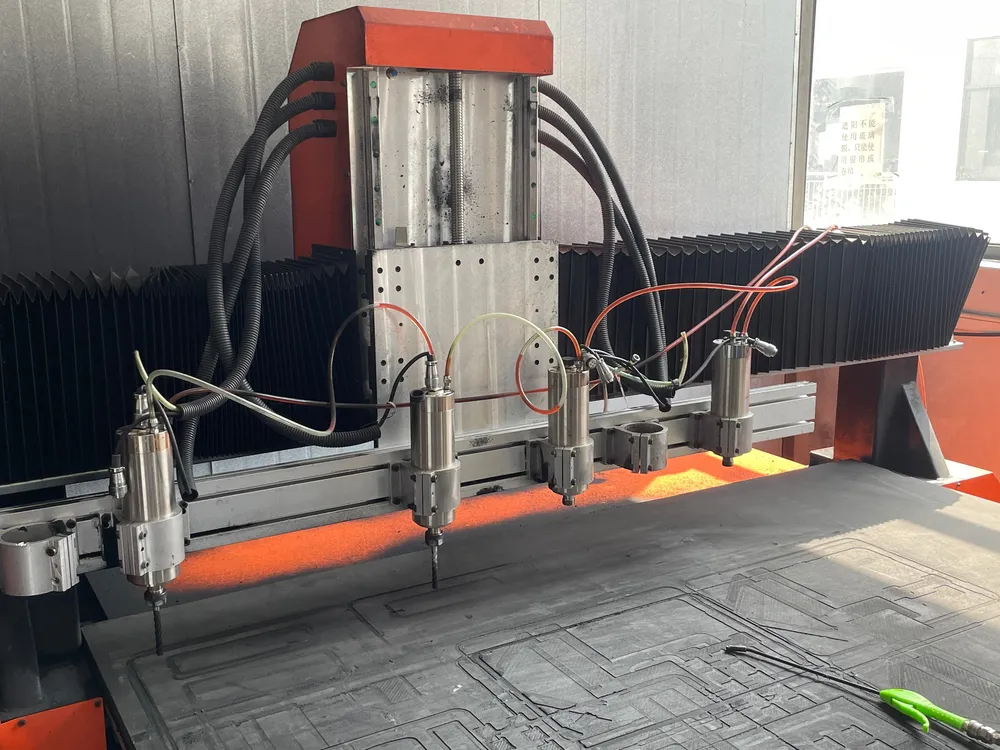
Inside a well-specified case, the interior is doing most of the protective work. A thermoformed EVA liner is one of the most durable ways to build that interior: instead of cutting cavities out of a block, flat sheet is heated and formed so the cavities become part of a continuous, skinned surface.
The Process, Step by Step
- Material selection. Sheet thickness, density and hardness are chosen against payload weight and fragility.
- Heating. The sheet is heated until it softens enough to form without tearing or thinning excessively.
- Forming. Heat-softened sheet is shaped against a tool, with vacuum or pressure holding it to the surface until it takes the shape.
- Cooling. The liner is cooled while still held in the tool so it sets to the intended geometry.
- Trimming and finishing. Excess material is removed and the liner is trimmed to fit the shell precisely.
- Fitting. The liner is installed and checked against the lid, latches and any internal hardware.
Specifying the Material
| Parameter | What it controls |
|---|---|
| Density | How much energy the foam absorbs and how well it recovers after repeated compression |
| Hardness | Firmness under load; too soft lets the payload bottom out, too hard transmits shock |
| Thickness | The standoff distance between payload and shell wall |
| Clearance | How tightly the cavity grips the item — too tight stresses it, too loose lets it move |
| Surface | The formed skin resists abrasion and is easier to clean than cut cell foam |
These interact. A very dense foam in a thin section can transmit rather than absorb a shock, while a soft foam under a heavy payload may compress fully on impact and let the item contact the shell. Matching the three — payload mass, fragility and drop height — is the actual engineering task.
How It Compares
| Interior type | Strengths | Limitations |
|---|---|---|
| Thermoformed EVA | Durable skinned surface, precise repeatable cavities, clean appearance | Requires tooling; best economics at volume |
| Die-cut foam | Flexible, no tooling needed, good for prototypes | Open cells abrade; cavities less precise over time |
| Pick-and-pluck | User configurable without tooling | Weaker cavity walls; least durable under repeated use |
What to Send a Supplier
The best interior starts from the real payload, not from dimensions alone. Provide the actual item or an accurate model, its weight, its most fragile features, the drop height you need to survive, and any items that must stay accessible during use. That lets density, thickness and clearance be chosen as a system rather than guessed.