


Quick answer: A fuel cell case keeps spares dry in cold storage with a 5 degree floor, a 12 mm drain port and 500 g of desiccant holding 40–60% RH.
Table of contents
- Where the Residual Liquid Goes in a Fuel Cell Case
- A 5 Degree Floor and a 12 mm Drain Port
- 500 g of Desiccant Against a 40 to 60% RH Window
- What -30 °C Does to Walls, Gaskets and Latches
- Monthly Recheck: Four Calls and a 32 kg Limit
- FAQ
1. Where the Residual Liquid Goes in a Fuel Cell Case
Pull a 620 mm case from a -30 °C cold room into a 20 °C service bay and within a minute water beads on the walls while 30 mL to 80 mL of liquid pools in the lowest corner. None of it leaked in; it arrived with the spares as coolant left in the manifold.
The fluid expands about 4% across the 50 K swing; freezing adds 9%, enough to lift a 20 mm EPE liner by 2 mm to 3 mm.
Condensation is the second path. Open the lid in a bay at 65% RH and warm air meets walls still at -20 °C, leaving 6 mL to 10 mL of droplets that run down to join the coolant.
Water is not the problem. Still water is.
Sitting water freezes and plugs the drain; moving water finds the low point itself, so a fuel cell case assumes water is inside and gives it a route.
| Where liquid settles | What is seen | Case-side measure | Set value |
|---|---|---|---|
| Centre of floor | liner lifted by ice | single-plane sloped floor | 5 degrees |
| Channel end | beads freeze in a row | R2 fillet, end sunk 1 mm | 4 mm deep |
| Plug thread | plug will not turn | plug stands 6 mm proud | 12 mm bore |
2. A 5 Degree Floor and a 12 mm Drain Port
Over 520 mm of internal length, 5 degrees gives a 46 mm drop, and gravity carries the liquid down without tipping the case.
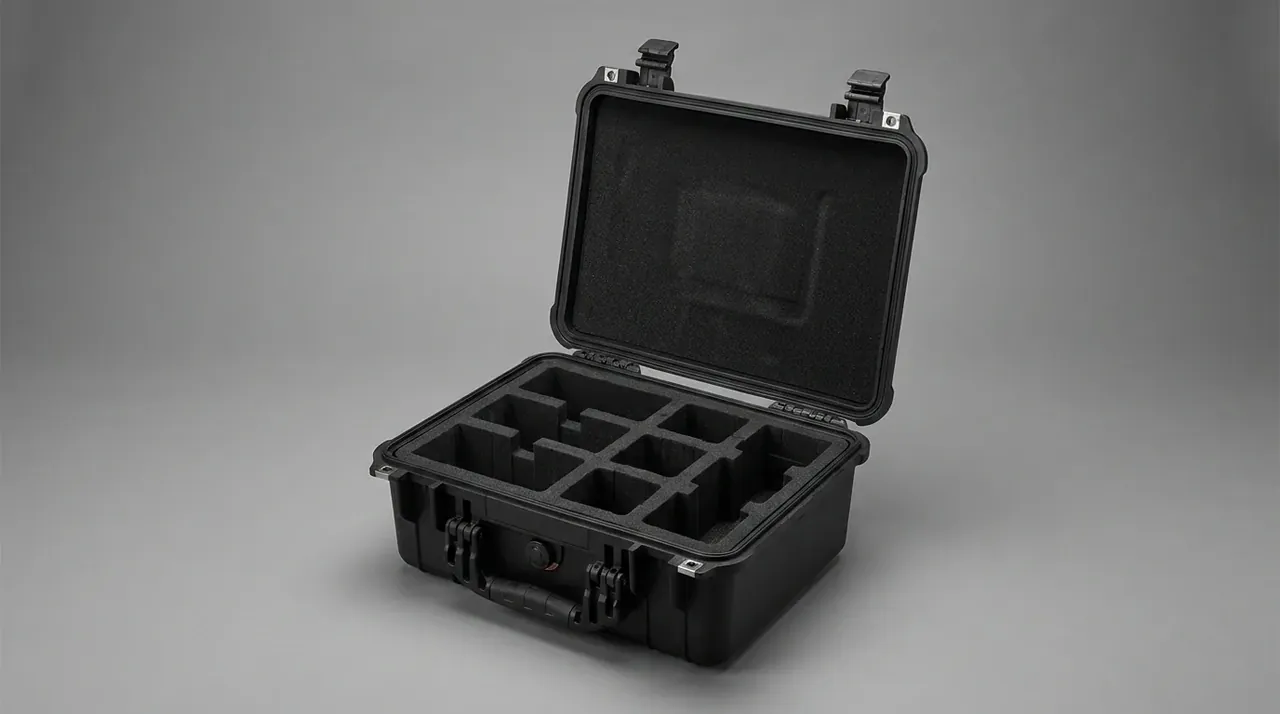
Three channels cross the floor at 150 mm spacing, 4 mm deep and 12 mm wide, with an R2 fillet that drains the 1 mm to 2 mm film a square channel would keep, worth 30 mL of residue.
The port sits at the lowest corner at 12 mm bore, closed by an M16×1.5 plug with a 3 mm nitrile O-ring, torqued to 2.5 N·m with 6 mm of thread exposed. Twelve millimetres clears 200 mL in 10 s; anything larger cuts a hole where the floor bends most.
Below the plug sits a 260 mL sump, sized on four spare sets shedding 40 mL to 50 mL each, plus a 200 mm by 300 mm pad rated at 180 mL.
Acceptance is 50 mL: empty the case, invert it for 10 min, then measure. More means the slope or the channel profile is wrong.
| Drainage stage | Construction | Size or slope | Pass value |
|---|---|---|---|
| Cavity floor | single plane, moulded in one shot | 5 degrees | 46 mm drop |
| Channels | 3 runs at 150 mm spacing | 4 mm deep, 12 mm wide | residue 10 mL or less |
| Port | lowest corner, M16×1.5 plug | 12 mm bore | 200 mL in 10 s |
| Sump | cavity under the plug | 260 mL | level 20 mm below rim |
3. 500 g of Desiccant Against a 40 to 60% RH Window
Humidity here has a floor and a ceiling. Below 40% RH the membrane dries and shrinks by up to 0.3%; above 60% RH any temperature drop condenses water on the surface. The case side has one narrow job: hold the cavity inside that 20 point band.
The charge is 500 g in two 250 g cartridges clipped into a lid recess. With 28 L of free volume, silica gel holds the cavity under 50% RH for about 90 days at 25 °C.
Cold weather makes the gel lazy: at -30 °C uptake falls to about 30% of its 25 °C value, so 500 g covers only 27 days.
Cards calibrated at 30%, 50% and 70% RH sit where the eye lands.
Desiccant is not a weight contest, just a question of lasting one changeover.
4. What -30 °C Does to Walls, Gaskets and Latches
Standard PP turns brittle near -20 °C; with 8% impact modifier the -30 °C notched Charpy value reaches 12 kJ/m² and a 5 mm wall holds, while an unmodified 8 mm wall cracks.

The gasket goes next. An 8 mm solid EPDM cord recovers in 2 s at 20 °C; at -30 °C recovery stretches to 6 s and set climbs from 15% to 35%, leaving a 1 mm to 2 mm gap for frost.
The answer is a double seal: 8 mm solid cord outside, 5 mm hollow cord inside, 12 mm apart. Both sit in a 10 mm groove closing at 30% compression.
A PA66 latch with 30% glass fibre needs 80 N at 20 °C and 120 N at -30 °C, beyond one gloved thumb, so the pair sits 320 mm apart for two hands, on stainless pins with 0.2 mm clearance.
Drop testing follows the cold condition: 24 h at -30 °C, six faces from 1.2 m within 90 s, no cracking and no gasket displacement. The same case reaches 1.5 m at 20 °C.
| Storage band | Material behaviour | Case-side response |
|---|---|---|
| 20 °C | gasket recovers in 2 s, latch 80 N | standard build |
| 0 °C | condensation peaks at 6 mL to 10 mL | sump plus absorbent pad |
| -10 °C | PP nears its brittle range | modifier, 5 mm wall |
| -30 °C | uptake 30%, latch 120 N | double seal, 320 mm spacing |
| 60 °C | faster compression set | EPE raised to 45 kg/m³ |
5. Monthly Recheck: Four Calls and a 32 kg Limit
The monthly check is four readings: sump volume no higher than 50 mL, card not yet at the 70% RH colour, gasket set no more than 1.5 mm, latch force no more than 120 N. Any failure sends you back to slope and seal, not more desiccant.
At 32 kg loaded the handling rule is two people on a handle 40 mm in from the edge, rated at 400 N, and stacks of 2, because the lower lid carries 32 kg plus the 3 g peak of a 0.5 m drop.
You can thicken a wall all day. A hand-tight plug still beats you.
Conclusion
Three numbers carry the cold-storage performance of a fuel cell case: a 5 degree floor, a 12 mm drain and 500 g of desiccant. Slope moves liquid to one place, the port lets it out, and the gel holds 40% to 60% RH.
Related Reading
- Transport protection for hydrogen fuel cell stacks
- Cavity layout for energy detection instruments
- Field inspection case configurations
- Selection limits for industrial equipment cases
Related Products
- 8 Series — Gun Cases; Military Equipment Cases; Camera Equipment Cases; Drone Cases; Watch Cases; Knife Cases; First Aid Cases; Electronics Equipment Cases
- WL8-2812 PP Gun Case — model WL8-2812
- All protective cases and toolboxes: 7 series, 158 models