

Quick answer: A Gas detector portable safety protective box pairs a 23% single-lip seal with a 0.8 MPa aperture panel and stays sealed at 1.0 m depth for 30 min.
Table of contents
- Single-lip rim seal and compression allowance of the Gas detector portable safety protective box
- Panel reinforcement and air-path isolation around the sampling apertures
- Leak-reading sequence after immersion re-check
- Stepped lid-opening force measuring points after drop
- Compression-rate scrap line in batch sampling
- FAQ
1. Single-lip rim seal and compression allowance of the Gas detector portable safety protective box
A Gas detector portable safety protective box closes its rim with a single lip seal, 1 ring, pressed on the lid sealing land. Latching brings the lip to a set 23% compression rate. The shell is moulded at a 3.2 mm wall, 440×320×170 mm outer and 390×270×125 mm inner, 3.1 kg empty and 6.5 kg loaded. Lid stiffness and lip rebound hold that compression. Compression allowance is the rebound height left after closing: too little loses contact pressure in the cold, too much shortens latch travel. With no backup seal, 23% is the one criterion, fixed in the tool, and JUNZHIJIA logs it in the first-article file.
Immersion tiers group by depth at 23% reference compression, each recording seepage only, never rewriting the lip-height setting.
| Immersion tier | Lip compression | Reading use |
|---|---|---|
| 1.0 m water / 30 min | 23% compression rate | Rim seepage verdict |
| 0.8 MPa static | Reinforcement frame only | Aperture panel verdict |
| Re-immersion after 1.0 m drop | Allowance re-read | Post-shift re-check |
2. Panel reinforcement and air-path isolation around the sampling apertures
A Gas detector portable safety protective box carries φ18 mm sampling apertures, 2 in number, in a non-load-bearing lid zone clear of the rim land, so no load path is cut and the lip is untouched. Each edge takes a same-resin reinforcement frame thicker than the panel, leaving local stiffness to the frame. Air-path isolation keeps the aperture panel and rim land unconnected: 0.8 MPa static tightness and 1.0 m / 30 min rim no-seepage are two separate, unmerged criteria. Bore and edge thickness are tool-fixed; after closing the frame stays clear of the sealing land.
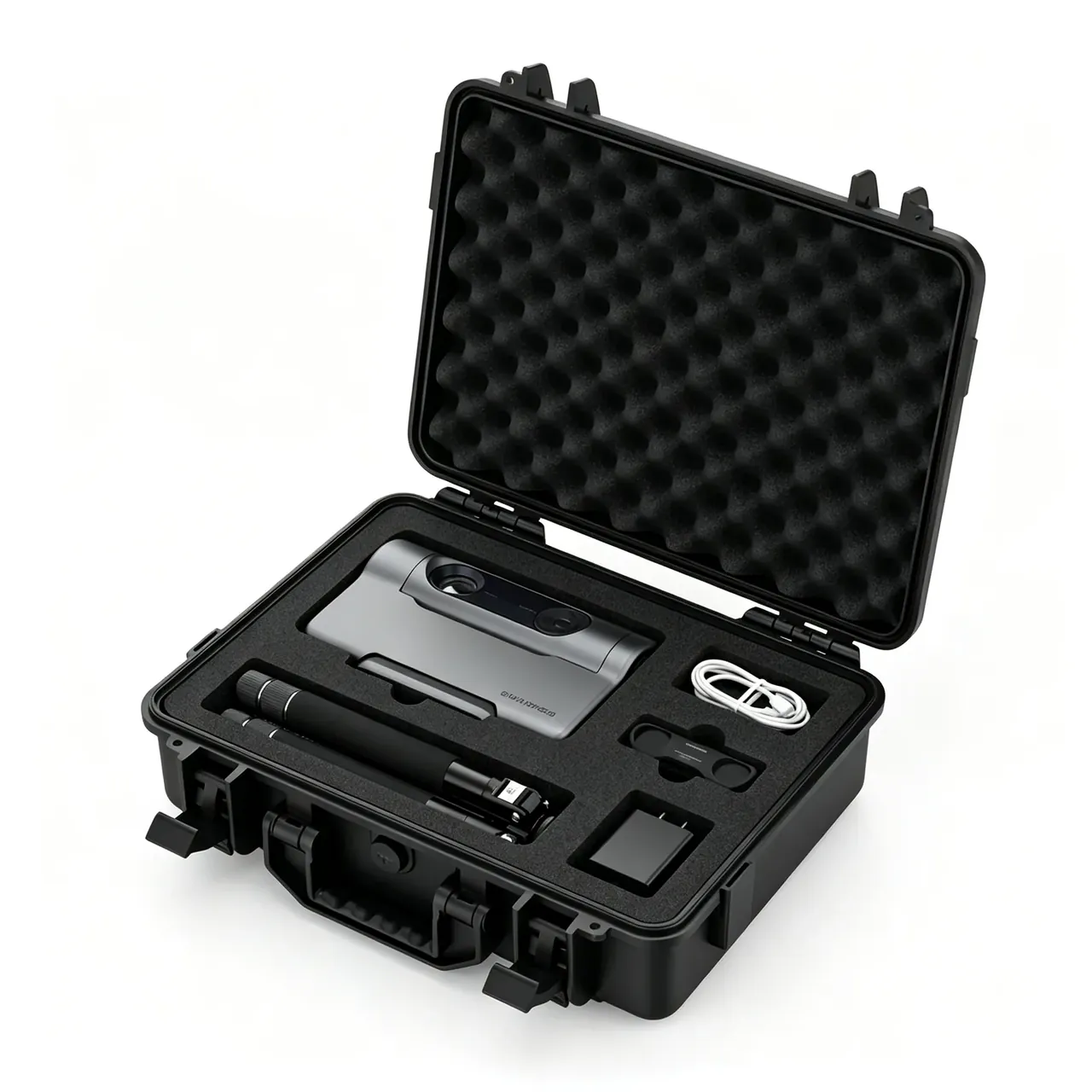
Aperture static readings and rim seepage readings are filed apart, and no single point stands in for a full-face verdict.
| Aperture location | Reinforcement | Inspection item |
|---|---|---|
| φ18 mm edges, 2 places | Same-resin frame | Bore and edge thickness |
| Non-load-bearing panel | Clear of main ribs | Load path uncut |
| φ12 mm pressure valve | Separate valve seat | No cross-pressure |
3. Leak-reading sequence after immersion re-check
An IP67 immersion check runs on the Gas detector portable safety protective box at 1.0 m for 30 min, read in the fixed order of rim, aperture panel and pressure valve. The rim shows water traces on the lip land, the panel around the frame, and the φ12 mm valve at its seat joint, each logged alone. Units cycled from −15 °C to 50 °C are re-immersed after warm-up and filed apart from ambient ones, since cold shrink shifts lip contact pressure. The round valve equalises pressure and is treated as a shell-side part.
The Gas detector portable safety protective box keeps this order because the three leak sources differ. The re-check reuses the first-article datum with one mark set before and after immersion.
4. Stepped lid-opening force measuring points after drop
After a 1.0 m drop, the Gas detector portable safety protective box measures opening force in three steps: release the two latches, lift to the first step, then swing to full open, with the whole travel held to ≤45 N. The two 330 N latches are re-read before and after the drop and logged apart from opening force. Measuring points sit at the lid front-edge midpoint and near both hinges, and the largest of the three enters the post-drop file; an out-of-range value goes first to a rim check. A drop shifts lid datums slightly, so opening force tracks lip contact better than a static value.
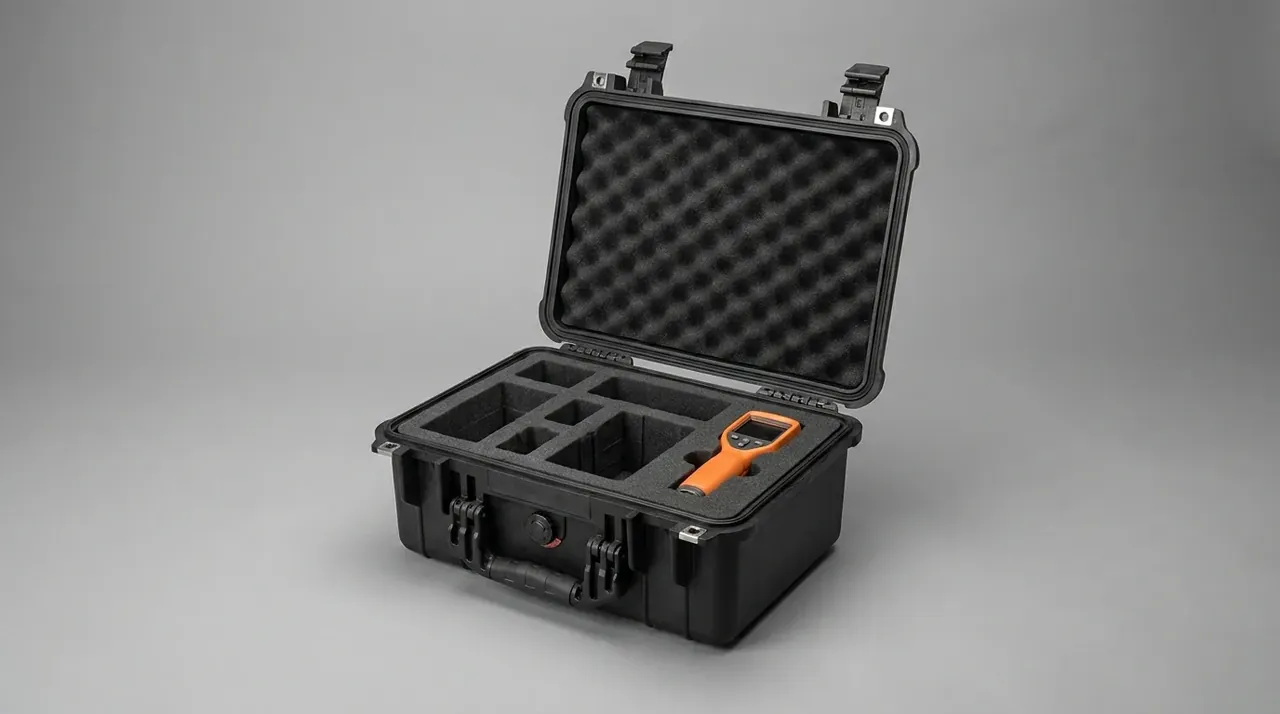
Stepped readings of the Gas detector portable safety protective box split static latch force from dynamic lift force, the latter set by the lip, lid flatness and hinge torque. Either row out of range returns to assembly review.
| Force reading | Measuring point | Use |
|---|---|---|
| ≤45 N | Front-edge lid lift | Opening-force limit |
| 330 N each | Two latches | Re-read before/after drop |
| First-step value | Lid half open | Compared with full open |
5. Compression-rate scrap line in batch sampling
Batch sampling of the Gas detector portable safety protective box centres its scrap line on the 23% compression rate, using the first-article gauge: under the lower bound means weak lip contact, over the upper bound tight latch travel. A 1-ring lip has no backup, so compression rate is tabulated with the ≤45 N opening force. JUNZHIJIA files compression, 1.0 m / 30 min immersion, 0.8 MPa static and stepped opening force per lot, while the shell — 440×320×170 mm outer, 390×270×125 mm inner, 3.2 mm wall — stays unchanged.
The scrap line accepts four readings only; appearance carries no weight.
Conclusion
The Gas detector portable safety protective box links a 23% single-lip rim compression, 0.8 MPa aperture-panel tightness, 1.0 m / 30 min no-seepage and a ≤45 N post-drop opening force into one shell-side specification chain, anchored at the rim, the aperture panel, the immersion rig and the stepped measuring points. JUNZHIJIA retains the 1 lip ring, the 2 φ18 mm apertures, the φ12 mm valve and the 330 N latches by benchmark method, with batch sampling reusing the first-article datum. The file covers shell structure, sealing process and inspection readings only, and stays with the case side of the design.
Related Reading
- Selection criteria and structural items for instrument cases
- Sealing and aperture specs for environmental detection cases
- Gasket groove sections versus compression allowance
- Sampling item list for batch incoming inspection
Related Products
- 8 Series — Gun Cases; Military Equipment Cases; Camera Equipment Cases; Drone Cases; Watch Cases; Knife Cases; First Aid Cases; Electronics Equipment Cases
- WL8-2812 PP Gun Case — model WL8-2812
- All protective cases and toolboxes: 7 series, 158 models