

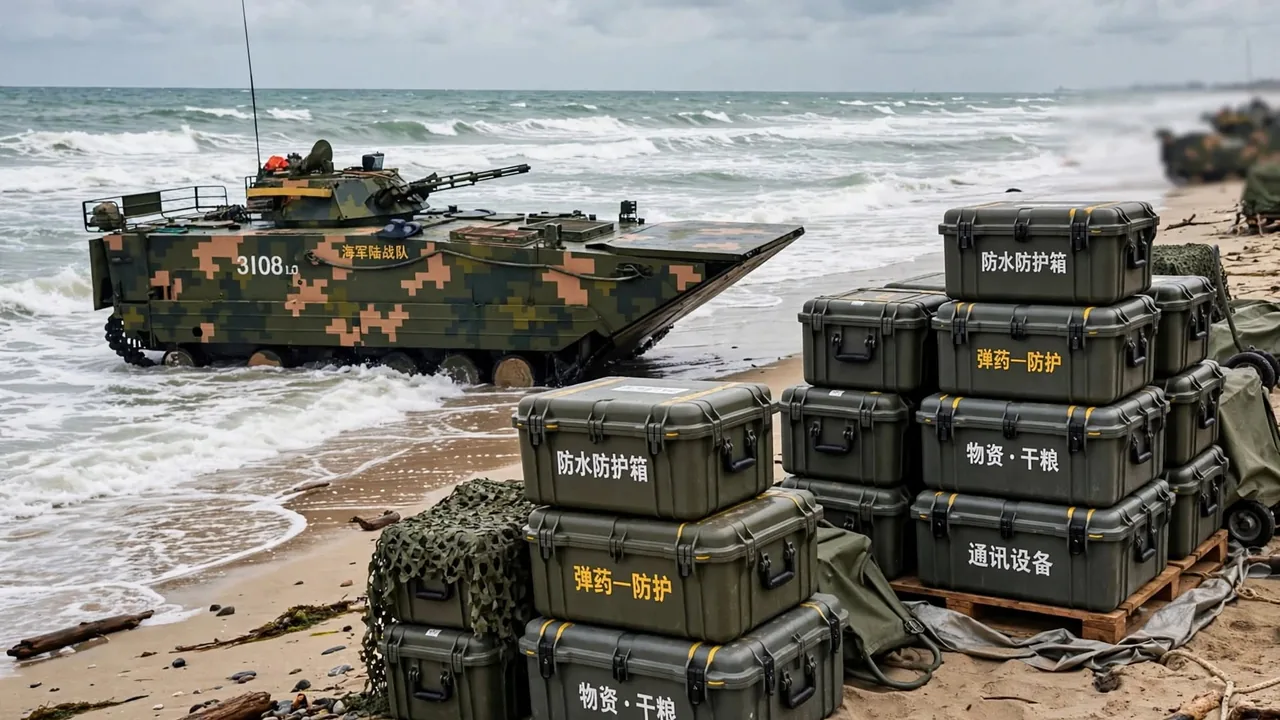
A detection instrument case is a protective container built to store, transport and field-deploy detection and measurement instruments such as non-destructive test sets, gas and flue analyzers, power quality analyzers, insulation resistance testers, oscilloscopes and multimeters, coating thickness gauges, vibration analyzers, environmental sampling instruments, and portable screening equipment. Unlike a laboratory instrument, a field instrument works in pipe galleries, foundation pits, workshops, ship compartments, substations and open terrain, where dust, vibration, rain and temperature swings arrive together. The instrument is opened and closed repeatedly, read on site and stowed again in a hurry. A detection instrument case must therefore deliver not only cushioning and moisture protection like any instrument case, but also zoned storage, fast retrieval, on-site working support and contamination control as one coherent package. This article explains how such cases are specified across protection needs, shell materials, liner zoning, dust sealing, shock isolation, latch load-bearing, stacking and certification, and links that thinking to Instrument Cases: Precision Meter Transport & Protection, Optical Instrument Case: Zoned Protection and Shock Isolation for Precision Optics and Sensor Case: ESD and Shock Protection for Sensitive Elements so a field team can turn a case into a genuinely durable working tool.
Application Scenarios and Protected Objects
The application range of a detection instrument case is very wide. In industrial quality control it carries ultrasonic thickness gauges, coating thickness gauges, hardness testers, roughness testers and measuring tools. In power and energy it carries insulation resistance testers, partial discharge detectors, power quality analyzers and thermal imagers. In environmental monitoring it carries flue gas analyzers, particulate samplers, water quality testers and sound level meters. In non-destructive testing it carries ultrasonic, eddy-current and magnetic particle hosts with their probe sets. In screening and emergency response it carries portable detection devices and sampling tools. What these instruments share is high accuracy, many accessories and frequent field use, and they often need the host, probes, cables, chargers and a log book arranged in a single case.
Field detection places three special demands on the case. First, fast retrieval: inspectors often have a narrow window to complete readings at several locations, so the host and its matching probe must be found at a glance rather than searched for in a mixed load. Second, working support: many instruments must sit level and connect cables, so the lid or body is often used as a temporary bench, which demands rigidity and a non-slip face. Third, contamination isolation: site dust, oil and humid air rush in the moment the case opens, and without sealing and cleaning provisions the instruments and probes quickly drift and develop contact faults. Planning shell, liner and accessory bays as one system is exactly what sets a detection instrument case apart from an ordinary instrument case.
Field Protection Needs and Failure Risks
The failure risks of a field instrument come from several directions. Mechanical vibration and shock are the most common: a case riding over rough roads, being set down carelessly on a site, or dropped while loading produces alternating stress inside the instrument that loosens connectors, cracks displays and fractures solder joints. Dust is the second risk: fine particles entering key gaps, cooling vents and probe connectors cause contact oxidation and mechanical jamming, and in metalworking or mining environments metal dust can even short circuits. Moisture and temperature swing are the third risk: an instrument moved from an air-conditioned room to a sunlit pit, or stowed straight after working in rain or mist, condenses inside the case and leads to leakage on high-impedance circuits and fogging on optical windows.
Against these risks, the protection goals of a detection instrument case should focus on four points. First, rigid bearing and shock absorption: the shell must resist squeezing and stacking loads while the liner absorbs transport and drop energy. Second, dust and water sealing: a continuous gasket and sensible compression keep dust and rain outside. Third, zoning and keying: independent cavities with orientation marks for each instrument and probe reduce misplacement and mixing. Fourth, field friendliness: the case should support the instrument stably when open, hold cables and be easy to clean. Around these four points, the shell material discussion in Case Shell: Structural Materials and Molding Process of Protective Cases and the liner processing in Case Foam Lining: Cushioning and Customization of Case Interiors together form the base capability of a detection instrument case.
Shell Materials and Structural Selection
Common shell materials for a detection instrument case include modified engineering plastics, polypropylene copolymer, magnesium-aluminum alloy and composites. Modified engineering plastics are injection molded, light and dimensionally precise, and they make it easy to place ribs and latch seats in the wall, so they are the default for most portable cases. Polypropylene copolymer resists chemicals and stays tough at low temperature, suiting environmental monitoring and wet field sites. A magnesium-aluminum shell is rigid and conducts heat well, fitting detection hosts that need thermal conduction or strong electromagnetic immunity, though it requires anodizing against corrosion. Composites win on weight and specific strength. Differences in impact resistance, weather resistance and molding precision are discussed in What Common Plastic Materials Are Used in Protective Cases?.
In structural form, detection instrument cases usually adopt a clamshell so that, once open, the body and lid hold a stable angle and the lid can serve as a temporary working surface. Edges should carry ribs and radii, and corners should take Case Stacking Corner: Load-Bearing and Alignment Hardware for Stacked Cases to serve both stack alignment and drop resistance. For kits with many accessories, an internal cable pouch and probe bays keep cables from tangling around the host in transit. Heavier detection hosts can add wheels and a telescoping handle, but the wheel mount needs reinforcement or it will crack after repeated loading on rough ground. Selection should also assess the site temperature band so that the material's low-temperature brittleness does not stop the case and its latches from working in winter.
Liner Zoning and Fast Field Retrieval
The liner is the core of fixation and fast retrieval in a detection instrument case. Typical materials include EVA foam, cross-linked polyethylene foam, polyurethane foam and adjustable dividers. EVA is balanced in hardness and toughness and molds easily, making it ideal for hard inserts matched to an instrument contour. Cross-linked polyethylene has a high closed-cell ratio and low water absorption for dusty, humid sites. Polyurethane is soft and suits wrapping probe faces and displays. The comparison of these foams is covered in What Foam Should a Protective Case Insert Use? EVA vs EPE vs XPE vs PU Compared.
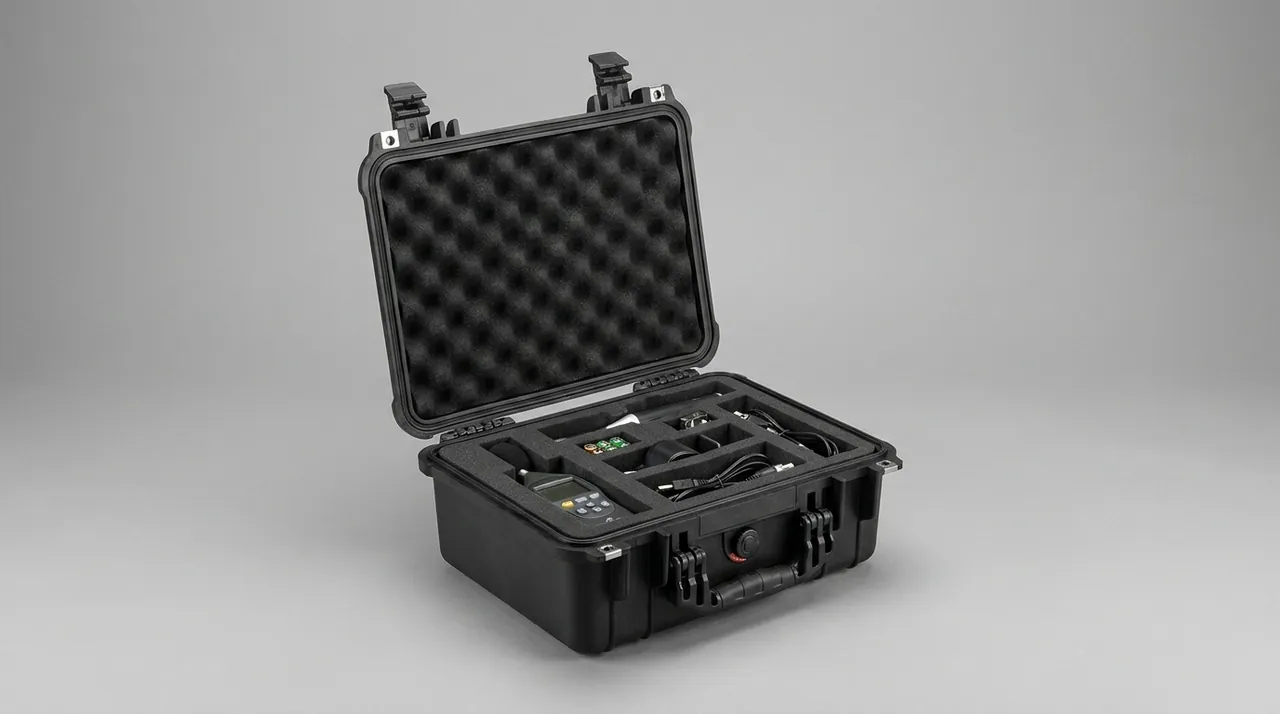
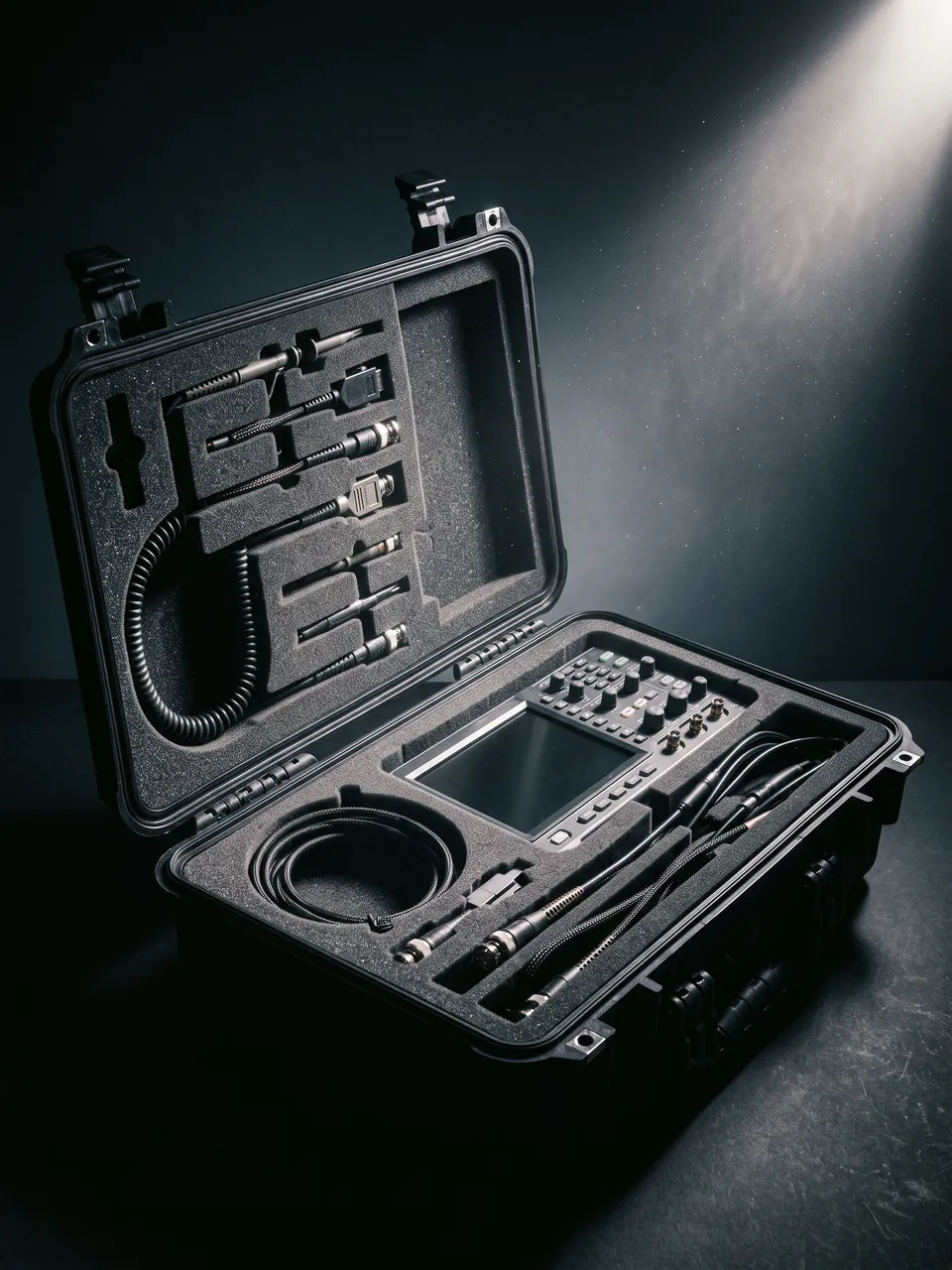
Fast field retrieval is the design goal that sets a detection instrument case apart. Zoning should follow the principles of host centered, probes adjacent, cables layered and spares in the corners. The host takes the largest cavity at the center so the center of gravity stays central. Probes are arranged next to the host by model, each in its own cavity and labeled. Cables go into a side pouch or around a winding post so they do not tangle with probes. Calibration coupons, batteries and a log book go into corners or the lid mesh pocket. For instruments that need two hands, the liner should not block the panel when the case is open, keeping the display and keys visible. In general, the more the zoning matches the actual workflow, the smoother the open, retrieve, read and stow cycle, and the lower the chance of contamination and collision.
Dust Sealing and Water Protection
Site dust and humid air are the long-term opponents of a field instrument, so sealing and dust exclusion are key metrics for a detection instrument case. The gap between lid and body is closed by a Case Seal Strip: The Key Waterproof and Dustproof Accessory for Protective Cases. A quality gasket is usually EPDM or silicone with good ozone, UV and aging resistance that stays elastic at low temperature. Common profiles include round, hollow rectangular and lip seals, and the lip type adapts to the closing lid for higher reliability. For rain and brief immersion, the case should reach IP67, meaning fully dust-tight and briefly immersible at a set depth without water ingress.
Sealing depends not only on the gasket but on even latch compression. A single over-tight latch deforms the case and leaves a local gap that breaks overall sealing, while multiple symmetrical latches distribute force around the lid. Routine maintenance should clean the gasket and latch gaps to keep grit and metal dust from forming leak-inducing dents, and should check for hardening or cracking after long use; the handling method is described in What to Do When a Protective-Case Gasket Ages. For cases opened frequently in dusty environments, a felt dust barrier and desiccant inside help: the felt traps some particles entering at the moment of opening while the desiccant keeps humidity low. The rating is only a design target; daily maintenance is what keeps sealing reliable.
Shock and Vibration Isolation
Shock isolation is the second main line of protection in a detection instrument case. The principle is to replace the rigid link between instrument and shell with a damped elastic link, so external impact energy is absorbed layer by layer through foam compression, elastomer deformation and damping loss, lowering the peak acceleration reaching the instrument. Sensors, optical windows and displays inside a detection instrument are sensitive to shock and high-frequency vibration, and insufficient damping causes a reading drift at best and structural damage at worst. The design must therefore serve two goals at once: isolate high-frequency vibration and limit large low-frequency displacement. The first relies on soft foam and damping material; the second relies on sensible compression against amplification near resonance.
In practice, a multi-layer damping structure outperforms a single layer. A common approach is a two-layer system of a shell damping layer plus a liner cushion layer: a thin damping film bonded inside the shell absorbs high-frequency chatter while the liner foam carries the main cushioning. For very sensitive hosts, a silicone pad or elastic support between instrument and insert creates three-stage protection. Damping must not be too soft, because overly soft foam can creep under sustained vibration and let the instrument sink out of constraint. Foam density should therefore match instrument weight, and at acceptance a free-drop and simulated transport vibration check should confirm the transmissibility target before batch issue. For instruments with a screen or glass window, add a pressure-spreading cushion over the display so a point load cannot crack the face.
On-Site Working Support and Error Prevention
In the field, a detection instrument case is often more than a transport container; it is a temporary bench. The lid interior should therefore be flat and ribbed so an instrument placed on it will not slide, and the case should hold a stable opening angle with a travel limit so the lid cannot snap back and pinch a wrist. For sites where the case is opened in rain or dust, choose a model that keeps a good sealing margin when open, or reserve a pocket for a rain cover inside the liner. Building working support into the case structure removes the need to hunt for a board or level ground on site and makes every reading more stable.
Error prevention matters just as much. Field instruments often have several probes and adapters of similar size, and without keyed cavities a mixed set leads to the wrong one being picked and a wrong reading recorded. A common approach is to design a unique cavity for each probe interface shape and size, then label it by color or number. For instruments whose keypad faces up, leave a finger recess above the panel so a power check is immediate. For instruments that need on-site calibration, fix the reference coupon and calibration fixture inside the case so the step does not depend on an external bench. The case structure can only lower the probability of error; documented procedures and training remain the root of correctness, and the design goal is to make the right action natural and the wrong one awkward.
Latches, Hinges and Load-Bearing Configuration
A detection instrument case often takes stacking pressure and impact in transit, so a latch must resist theft and also hold the lid closed under load. Common types include draw latches, butterfly catches, push latches and recessed combination locks. Draw latches are simple and load-stable, suiting heavier or larger host cases; butterfly catches open and close quickly for frequent field access; combination locks add a theft-resistance layer for unattended transfer. Selection should consider material and corrosion resistance, favoring stainless steel or corrosion-treated hardware so it will not rust shut in humid conditions; further points are covered in Case Latch: Pressure and Theft Resistance Hardware for Protective Cases and How to Choose a Protective-Case Latch: Types, Compression Points, and Selection Checklist.
Hinges and lid supports deserve equal attention. A detection instrument case is opened frequently, so a weak hinge will loosen and misalign over time and fail to compress the gasket. A metal-pin hinge with a travel limit keeps the opening angle controlled and prevents self-weight rebound. For kits with many accessories, an internal cable pouch and tool slot keep attachments from scattering and striking the instrument in transit. On the theft side, a steel cable seal and a numbered seal can make unauthorized opening visible during transfer. Latches and hinges are auxiliary protection; the real safety of a field instrument still rests on disciplined procedures and full-time supervision, with the container acting only as the last physical barrier that lowers risk.
Stacking, Transport and Whole-Case Securing
In warehouses, workshops and vehicles, detection instrument cases are often stacked in multiple layers to save space, which requires reliable stacking capability. Case Stacking Corner: Load-Bearing and Alignment Hardware for Stacked Cases lets upper and lower cases align precisely and routes upper weight into ribs and corner posts rather than thin walls, spreading the static load; the structural principle is discussed in How Do Protective Cases Achieve Stable Stacking? Stacking Ribs, Locator Bosses, and Interlocking Principles. Stack height depends on the rated stacking weight of a single case, its footprint and the bearing capacity of the bottom layer, and should follow heavy-at-bottom, light-at-top and same-size-first rules, with a transition board when mixing sizes and never exceeding the manufacturer's limit.
Transport securing also needs discipline. Wheeled models suit flat-ground towing, but on stairs, gravel and mud they should be carried by handle. Handles should sit on both sides of the center of gravity so a single-side load does not twist the case. For a whole stack in transit, use straps and anti-slip mats to secure the column so it cannot slide forward in a sudden stop. Stacking only solves static bearing; bumps in transit still have to be absorbed by the liner, and the two cannot replace each other. For a single case fixed in a trunk or on a rack, use the strap holes molded into the body so it cannot slide. For instruments with a fine optical path or a balance-type sensor, avoid long tilt and mark the exterior with this-way-up and tilt warnings.
Temperature and Humidity Management
Even with good sealing, the interior of a detection instrument case can still develop condensation under day-night temperature swings or high humidity. Field instruments shuttle between temperature zones, from an air-conditioned room to a sunlit pit and from rainy outdoors to a warm vehicle cabin, and the resulting condensation fogs optical windows, leaks across high-impedance circuits and corrodes metal parts. Cases therefore commonly include desiccant, humidity indicator cards or active dehumidification modules. Silica gel is inexpensive and can be dried and reused, making it an entry-level option, while color-changing silica gives a visual cue on moisture uptake. For long storage or cross-climate transport, an electronic humidity readout and a semiconductor dehumidifier hold relative humidity in a safe band.
Desiccant use needs the right amount and timing. The quantity should match case volume and transport duration; too little leaves dehumidification incomplete, while too much may release moisture back at extreme low temperature. After opening and retrieving gear, reseal promptly to keep outside moisture from flooding in. If the instrument moves from a cold environment directly into a warm, humid one, let it temper inside the sealed case before opening so its temperature approaches ambient and condensation risk falls. After wet-weather work, wipe off the surface water film before stowing so bulk water does not enter the case. Treating temperature and humidity as controlled variables, consistent with the environmental thinking in Precision Instrument Cases: CMM, Spectrometer & Laser Rangefinder Protection, extends instrument life.
Labeling, Inventory and Calibration Traceability
When a field team uses several detection instrument cases at once, labeling and traceability become the key to management efficiency. The lid exterior should carry instrument category, serial number, assigned crew, verification status, this-way-up and fragile marks so handling and dispatch are obvious. The interior should include a gear list, an accessory cross-reference and stowage numbers so every instrument and probe has a fixed place. Instruments that need metrological traceability should carry a calibration validity label that prompts a check before and after use. Modern management can add QR codes or RFID tags for scan-based counting and full lifecycle traceability, turning stock-taking from human memory into data verification.
Traceability pays off especially in detection work, where readings often serve as evidence. When an instrument drifts or fails, the cause must be separated into instrument aging, shock or moisture in storage and transport, or improper field use. By building a file for the case and its key instruments that records calibration dates, issue and return times, assigned crews and maintenance history, fault review can locate the stage quickly. For probes as wear parts, the file should also record use counts and visual inspection results, because probe wear directly decides measurement accuracy. Label materials should be weather-resistant, with critical warnings laser-etched or on metal nameplates so they do not peel and blur after sun and rain. Any labeling and traceability system should serve compliance management, and cross-border transport must follow local regulations and export-control requirements.
Molding Process and Custom Tooling
The molding process of a detection instrument case directly affects strength, sealing and consistency. Engineering-plastic shells mainly use injection molding or blow molding. Injection molding suits complex, precise cases, forming ribs, latch seats and seal grooves in one shot with even wall thickness and stable dimensions. Blow molding suits large hollow cases with good integrity and impact resistance but slightly lower detail precision. Metal shells are usually produced by stamping, bending and welding, then given a surface treatment to improve corrosion resistance. Before custom tooling, confirm the parting line, draft angle, shrinkage and gate location, and verify dimensions and assembly through trial molding to avoid uneven lid gaps or misaligned latches in mass production.
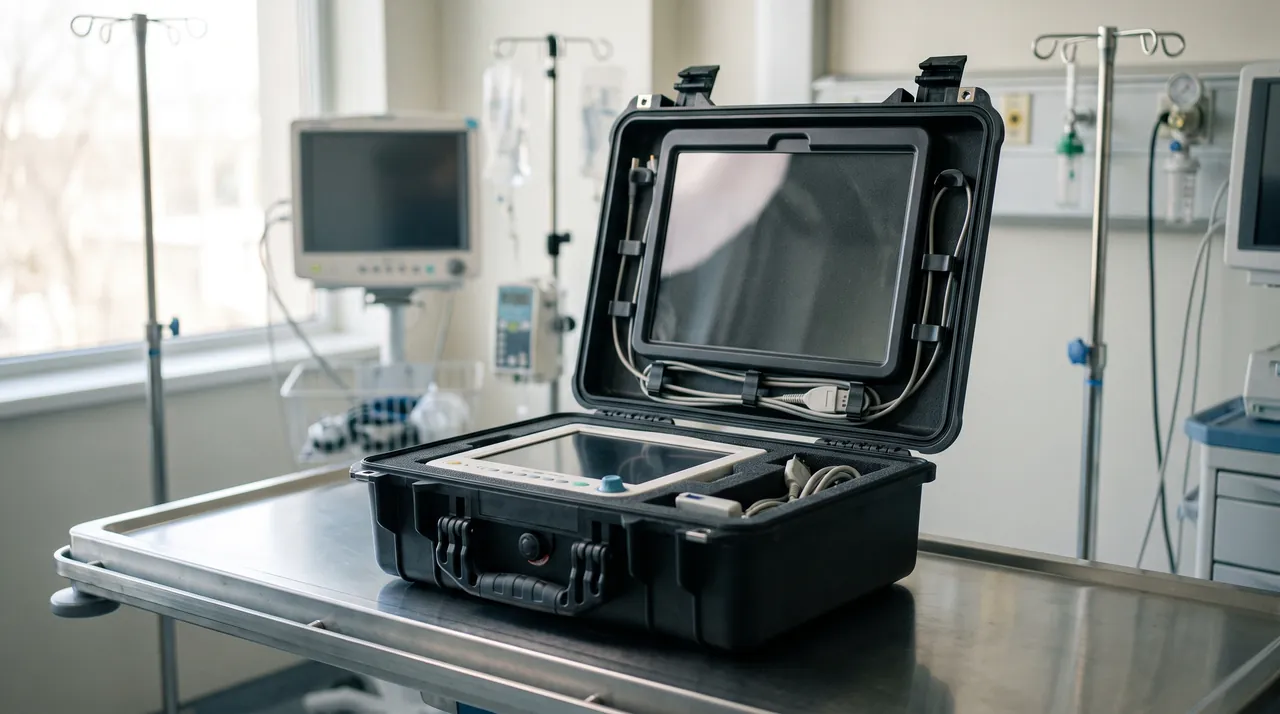
The customization workflow usually splits into shell tooling and liner processing. In the shell stage, the external shape, wall thickness, ribs and latch seats are designed from the instrument 3D model. In the liner stage, zoned foam is CNC carved or thermoformed from the instrument contour, probe shapes and the working workflow. Before tooling, confirm foam density, color and flame class, and design support zones at probe faces, displays and connectors. Although tooling has higher upfront cost, it maximizes fixed positioning and damping and lowers long-term breakage and repair cost. For small, frequently changing batches, a standard shell plus a custom liner delivers near-custom protection at lower cost. For one instrument family with several models, a common shell with differentiated liners lets variants share one shell mold, cutting cost while simplifying inventory.
Certification, Acceptance and Export Compliance
A detection instrument case is a packaging container, but its reliability is usually verified against general protective-case standards. Common references include IP ratings, MIL-STD-810H environmental engineering and test methods, and applicable domestic industry and military specifications covering drop, vibration, rain, dust, salt fog and low pressure. For field detection, the case protection rating and drop test results matter most, and the supplier should provide the corresponding test reports as objective evidence. At acceptance, the user should run a simple inspection: check for cracks and deformation, verify latch smoothness, confirm the gasket is complete and well seated, check that liner cavities match the instruments, and measure lid gap uniformity both empty and fully loaded.
A purchase specification should include at least shell material and wall thickness, liner material and density, sealing rating, latch type, stacking load, temperature range, certification basis and the liner zoning drawing, and it should write the acceptance checklist and critical-batch sampling requirement into the contract so quality decisions have a basis. For high-value detection instruments, a first-article vibration-table and free-drop check is recommended before batch issue. Finally, a clear note: this article discusses only the structural, material and performance aspects of the detection instrument case as a packaging container and does not address the internal measuring principles or technical parameters of the protected instruments. Cross-border transport and export of related equipment must follow local laws, regulations and export-control requirements and be assessed separately by the user; nothing here constitutes a compliance conclusion.
FAQ
Q: What is the essential difference between a detection instrument case and an ordinary tool box? A: The essential difference lies in protection precision and field fit. An ordinary tool box mainly holds wrenches and screwdrivers that tolerate knocks, with little demand on liner fit, sealing or damping. A detection instrument case serves precision instruments such as non-destructive test sets, gas analyzers, power quality meters and thermal imagers, so its core is zoned fixation, shock isolation, dust and moisture protection and fast retrieval. It is stricter in shell rigidity, liner molding precision, sealing rating, latch load-bearing and stacking design, and it is often carved one-to-one from instrument 3D data with unique cavities for probes and adapters so they cannot be mixed. A detection instrument case must also support on-site work, letting the lid or body act as a temporary bench when open. It is therefore not just about fitting and carrying, but about keeping the instrument measurable, readable and stowable at any moment, cutting setup time and error. Labeling the case with the instrument model also tells a new team member what to expect before the lid opens.
Q: How does a detection instrument case keep dust out on a dusty site? A: Dust exclusion works through three elements at once: sealing, compression and cleaning. For sealing, choose a case with a continuous seal groove and a quality lip gasket, preferably EPDM or silicone that stays elastic at low temperature. For compression, place latches symmetrically so the lid load is even, avoiding a single over-tight latch that deforms the case and leaves a local gap. For cleaning, wipe the case surface and latch gaps after every shift, especially the seal groove, so grit and metal dust cannot lodge there and form leak-inducing dents. For cases opened frequently in dusty conditions, add a felt dust barrier and desiccant inside: the felt traps some particles entering at the moment of opening while the desiccant keeps humidity low. If the instrument must resist rain, choose an IP67 case and check the gasket for hardening, replacing it promptly when it degrades. Keeping a spare gasket of the right profile on hand makes that replacement a routine task rather than an emergency.
Q: How should the liner be zoned for fast field retrieval? A: Zoning should match the actual workflow, following the principles of host centered, probes adjacent, cables layered and spares in the corners. The host takes the largest cavity at the center so the center of gravity stays central for two-handed carrying and stable reading. Probes are arranged next to the host by model, each in an independent, labeled cavity keyed to the interface shape. Cables go into a side pouch or around a winding post so they do not tangle with probes. Calibration coupons, batteries and a log book go into corners or the lid mesh pocket. For instruments read directly when the case is open, leave a finger recess above the panel so the display and keys are not blocked and a power check is immediate. The closer the zoning matches real field work, the smoother the open, retrieve, read and stow cycle and the lower the risk of contamination and collision, which directly raises site efficiency. A photograph of the correctly packed case taped inside the lid removes all guesswork for a replacement crew.
Q: Should the liner use EVA or cross-linked polyethylene? A: The choice should follow the instrument form factor and the site environment. EVA is balanced in hardness and toughness and molds easily, suiting hard inserts that match an instrument contour and give even circumferential support while resisting cracking at low temperature. Cross-linked polyethylene has a high closed-cell ratio, very low water absorption and good resilience, suiting dusty, humid or water-contact conditions with low long-term creep under compression. If a probe face or display is delicate and needs a soft wrap, a layer of soft polyurethane can be added at the contact surface. In practice, EVA often carries the main support while cross-linked polyethylene provides the environmental barrier, and the combination works best. The decision should also weigh instrument weight, transport duration and ambient temperature and humidity, and foam density must not be too low. Taking a small sample and measuring compression set is the most reliable way to confirm the choice. Keeping a record of the tested grade on the liner edge also makes later replacement straightforward.
Q: Does a detection instrument case need to be fully waterproof? A: Not every scenario needs full waterproofing, but dust protection and moisture control are general requirements. If the instrument works in rain, a pit, on a vessel or in a wet workshop, choose a case with a quality gasket rated IP67 or better and inspect the gasket regularly. If it mainly travels between a workshop and a laboratory, dust and splash protection is often enough, and chasing deep immersion adds cost and weight for little gain. Whatever the rating, the interior should work with desiccant or a dehumidifier, because even without water ingress, condensation from day-night temperature swings can fog optical windows, leak across high-impedance circuits and corrode metal parts. The key is to set the rating from the mission checklist and embed maintenance in the routine, wiping off surface water before stowing and replacing desiccant promptly so the interior stays dry and clean. A humidity indicator card visible through the lid lets a handler judge the state without opening the case.
Q: How should case labeling and calibration traceability be designed? A: Labeling should follow the principle of showing key information outside and holding a full list inside. The lid exterior carries instrument category, serial number, assigned crew, verification status, this-way-up and fragile marks so handling and dispatch are clear. The interior holds a gear list, an accessory cross-reference and stowage numbers so every instrument and probe has a fixed place. Instruments needing metrological traceability carry a calibration validity label prompting a check before and after use. Modern management can add QR codes or RFID tags for scan-based counting and full lifecycle traceability, and should record use counts and visual inspection results for probes as wear parts, because probe wear directly decides measurement accuracy. External labels must be weather-resistant, with critical warnings laser-etched or on metal nameplates. A one-case-one-file record of calibration dates and assigned crews lets any data anomaly be traced quickly. Backing the file up digitally means a lost label never erases the instrument's calibration history.
Q: Can detection instrument cases be stacked, and how high is appropriate? A: They can be stacked, but stacking corners must be used and the rated load must not be exceeded. Stacking corners let upper and lower cases align precisely and route upper weight into ribs and corner posts rather than thin walls, spreading the static load. Stack height depends on the rated stacking weight of a single case, its footprint and the bearing capacity of the bottom layer, and should follow heavy-at-bottom, light-at-top and same-size-first rules, with a transition board when mixing sizes. Stacking only solves static bearing; bumps in transit still have to be absorbed by the liner, and the two cannot replace each other. Vehicles should strap and anti-slip the whole column to prevent forward slide in a sudden stop, and a single case fixed on a rack or in a trunk can use the case's molded strap holes. Never exceed the manufacturer's stacking limit, and rotate long-term stacks to check the bottom cases for creep. Marking the approved stack height on the exterior helps new handlers comply without a special briefing.
Q: What documents should a buyer request from a detection instrument case supplier? A: Three categories matter most. First, material and structure documentation, including shell material, liner scheme and density, sealing structure, latch and stacking-corner configuration, and hardware corrosion treatment, to judge whether they meet the weight and field environment. Second, protection performance test reports such as IP rating, MIL-STD-810H or corresponding industry and military drop, vibration, rain, dust, salt-fog and low-pressure results as objective reliability evidence. Third, customization and maintenance information, including whether the liner can be CNC-carved from instrument 3D data, whether keyed cavities and cable storage are supported, and the replacement cycle and supply channel for gaskets. After delivery, run a simple acceptance check for cracks, deformation, sealing integrity, cavity fit and even lid gaps, and give high-value detection hosts a first-article vibration and drop check before batch issue, keeping the results in the instrument file. Comparing the delivered documents against the specification line by line before payment is the cheapest way to catch a mismatch.