


Case foam lining is the layer of cushioning accessory that sits closest to the equipment inside a protective case, and it directly determines the survival rate of internal devices during drops, transport vibration, and stacking compression. No matter how rigid the outer shell is, if the interior lacks a properly designed foam lining to isolate and locate the equipment, precision instruments can still collide with each other, rattle loose, or receive impact forces transmitted straight through the case wall. This article approaches the topic from a container engineering perspective, systematically explaining the materials, density, routing processes, zoned layouts, anti-static treatments, and maintenance points of case foam lining. It helps modification and procurement personnel select, cut, and maintain this protective case accessory correctly, and understand its systematic relationship with the Case Shell: Structural Materials and Molding Process of Protective Cases, the Case Seal Strip: The Key Waterproof and Dustproof Accessory for Protective Cases, and the Case Latch: Pressure and Theft Resistance Hardware for Protective Cases. Readers who need whole-case shock isolation reference can also read this alongside the Instrument Cases: Precision Meter Transport & Protection.
The Role and Function of Case Foam Lining in Protective Cases
The protective capability of a case is built from the shell, the seal, the latch, and the lining, among which the foam lining is the element nearest to the equipment and the one most easily underestimated. It does not carry the structural load of the whole case, yet it is responsible for converting external shock and vibration into controllable deformation, so that precision components are not subjected to hard, direct force transmission when the case is struck. As a fundamental protective case accessory, the value of foam lining is often only truly recognized at the instant an accident occurs.
Functionally, case foam lining performs three tasks at once: cushioning drop impact, fixing equipment position, and isolating devices from mutual friction. Cushioning determines whether the impact peak can be reduced to a level the equipment can tolerate; fixation determines whether the equipment slides or collides inside the case during transport; isolation reduces scratches and wear between metal and optical surfaces. These three tasks are interrelated, but the required materials and forming methods are not identical, so before any modification the equipment list, weight distribution, and transport conditions must be clarified first, and then the technical route for the foam lining decided. Treating foam lining as just a few random sponges is one of the most common root causes of on-site equipment damage.
From a maintenance perspective, foam lining is also the protective case accessory whose condition can be quickly judged on site. After opening the lid, simply observing whether the foam has collapsed, whether the cut pockets have deformed, and whether the equipment has loosened can give a preliminary judgment of the internal protection health. Establishing this low-cost routine inspection habit can intercept the vast majority of internal collision accidents before they happen.
Core Functions: Cushioning and Fixation
Cushioning and fixation may seem like similar requirements, but in practice their demands on foam are clearly different. Cushioning mainly relies on the energy-absorbing property of the foam: when the case drops or is struck, the foam extends the duration of the impact force as it compresses, thereby lowering the peak acceleration transmitted to the equipment. Fixation relies more on the pocket shape and resilient fit of the foam, so that the equipment is uniformly held in place without displacement. Both are necessary, but the emphasis differs.
In engineering, drop tests and vibration spectra are used to describe this boundary. For example, a transport vibration spectrum specifies acceleration magnitudes at certain frequencies, and the foam lining must keep the response transmitted to the equipment below that magnitude. As a protective case accessory, the cushioning efficiency and fixation reliability of foam must both meet standards; simply adding a thicker layer of soft foam does not automatically solve fixation. Understanding the boundary between cushioning and fixation is the first step in good lining design, and it is also the yardstick that distinguishes a qualified case from an excellent one. A well-designed lining therefore treats the two goals as a single coupled problem rather than two separate tasks.
Common Foam Materials: EVA, PU, and PE
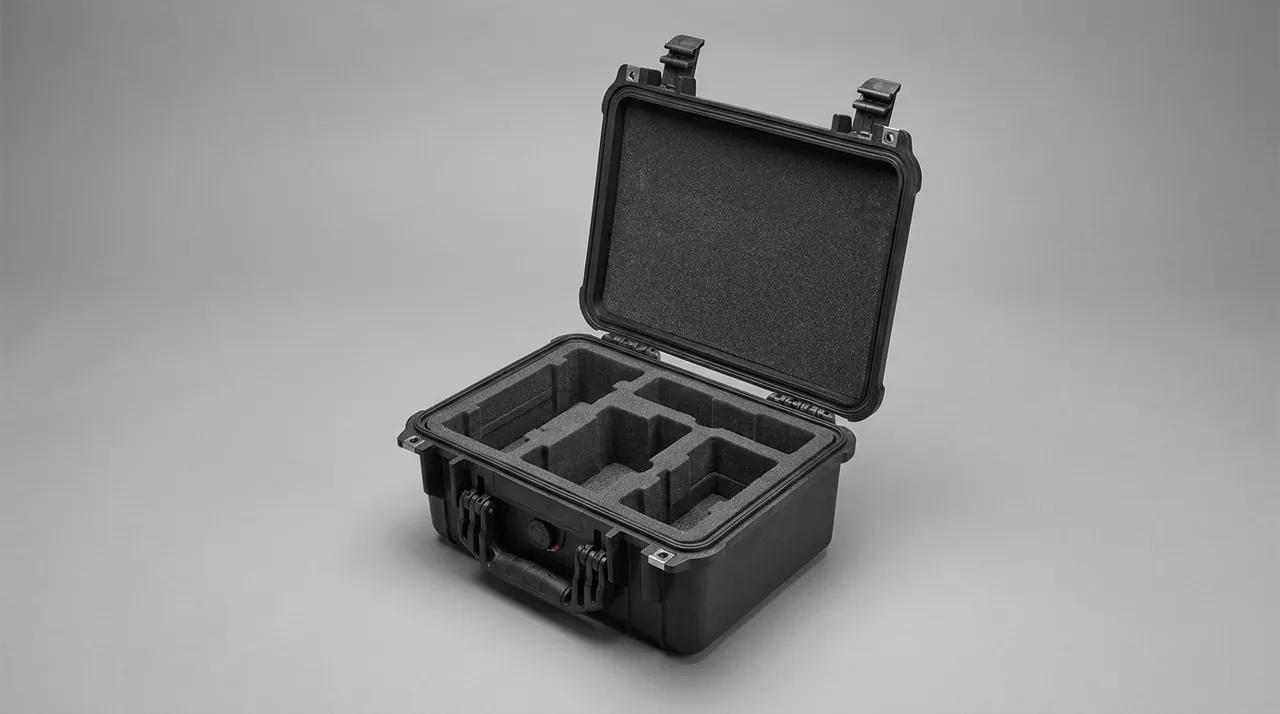
The three mainstream materials used for protective case lining are EVA, PU, and PE. EVA (ethylene-vinyl acetate copolymer) has good rebound, strong resistance to compression set, and is easy to CNC route, making it the most common foam lining choice for precision instrument cases. PU (polyurethane) foam is soft with a pleasant touch, suitable for light-contact protection of small lightweight accessories, but its permanent set after long compression is slightly higher. PE (polyethylene) cross-linked foam is closed-cell, chemically resistant, and light, suitable for scenarios requiring moisture resistance or mild liquid isolation.
Material selection should return to the characteristics of the equipment: heavier instruments that fear shock should prioritize EVA for rebound and support; light and scratch-prone accessories can use a PU soft-contact layer; environments requiring moisture resistance or oil contact should consider PE cross-linked foam. Whichever is chosen, the foam lining as a protective case accessory should clearly mark its density and color (to distinguish hardness grades), and lock the batch during stocking to avoid inconsistent support from mixing different hardness foams. In general transport scenarios such as Equipment Cases: General Instrument & Gear Transport Protection, material traceability is especially important. When procuring, require each batch to arrive with density and hardness test records, and sample for compression rebound verification on receipt to avoid suppliers substituting inferior material.
Furthermore, the color of foam does not equal performance. Common black, gray, and blue foams owe their color to fillers or dyes, with no direct relation to cushioning ability. Selection should be based on density, hardness, and closed-cell ratio, not misled by appearance. A single case should preferably fix one material and one hardness to reduce the uncertainty of mixed use.
Engineering Selection of Foam Density and Hardness
Density and hardness are the most central parameters in foam lining engineering, directly determining the support force and the shape of the cushioning curve. If the density is too low, the foam cannot support the equipment weight and will collapse under long-term compression; if too high, it becomes too hard with a short cushioning stroke, instead transmitting shock directly during a drop. Precision instrument linings commonly use EVA in the range of thirty to eighty kilograms per cubic meter, depending on equipment weight and allowable compression.
Hardness is usually expressed by Shore hardness. As a protective case accessory, the hardness of foam lining should match the brittleness and weight of the equipment: heavy but not brittle equipment can use firmer foam for bottom support, while light and brittle optical parts need a two-stage structure with a softer top layer over a harder base. For acceptance, a simple check can be done: compress the sample to the design compression for a period, release, and measure the rebound height; insufficient rebound means changing the supplier or adjusting density. For demanding cases such as Optical Instrument Case: Zoned Protection and Shock Isolation for Precision Optics, density sampling cannot be omitted.
Cutting Processes: CNC Routing and Die Cutting
Foam lining forming generally uses two processes. CNC routing uses a numerically controlled cutter to carve the equipment contour pockets into a solid foam block according to a three-dimensional model, with high fit and support for small-batch customization, suitable for protective case accessory solutions with complex equipment shapes or mixed models. Die cutting uses a knife mold for batch punching, with high efficiency and low cost, suitable for standardized linings with regular shapes and large volumes.
Regardless of process, as a protective case accessory, the tolerance of the cut pockets is critical: the pocket width should be slightly smaller than the equipment outline, using foam rebound to hold it; the pocket depth should leave a cushioning margin above the equipment after insertion, avoiding contact with the lid. When making foam lining, modification shops should prioritize obtaining the real three-dimensional dimensions or physical samples of the equipment to reduce looseness from dimensional deviation. Like the Photography Equipment Case: Shock Isolation and Dust Protection for Imaging Gear, foam lining is also a basic accessory affecting whole-case reliability and should not be taken lightly.
Zoned Layout and Equipment Positioning
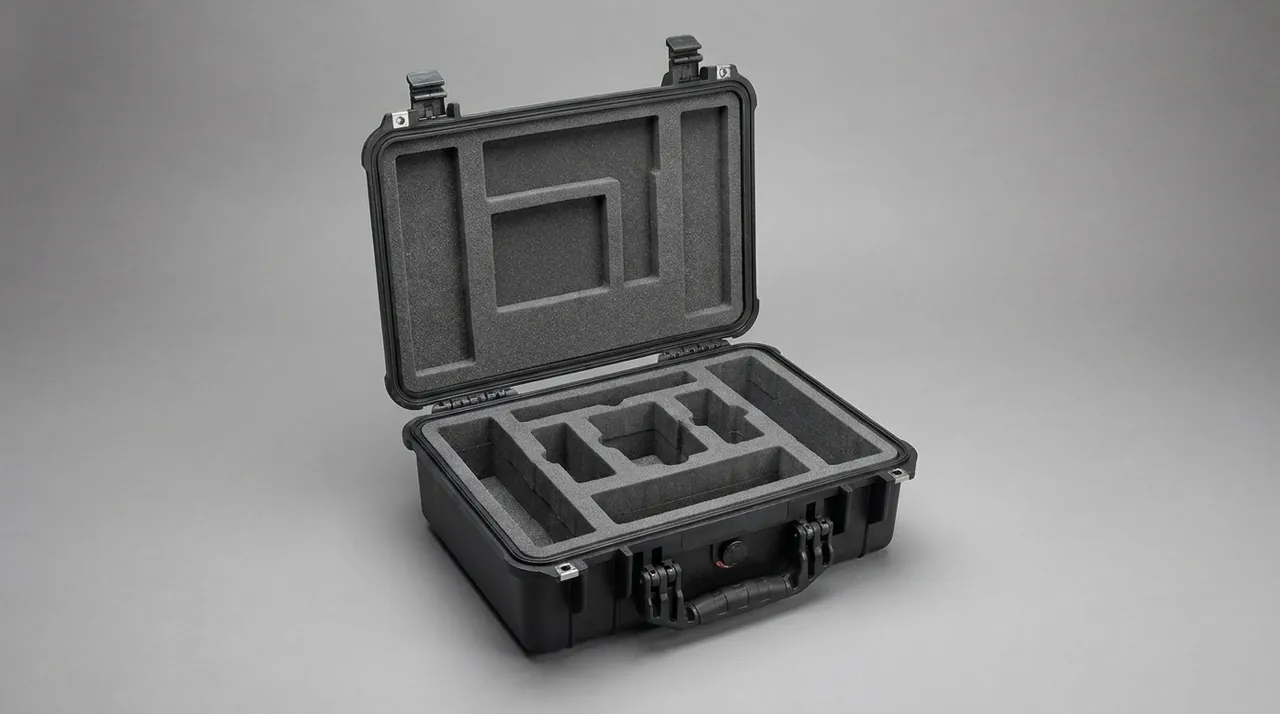
Foam lining is not simply stuffing equipment into a box, but requires zoned positioning: place heavy parts at the bottom near the center of gravity, light and brittle parts on the upper layer with isolation, and cables and accessories in separate pockets to avoid tangling. A reasonable zone keeps equipment from squeezing each other in any orientation and facilitates quick access and inventory.
As a protective case accessory, zoning design must coordinate with the internal dimensions and lid depth of the case: flip-top cases should also arrange a thin foam layer on the lid side for compression, so the equipment is clamped top and bottom; opposite-opening cases should have the two half linings interlock, leaving no gap after closing. Design should reserve tolerance for shell processing and foam thickness, avoiding looseness or over-tightness from dimensional fluctuation. For mixed-model task cases, replaceable lining modules are recommended to quickly change pocket layouts by mission.
Anti-Static and Damping Material Applications
When the case carries electrostatic-sensitive components such as circuit boards and sensors, the foam lining needs additional anti-static treatment, for example using conductive or anti-static foam and forming an electrostatic discharge path inside the case. Ordinary foam may generate static accumulation from friction in dry environments, posing a hazard to sensitive components. As a protective case accessory, anti-static lining should specify surface resistance range in the technical requirements and be tested periodically.
Damping materials are used to suppress resonance at specific frequencies, for example adding a viscoelastic damping layer between the foam and the equipment to absorb energy from transport vibration. For the overall protection of sensitive components, see Sensor Case: ESD and Shock Protection for Sensitive Elements. Reasonably combining anti-static and damping can upgrade foam lining from a simple soft pad to a systematic vibration isolation platform.
Synergy with the Case Shell
Foam lining is not an isolated part; it is directly related to the rigidity and internal cavity dimensions of the Case Shell: Structural Materials and Molding Process of Protective Cases. If the shell lacks rigidity and deforms as a whole under transport vibration, the cushioning stroke of the foam lining is compressed and support fails; if the internal cavity dimensions fluctuate, gaps appear between the foam and the case wall, and the equipment rattles. Therefore, improving internal protection often starts with the manufacturing tolerance and rib layout of the shell.
In modification practice, the foam lining and shell are often tuned as a system: first confirm the net internal dimension, then design foam thickness and pocket depth, and finally use the compression of the How to Choose a Protective-Case Latch: Types, Compression Points, and Selection Checklist to keep the lid-side compression foam stably clamping the equipment. Only when the shell and lining cooperate can the protective case accessory system function stably; any single-point optimization is hard to compensate for a system shortfall.
System Relationship with Seal Strip and Latch
The cushioning effect of foam lining also depends on the joint protection of the Case Seal Strip: The Key Waterproof and Dustproof Accessory for Protective Cases and the Case Latch: Pressure and Theft Resistance Hardware for Protective Cases. The seal strip ensures external moisture and dust do not enter the cavity, avoiding performance decline from foam moisture absorption; the latch provides stable closing compression, so the lid-side compression foam always stays close to the equipment and does not loosen from transport jolts.
In engineering, an acceleration recorder can be placed between the equipment and foam to measure the peak response during transport, and adjust foam density or pocket depth accordingly. As a protective case accessory, the compression stroke of the latch should also match the lid-side foam thickness: too short a stroke leaves it uncompressed, too long causes long-term foam collapse. The balance between the two is the key to whole-case internal protection stability, and directly relates to the long-term performance of the case during drops and transport vibration.
Balancing Lightweighting and Load Bearing
While providing cushioning, foam lining also adds weight, and for cases that must be carried or air-freighted, weight reduction matters. Weight reduction is not simply thinning: it can be achieved by using low-density closed-cell PE foam, adopting hollow support structures, and cutting weight-reduction cavities in non-load areas. As a protective case accessory, lightweight design must return to the real load path of the equipment, ensuring sufficient support at load points and not sacrificing cushioning in weight-reduction zones.
For carry cases with strict weight control, a balancing design is recommended: place heavy parts centrally, symmetrically route the lining, so the whole-case center of gravity is stable and avoids collision from offset when carried with one hand. Trade-off testing between lightweight and reliability is necessary; weight reduction must not sacrifice the critical drop cushioning margin.
Temperature, Humidity, and Aging
Foam lining is exposed to temperature and humidity changes over time, and the material gradually ages. EVA softens and loses rebound under sustained high temperature; PU foam absorbs moisture and its cushioning degrades while easily breeding mold; PE cross-linked foam has better temperature and humidity resistance but hardens at low temperature and shortens its cushioning stroke. Cushioning performance declines with aging, manifesting as surface powdering, collapse, or permanent compression marks.
As a protective case accessory, the environmental adaptability of foam lining should be written into technical requirements at selection: clarify the operating temperature range, whether high humidity or salt fog, and whether long-term outdoor use. The larger the temperature difference between storage and transport environments, the more attention should be paid to the two boundaries of low-temperature hardening and high-temperature softening. Regular visual inspection of foam surface condition is a low-cost and effective preventive measure. In extreme environments such as desert, seaside, or high altitude, inspection frequency should be further increased. Seaside environments should especially pay attention to salt fog corrosion of foam and shell; after each use, clean the cavity and dry it. At high altitude with large day-night temperature differences, the foam hardens at low temperature, and the opening feel and cushioning performance change with the environment, so rebound under low temperature should be checked during inspection.
Maintenance, Cleaning, and Replacement
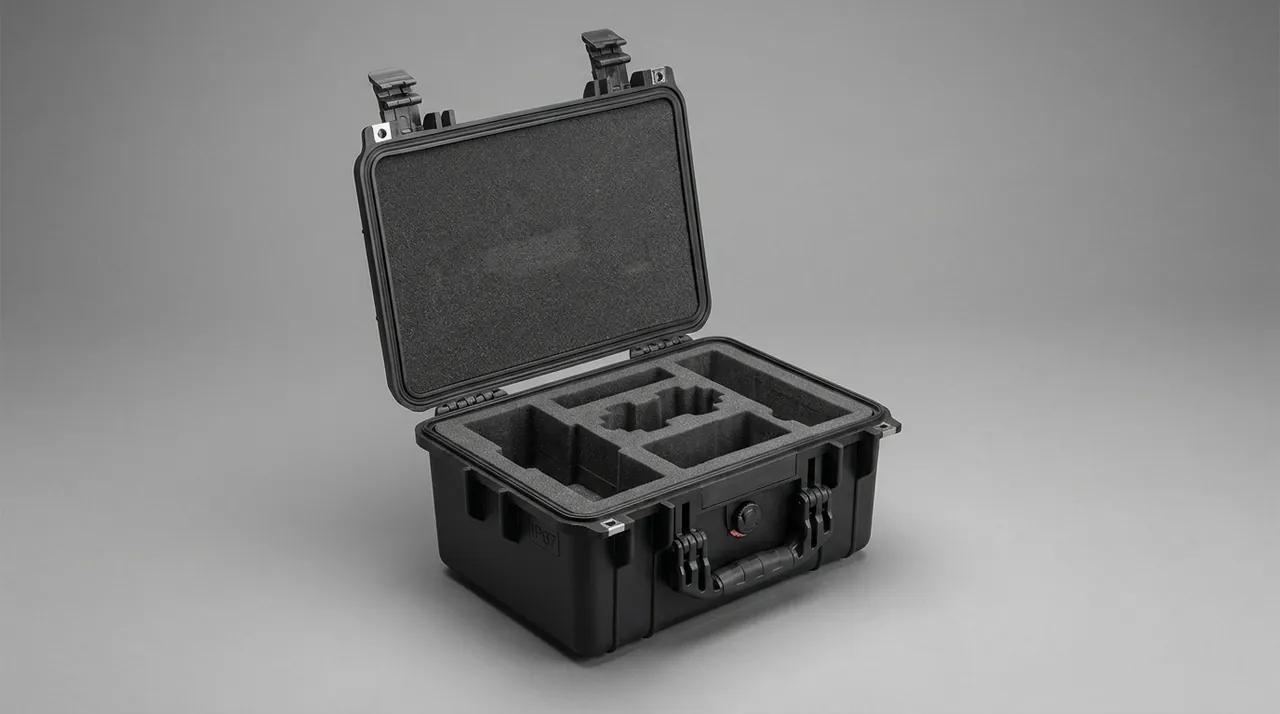
Foam lining has no fixed shelf life; actual life depends on opening frequency, environmental severity, and material. Signals for replacement include: surface powdering or crumbling, obvious and unrecoverable compression marks after pressure, loosened rattling equipment after insertion, or cracked pocket edges. Any signal appearing warrants replacement.
In daily maintenance, the foam lining among protective case accessories must avoid strong solvent wiping, which swells or embrittles the foam. Use a neutral cleaner with a soft cloth, and keep the cavity ventilated after drying. Establish a replacement ledger recording loading time and conditions by batch, helping shift from passive repair to planned maintenance. The Case Stacking Corner: Load-Bearing and Alignment Hardware for Stacked Cases, another accessory affecting storage and transport reliability, should also be included in ledger management. The storage and transport environment is often less controllable than the use site, so checking the lining status once before outbound and after return is a highly cost-effective habit.
It should be emphasized that foam lining replacement is not complicated, but must be standardized. When removing old foam, thoroughly clean residual glue and debris, confirm the cavity is undamaged before installing new foam; adhesive processes should control glue amount and curing time per instructions, and embedded processes should confirm foam fits the wall without warping. After replacement, a simple drop or vibration check is recommended to confirm secure equipment fixation before delivery, avoiding going to work with defects.
In maintenance practice, attention should also be paid to the cleanliness of the contact surface between the lining and the equipment. If dust or sand is trapped long term between the foam pocket and the equipment, it acts like an abrasive during opening or transport vibration and scratches the equipment surface, especially optical lenses and precision metal faces. Therefore, every return-to-base service should, besides checking the foam itself, clean the fine particles from the pockets using a soft brush or compressed air. For long-term sealed cases, placing a thin cotton cloth or anti-static bag between the equipment and foam both isolates direct-contact wear and reduces the effect of foam effluent on the equipment. Making cleaning a mandatory item in the maintenance ledger extends the protection of foam lining from cushioning to cleanliness, further lowering the hidden loss of equipment during storage and transport. A small amount of routine care thus preserves both the lining and the valuable contents it is meant to protect.
Selection Checklist and Common Mistakes
When selecting foam lining as a protective case accessory, confirm item by item per checklist: clarify the equipment list and weight distribution, determine net internal dimensions and lid depth, select material density and hardness, determine cutting process and tolerance, plan zoning and anti-static requirements, obtain samples for compression rebound testing, and plan replacement cycle. Implementing each item avoids the embarrassment of looking full but being loose in use.
Common mistakes include: believing softer foam always protects better, using thicker foam to force fixation, ignoring equipment center of gravity and zoning, procuring by price instead of density parameters, and mixing different batches causing inconsistent support. Correcting these mistakes is essentially thinking of foam lining within the whole-case system, rather than treating it as a randomly padded sponge. Only by establishing a four-in-one accessory view of shell, seal, latch, and lining can the protective case be truly reliable.
Frequently Asked Questions
Q: How often does protective case foam lining generally need to be replaced? A: Foam lining has no uniform replacement cycle; actual life depends on opening frequency, environmental severity, and the selected material. Scenarios with long-term outdoor exposure, frequent opening, or high humidity and salt fog accelerate aging significantly and may require inspection and replacement within about a year, while static storage in stable temperature and humidity can last much longer. Judgment for replacement should look at concrete signals: surface powdering or crumbling, obvious and unrecoverable compression marks after pressure, loosened rattling equipment after insertion, or cracked pocket edges. Any signal appearing warrants replacement. Daily cleaning with a neutral agent and a soft cloth, while avoiding strong solvents, can significantly slow aging and shift passive repair into planned maintenance. Establishing a replacement ledger and recording loading conditions by batch helps proactively schedule replacement before problems occur, rather than repairing only after equipment collision. For critical-task cases, a dual trigger of service years and opening counts is recommended so that preventive replacement happens before any performance decay reaches a dangerous level, protecting both the equipment and the operating schedule from unexpected downtime.
Q: Why is the claim that softer foam always protects equipment better incorrect? A: The cushioning protection of foam does not depend on softness alone, but on whether it can reduce the impact peak to a level the equipment tolerates while stably fixing the equipment. Over-soft foam is completely flattened under equipment weight or drop impact, losing its cushioning stroke and transmitting shock directly to the equipment; over-hard foam has a short stroke and may also transmit peak force to brittle parts. The correct approach is to select matched density and hardness by equipment weight and brittleness: heavier parts use firmer foam for support, brittle parts use a softer top layer over a harder base in a two-stage structure. In addition, fixation matters; pocket width should be slightly smaller than the equipment outline to use rebound clamping. Evaluate foam within the whole-case system rather than pursuing softness in isolation. On-site, use an acceleration recorder to measure transport response and find the section that truly needs adjustment. Only by balancing support, stroke, and fixation can the lining deliver reliable protection across the full range of handling and transport hazards the case will actually meet.
Q: How should EVA, PU, and PE foam be selected? A: The three have different emphases. EVA has good rebound, strong compression-set resistance, and is easy to CNC route, making it the most common lining choice for precision instrument cases, suitable for heavier shock-fearing equipment. PU foam is soft with a pleasant touch, suitable for light-contact protection of small lightweight accessories, but its permanent set after long compression is slightly higher. PE cross-linked foam is closed-cell, chemically resistant, and light, suitable for moisture-resistant or oil-contact environments. Selection should return to real equipment characteristics: heavy but not brittle prioritizes EVA, light and scratch-prone can use a PU soft-contact layer, and moisture or chemical resistance considers PE. Whichever is chosen, clearly specify density, hardness, and closed-cell ratio to the supplier, and obtain samples for compression rebound testing to ensure batch consistency. Do not judge by color or touch alone; rely on measured density and rebound rate. Where multiple materials are possible, run a small comparative drop test with the actual equipment so the choice is validated by data rather than assumption, and document the result for future procurement.
Q: How should foam lining pockets be cut to avoid looseness? A: Pockets should make the equipment uniformly held by the foam after insertion; any loose section lets the equipment slide and collide inside the case. The pocket width should be slightly smaller than the equipment outline, using foam rebound to clamp; the pocket depth should leave a cushioning margin above the equipment after insertion, avoiding contact with the lid. Flip-top cases should also arrange a thin foam layer on the lid side for compression, clamping the equipment top and bottom; opposite-opening cases should have the two half linings interlock, leaving no gap after closing. After installation, gently shake the closed case to check whether the equipment is stable and whether there is displacement or light leakage. For adhesive processes, the glue layer should be continuous and full, using a specialized aging- and temperature-resistant adhesive. After completion, a simple drop or vibration check is recommended to confirm secure fixation before delivery. Poorly cut pockets are the leading cause of in-transit damage, so spending extra time on accurate measurement and a physical fit test pays off far more than any later reinforcement effort.
Q: What should be noted for lining when loading electrostatic-sensitive components? A: When the case carries electrostatic-sensitive components such as circuit boards and sensors, the foam lining needs additional anti-static treatment, for example using conductive or anti-static foam and forming an electrostatic discharge path inside the case. Ordinary foam may generate static accumulation from friction in dry environments, posing a hazard to sensitive components. As a protective case accessory, anti-static lining should specify surface resistance range in technical requirements and be tested periodically for performance decay. At the same time, a viscoelastic damping layer can be added between the foam and equipment to absorb transport vibration energy and suppress resonance at specific frequencies. Reasonably combining anti-static and damping upgrades foam lining from a simple pad to a systematic vibration isolation platform; the overall protection can refer to sensitive-component protection schemes. Only by managing both electrostatic and vibration lines can sensitive components be reliably protected. Document the measured surface resistance on the ledger so that gradual conductivity loss is caught during routine inspection rather than after a static damage event.
Q: Can aged foam lining be remedied by simply thickening it? A: It is not recommended to force fixation and cushioning by thickening foam. The internal cavity dimension is the support boundary of the foam; foam that is too thick exceeds the design clearance, and the lid-side compression layer is over-compressed at closing, leading to long-term collapse; too thin leaves the equipment unstable with rattle space. The correct approach is to first confirm the net internal dimension and real equipment size, then select matched density and thickness foam and re-route the pockets. Foam thickness must be designed jointly with equipment weight and allowable compression; insufficient thickness cannot support, excessive thickness squeezes the lid depth. During modification, prioritize the original internal dimension and routing method; if the cavity is severely deformed, repair the shell or add an inner liner insert rather than simply thickening foam. If the foam has powdered or cracked, replace the whole layer uniformly to avoid uneven support from mixing old and new. Thickening also adds uncontrolled weight, which can push the whole case beyond its carry or air-freight limit and create new handling risks.
Q: What cleaner can be used to maintain foam lining? A: As a protective case accessory, foam lining must avoid strong solvent wiping; gasoline, banana oil, strong alkali, or strong acid cleaners swell or embrittle the foam, accelerating aging and powdering. Daily maintenance recommends a neutral cleaner with a soft cloth to remove surface dust and salt fog residue, rinsing with water if necessary and drying while keeping the cavity ventilated. After drying, no oil-based protectant is needed because foam does not rely on an oil film for corrosion resistance. Cleaning frequency depends on the environment; seaside, saline, or dusty scenarios should increase inspection and cleaning frequency. Establish a replacement ledger recording loading time and conditions by batch to shift maintenance from passive repair to planned management. Each maintenance should also check pocket edges and equipment fit to detect aging early. A quick visual pass after every return from the field is enough to catch most problems while they are still cheap to fix, turning what would be a costly equipment failure into a routine, scheduled foam replacement that keeps the case ready for the next mission.
Q: What are the risks of mixing different batches of foam during modification? A: Even if different batches of foam are nominally the same model, process fluctuations from suppliers may cause differences in density, hardness, or rebound rate. After mixing, the support and cushioning of different sections within the same case become inconsistent; during transport vibration, locally soft sections collapse while locally hard sections transmit shock, unbalancing overall protection. In addition, different materials age at different speeds, making the overall replacement cycle hard to plan. During modification and stocking, lock the same supplier, same density and hardness as much as possible, and retain batch numbers for traceability. When replacing, uniformly replace the whole layer to avoid uneven support from mixing old and new. For critical-task cases, strictly enforce same-batch whole-layer replacement to ensure consistent cushioning and fixation performance. Mixed batches also complicate failure analysis, because when damage occurs it becomes difficult to tell whether the cause was material variation or a design flaw, delaying the corrective action that would prevent recurrence.