

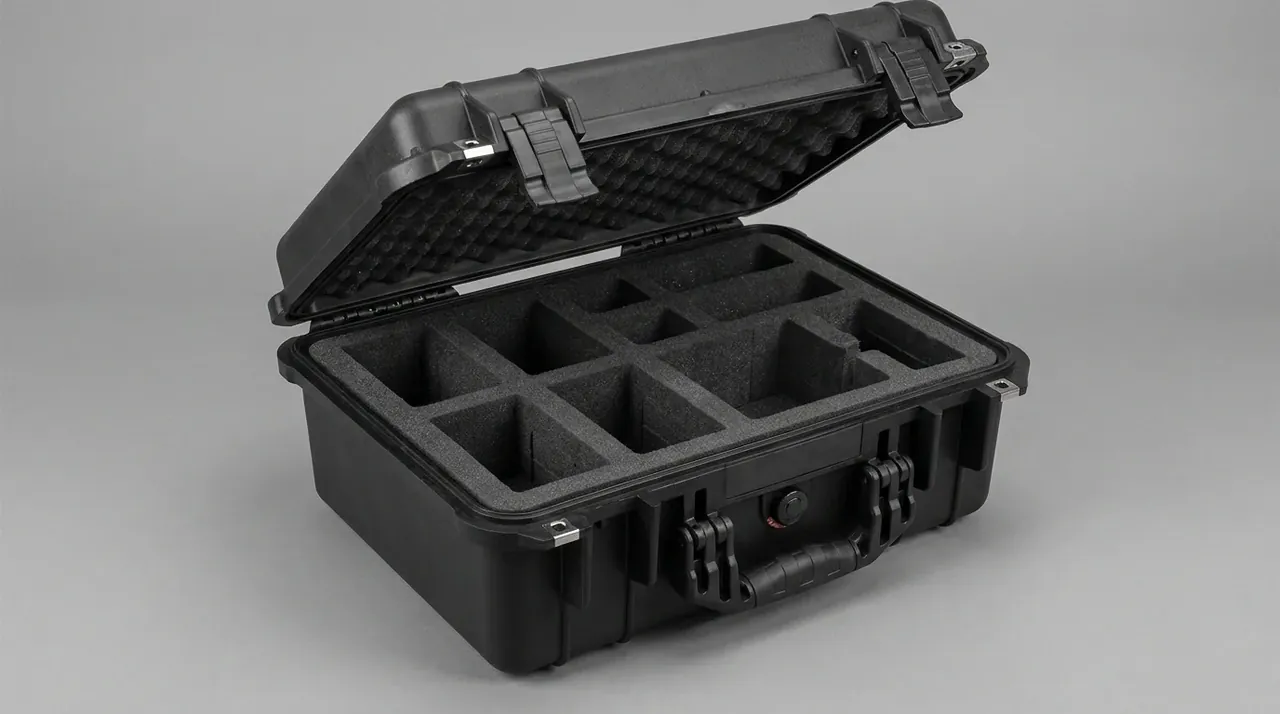
Quick answer: A hydrogen nozzle case holds a -40 C body with a PTFE ring and an EPDM O-ring in series at 20 percent squeeze and 40 N·m, inside ISO 19/16/13.
Table of contents
- Picking Materials for Minus Forty
- Two Seals: PTFE First, EPDM Second
- Twenty Percent Squeeze at Forty Newton Metres
- Holding ISO 19/16/13 Inside
- Dust Cap and Three O-Ring Bays
- FAQ
1. Picking Materials for Minus Forty
A nozzle lifted from this case may still be at -40 C on its body, and that heat pulls the inner wall below -20 C within 10 min. Material selection starts there, not with colour.
Homopolymer PP embrittles around -20 C: a grade at 40 kJ/m² of notched impact falls to about 12 kJ/m² at -40 C. Copolymer PP holds 25 kJ/m², costing 8 percent stiffness that 6 ribs put back.
Hinges and latches move to PA66 with 30 percent glass, keeping 70 percent of impact strength at -40 C. Metal parts are 304 stainless, since no oil is allowed inside and a breached coating would have nothing to slow moisture.
Cycling runs 20 times between -40 C for 4 h and 20 C for 2 h, checking for wall cracks, permanent set in the seals and latch force within 15 percent.
Frost follows: a body at -40 C draws 0.1 mm of white frost onto the liner, and 30 g of desiccant holding the dew point under -20 C keeps melt water at 0.02 g.
| Temperature node | Where it lands | Material | Limit |
|---|---|---|---|
| -40 C body | Inner wall | Copolymer PP | Impact 25 kJ/m² min |
| -20 C wall | Hinge | PA66, 30% glass | 70% impact retained |
| 4 h at -40 C | Seals | PTFE ring, EPDM ring | Set 25% max |
| -50 C brittle point | Second stage | EPDM | No crazing |
2. Two Seals: PTFE First, EPDM Second
Stage one is a PTFE ring, 3.5 by 2.0 mm, rated -200 to 260 C, and it stops particles. Stage two is an EPDM O-ring, 3.5 mm cord, brittle at -50 C, and it stops gas and water. A 1.5 mm buffer cavity sits between them.
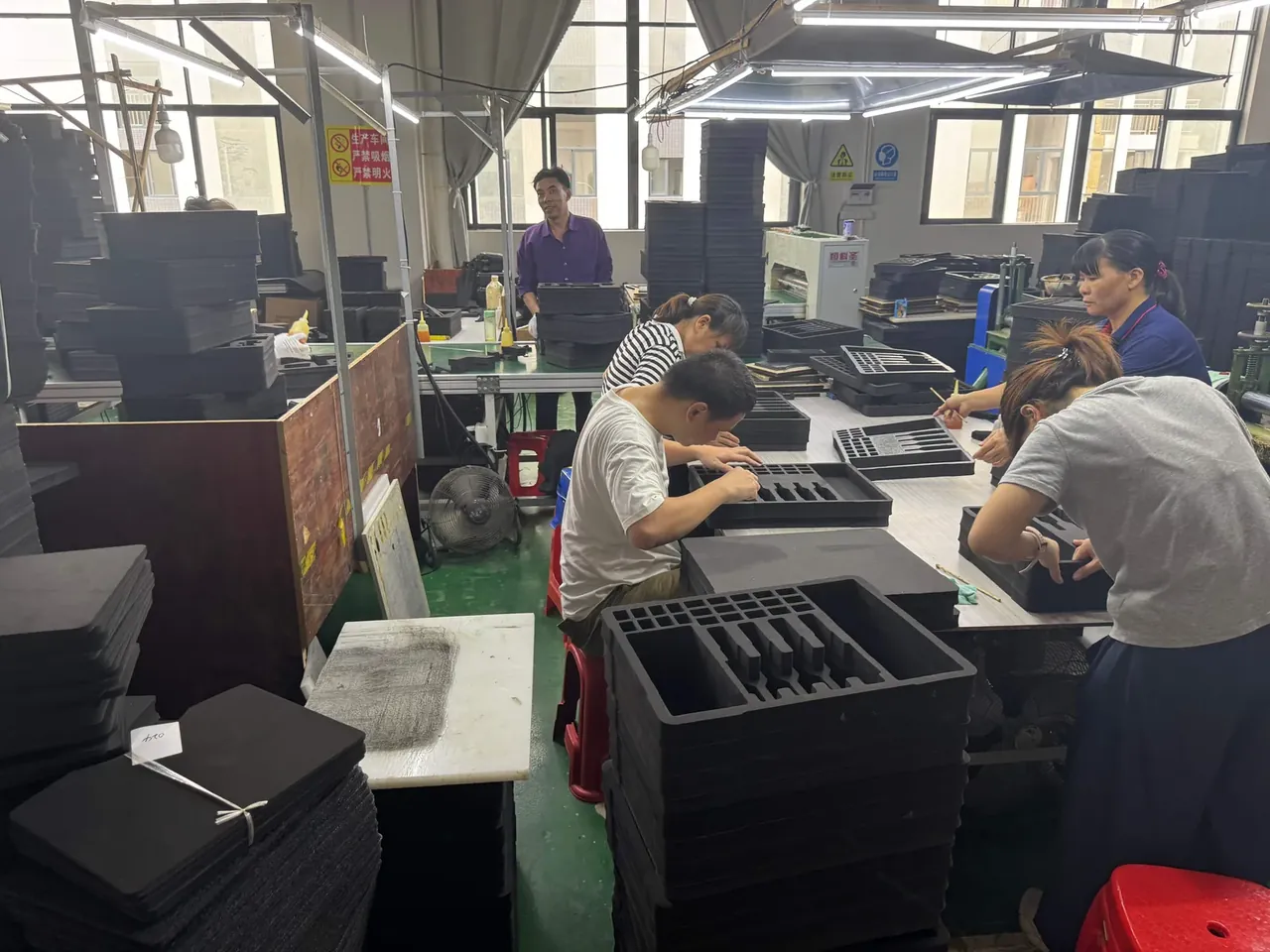
PTFE recovers only 12 percent of a 20 percent squeeze, so it cannot work alone; EPDM recovers well but extrudes, hardening from 70 to 85 Shore A at -40 C, and the ring ahead blocks that path.
EPDM must hold set under 25 percent after 22 h at -40 C, or the second assembly leaks; that figure, not room temperature hardness, is the one to specify.
The cavity earns its 1.5 mm: trapped air between -40 C and 20 C compresses 3 percent and rises 4 kPa, which the cavity absorbs instead of loading the first ring.
| Seal stage | Material | Section | Duty |
|---|---|---|---|
| First | PTFE ring | 3.5 x 2.0 mm | Particles, residue |
| Second | EPDM O-ring | 3.5 mm cord | Gas and water |
| Groove | Lid channel | 2.8 mm deep, 4.6 mm wide | 20% squeeze |
| Buffer | Between stages | 1.5 mm | Absorbs 4 kPa |
3. Twenty Percent Squeeze at Forty Newton Metres
Groove depth 2.8 mm and width 4.6 mm against a 3.5 mm cord put squeeze at 20 percent. Under 15 percent it will not seal; over 30 percent it takes a permanent set out of EPDM at -40 C.
Four M10 bolts at 40 N·m give about 25 kN each, 100 kN in total; about 36 kN of that reaches the 12 mm sealing face, or 8 MPa, far above the 4 kPa the case may see.
Torque is not a feel thing. At 50 N·m the PTFE ring collapses 0.15 mm and leaves a step in the sealing face, which becomes the leak path on reassembly.
After 20 cycles between -40 C and 20 C, residual torque must stay above 92 percent; below that, bolts are replaced. Recheck is due at 50 assemblies or 3 months.
4. Holding ISO 19/16/13 Inside
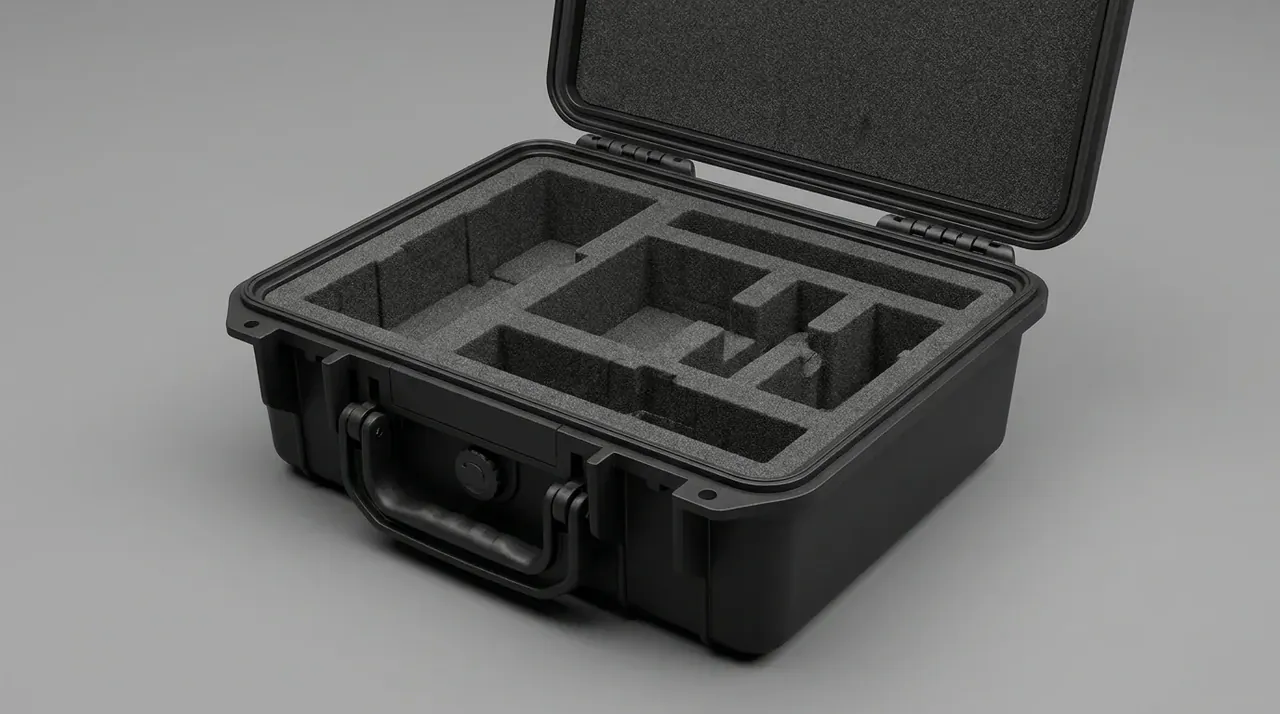
Cleanliness follows ISO 4406 at 19/16/13: 2500 particles above 4 μm per millilitre, 640 above 6 μm, 80 above 14 μm. None of that is met by a filter; it is met by the inner surface.
Finish is Ra 1.6 μm. The cavity is polished to 0.8 μm so no drag mark survives ejection, since a 0.05 mm mark is a trap no cloth reaches.
Wiping is two passes, dry cloth then isopropyl alcohol, one direction only; back and forth pushes particles into the middle of the cavity.
Nothing oily goes inside: no rust preventive, stainless hinge pins in PTFE bushes, zinc-nickel latches. That is what no-oil means on the case side.
Closed cell EPDM foam, not open cell PE, whose walls hold what a two pass wipe leaves behind; a continuous skin lifts removal from 60 to 92 percent.
Thirty minutes open indoors takes code 19 to 20 and humidity from 30 to 45 percent RH; outdoors the same 30 min reaches 55.
| Opening event | Particle shift | Humidity | Action |
|---|---|---|---|
| Routine pick, 5 min | No step | 30 to 34% RH | Cap back on |
| Field refit, 15 min | One step | 30 to 40% RH | Wipe, then close |
| Open outdoors, 30 min | Two steps | 30 to 55% RH | Two pass wipe |
| Spare swap | No step | Unchanged | Reset the bay |
5. Dust Cap and Three O-Ring Bays
The dust cap is a 30 mm silicone plug, hand tight at no more than 2 N·m, with a 1 mm lip that lands on the nozzle interface face and keeps particles outside it.
Three spare bays of 40 by 40 by 12 mm sit in the lid, shielded from light and ozone, since EPDM crazes within 5 years. Spares never share a bay with the ring in service; a 0.2 mm difference is invisible until it fails.
The loaded case runs 11 kg: shell 3.2 kg, nozzle 4.6 kg, accessories 1.2 kg, liner and hardware 2 kg. Two people carry it, the handle is rated 25 kg, and four 10 mm holes with 4 mm walls at the corners take a temporary sling.
Conclusion
A hydrogen nozzle case is a temperature problem and a cleanliness problem at once: a -40 C body drags the wall below -20 C, so the shell is copolymer PP with PA66 hinges and the seal is a PTFE ring ahead of an EPDM ring at 20 percent squeeze and 40 N·m. Inside, ISO 19/16/13, Ra 1.6 μm, two pass wiping and no oil hold the count. Close it within 30 min and both lines stay in place.
This article covers only the case side, meaning the enclosure specifications and what they imply in design. It does not deal with handling, loading or use of anything placed inside.
Related Reading
- Support structures inside a fuel cell stack case
- Cavities and shock isolation for test instruments
- General selection rules for industrial cases
- Carrying methods for field inspection kits
Related Products
- 8 Series — Gun Cases; Military Equipment Cases; Camera Equipment Cases; Drone Cases; Watch Cases; Knife Cases; First Aid Cases; Electronics Equipment Cases
- WL8-2812 PP Gun Case — model WL8-2812
- All protective cases and toolboxes: 7 series, 158 models