

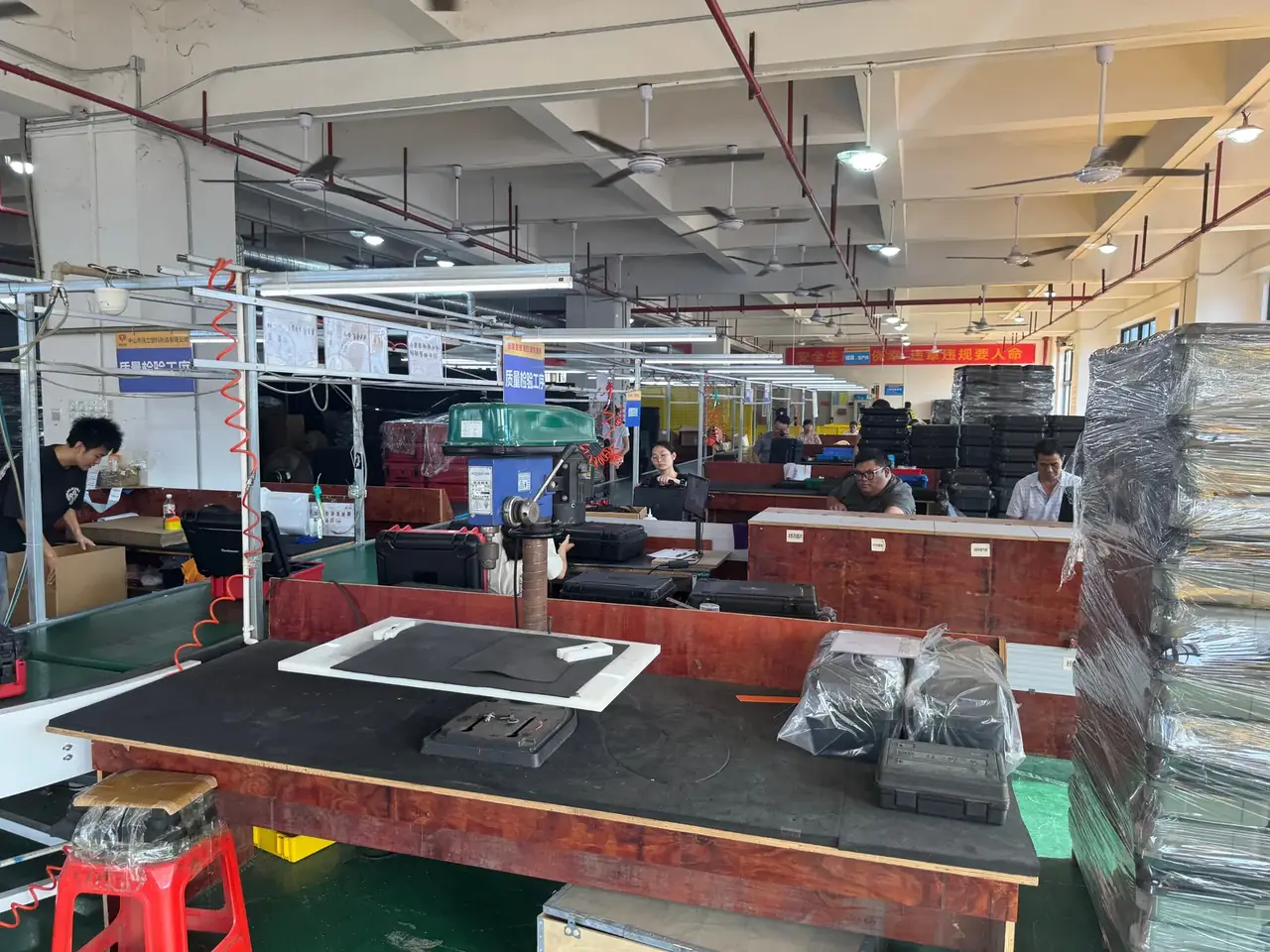
Quick answer: A hydrogen valve case keeps residual oil under 5 mg/m² and particles under 100 µm, pockets eight valves in a 2×4 grid, and clamps its lid at 30 N·m.
Table of contents
- Cleanliness in a hydrogen valve case is a per-square-metre number
- Degreasing runs on a conductivity staircase
- Eight pockets, six bolts, one torque value
- Double bagging and the class of the unboxing bench
- Why the tools get their own colour
- FAQ
1. Cleanliness in a hydrogen valve case is a per-square-metre number
A 520 × 380 × 220 mm shell presents about 0.94 m² of internal wall, so at 5 mg/m² the whole case may carry 4.7 mg of residue, a tenth of a drop of machine oil.
Eight valves ride in each case at 1.2 kg apiece. Seal faces sit near Ra 0.4 µm, so a 0.1 µm film already traps a 20 µm particle; closed once, it leaves a dent that later reads as a leak near 0.3 mL/min.
| Cleanliness item | Limit | Test method |
|---|---|---|
| Residual oil | ≤5 mg/m² | Single-direction wipe, 300 mm × 300 mm lint-free cloth, UV fluorescence |
| Particles | Largest ≤100 µm, ≥5 µm count ≤20 per 100 cm² | Laser particle counter over a 100 cm² patch |
| Oxygen | ≤5 ppm by volume | Gas sample from inside the case, electrochemical sensor |
| Non-volatile residue | ≤3 mg/m² | Solvent extraction, gravimetry on a 0.01 mg balance |
Oil travels upward too: handling vibration walks the film 150 mm up the wall within 48 hours. Five points therefore cover the shell, four corners and the centre, each 300 mm × 300 mm, wiped one way only. One failed point sends the case back to the wash line, since spot cleaning pushes oil outward and leaves a bright outline under UV.
2. Degreasing runs on a conductivity staircase
What defeats a degreasing line is not the visible oil but the layer underneath: an alkaline detergent saponifies the film, and only water of steadily lower conductivity carries the residue away. Skip one rung and the earlier stages are wasted.
| Rinse stage | Medium | Set point | Duration |
|---|---|---|---|
| Pre-wash | Alkaline detergent, pH 11 | Free alkali 12 g/L | 5 min |
| Main wash | Ultrasonic, 40 kHz | Power density 12 W/L | 8 min |
| First rinse | Deionised water | Conductivity ≤10 µS/cm | 3 min |
| Final rinse | Deionised water | Conductivity ≤1 µS/cm | 2 min |
| Dry | Oil-free compressed air | 0.4 MPa | 6 min |
The pre-wash only lifts the bulk of the film. Cavitation at 40 kHz reaches blind holes, and 12 W/L is the floor: below 10 W/L a ring of oil survives in an M6 pocket, hidden under the bolt that goes in later.
Conductivity is the only honest signal that rinsing has finished. The final tank is checked every 4 hours and replaced whole once it passes 1 µS/cm; topping up makes the reading swing for 2 hours. Drying runs at 0.4 MPa, angled 150 mm off the wall, and packaging closes within 30 min of a passed dry, or residue climbs from 3 mg/m² to 6 mg/m².
3. Eight pockets, six bolts, one torque value
The grid is 2×4, 130 mm between pocket centres, split by 5 mm PP dividers standing 10 mm above the valve body. That height is the roll margin of a 1.2 kg body under 1.5 g: higher and the divider meets the lid, lower and the body tips.
Each valve sits in a φ90 mm well over 10 mm of EPE at 50 kg/m³, compressed no more than 2 mm. The foam supports without wrapping, 3 mm clear on each flank and the divider doing the locating; foam pressed on a valve leaves a mark, and oil hides in marks.
The lid is 6 mm PP on six M8 stainless bolts, tightened diagonally in three passes of 10 N·m, 20 N·m and 30 N·m, two minutes apart. Going straight to 30 N·m over-compresses one spot by 0.5 mm and lifts the corners, and rain and mist find that gap. Wrenches hold ±4% and are calibrated quarterly.
4. Double bagging and the class of the unboxing bench
Six layers separate the valve port from outside air, each doing one job. More layers are not safer: every extra layer adds a rub during unpacking, and rubbing is itself a particle source.
| Packaging layer | Material and size | Function |
|---|---|---|
| Port cap | φ28 mm PE cap, one per port | Seals both connections |
| Valve bag | 0.08 mm PE, 8 mm heat seal | Keeps body off the pocket |
| Pocket divider | 5 mm PP insert, eight slots | Stops valve-to-valve contact |
| Inner bag | 0.12 mm PE, drawn to −0.06 MPa | Traps particles inside |
| Outer bag | 0.15 mm foil laminate, 10 mm seal | Blocks moisture and oil mist |
| Case | 5 mm PP, 8 mm gasket | Seals out mist and particles |
The inner bag rests 2 min after evacuation before sealing, letting air creep out of the thread relief; skip the pause and it inflates in transit, which is when the foil rubs through.
The bench runs at ISO 8, no more than 3.52 × 10^6 particles at 0.5 µm and above per cubic metre, on a 304 stainless top wiped with isopropanol once a shift; a case moves on within 15 min. Operators wear powder-free nitrile gloves changed every 2 hours: sebum alone pushes local residue from 5 mg/m² to 40 mg/m².
5. Why the tools get their own colour
The cleaning kit is a 12-piece set in a red bag, numbered 01 to 12, kept apart from the blue and yellow kits at other stations. The colour lets anyone spot a wrong kit on a mixed shelf in 3 s.
Every piece is 316 stainless or PTFE, nothing zinc-plated, no ratchet carrying grease. The kit is retested monthly against the same 5 mg/m² limit; a failure is wiped with anhydrous ethanol and retested, two failures mean scrap. Pieces are counted back each shift, and a missing item seals the bag.
Conclusion
Two numbers carry this design: 5 mg/m² of residual oil and 100 µm for the largest particle. A hydrogen valve case earns them through a five-stage conductivity staircase, a 2×4 pocket grid, 30 N·m on six bolts and six packaging layers. The shell is only the carrier; what is protected is the seal face, down to 0.1 µm.
This article discusses specifications and design intent on the container (case) side only, and does not cover any handling, loading, or use of the items inside.
Related Reading
- How a fuel cell stack case is structured
- Cleanliness and dust control for inspection equipment cases
- What air freight declaration asks of the case
- General selection criteria for industrial equipment cases
Related Products
- 8 Series — Gun Cases; Military Equipment Cases; Camera Equipment Cases; Drone Cases; Watch Cases; Knife Cases; First Aid Cases; Electronics Equipment Cases
- WL8-2812 PP Gun Case — model WL8-2812
- All protective cases and toolboxes: 7 series, 158 models