

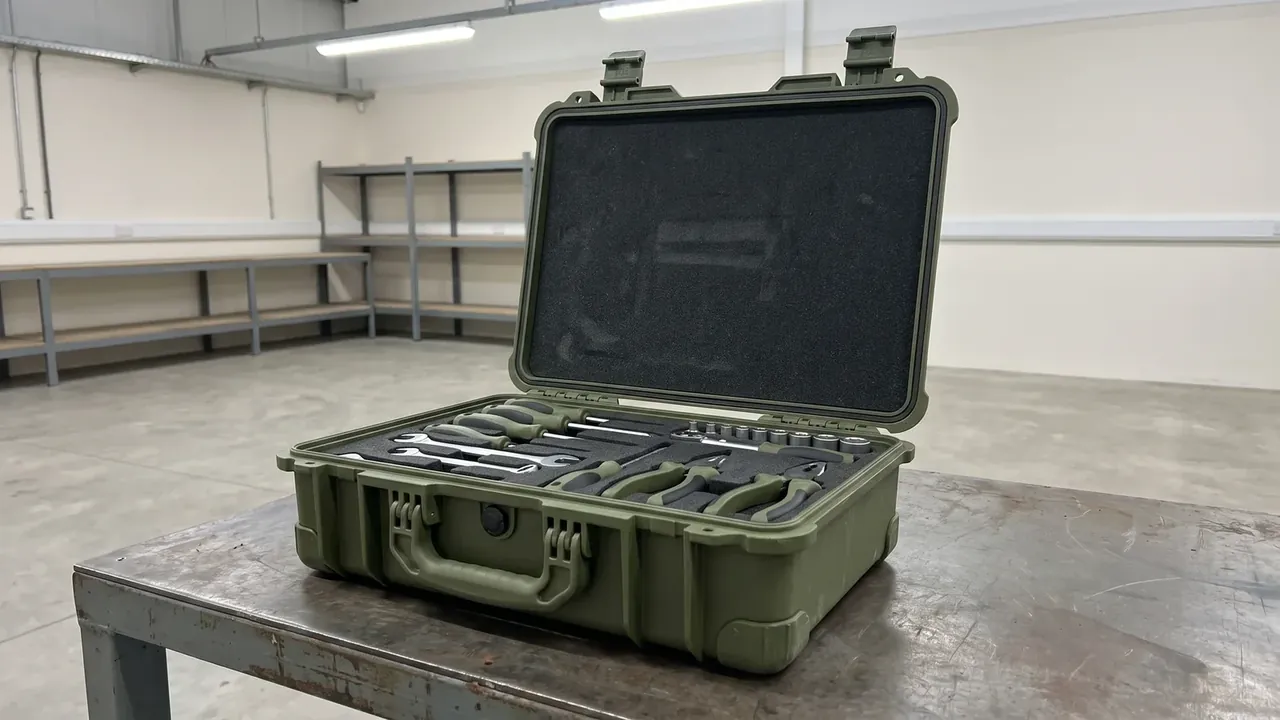
Quick answer: An industrial tool box is specified by the scope it governs, not by its footprint. Station level serves one machine and is judged on retrieval speed; crew level travels between several points a day and is judged on load, latching and vibration.
Table of contents
- Where an Industrial Tool Box Fits at Station and Crew Level
- Inspection Stations and Tool Location
- Vehicle Crews and Spare Parts Turnover
- Contractor Sites and Issue Control
- Configuration Matrix Across Four Scenarios
- FAQ
1. Where an Industrial Tool Box Fits at Station and Crew Level
A station-level industrial tool box never leaves the bench: forty openings a shift, built for speed. A crew-level industrial tool box rides with vehicles across three to five points a day, so load and vibration lead instead.
Ownership turns on two questions: does the box stay put overnight, and who replaces a missing item.
| Scenario | Scope | Opens | Focus |
|---|---|---|---|
| Inspection station | One machine | Over 40 | Compartments |
| Vehicle crew | Three to five points | 6 to 10 | Load, vibration |
| Spare-parts turnover | One bin to many | Under 2 | Stacking |
| Contractor site | One crew | Around 10 | Locks, records |
2. Inspection Stations and Tool Location
Compartment order follows the inspection sheet, not tool size: if the first check is oil level, the first compartment holds the wipe and torch.
The station industrial tool box is sized from the bench: 520 × 380 × 190 mm on a 600 mm deep surface, 145 mm of internal depth for an upright socket, and four of 24 compartments cut to 90 mm.
Cuts follow the tool outline with 3 mm of clearance, colour blocks underneath marking mandatory, optional and standby. A named tool comes out in under six seconds.
3. Vehicle Crews and Spare Parts Turnover
Load arrives vertically from the road, horizontally from braking. Two 25 mm straps over the middle of the industrial tool box hold it down, routed over the lid latches.
A rated load is not a working load. A box rated at 32 kg turns awkward at 26 kg, and carrying stays comfortable under 20 kg, so crew boxes load to 22 kg.
Turnover runs on 400 mm shelf spacing against a 190 mm box height, four boxes per level, pulled out whole every 21 days.
| Duty | Rated | Working | Layers | Top load |
|---|---|---|---|---|
| Vehicle daily | 32 kg | 20 to 22 kg | None | Not applicable |
| Spare-parts turnover | 40 kg | Up to 30 kg | 3 | 90 kg |
At three layers the fit between lid recess and base boss matters more than the load figure: under 5 mm of engagement, a turning forklift shifts the stack.
4. Contractor Sites and Issue Control
A contractor box has three traits: people change, the site is not fixed, tools leave with the crew. The lock is a handover token, so a 6 mm shackle hole takes a three-digit combination lock set per crew.
Issue control lives in the numbering, box number bound to employee number. A posting runs 90 days with a full count every 30 days.
A foamed silicone gasket at 30 percent compression holds IP54 on the industrial tool box; a higher rating needs stiffer latches.
5. Configuration Matrix Across Four Scenarios
Four scenarios on one shell change four variables: compartments, gauge, locking, numbering. Compartments set retrieval speed, gauge sets service life, numbering decides whether the count reconciles.
Gauge is banded by scenario. Station boxes run 2.5 mm, vehicle and site boxes 3.0 mm with base ribs, turnover boxes 2.8 mm where flat stacking faces matter more.
| Scenario | Compartments | Wall | Locking |
|---|---|---|---|
| Inspection station | 24 shallow, 4 deep | 2.5 mm | Self-latching |
| Vehicle crew | 18 plus long bay | 3.0 mm | Latches plus hole |
| Spare-parts turnover | Open cavity, dividers | 2.8 mm | Seal hole, tie |
| Contractor site | 20 plus roll bay | 3.0 mm | Three-digit code |
Numbering has to be speakable, so labels sit 60 mm above the base at one height, which lets one industrial tool box platform serve four scenarios.
Conclusion
The split between station and crew level produces the four differences in an industrial tool box: compartments, load path, locks and numbering. Stations buy speed, crews buy vibration resistance, turnover buys stack stability, contractor sites buy a verifiable handover. One body with a removable insert covers most plant floors, and the industrial tool box specification writes itself.
This article discusses only the container (case body) side of specifications and design intent, and does not cover any handling, loading or use of the contents.
Related Reading
- Hardware tool boxes on the shop floor
- Tool box alternatives compared
- Rolling tool case configurations
- Vehicle tool case selection
Related Products
- 8 Series — Gun Cases; Military Equipment Cases; Camera Equipment Cases; Drone Cases; Watch Cases; Knife Cases; First Aid Cases; Electronics Equipment Cases
- WL8-2812 PP Gun Case — model WL8-2812
- All protective cases and toolboxes: 7 series, 158 models