

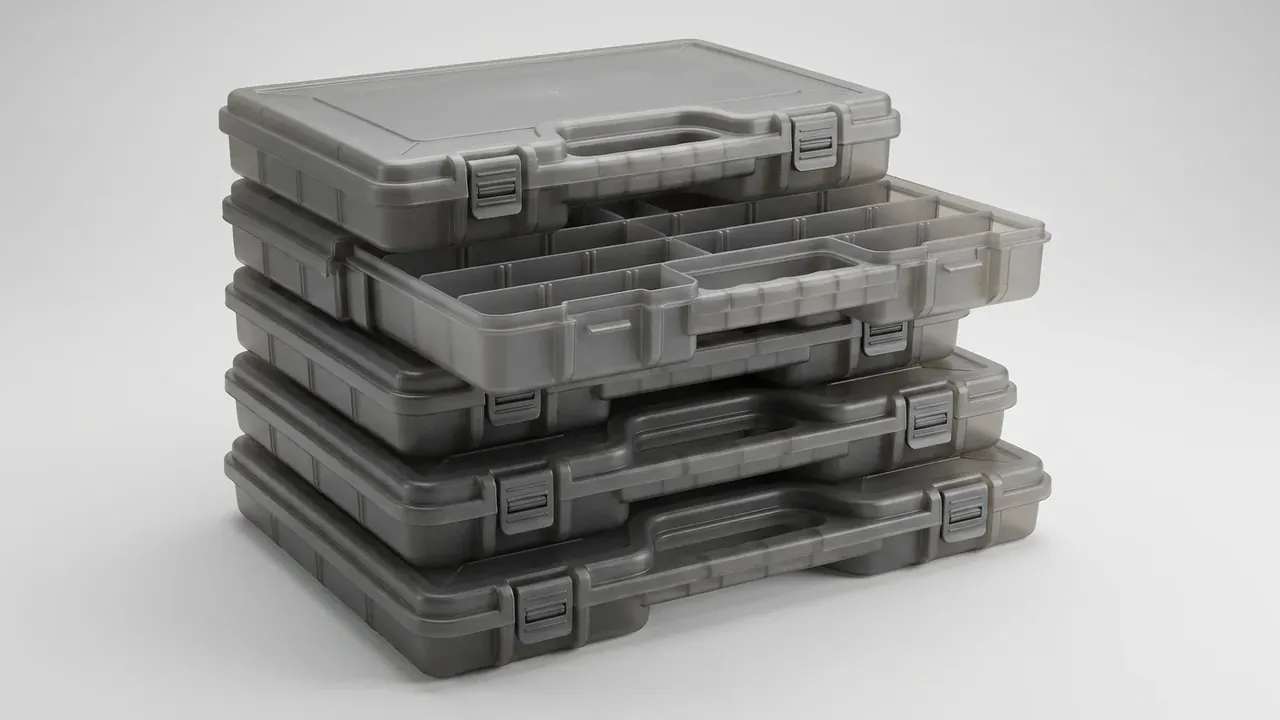
Quick answer: The cost of a Kids Tool Box sits in rework, not resin. A wrong assembly order pushes rework from 2% to 6.8%, or 11 yuan a case.
Table of contents
- Four Handling Moves a Kids Tool Box Meets in Class
- Assembly Order Sets the Rework Rate
- Cost per Unit, Spread Across a Class
- Where Family Use Goes Wrong
- Four Moves That Push Rework Cost Down
- FAQ
1. Four Handling Moves a Kids Tool Box Meets in Class
A primary school craft room holds 32 desks, one Kids Tool Box on each, 40 minutes a lesson. Students fetch, build and pack away, and four moves land on the case.
| Move | Time | Usual mistake | What follows |
|---|---|---|---|
| Opening | 3 s | One hand, one latch | Single-side load |
| Tray lift | 6 s | Carried by the rim | Clips let go, parts spill |
| Packing | 9 s | Lid forced over divider | White mark, 3 mm gap |
| Latching | 2 s | One latch, then walk | Lid springs open |
The four total 20 seconds, one twelfth of the lesson.
The most expensive mistake is not a drop. A student reverses a divider, closes the lid anyway, and that white mark reaches a class chat group as a photo.
2. Assembly Order Sets the Rework Rate
The order is fixed in the plant: latch seats, handle, dividers, print before assembly, packing last. Break it and rework follows.
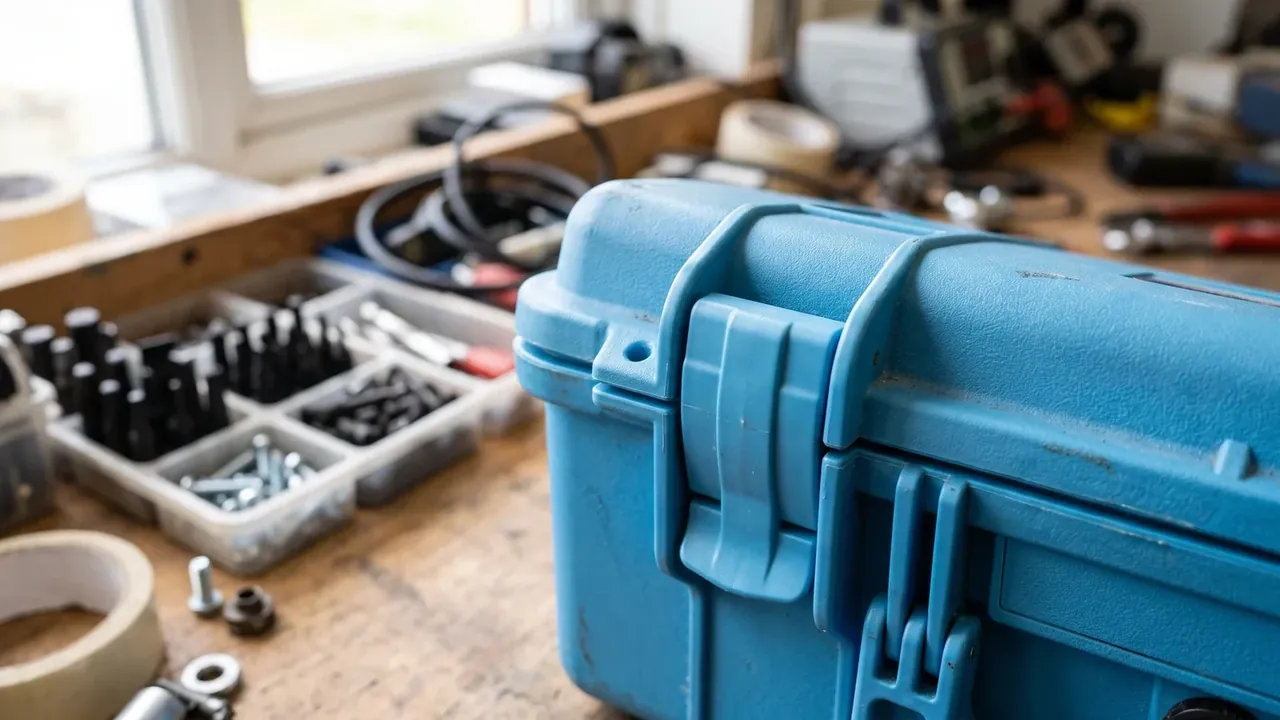
Five rules, all learned on the line:
- Latch seats within 24 hours of moulding, while residual heat releases stress evenly.
- Handle staking after the seats, since the fixture locates off them.
- Dividers before printing, because hands brush the shell.
- Printed shells rest four hours before bagging, or ink mirrors onto the bag.
- Inserts cut to the shell outline with 0.5 mm clearance, never generic bubble wrap.
One broken rule costs a point of rework; every line that moved dividers after printing ran above 6%.
The classroom has an order too: long items first, trays next, latch last.
3. Cost per Unit, Spread Across a Class
A Kids Tool Box carries four cost blocks before it leaves the gate. On a 0.42 kg PP shell: resin 14.6 yuan, labour 5.2, packing 2.4, freight 3.1, for 25.3 total.
| Cost block | Per case | After one rework |
|---|---|---|
| Resin | 14.6 yuan | Scrapped seat, +0.8 |
| Labour | 5.2 yuan | Strip and rebuild, +4.0 |
| Packing | 2.4 yuan | Bag void, +1.2 |
| Freight | 3.1 yuan | Single reship, +4.8 |
| Total | 25.3 yuan | about 36.3 |
Eleven yuan a rework sounds small. At 6.8% it adds 0.75 yuan a case, and a 1.8% after-sales rate at 18 yuan adds 0.32. Together they eat 40% of the packing budget.
That money does not come out of margin. It comes out of the next batch of resin.
4. Where Family Use Goes Wrong
Home use means fewer moves and longer sessions: a case lies open for hours, and failures cluster in three places.
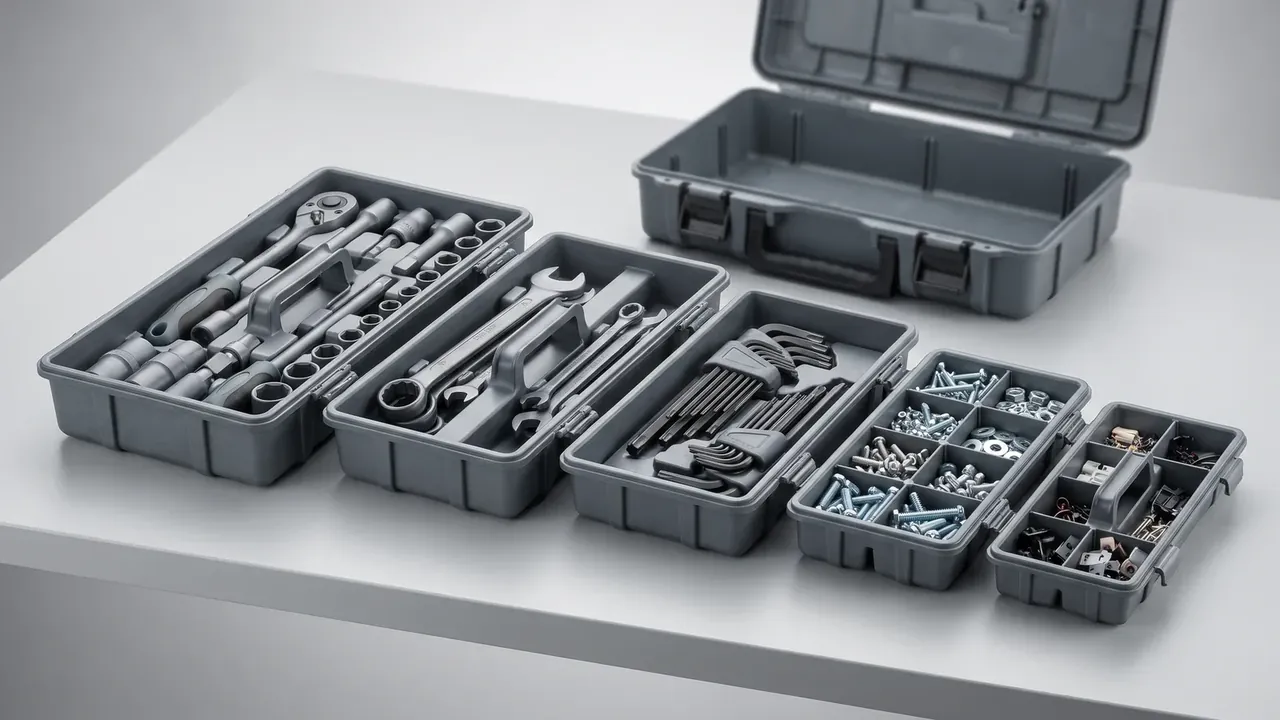
The first is the handle. Loaded with real tools and carried upstairs one-handed, a case at 6 kg static dishes 0.4 mm either side of the opening and leaves white lines around the stakes. White lines are not cracks yet, but they are where stress collects. A child running with the case lands at three times that load. The lines travel down the rib roots and turn into visible cracks within a year. Holding that off takes 0.3 mm of extra wall at the opening. It also takes a 4.5 mm boss on each side of the stake. Two lines on a drawing, and the first thing to fail at home.
The second is the divider. A reversed tray breaks nothing at once; it makes the lid eat 2 mm more force, read as a stiff case.
The third is wiping. A damp cloth or an alcohol wipe pushes water into the latch gap, and the snap turns gritty within two weeks.
None of the three is a quality defect, and all three come back as one.
5. Four Moves That Push Rework Cost Down
First, a staking fixture: a contoured nest holds the shell while the seat goes down in one stroke against a stop block.
Second, a poka-yoke divider. Offset the slots by 2 mm so a reversed tray cannot seat, and the error surfaces before the lid closes. One mould edit, no added part.
Third, positioned inserts cut to the shell outline with 0.5 mm clearance; freight damage falls from 3% to 0.9%.
Fourth, a full latch cycle at inspection: close and open twice, watch the spring-back. Four extra seconds keeps bad staking inside the plant.
Run all four and rework falls from 6.8% to 2.1%, the cost per case from 0.75 yuan to 0.23.
Conclusion
A Kids Tool Box is opened hundreds of times a term, and the cost that matters is not shell thickness but whether four moves stay easy. Fixtures, a poka-yoke divider, positioned inserts and a full latch cycle pull rework back to 2.1%, which beats cheaper resin on any Kids Tool Box.
This article discusses only the container (case body) side of specifications and design intent, and does not cover any handling, loading or use of the contents.
Related Reading
- How to judge which kids tool box fits a programme
- Safety items inspected on a kids tool box
- How hardware tool boxes are configured on a shop floor
- Rolling tool cases in moving and handling work
Related Products
- 8 Series — Gun Cases; Military Equipment Cases; Camera Equipment Cases; Drone Cases; Watch Cases; Knife Cases; First Aid Cases; Electronics Equipment Cases
- WL8-2812 PP Gun Case — model WL8-2812
- All protective cases and toolboxes: 7 series, 158 models