

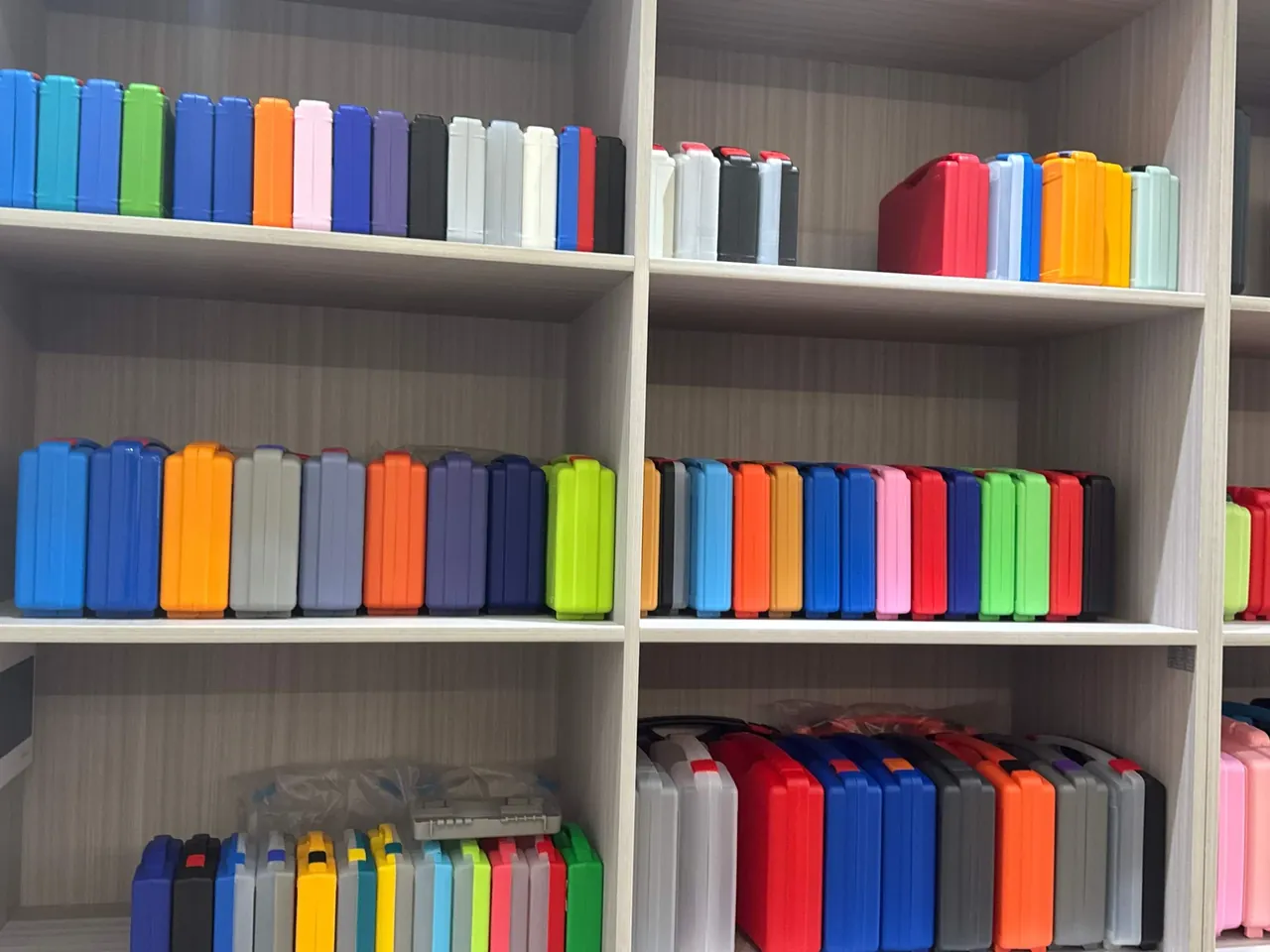
Quick answer: A Kids Tool Box is specified on four measurable items: corner radius, single-latch force, main wall and hinge life. Corners run R3 to R8, latch force 15 to 25 N, walls 1.8 to 2.5 mm, hinges 5,000 cycles. All four read on a gauge.
Table of contents
- Four Measurable Specs for a Kids Tool Box
- Corner Radius and Rim Transition
- Latch Force and Closing Travel
- Material and Wall Thickness
- Size Steps and Handle Load
- FAQ
1. Four Measurable Specs for a Kids Tool Box
Four items on the body read with a gauge: corner radius, single-latch force, main wall, hinge cycles. They set the mass in the hand and the working life of a Kids Tool Box.
The four are coupled: a wall from 1.8 to 2.5 mm adds 4 to 6 N of latch force, and a corner from R3 to R8 removes sink at the cost of 3 to 5 mm of cavity. Thickness first, corners last.
| Spec | Range | If it is missed |
|---|---|---|
| Corner radius | R3 to R8 | Under R2 the corner whitens |
| Latch force | 15 to 25 N | Under 10 N the lid springs open |
| Main wall | 1.8 to 2.5 mm | Under 1.5 mm it feels soft |
| Hinge cycles | 5,000 | Past 3,000 the lid shifts |
2. Corner Radius and Rim Transition
R3 to start: inner and outer arcs differ by 1.8 mm of wall, so melt does not slow and nothing whitens. Below R2, PP stretches on release and hairline cracks open within two weeks.
R5 suits hand-held sizes to 300 mm. Past 400 mm outside and 1 kg empty, a Kids Tool Box moves to R8 for contact area and lower corner stress.
The rim runs 1.2 mm wide with a 0.5 by 45 degree break; thinner lips warp, thicker ones leave a sink ring. Base fillets stay no smaller than the wall, or the feet lift.
3. Latch Force and Closing Travel
Force sits at 15 to 25 N, the peak on a gauge pulling the tongue out at 50 mm per minute. Under 10 N the lid springs open on its side; over 35 N the root whitens within 2,000 cycles.
Travel is 2.5 mm on a 1.2 mm root, about 12 degrees and inside the elastic range of PP. A shut Kids Tool Box shows an even 0.3 mm gap; a gap that opens along the rim means 0.5 mm of hinge misalignment.
4. Material and Wall Thickness
Copolymer PP at 0.90 with 1.8 to 2.5 mm walls flexes on impact and holds at minus 10 C. ABS at 1.05 is harder and glossier, loses half its impact strength cold and splits first at the corner. Talc-filled PP lifts modulus 30 percent and cuts lid deflection from 3 to 2 mm, while notched impact falls to 8 kJ per square metre.
Distribution beats grade: at a 2.0 mm main wall, corners go to 2.4 mm and ribs root at 1.6 mm. Past 15 percent spread, thick zones sink.
| Material | Density | Wall | Cold drop |
|---|---|---|---|
| Copolymer PP | 0.90 | 1.8 to 2.5 mm | No break at minus 10 C |
| PP plus talc | 1.05 | 2.0 to 2.8 mm | Corner crack at minus 5 C |
| ABS | 1.05 | 2.0 to 2.6 mm | Half the impact at minus 10 C |
| Recycled PP | 0.91 | 2.2 to 2.8 mm | Lot to lot spread |
5. Size Steps and Handle Load
Outside sizes run 260 by 180 by 90, 320 by 220 by 110 and 400 by 280 by 130 mm, with empty mass at 320, 480 and 760 g.
Span is 0.42 to 0.5 of case length: shorter and it swings, longer and the walls need ribs. The grip is an 18 by 8 mm oval with R3 edges.
Load is three times the rated fill for an hour, with set under 2 mm; a root at 1.5 mm with no rib sags inside 40 minutes.
| Outside | Cavity | Empty mass | Latches |
|---|---|---|---|
| 260 by 180 by 90 mm | 236 by 156 by 76 mm | 320 g | 2 |
| 320 by 220 by 110 mm | 292 by 192 by 94 mm | 480 g | 2 |
| 400 by 280 by 130 mm | 368 by 248 by 112 mm | 760 g | 3 |
Conclusion
Four numbers carry a Kids Tool Box: corners R3 to R8, latches 15 to 25 N, walls 1.8 to 2.5 mm, hinges 5,000 cycles. Radius takes knocks, latch takes opening, wall takes stiffness. Measure those four, then talk about colour.
This article discusses only the container (case body) side of specifications and design intent, and does not cover any handling, loading or use of the contents.
Related Reading
- How case corners are designed
- Tool Cases: Hardware Tool Storage & Transport Protection
- Portable Tool Box: Balancing Carry Weight and Capacity
- Guide to plastic hand-carried tool boxes
Related Products
- 8 Series — Gun Cases; Military Equipment Cases; Camera Equipment Cases; Drone Cases; Watch Cases; Knife Cases; First Aid Cases; Electronics Equipment Cases
- WL8-2812 PP Gun Case — model WL8-2812
- All protective cases and toolboxes: 7 series, 158 models