

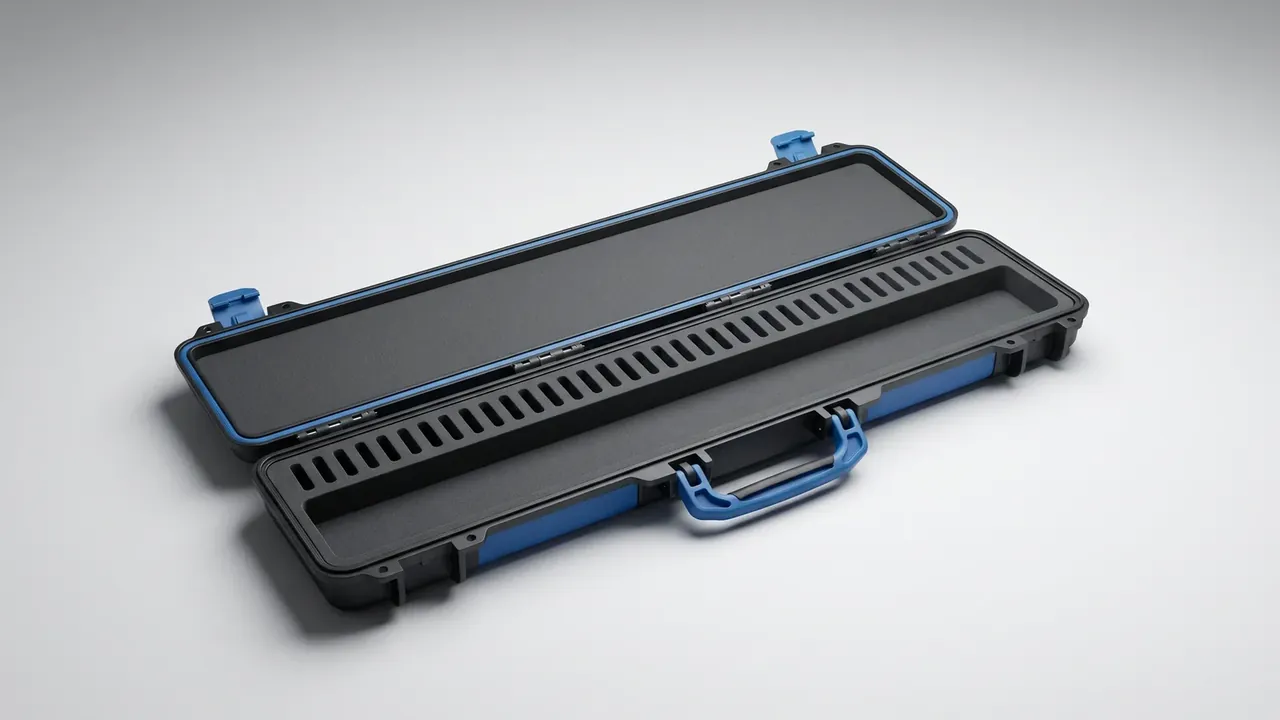
Quick answer: A custom plastic box is specified tier first, lid second, load and latch last. Four cavity tiers cover the range, the lid sets stiffness, filled weight decides wall thickness, and cavity tolerance is ±0.8 mm.
Table of contents
- How Custom Plastic Box Specifications Split Into Size Tiers
- Lid Structure and Wall Thickness Set Stiffness
- Load Ceiling and Stacking Height
- Latch Count and Rim Sealing
- Sampling Parameters and Acceptance List
- FAQ
1. How Custom Plastic Box Specifications Split Into Size Tiers
A custom plastic box is not continuously adjustable, so tier comes first. Four cavities cover 100×70×30, 140×100×45, 180×130×60 and 240×170×85 mm, about 1.8 times apart in volume, which keeps selection to one decision rather than a dozen near-identical sizes.
The envelope is cavity plus two walls plus a 3 mm rim flange, so a 180×130×60 cavity at 2.0 mm lands near 192×142×70 mm. Flanges below 2.5 mm warp as the lid closes, and shrinkage of 1.5 to 1.8% already moves a 240 mm box by 0.7 mm.
| Outside mm | Cavity mm | Wall mm | Empty mass g | Load kg |
|---|---|---|---|---|
| 110×80×38 | 100×70×30 | 1.8 | 78 | 3 |
| 152×112×54 | 140×100×45 | 2.0 | 132 | 5 |
| 192×142×70 | 180×130×60 | 2.2 | 205 | 8 |
| 254×184×96 | 240×170×85 | 2.5 | 320 | 12 |
2. Lid Structure and Wall Thickness Set Stiffness
The lid collapses first: a 2.0 mm flat lid sags 0.9 mm under 5 kg at the centre, a 2.5 mm ribbed lid 0.4 mm, a 2.8 mm stepped lid uses one fold, a 3.0 mm flanged lid serves the 240 mm tier.
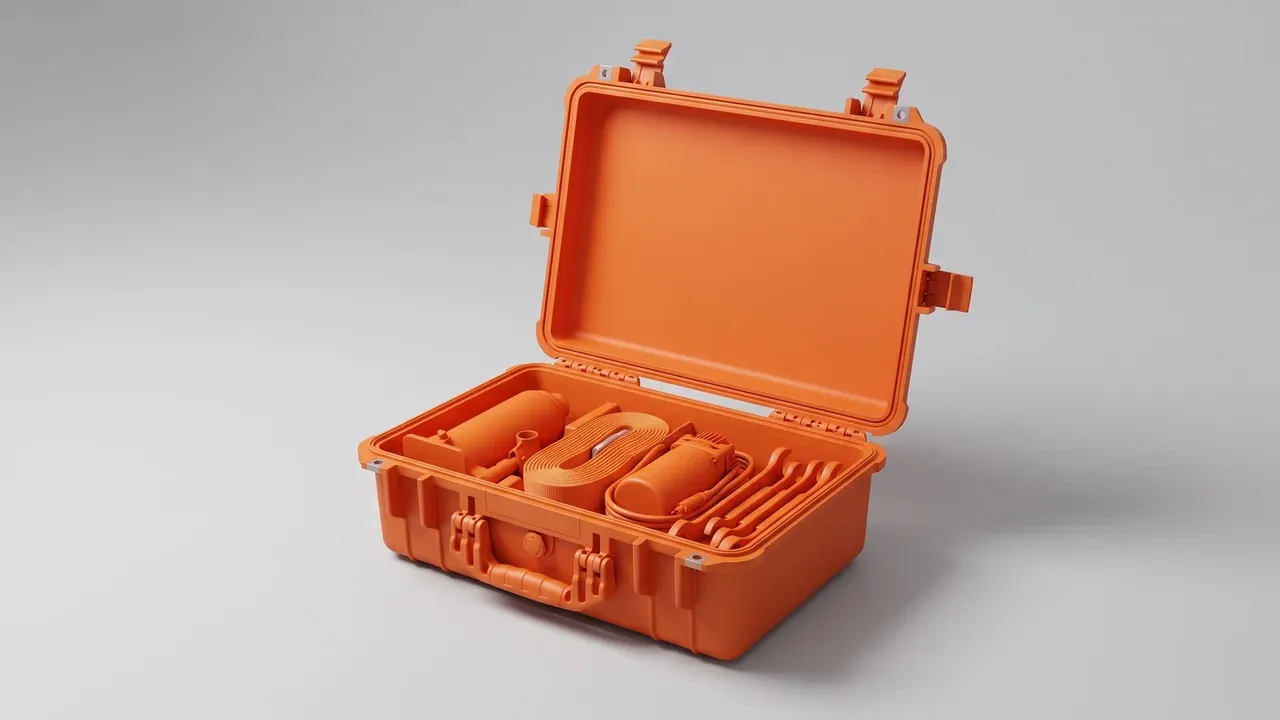
Hinges match the lid: a thin integral hinge suits boxes under 160 mm at 5,000 cycles, a double-pin hinge reaches 8,000, a metal pin under a flanged lid 12,000. Below 1.5 mm at the root, the third drop cracks it.
Keep the closed gap under 0.5 mm, or the rim pinches fingers and dust enters. Lid ribs must run along the length, since cross ribs mostly see shear.
3. Load Ceiling and Stacking Height
Load splits into the single unit and the stack. A custom plastic box carries 3, 5, 8 or 12 kg across the tiers with base deflection under 0.8 mm, beyond which the base dishes on a shelf and each extra layer sinks deeper.
Stacking is 8 layers, 48 hours at 23 °C, side-wall deflection under 1.5 mm, drifting to 2.2 mm at 40 °C, so either six layers or two crossed base ribs at about 6% more cost. Drop testing is 1 m over ten impacts, where moving the corner radius from R1.5 to R3 lifts pass rates from about 70% to over 90%.
4. Latch Count and Rim Sealing
Latches are lighter than on a large case: one below 160 mm, two from 160 to 220 mm, two plus a side catch above. A custom plastic box is carried by hand, so opening force sits at 35 to 60 N; beyond that users pull with both hands and distort the rim.
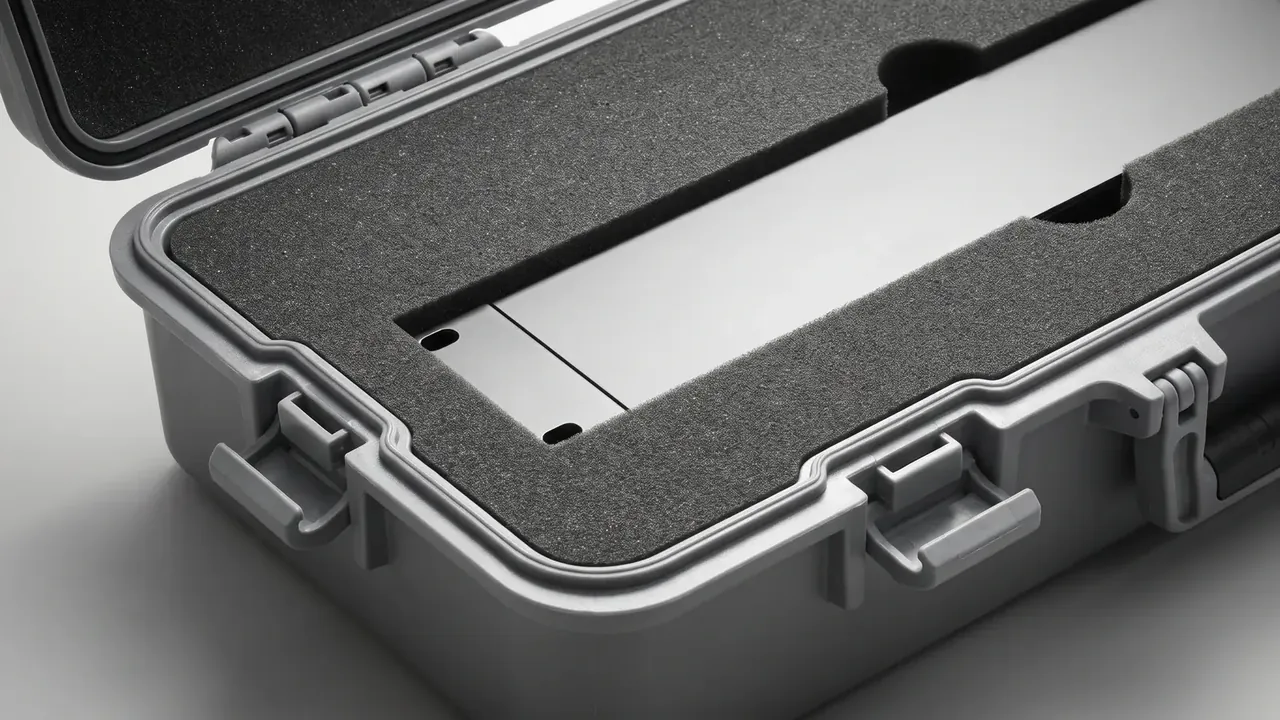
Sealing has three levels: none for dry storage, a single 2.5 mm EPDM cord to IP54, a double cord with a 2 mm lip to IP65. POM catches lose under 15% of their opening force after 8,000 cycles, against nearly 30% for PP.
5. Sampling Parameters and Acceptance List
First articles run 30 pieces at 38 °C mould temperature, 225 °C melt, 38 MPa packing and 12 s cooling, and a four-cavity tool cycles in about 26 s.
| Item | Value | Method |
|---|---|---|
| Cavity dimensions | ±0.8 mm | Caliper, three points |
| Rim flatness | 0.4 mm | Surface plate and feeler |
| Wall thickness | ±0.12 mm | Ultrasonic, five-point mean |
| Latch opening force | 35–60 N | Push-pull gauge |
| Stacking | 8 layers, 48 h, ≤1.5 mm | Ambient load |
| Hinge cycling | 8,000 cycles, no crack | Cycling rig |
Fix the datum: cavity from the inner base, envelope from the outer base, or ±0.8 mm becomes 1.5 mm at assembly.
Conclusion
The difficulty is not one number but the match between tier, lid, load and latch. Fix the cavity tier and its ±0.8 mm tolerance, choose lid and hinge from the load, then close with latch force and sealing. A custom plastic box is judged on holding small dimensions, not on being made bigger.
This article discusses only the container (case body) side of specifications and design intent, and does not cover any handling, loading or use of the contents.
Related Reading
- Small plastic case selection guide
- Protective case size range explained
- Tool box lid structure and load
- Trial moulding and first article approval
Related Products
- 8 Series — Gun Cases; Military Equipment Cases; Camera Equipment Cases; Drone Cases; Watch Cases; Knife Cases; First Aid Cases; Electronics Equipment Cases
- WL8-2812 PP Gun Case — model WL8-2812
- All protective cases and toolboxes: 7 series, 158 models