

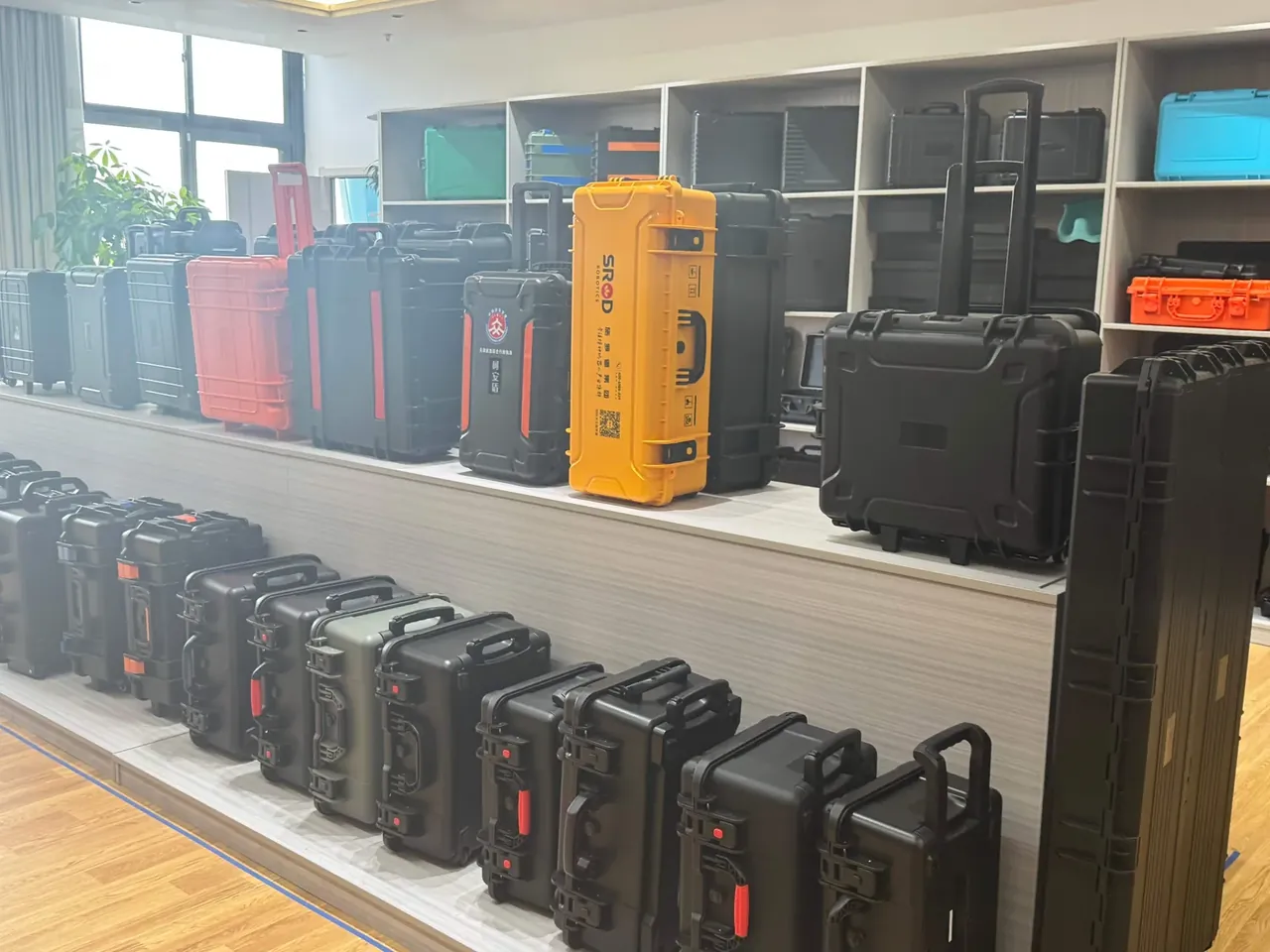
Quick answer: A protective case size range stacks four figures: cavity, outside envelope, shipping size with wheels and handle, and stacking footprint. They differ by wall, rib and draft, so one case can show a 16 to 20 mm gap between inside and outside.
Table of contents
- Three Measurements and One Stacking Figure
- What Wall and Ribs Take Away
- Cavity Volume Is Not Loadable Volume
- Steps from Small Case to Pallet Class
- Nominal Versus Measured Figures
- FAQ
1. Three Measurements and One Stacking Figure
A protective case size range never reduces to one number: a line carries cavity, envelope, shipping size with wheels and handle, and stacking figure. Swapping one for another shifts a quote by tens of millimetres.
Cavity runs wall to wall, clear of the floor pad. Envelope is the largest body, ribs in and latch bosses out. Shipping size runs from the wheel patch to the retracted handle. A 560 x 400 x 250 mm cavity gives a 584 x 424 x 274 mm envelope, and wheels push shipping height to 330 mm.
| Figure | What it measures | Where the tape sits |
|---|---|---|
| Cavity | Usable internal space | Wall to wall, radius start |
| Envelope | Largest body dimension | Ribs in, latch bosses out |
| Shipping size | Footprint in transit | Wheel contact to handle top |
| Stacking figure | Bearing area, pile height | Lid plane plus wheel height |
2. What Wall and Ribs Take Away
In every protective case size range, wall, ribs and draft sit between cavity and envelope. Rotomoulded walls run 2.5 to 4.0 mm and side ribs add 4 to 6 mm, so one side carries 8 to 10 mm and a pair 16 to 20 mm. A 560 mm cavity ending at 580 mm outside is normal practice.
Rib pitch runs 60 to 80 mm at 1.5 to 2 times the wall. Sparse ribs let the wall bulge in a drop; tight ribs trap air, sink marks form at the root and the wall measures 1.8 mm. A 1 to 2 degree draft over 250 mm of depth pulls each side in by 4 to 9 mm, so tall items enter on the floor dimension.
3. Cavity Volume Is Not Loadable Volume
Length times width times depth gives gross volume, not usable volume. Radii, floor pad and rim flange take a share: a 430 x 310 x 200 mm cavity holds 26.7 litres gross, 1.4 litres goes to radii and pad, 0.4 litres to the flange, leaving 24.9 litres.
Foam takes another bite: 20 mm per side and 15 mm on top shrink the cavity to 390 x 270 x 185 mm, so usable volume falls to 19.5 litres. Of two 25 litre cavities, 500 x 300 x 167 and 400 x 400 x 156 mm, only the first takes a 480 mm bar. In a protective case size range, longest edge comes before volume.
4. Steps from Small Case to Pallet Class
A mature protective case size range runs six to eight steps, not proportional: small sizes jump 60 to 80 mm, mid sizes 100 to 150 mm, pallet class 200 mm or more. Jumps follow the carry method, hand to shoulder to two-person lift to wheels.
Weight sets the step in any protective case size range: hand carry stops at 9 kg, a two-person lift at 25 kg, wheels above that. Going from 11.4 to 26.7 litres takes tare from 2.1 to 3.6 kg, right at the limit.
| Step | Cavity (mm) | Volume (L) | Envelope (mm) | Tare (kg) |
|---|---|---|---|---|
| S2 | 310 x 230 x 160 | 11.4 | 330 x 250 x 180 | 2.1 |
| S3 | 430 x 310 x 200 | 26.7 | 452 x 332 x 222 | 3.6 |
| M1 | 560 x 400 x 250 | 56.0 | 584 x 424 x 274 | 6.2 |
5. Nominal Versus Measured Figures
In a protective case size range, most disputes are about method, not moulding: where cavity length starts, whether latches or wheels count. Leave those open and one case reports figures 30 mm apart.
Rotomoulding shrinks 1.2 to 1.8 percent: a 1000 mm mould loses 12 to 18 mm, the rim pulls in 2 to 3 mm as it cools, and an assembled shell closes with 1 to 2 mm of compression. Quote a range, plus 2 minus 1 mm, so a 560 step accepts 559 to 562 mm.
| Item | Instrument | Datum | Tolerance |
|---|---|---|---|
| Cavity length, width | Tape and internal caliper | Straight run, radius excluded | +2 / -1 mm |
| Cavity depth | Depth gauge | Floor to rim plane | plus or minus 1.5 mm |
| Envelope | Tape | Ribs in, latch bosses out | plus or minus 2 mm |
Conclusion
Cavity, envelope, shipping size and stack height each answer a different question. A protective case size range only works when each figure carries its datum.
This article discusses only the container (case body) side of specifications and design intent, and does not cover any handling, loading or use of the contents.
Related Reading
- How to choose a toolbox size
- Stacking height and load limits for cases
- Shell structure and wall distribution
- Rotomolded Cases: Rotational-Moulded Shell Structure & Pro…
Related Products
- 8 Series — Gun Cases; Military Equipment Cases; Camera Equipment Cases; Drone Cases; Watch Cases; Knife Cases; First Aid Cases; Electronics Equipment Cases
- WL8-2812 PP Gun Case — model WL8-2812
- All protective cases and toolboxes: 7 series, 158 models