

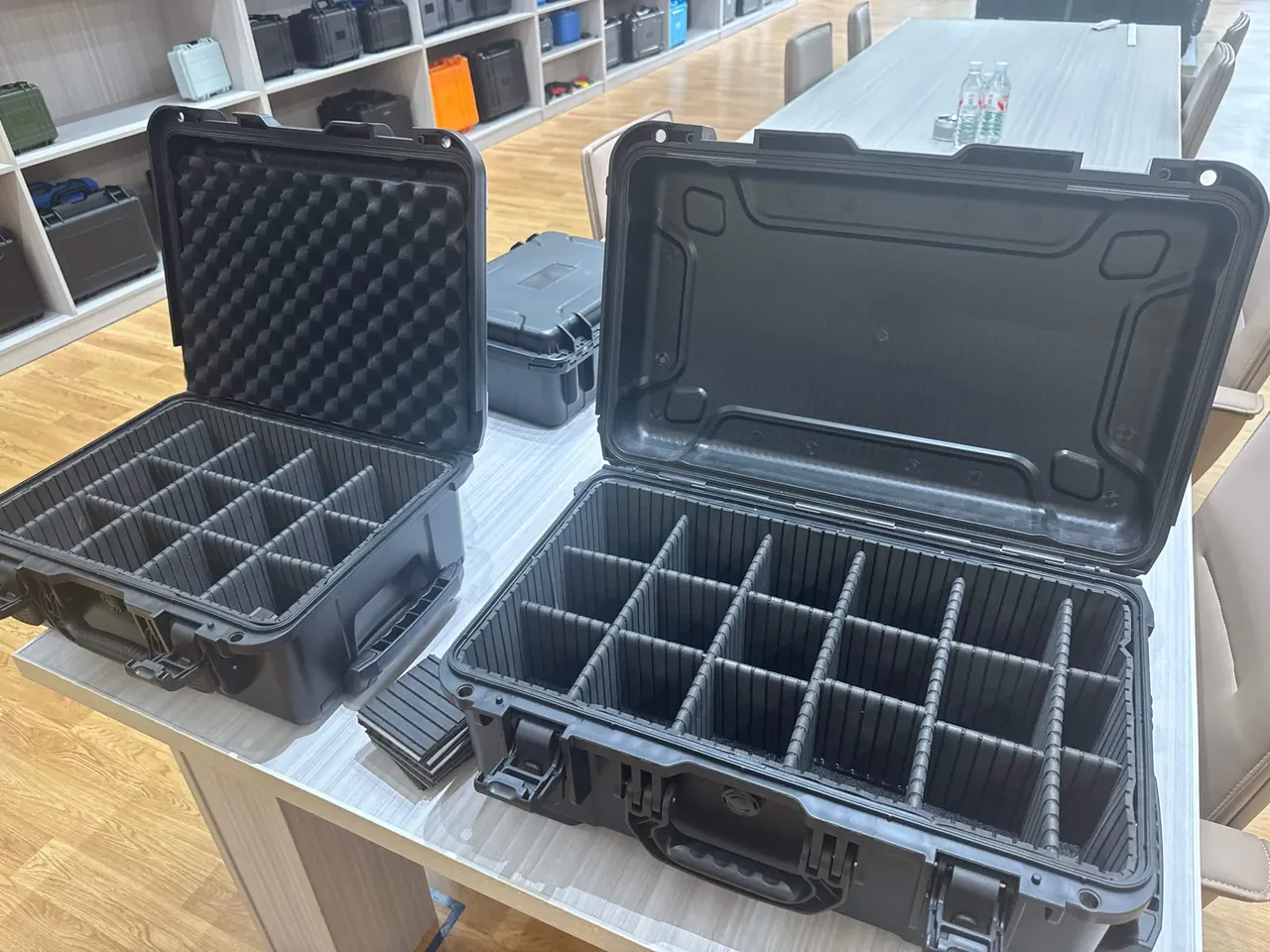
Quick answer: The Military walkie-talkie radio protective briefcase pairs a 3.0 mm handle root and a 105-degree stop, limiting drift to 0.4 mm after 8000 lifts.
Table of contents
- Handle-root build-up in the Military walkie-talkie radio protective briefcase
- Setting the hinge stop angle
- Drift readings across lift cycles
- Root inspection after the drop retest
- Build-up rejection line for carry batches
- FAQ
1. Handle-root build-up in the Military walkie-talkie radio protective briefcase
The Military walkie-talkie radio protective briefcase takes its carrying load at the two handle roots where the grip meets the lid. A 3.0 mm local build-up gives the moulding a continuous radius instead of a thin-to-thick step that traps weld lines, while the shell wall stays at 3.8 mm. Within a 470 x 340 x 180 mm envelope and a 410 x 285 x 125 mm cavity, the root spans about one fifth of the lid front edge, and its stiffness sets the drift reading after lifting.
Inspection of the Military walkie-talkie radio protective briefcase starts with three wall sections along the handle-seat axis, each held within 0.15 mm of the 3.0 mm nominal. JUNZHIJIA trial-moulds with a 12 kg mass to mimic a loaded lift, then reads root displacement against the lid datum after 8000 cycles, holding the line at 0.4 mm. Section data alone cannot predict fatigue loosening, so both the cuts and the whole-case lift figures land in one record sheet.
| Build-up tier | Measured root thickness | Terminal drift at 12 kg / 8000 cycles |
|---|---|---|
| Thin | 2.8 mm | 0.48 mm, reject |
| Nominal | 3.0 mm | 0.32 mm |
| Thick | 3.2 mm | 0.27 mm |
2. Setting the hinge stop angle
A stop shoulder on the Military walkie-talkie radio protective briefcase lid hinge arrests opening at 105 degrees, so the lid never folds back far enough to make the handle seat a fulcrum. A smaller angle crowds the wrist against the lid edge; a larger one lets lid weight add a bending moment about the hinge on every lift and speeds up root creep. At 3.6 kg empty and 7 kg loaded, 105 degrees keeps the lid centre of mass inside the footprint, and the shoulder still shows only low-end wear after 4000 open-close cycles.
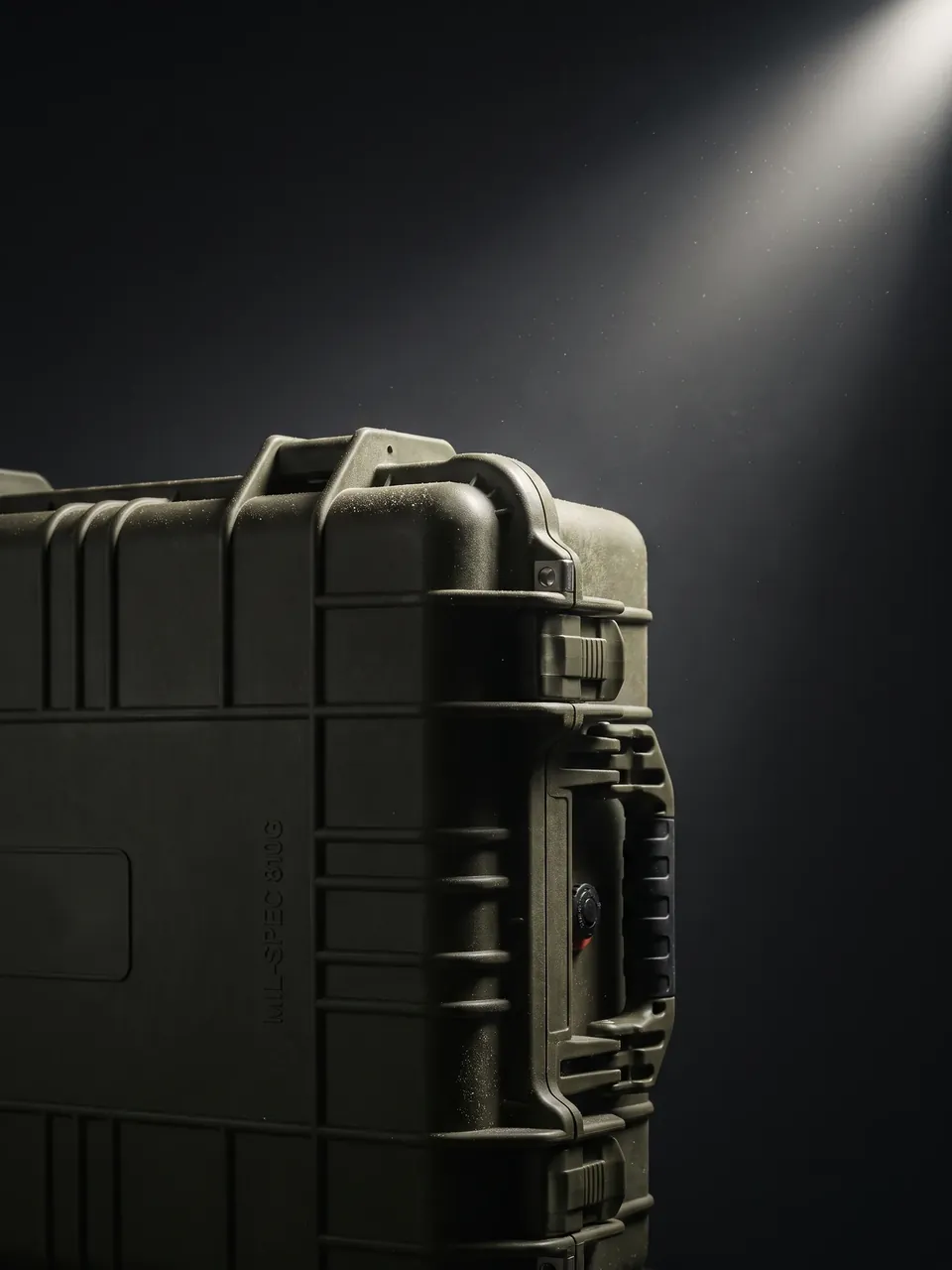
The hinge-pin to stop-shoulder clearance of the Military walkie-talkie radio protective briefcase is held near 0.2 mm, since a loose fit lets the lid rock at the instant of lifting and the dial gauge would log that rocking as handle drift. The shell is cycled empty for a baseline curve, then retested with the 12 kg mass, and the difference between curves is the root's own plastic deformation. Two latches at 340 N each are checked here; any run with the lid not fully latched is discarded.
3. Drift readings across lift cycles
Fatigue testing of the Military walkie-talkie radio protective briefcase follows a 12 kg / 8000-cycle programme, with a dial-gauge reading every 1000 cycles. Eight readings that climb monotonically mean the ribs are still yielding rather than settling. The terminal value of 0.4 mm at cycle 8000 is the release line, and any step above 0.3 mm ends the run early. The single gasket at 19 percent compression carries no load here and serves only as a closed-lid reference.
| Lift cycle | Drift increment at 12 kg | Reading |
|---|---|---|
| 1000 cycles | 0.05 mm | initial seating |
| 4000 cycles | 0.12 mm | linear span |
| 8000 cycles | no more than 0.4 mm | release ceiling |
The fixture shifts about 0.02 mm over 8000 cycles, so a separate column removes that settlement.
4. Root inspection after the drop retest
After the lift programme the Military walkie-talkie radio protective briefcase goes through a 1.0 m six-face drop, landing on the diagonal opposite the handle seat so the shock runs along the root ribs into the rim flange. The root is checked by eye for blushing or hairline cracks, then remeasured; the gap from the cycle-8000 reading must stay within 0.08 mm. A 1.0 m drop and a 12 kg / 8000-cycle lift are two load paths, one probing brittle cracking and the other cumulative creep.
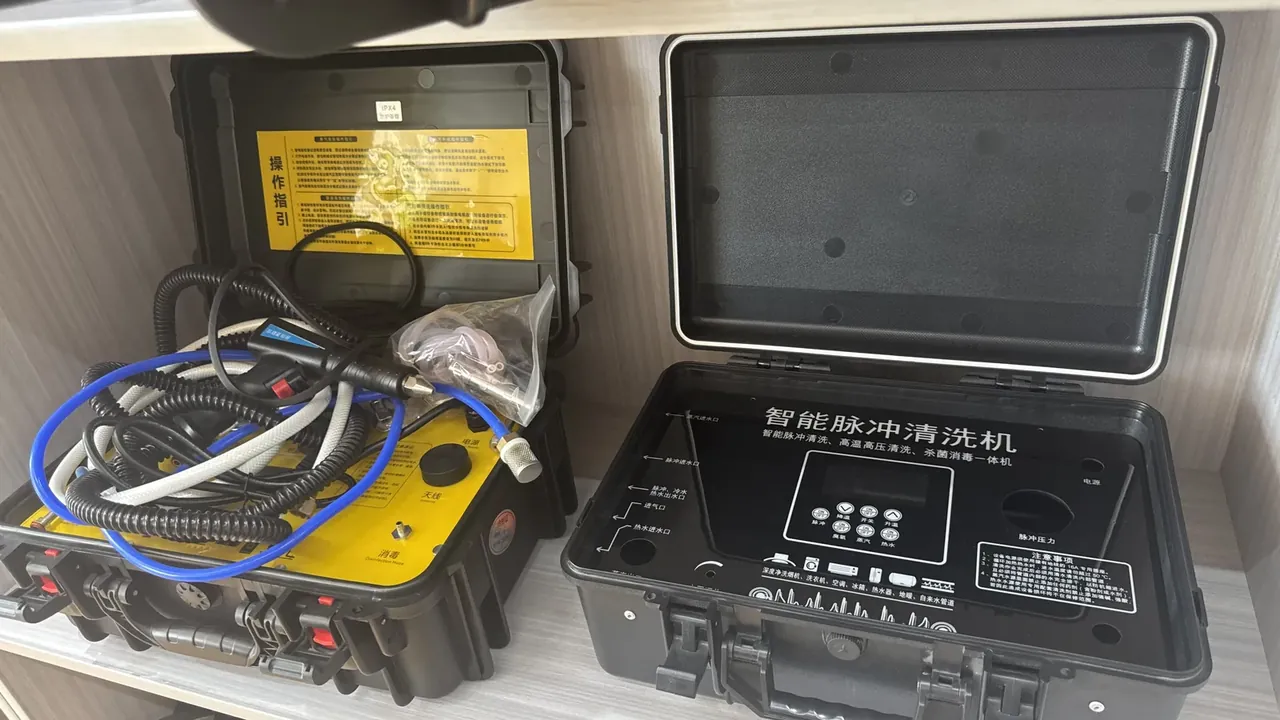
The drop retest of the Military walkie-talkie radio protective briefcase also checks whether the 105-degree stop has shifted, since a dented stop quietly widens the opening angle and the extra lid moment returns to the root. An IP66 spray retest follows, where the single gasket at 19 percent compression still has to seal and the rim must not warp from root deformation.
5. Build-up rejection line for carry batches
For the Military walkie-talkie radio protective briefcase, eight shells per batch are sectioned at the root, and a reading 0.15 mm under the 3.0 mm nominal is a reject; two such shells send the whole batch back. The line matches the smallest rib thickness that still holds drift within 0.4 mm after 8000 cycles, and a little less wall turns the curve upward past 6000 cycles. JUNZHIJIA writes it into the process card and reruns a full 12 kg / 8000-cycle check after any tool or material change.
Rejection records for the Military walkie-talkie radio protective briefcase map one to one onto drift values.
| Drift value | Matching build-up tier | Disposition |
|---|---|---|
| no more than 0.4 mm | nominal 3.0 mm | release |
| 0.4 to 0.5 mm | thin 2.8 mm | retest root |
| above 0.5 mm | reject band | whole batch rework |
Conclusion
The Military walkie-talkie radio protective briefcase pairs a 3.0 mm root build-up with a 105-degree hinge stop to lock drift within 0.4 mm after a 12 kg / 8000-cycle lift, with the 1.0 m drop retest covering brittle cracking. JUNZHIJIA files the section thickness, the drift curve and the rejection line, and reruns them after any tool change. When specifying a carry case of this kind, ask first whether root build-up and stop angle come with measured figures.
Related Reading
- Communication equipment case selection guide
- Communication equipment case specifications
- Communication test instrument case structure
- Emergency comms carry case configuration
Related Products
- 8 Series — Gun Cases; Military Equipment Cases; Camera Equipment Cases; Drone Cases; Watch Cases; Knife Cases; First Aid Cases; Electronics Equipment Cases
- WL8-2812 PP Gun Case — model WL8-2812
- All protective cases and toolboxes: 7 series, 158 models