

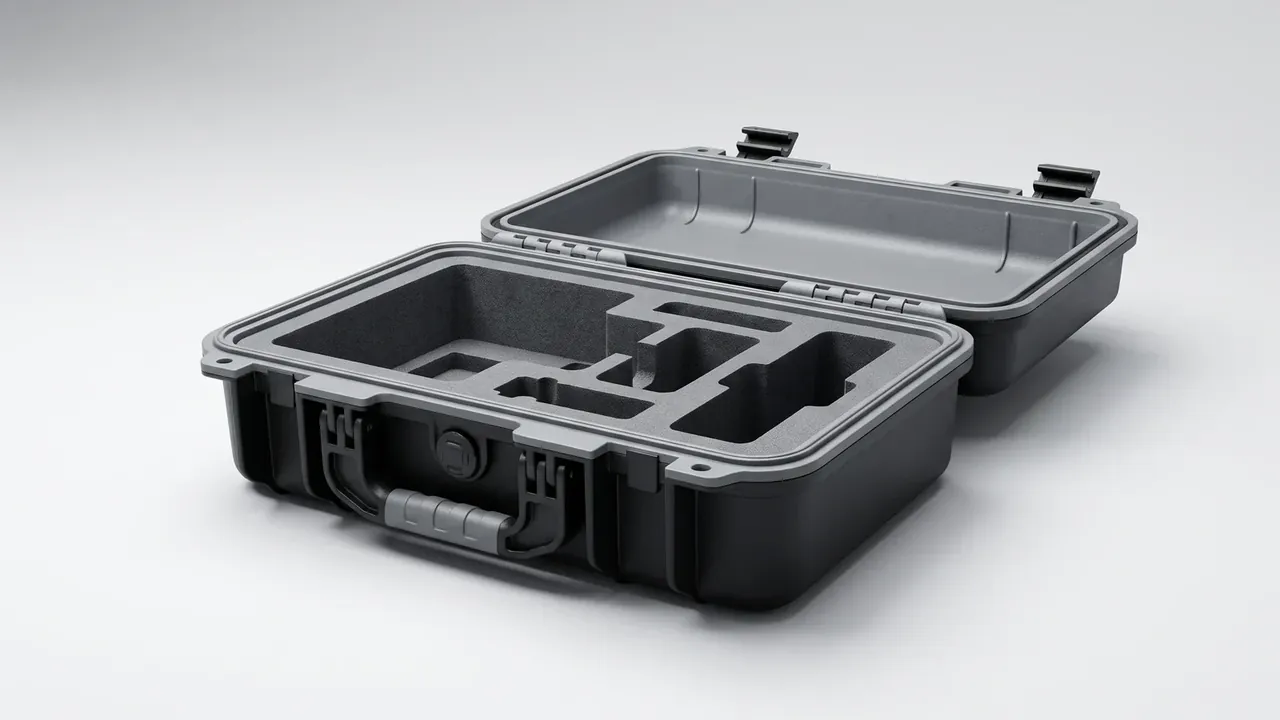
Quick answer: A quote from an OEM/ODM plastic tool box factory splits into tooling, material, machine time and packing. MOQ sets the tooling denominator, and tooling plus first-shot approval decide lead time.
Table of contents
- What the OEM/ODM Plastic Tool Box Factory Quote Contains
- How MOQ Ties to Cavities and Press Tonnage
- Scheduling Tooling, Sampling and Volume
- Cost Curve and Price Steps at Volume
- Factory Audit, Acceptance and Payment
- FAQ
1. What the OEM/ODM Plastic Tool Box Factory Quote Contains
Most quotes arrive as one unit price, but four blocks sit behind it: tooling, material, machine time, and packing with testing. A near-double gap on one drawing is definition, not margin: one supplier itemises the mould, the other buries it.
A single-cavity mould for a 400 × 300 × 150 mm body runs RMB 60,000 to 120,000: RMB 2 to 4 each over 30,000 pieces, RMB 12 to 24 over 5,000. A PP case with a 3.0 mm wall and 2.5 mm lid weighs 1.6 to 2.4 kg, material at about 40 percent of price.
| Block | Basis | Range |
|---|---|---|
| Tooling | mould ÷ volume | RMB 60k–120k per cavity |
| Material | shot weight × resin | about 40% of price |
| Machine time | cycle ÷ cavities | about 20% of price |
2. How MOQ Ties to Cavities and Press Tonnage
An OEM/ODM plastic tool box factory derives MOQ from tonnage and cavities, not habit. Projected area drives clamping force at 0.35 to 0.4 tonnes per cm²: a 400 × 300 mm body projects 1,200 cm², needs 420 to 480 tonnes, and lands on a 530 tonne press at a 45 to 60 second cycle.
Colour is the second threshold. Standard black and grey run straight through; a custom colour stops the press for a two hour purge and 12 to 18 kg of compound, so custom orders open at 1,000 pieces and standard at 500.
| Press | Projected area | MOQ |
|---|---|---|
| 250 t | 500–700 cm² | 300 pcs |
| 530 t | 1,100–1,400 cm² | 500 pcs |
3. Scheduling Tooling, Sampling and Volume
Design review takes three days and checks draft angles above 1.5 degrees, even wall transitions and an R2 fillet at the latch boss root. Tooling runs 20 to 25 days; first shot takes two days, with 12 dimensions measured and one 1.2 m drop.
A revision usually follows: an uneven lid gap, weak latch preload or base warp beyond 0.8 mm, five to seven days per loop. Write the permitted loops into the contract.
Volume then follows the press. A 530 tonne machine at 55 seconds and 20 effective hours yields 1,300 pieces a day, so 10,000 pieces take eight days. Sea freight Ningbo to Rotterdam runs 28 to 32 days, rail 18 to 22, putting a first order at 75 to 90 days from drawing approval.
4. Cost Curve and Price Steps at Volume
The steepest step is not the last one but the first few thousand pieces, where tooling dilutes. After that, price falls on machine efficiency and packaging.
Steps at an OEM/ODM plastic tool box factory follow container breakpoints. At 0.023 m³ per carton a 20 ft holds about 1,150 cases and a 40 ft high cube 2,600, so much of the gap between 2,000 and 5,000 pieces is LCL switching to a full container.
| Batch | Price index | Tooling share |
|---|---|---|
| 500 pcs | 100 | 18% |
| 2,000 pcs | 88 | 7% |
| 5,000 pcs | 79 | 3% |
| 20,000 pcs | 71 | 1% |
5. Factory Audit, Acceptance and Payment
An audit needs three things: three presses above 530 tonnes, a tooling register matching part numbers, and first-article records kept per batch. The register decides whether a revision can find its original drawing.
Acceptance clauses must be executable: minimum wall 2.7 mm, lid gap 0.6 to 1.0 mm, hardware at 48 hours salt spray rated 9, six-face drops from 1.2 m, and AQL 1.0 at Ac 1 Re 2. Payment splits 30/60/10, with 5 percent held six months on a first ODM project.
Conclusion
Buying from an OEM/ODM plastic tool box factory comes down to three tables: quote structure, schedule and acceptance. The first separates tooling, material and machine time so prices compare; the second fixes tooling and revision loops so a date is a commitment; the third turns wall, gap, salt spray and drop into numbers. Align all three before releasing an order, and choosing an OEM/ODM plastic tool box factory stops depending on instinct.
This article discusses only the container (case body) side of specifications and design intent, and does not cover any handling, loading or use of the contents.
Related Reading
- How export packing and loading are costed
- Scheduling delivery for mixed orders
- Reading injection press tonnage
- Applications for comparable case formats
Related Products
- 8 Series — Gun Cases; Military Equipment Cases; Camera Equipment Cases; Drone Cases; Watch Cases; Knife Cases; First Aid Cases; Electronics Equipment Cases
- WL8-2812 PP Gun Case — model WL8-2812
- All protective cases and toolboxes: 7 series, 158 models