

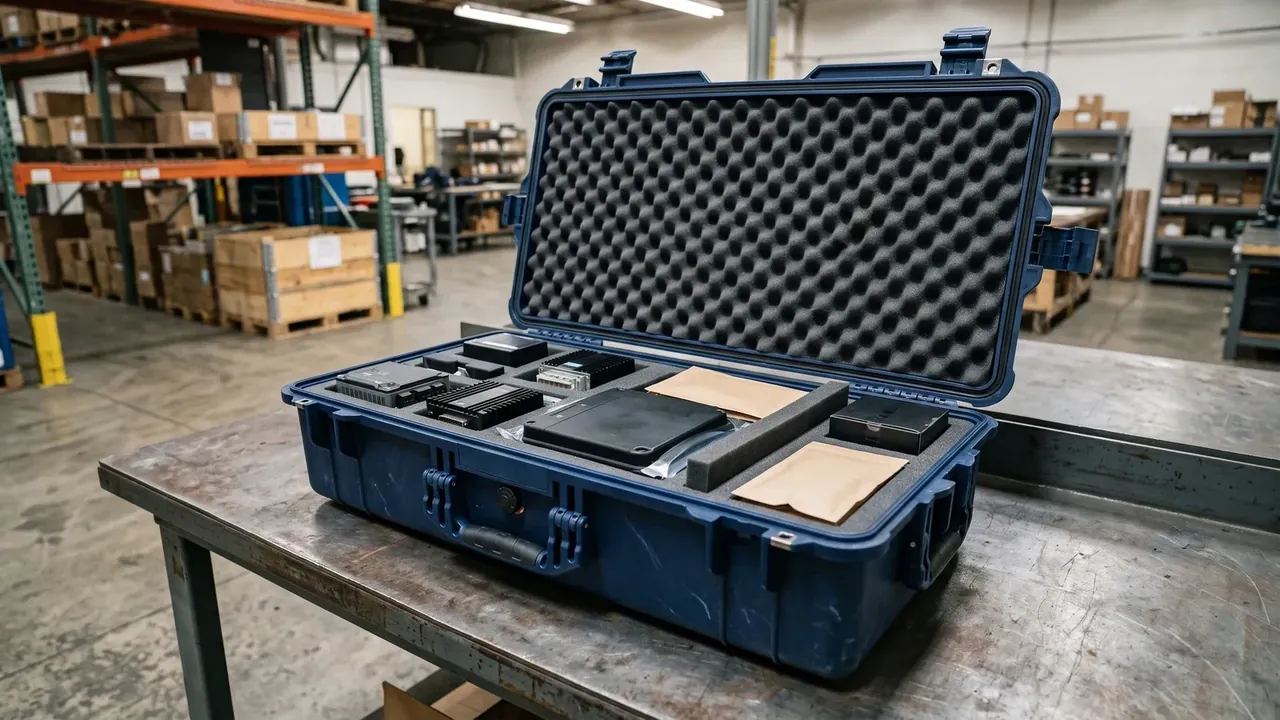
Quick answer: An Outdoor two-way radio protective hard box caps acceleration at 4.5 g across 5-200 Hz and keeps latch clearance under 0.6 mm after 4000 cycles.
Table of contents
- Lid inner press-frame clearance of the Outdoor two-way radio protective hard box
- Antenna groove pitch and groove-wall support
- Transmitted acceleration readings across the sweep band
- Groove re-check after six-face drop
- Clearance verdict on the open-close life rig
- FAQ
1. Lid inner press-frame clearance of the Outdoor two-way radio protective hard box
An Outdoor two-way radio protective hard box leaves its lid press-frame clear of the foam groove tops, so closing only locates the EVA insert without bearing hard on the groove walls. The shell is moulded at a 3.6 mm wall, 480×350×190 mm outer and 425×290×140 mm inner, 3.4 kg empty and 7 kg loaded. Clearance is set to one value for all 12 grooves, with the frame edge landing on the rib between grooves rather than over a groove mouth. Too little clearance transmits rig vibration straight into the base; too much lets the insert shift on drop. The frame is moulded with the lid and its clearance fixed in the tool. JUNZHIJIA files clearance, 14 mm groove pitch and 40 kg/m³ EVA density together in the first-article record.
Clearance logs only frame-to-groove-top distance and is never mixed with groove-depth tolerance.
| Slot group | Pitch and wall | Inspection item |
|---|---|---|
| Front row of 12 grooves | 14 mm pitch | Wall clear distance |
| Rear row of 12 grooves | 40 kg/m³ EVA density | Wall non-collapse verdict |
| Groove-wall root | Continuous base layer | Load path uncut |
2. Antenna groove pitch and groove-wall support
An Outdoor two-way radio protective hard box mills 12 grooves into the base pad, where 14 mm pitch is the clear gap between adjacent walls and wall thickness sets isolation stiffness with it. EVA density of 40 kg/m³ is used: lower density lets walls collapse under the 7 kg load, higher density raises transmitted acceleration. Both walls of each groove come from the same pad, with a continuous layer under the groove and an uncut wall root, so six-face drop loads travel down the wall to the pad. Pitch aligns on the drawing with the press-frame ribs, keeping clearance intact. Sampling measures pitch and wall thickness only before the insert is bonded.
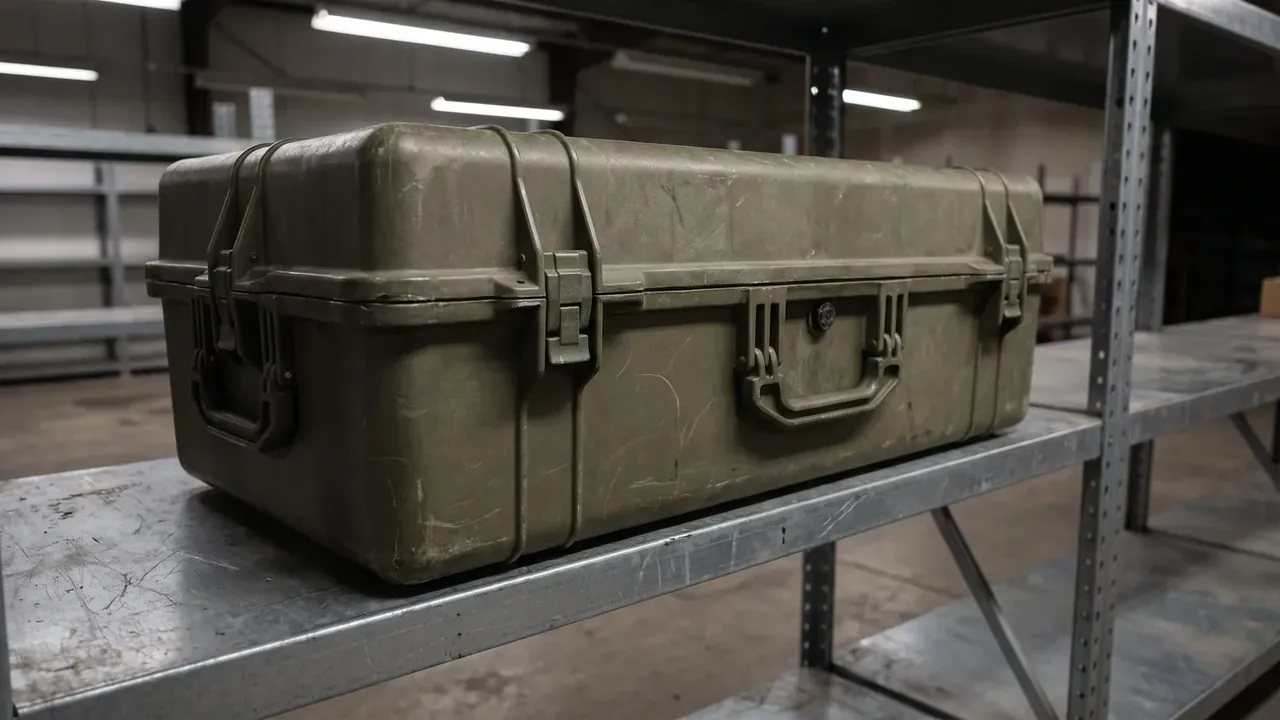
Wall support and base clearance are logged apart; pitch is not converted into depth tolerance, and no single point stands for a whole row.
3. Transmitted acceleration readings across the sweep band
The sweep rig runs the Outdoor two-way radio protective hard box across 5–200 Hz, sampling the base accelerometer and the table reference together and taking transmitted acceleration as their amplitude ratio, with the full-band ceiling held to ≤4.5 g. Resonance peaks are logged alone rather than standing in for the band, and 40 kg/m³ curves are filed apart from off-density parts. Press-frame clearance is re-read before and after the sweep, on its own row from the amplitude ratio. An IP66 immersion check follows the sweep, never before it, using one mark set on the frame.
Readings of the Outdoor two-way radio protective hard box split by band: low frequency shows wall stiffness, high frequency shows pad isolation, and only the full-band row meets the ≤4.5 g limit.
| Sweep band | Sampling | Reading use |
|---|---|---|
| 5 Hz start | Point-by-point ratio | Low-frequency wall stiffness |
| 200 Hz end | Mark resonance peak | High-frequency isolation |
| 5–200 Hz full band | Take ratio ceiling | Compared with ≤4.5 g |
4. Groove re-check after six-face drop
After a 1.2 m six-face drop, the Outdoor two-way radio protective hard box re-checks its grooves: 14 mm pitch, wall thickness and the continuous base layer are measured per unit with the same gauge as before. The verdict is that walls do not collapse; a collapsed edge sends the unit first to a 40 kg/m³ density check, then to a frame-clearance check, rather than straight to shell rejection. The two latches, each 350 N, are re-read before and after the drop and logged apart from wall movement. A 72 h salt spray is followed by one more wall check for peeling or cracks.
The Outdoor two-way radio protective hard box logs the six-face drop face by face; groove readings do not rerun the sweep, and re-check accepts only groove geometry and frame clearance.
5. Clearance verdict on the open-close life rig
After 4000 open-close cycles, the Outdoor two-way radio protective hard box is judged on latch clearance of ≤0.6 mm, read with a feeler gauge at the tongue and seat of both latches and taking the larger value. Excess clearance sends the unit first to a latch-seat insert check, then to a frame-clearance check for lid tilt, rather than to latch rejection. Cycling does not change the 12-groove layout and does not rerun the sweep.
The clearance verdict accepts feeler readings only; hand feel carries no weight.
| Clearance value | Measuring point | Use |
|---|---|---|
| ≤0.6 mm | Two latch tongues | Life-rig scrap line |
| 350 N each | Latch closing force | Re-read before/after drop |
| Initial clearance | First article | Compared with 4000 cycles |
Conclusion
The Outdoor two-way radio protective hard box links frame clearance, 14 mm pitch with wall support, ≤4.5 g transmitted acceleration over 5–200 Hz, no wall collapse after a 1.2 m six-face drop and ≤0.6 mm latch clearance after 4000 cycles into one shell-side specification chain, anchored at the frame, insert, sweep rig, drop re-check and life rig. JUNZHIJIA retains the 12 grooves, 40 kg/m³ EVA, 350 N latches, IP66 benchmark and 72 h salt spray by benchmark method, with sampling reusing the first-article datum. The file covers shell structure, insert process and inspection readings only, and stays with the case side of the design.
Related Reading
- Selection criteria and structural items for communication cases
- Specification item list for communication equipment cases
- Structure and sealing requirements for emergency communication cases
- Surface resistance and inserts of anti-static protective cases
Related Products
- 8 Series — Gun Cases; Military Equipment Cases; Camera Equipment Cases; Drone Cases; Watch Cases; Knife Cases; First Aid Cases; Electronics Equipment Cases
- WL8-2812 PP Gun Case — model WL8-2812
- All protective cases and toolboxes: 7 series, 158 models