

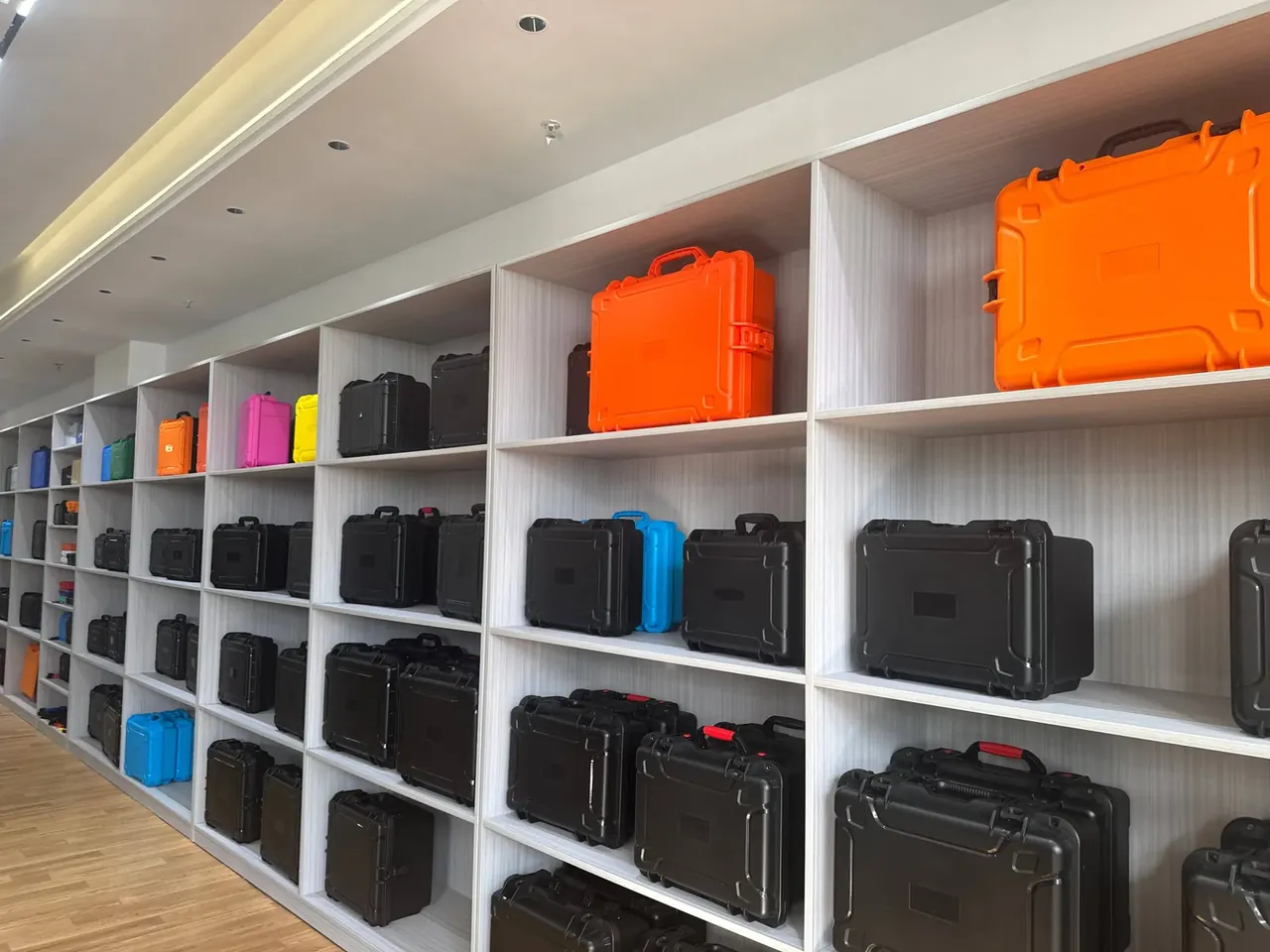
Quick answer: A submachine gun storage case is quoted from three blocks — tooling, material and finishing — while MOQ follows the tooling route and colour count, and lead time splits between sample approval and paperwork.
Table of contents
- What a Submachine Gun Storage Case RFQ Must State
- How to Read the Four Cost Blocks
- MOQ Set by Tooling Route and Colour Batch
- Samples, Sign-off and Golden Units
- Lead Time Milestones and Shipping Documents
- FAQ
1. What a Submachine Gun Storage Case RFQ Must State
A thin RFQ produces quotes nobody can compare. Given only an outside dimension and a quantity, a supplier guesses wall thickness on the safe side, and every extra millimetre returns as a heavier part.
| RFQ field | What to state | Cost of omitting it |
|---|---|---|
| Internal cavity | L × W × H with tolerance, insert included | Cavity inflated, weight added |
| Stacking tiers | Storage height and direction | Base ribs and corner blocks dropped |
| Annual volume and colours | Year total, batch size, units per colour | Amortisation base unclear |
Stacking tiers and annual volume are skipped most often. Tiers set base thickness and corner blocks, so a case designed for two tiers but stacked four high is thickened everywhere.
2. How to Read the Four Cost Blocks
Ask for tooling, material, machine time and finishing as separate lines. A rotomolded submachine gun storage case at 820 × 360 × 180 mm with a 6 mm wall weighs 6.8 kg: resin at 11 CNY per kilogramme is about 75 CNY, an 18-minute cycle on a two-cavity arm adds roughly 30 CNY, and four latches with a gasket run add 25 to 35 CNY.
Tooling is the only block that shrinks with volume. An aluminium mould at 35,000 to 60,000 CNY spread over 2,000 pieces is 18 to 30 CNY each; over 200 pieces it is 175 to 300 CNY. A high quote is usually a different denominator, not a fatter margin.
3. MOQ Set by Tooling Route and Colour Batch
The minimum order quantity for a submachine gun storage case is arithmetic rather than negotiation, and the three routes differ by an order of magnitude.
| Tooling route | Upfront cost | Typical MOQ | Best fit |
|---|---|---|---|
| Welded steel | Fixtures 2,000–6,000 CNY | 30 pcs | Cases over 1 m, low volume |
| Rotomoulding | Mould 35,000–60,000 CNY | 200 pcs | Mid to large batches |
| Injection moulding | Mould 120,000–250,000 CNY | 800 pcs | Small cases, tight cosmetics |
Below 30 pieces, welded steel wins because no mould is needed. Colour is the quieter constraint: a change needs a 40-minute clean-out and 3 kg of scrap, so one colour starts at 200.
Room to negotiate sits in batch splitting: 2,400 pieces a year as three batches of 800 keeps tooling spread across 2,400, while a first batch of 200 only moves cost into wall thickness.
4. Samples, Sign-off and Golden Units
Sampling runs three rounds. A printed prototype takes 5 to 7 days and proves outer form and lid feel; the first moulded part takes 8 to 12 days and exposes shrinkage and wall distribution; the signed sample carries colour chip, marking and latches as the production reference.
Keep three golden units from one mould and one resin lot, tagged with date and mould number. Measure wall thickness at six points, accept nothing under 90 percent of nominal, and keep latch force between 30 and 60 N on the loaded submachine gun storage case.
5. Lead Time Milestones and Shipping Documents
Ask for lead time node by node, because sampling and inspection are the stages most often compressed by a verbal promise.
| Milestone | Working days | Output |
|---|---|---|
| Enquiry to quote | 2–4 | Quotation and tooling proposal |
| Prototype to first shot | 10–16 | Samples with dimension sheet |
| Sign-off to first batch | 25–35 | Batch and inspection record |
| Drop and stack tests | 7–12, in parallel | Test report |
Paperwork is where schedules quietly die. A sea shipment of submachine gun storage cases needs material certification, an inspection record of measured wall thickness and latch force, IPPC-marked pallets, and a packing list with carton marks.
Testing runs only on real cases, and samples travel to the lab and back in 7 to 12 days, so the test must overlap with production. The model and quantity on the report must match the shipment.
Conclusion
Procurement comes down to three numbers: how many pieces carry the tooling, where the MOQ sits, and how many days paperwork consumes. A complete RFQ makes quotes comparable, and a test schedule running alongside production protects the delivery date. What survives an audit is a submachine gun storage case with measured wall thickness and a full document set.
This article discusses only the container (case body) side of specifications and design intent, and does not cover any handling, loading or use of the contents.
Related Reading
- How to Set Submachine Gun Storage Case Specifications
- Acceptance Criteria for Submachine Gun Storage Cases
- Export Packaging and Shipping Documents for Cases
- Splitting Mixed Orders and Delivery Rhythm
Related Products
- 8 Series — Gun Cases; Military Equipment Cases; Camera Equipment Cases; Drone Cases; Watch Cases; Knife Cases; First Aid Cases; Electronics Equipment Cases
- WL8-2812 PP Gun Case — model WL8-2812
- All protective cases and toolboxes: 7 series, 158 models