

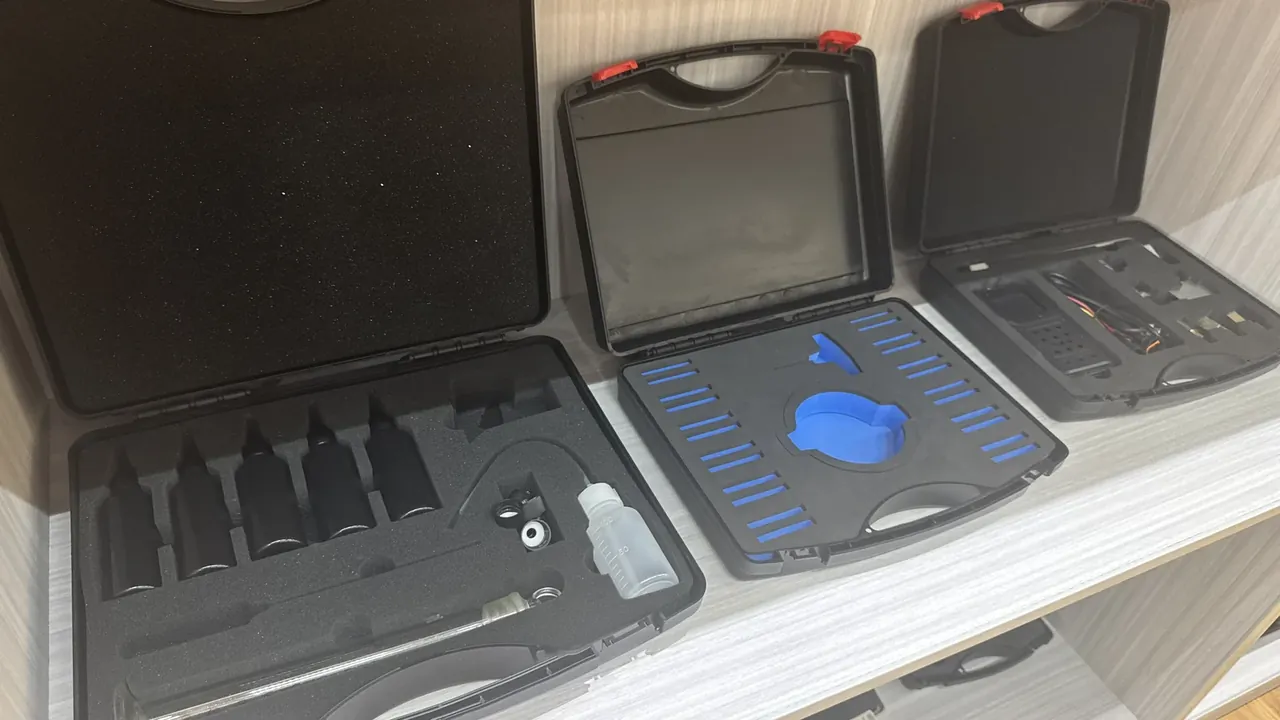
Quick answer: Work backwards from the load. Fix the internal envelope from the packed profile, add wall and latch overhang for the outside, size base and rib pitch against the rated load, then close with tolerance and tare.
Table of contents
- Four Numbers for a Submachine Gun Storage Case
- Internal Envelope and Clearance
- Wall Thickness Paired With Rib Pitch
- Load Rating and Stack Tiers
- Tolerances, Tare Weight and Fittings
- FAQ
1. Four Numbers for a Submachine Gun Storage Case
A submachine gun storage case needs four numbers: internal envelope, outside size, wall allocation, rated load. Fix them in that order, or the sheet contradicts itself.
The envelope of a submachine gun storage case follows the packed profile, not the nominal weapon length. A folding-stock weapon runs 590 mm extended, 150 mm at the tallest point with a 30-round magazine seated and 290 mm across the magazine well, giving a 620 x 320 x 170 mm cavity. The margin is foam thickness, compression and finger room. Outside adds 3.2 mm sides, 4.0 mm base, 2.8 mm lid, 6 mm rib and 8 mm latch overhang: 660 x 360 x 200 mm.
| Item | Value | Derived from |
|---|---|---|
| Internal envelope | 620 x 320 x 170 mm | Packed profile plus foam |
| Outside size | 660 x 360 x 200 mm | Cavity plus wall and rib |
| Rated load | 22 kg | Base thickness and ribs |
2. Internal Envelope and Clearance
Clearance in a submachine gun storage case differs by direction. Along the length, 8 mm feeds foam compression; across the width, 6 mm lets a hand pass beside the weapon; vertically, 12 mm preloads the lid foam.
Interference sets the spring rate. At 35 kg/m³, foam compressed 30 percent pushes back near 4 kPa, about 800 N across that cavity. Take interference to 4 mm and compression passes 45 percent, the grip disappears. Height has 20 mm to spend: 12 mm of lid foam plus an 8 mm base step, so closed foam sits at 9 mm, a 25 percent squeeze.
3. Wall Thickness Paired With Rib Pitch
Sides run 3.2 mm with 2.0 mm ribs on a 48 mm pitch, 6 mm tall, rooted at R1.5. Holding rib thickness near 0.6 of the wall keeps root cooling close to the wall, so no sink line reaches the outside. Pitch is back-calculated from bulge at 110 kg; open it to 70 mm and the middle bows past 3 mm.
The base of a submachine gun storage case runs 4.0 mm with a three-by-two rib grid, 8 mm tall, spanning at most 200 mm. Under 500 N uniform load a flat base deflects 2.1 mm, the grid 0.8 mm. Bending comes from section modulus: the grid adds 0.35 kg, a 6 mm slab 1.1 kg.
| Zone | Wall | Ribs | Duty |
|---|---|---|---|
| Sides | 3.2 mm | 2.0 mm, 48 mm pitch | Stacking bulge |
| Base | 4.0 mm | 3 + 2 grid, 8 mm | Drop and stack |
| Lid | 2.8 mm | Perimeter ring | Denting |
4. Load Rating and Stack Tiers
A rating needs kilograms, tiers and duration. The 22 kg figure covers 16 kg of contents, 2 kg of foam and fittings, and the 4.6 kg tare. At five tiers the bottom case carries 4 x 22 + 22 = 110 kg.
Temperature is a separate line for a submachine gun storage case. PP at 40 Celsius loses about 20 percent of its modulus against 23 Celsius, so 110 kg derates to 88 kg; a closed truck body at 50 Celsius takes 0.68.
| Tiers | Bottom carries | 24 h deflection | Verdict |
|---|---|---|---|
| 3 | 66 kg | 1.5 mm | Stack as built |
| 5 | 110 kg | 2.0 mm | Warehouse limit |
5. Tolerances, Tare Weight and Fittings
On a submachine gun storage case only two tolerances bind: hinge bores and latch hooks. The cavity holds plus or minus 0.6 mm, holes plus or minus 0.3 mm, closing gap 1.2 mm, base flatness 0.5 mm. Holes run tighter because the two mouldings shrink apart.
Tare splits into 3.2 kg of shell, 0.35 kg of hardware, 0.75 kg of foam and 0.3 kg of labels and valves. The usual overrun is foam density drifting from 35 to 45 kg/m³, 0.2 kg per case. Reserve a 100 x 28 mm label recess and keep the 8 mm pressure valve 18 mm off the seal groove.
Conclusion
Order matters more than quantity: envelope drives outside size, wall drives load, rib pitch and stack tiers set the rating, tolerance and tare close the loop. Fill the four groups in sequence and a submachine gun storage case can be quoted without a second drawing.
This article discusses only the container (case body) side of specifications and design intent, and does not cover any handling, loading or use of the contents.
Related Reading
- What Is a Submachine Gun Storage Box: Structure and Protec…
- How to choose a submachine gun storage case
- How protective case size ranges are split
- What to put in a custom foam insert spec
Related Products
- 8 Series — Gun Cases; Military Equipment Cases; Camera Equipment Cases; Drone Cases; Watch Cases; Knife Cases; First Aid Cases; Electronics Equipment Cases
- WL8-2812 PP Gun Case — model WL8-2812
- All protective cases and toolboxes: 7 series, 158 models