

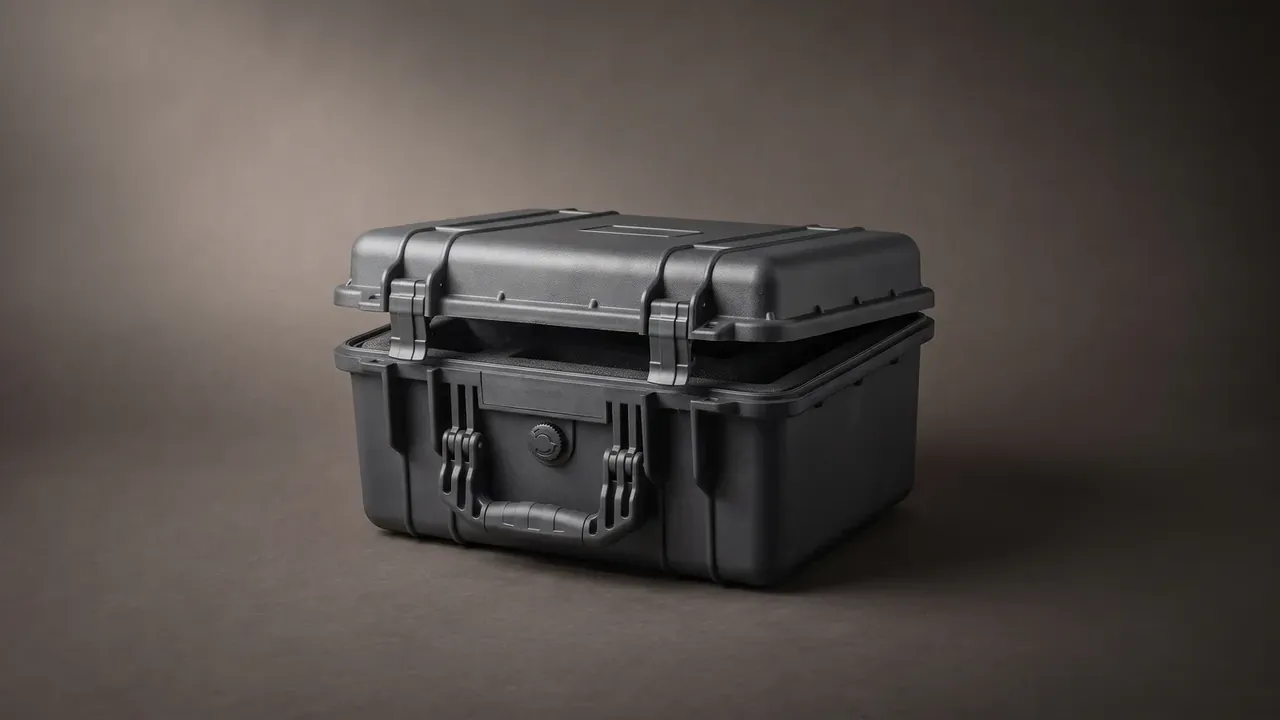
Quick answer: Four figures on a Custom Foam Insert sheet decide whether it assembles: base thickness, pocket depth, compression ratio and tolerance. The first two set how deep a part sits, the third takes up movement, the fourth makes unit twenty match unit one.
Table of contents
- Four figures that matter
- Thickness in three segments
- Compression ratio
- Tolerance accumulation
- Measuring before ordering
- FAQ
1. Four figures that matter
A sheet usually lists material, colour, density, thickness and tolerance, which looks complete. Only four decide whether the insert fits: base thickness, pocket depth, compression and tolerance. Start with material and the usual ending is a pocket too shallow to use.
| Line | Typical value | What it governs |
|---|---|---|
| Base thickness | 15 mm | travel on a corner drop |
| Pocket depth | 55 mm | how deep the part sits |
| Compression | 8–12% | movement and lid force |
| Tolerance | ±0.5 mm | batch interchangeability |
Base thickness is the distance from pocket floor to case floor; pocket depth against part thickness sets compression. Read all four together: base plus pocket plus lid pad equals interior height, and the millimetres left over are the compression.
2. Thickness in three segments
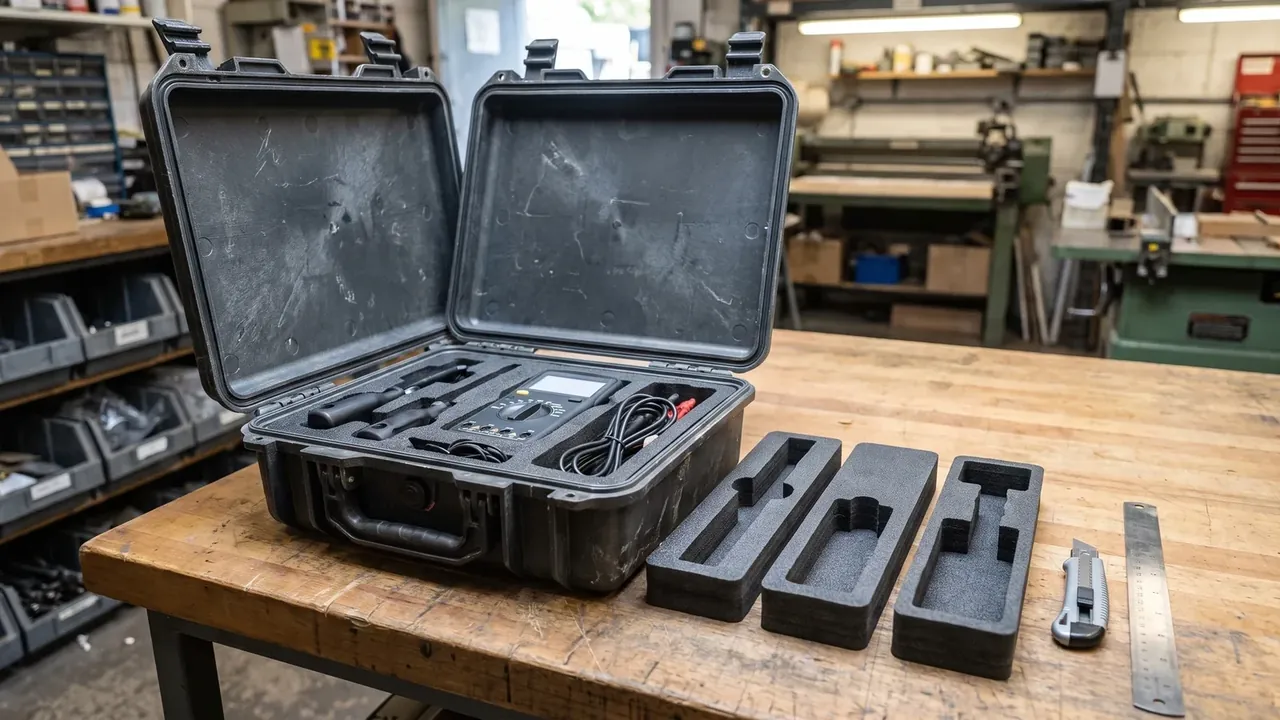
Interior height covers base, pocket and lid pad. Base takes 10 to 15 mm, pocket depth is part thickness minus compression, and the pad takes the rest. Too much and the lid will not close; too little and the part rattles.
At 120 mm interior and a 60 mm part: base 15, pocket 55, pad 50. The part is held under 5 mm, about 8 percent compression. Thicker is not better, since 5 mm onto the base takes 5 mm off the pocket and eats the grip; heavy parts ride on the base, light ones on the pad.
3. Compression ratio
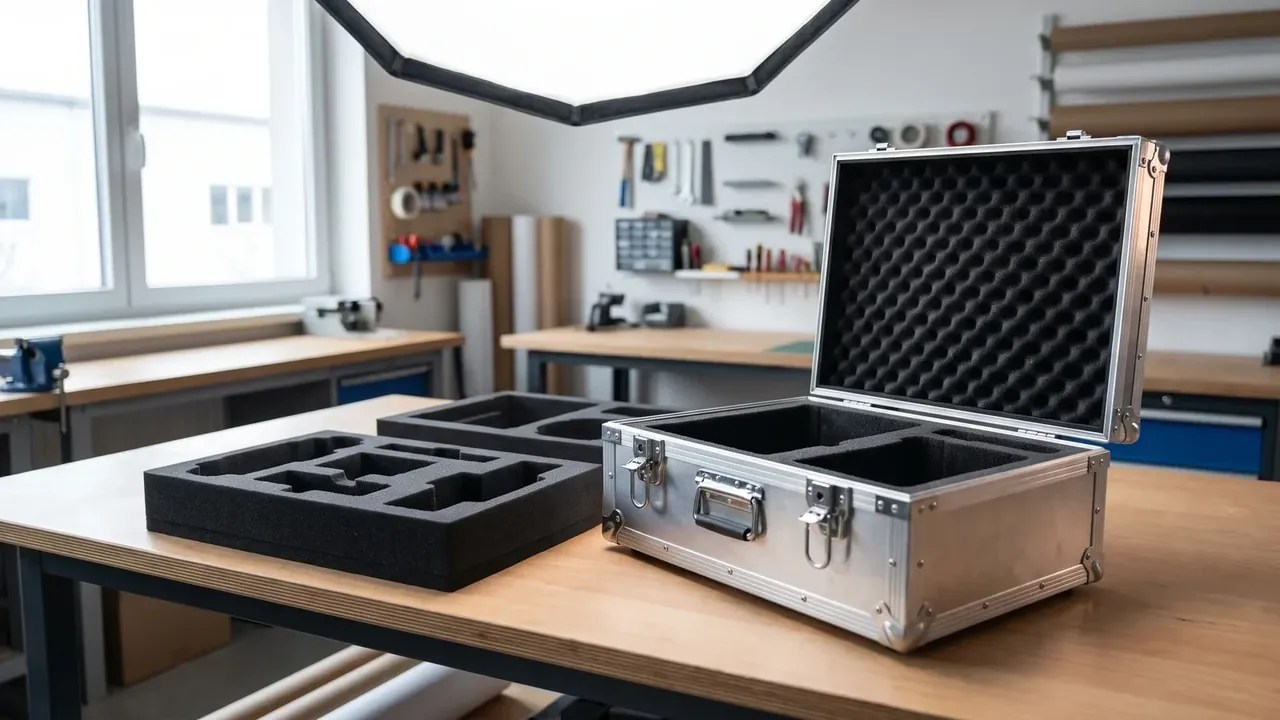
Compression is part thickness minus pocket depth, divided by part thickness, and usually runs 5 to 15 percent. Below 5 the part moves and hits the wall in a drop; above 15 the lid needs force and the latches stay loaded.
By weight: under 2 kg takes 5 to 8 percent, 2 to 10 kg takes 8 to 12, above 10 kg takes 12 to 15. Frequent handling takes the low end, a single shipment the high end.
Compression and hardness are a pair. Soft foam compresses but recovers slowly, hard foam refuses and pushes back, so a sheet quoting compression without hardness has quoted half a specification. Check it by closing the case for 24 hours and looking for an even ring on the pocket wall.
4. Tolerance accumulation
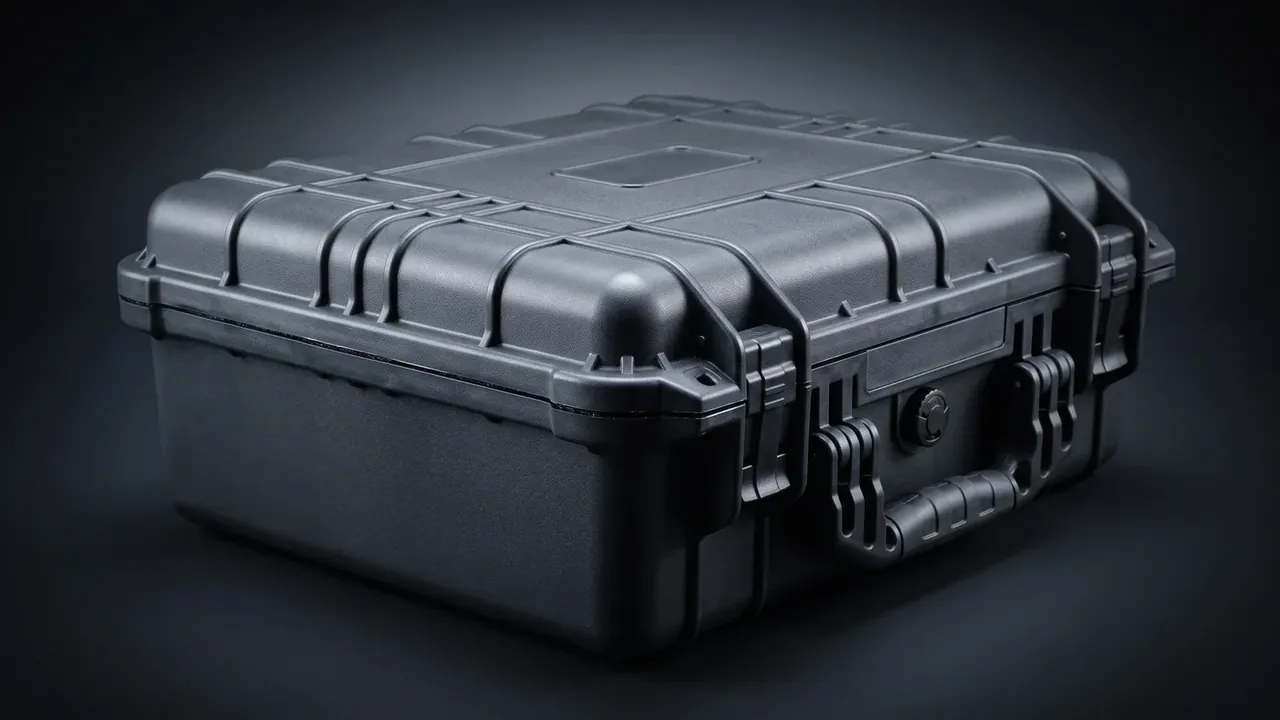
Tolerance is not cutting alone. Three sources add up: interior moulding at plus or minus 1.5 mm, pad cutting at 0.5, lamination at 0.8, reaching 2.8 mm when they run the same way.
| Step | Single tolerance | Note |
|---|---|---|
| Case interior | ±1.5 mm | moulding variation |
| Pad cutting | ±0.5 mm | die or routing |
| Lamination | ±0.8 mm | glue and press shift |
| Accumulated | ±2.8 mm | all in one direction |
Direction matters as much as size. Pockets take the minus side so interference grips the part; the outer profile takes the plus side, or the insert will not enter the case.
5. Measuring before ordering
Measure the interior at three points and take the smallest; moulded walls bulge by a few tenths and an average makes the insert arch. Measure the part at its largest outline, bosses and connectors included, and use one instrument for both. Where an antistatic bag is used, add 1 to 2 mm all round.
Six lines complete a drawing: interior size, base thickness, pocket depth, pocket outline, compression and accumulated tolerance.
Conclusion
A Custom Foam Insert sheet does not need length, it needs closure: base plus pocket plus lid pad equals interior height, compression sits between 5 and 15 percent, tolerance is stated as an accumulated figure. Fill those four lines and the Custom Foam Insert assembles on the first try.
This article covers container-side specifications and design implications only, not the handling, loading or use of the contents.
Related Reading
- How pre-cut foam inserts are made
- What drives custom foam cost
- Technical parameters on a case drawing
- How to size a protective case
Related Products
- 8 Series — Gun Cases; Military Equipment Cases; Camera Equipment Cases; Drone Cases; Watch Cases; Knife Cases; First Aid Cases; Electronics Equipment Cases
- WL8-2812 PP Gun Case — model WL8-2812
- All protective cases and toolboxes: 7 series, 158 models