

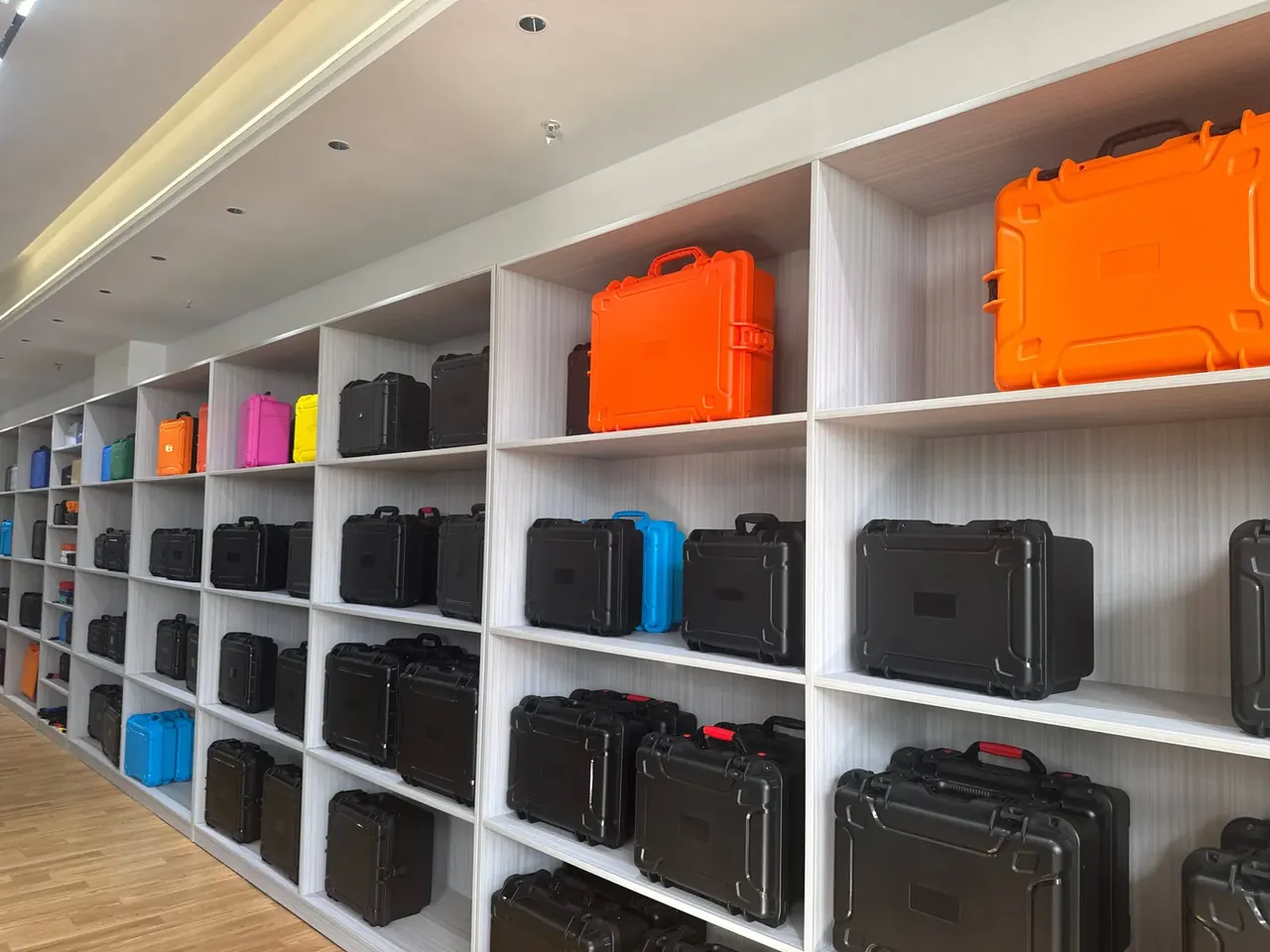
Quick answer: Acceptance rests on four groups: appearance, dimensions, performance and marking. Each needs its own verdict rule, sample size and disposition path in the contract.
Table of contents
- Four Inspection Groups for a Submachine Gun Storage Case
- How Appearance and Size Are Checked
- Type Tests and Their Verdicts
- Sampling Plan and Defect Classes
- Reject Lots, Sorting and Re-inspection
- FAQ
1. Four Inspection Groups for a Submachine Gun Storage Case
Acceptance for a submachine gun storage case runs on four groups: appearance, dimensions, performance, marking. Each carries its own rule, and blurring them lets a cosmetic flaw and a structural one share one yield figure.
One yield figure hides the difference. A short-shot latch hook and a light flow line both count as a single defect, so a sealing failure gets averaged out by cosmetics.
| Group | Method | Verdict basis |
|---|---|---|
| Appearance | Visual, 600 mm, 800 lux | Defect class, major is zero tolerance |
| Dimensions | First article plus shift sampling | Drawing tolerance band |
| Performance | Type test on triggers and quarterly | Pass or fail, no scoring |
| Marking and packing | Unit check plus carton sampling | Height, lot code, barcode |
2. How Appearance and Size Are Checked
Viewing conditions for a submachine gun storage case come first: 600 mm distance, 800 lux, D65 light, sample and colour chip on one plane, or the same scratch earns two verdicts.
Four defects on a submachine gun storage case are always major: cracks, through-holes, sealing-face nicks, short shots on the latch hook. Flash holds minor to 0.3 mm and turns major past 0.8 mm, where it cuts hands.
First article measures 12 key dimensions on 3 cases; production checks 6 assembly dimensions on 5 cases per shift. Wall thickness goes on an ultrasonic gauge at 8 points, four midpoints and four corners, failing below 90 percent of drawing.
| Item | Instrument | Verdict |
|---|---|---|
| Cavity length, width, depth | Caliper or go/no-go gauge | Inside the tolerance band |
| Wall thickness | Ultrasonic gauge, 8 points | At least 90 percent of drawing |
| Closing gap | Feeler gauge | 0.8 mm or less |
| Latch holding force | Force gauge | 160 N or more |
3. Type Tests and Their Verdicts
Type tests on a submachine gun storage case run on three triggers: design freeze, a change of material, a major mould repair. Production repeats them quarterly on 3 cases drawn from a normal lot.
Drop testing of a submachine gun storage case runs at 1.5 m across six faces, three edges and one corner, 10 drops with the case loaded. Verdicts: no shell cracks, both latches openable with one hand, seal cord still in its groove.
Immersion holds the case at 1 m for 30 minutes with absorbent paper inside; no watermark allowed. Latch life runs 15,000 cycles with 15 percent force loss, and hardware takes 72 hours of neutral salt spray to rating 9 under GB/T 6461.
| Test | Condition | Verdict |
|---|---|---|
| Drop | 1.5 m, 6 faces, 3 edges, 1 corner | No cracks, one-hand opening |
| Immersion | 1 m, 30 minutes | No watermark on paper |
| Latch life | 15,000 cycles | Force loss within 15 percent |
| Salt spray | 72 hours neutral | Rating 9 or better |
4. Sampling Plan and Defect Classes
Sampling of a submachine gun storage case follows GB/T 2828.1, level II, normal single: majors at AQL 1.0, minors at 2.5. A lot of 501 to 1200 maps to code J with 80 samples, accept 2 reject 3 on majors, accept 5 reject 6 on minors.
Class must be written apart from yield. Three minor defects in 80 samples read as 96 percent good and still reject the lot at AQL 2.5, while one short-shot hook is 1.25 percent and stops the shipment.
5. Reject Lots, Sorting and Re-inspection
A rejected submachine gun storage case lot has three exits: sorting, downgrading, return. Majors require 100 percent sorting, minors can be downgraded with separate marking, and performance failures go back without discussion.
Re-inspection is not a fresh draw. A sorted lot returns under tightened inspection at the same sample size with the acceptance number down by one. Two consecutive rejects stop the line; five consecutive accepts restore normal inspection.
Records need sample number, inspector and time of verdict. Miss one and traceability breaks inside six months, pulling every lot from the same tool into a recall.
Conclusion
A standard earns its keep when every clause decides something: conditions for appearance, instruments for dimensions, fixed verdicts for performance, sample sizes for lots, exits for rejects. Tie the five together and a submachine gun storage case standard can be audited by anyone holding the sheet.
This article discusses only the container (case body) side of specifications and design intent, and does not cover any handling, loading or use of the contents.
Related Reading
- Buying a submachine gun storage case: price, MOQ, lead time
- How military supply cases are inspected
- Writing a case production SOP that holds
- Gun case production audit from resin to shipment
Related Products
- 8 Series — Gun Cases; Military Equipment Cases; Camera Equipment Cases; Drone Cases; Watch Cases; Knife Cases; First Aid Cases; Electronics Equipment Cases
- WL8-2812 PP Gun Case — model WL8-2812
- All protective cases and toolboxes: 7 series, 158 models