

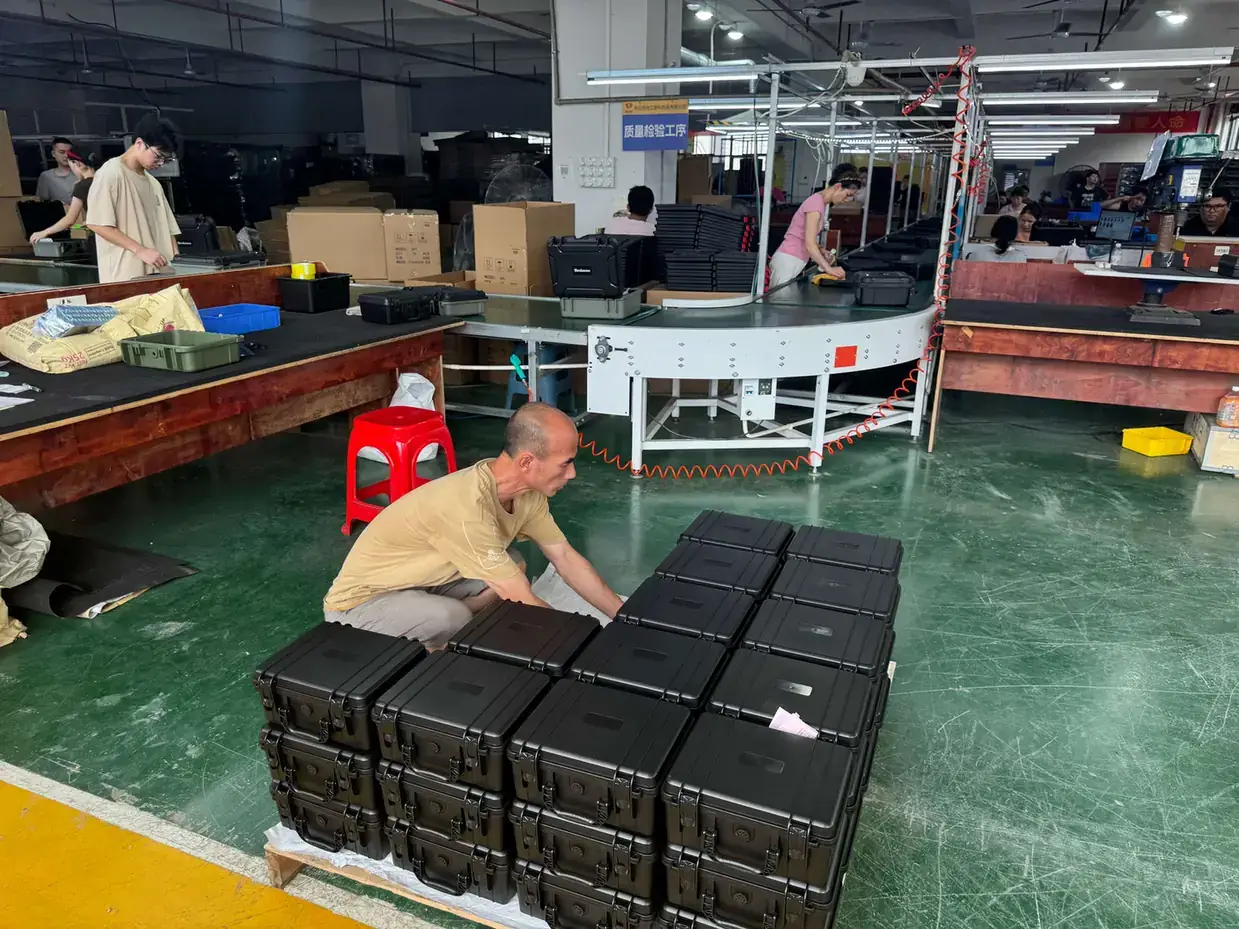
Quick answer: A Gun Case Production audit covers three blocks: whether machines hold their rated parameters, whether the process has hold points, and whether records can trace a finished case back to a material lot. Each block has its own benchmark and evidence, and sampling logs on site beats listening to a briefing.
Table of contents
- Machine Review in Gun Case Production
- Process Review: First Article, Patrol and Hold Points
- Record Review: Batch Traceability and Three Logs
- Verdict Rules: Conforming, Observation, Nonconforming
- Planning the Visit and Sample Size
- FAQ
1. Machine Review in Gun Case Production
A Gun Case Production audit starts with what the machine delivers that day. A 3,000 mm swing covers a case diagonal near 1,200 mm, an 8 °C oven spread means the ducting has drifted, and 800 tonnes of clamp only counts with platen parallelism within 0.05 mm.
Instruments get skipped most often: a leak tester needs a class 1.6 gauge, and torque wrenches need calibration within 12 months, stickers matching certificates.
| Machine | Check | Benchmark | Evidence |
|---|---|---|---|
| Rotomolder | Swing, oven spread | 3,000 mm, within 8 °C | Nameplate, oven chart |
| Injection press | Clamp, platen | 800 tonnes, within 0.05 mm | Controller, feeler gauge |
| Leak tester | Gauge, calibration | Class 1.6, in date | Certificate |
2. Process Review: First Article, Patrol and Hold Points
The process block asks whether settings are locked by hold points or remembered by people. After any tool, material or shift change, three consecutive parts are inspected in full before the run starts.
Molding is sampled every 2 hours at 5 parts, with thickness read at 8 points including the four corners, which run thinnest. Hold points belong at the station: latch torque and air tightness are 100% checks with limits posted, and lining batches run 3 peel tests.
| Step | Hold point | Frequency | Record |
|---|---|---|---|
| Molding | Thickness, 8 points | 5 parts every 2 hours | Patrol sheet |
| Lining | Peel strength | 3 parts per batch | Test file |
| Latch | Torque, air hold | 100% | Station board |
3. Record Review: Batch Traceability and Three Logs
One thread runs through the records: from a trace code, an auditor should pull the material lot, tool cycle, shift and inspector within 10 minutes.
Three logs must exist: thickness entries with point and reading, rework with a defect code and second signature, and daily checks with real temperatures rather than one page in a single hand. Keep them 3 years or more.
Pick a batch at random, ask for the full set, then match 5 cases to their codes. Three defects recur: good values only, rework without a signature, logs filled in ahead of time.
| Log | Required fields | Retention | Common defect |
|---|---|---|---|
| Thickness | Cycle, point, reading, verdict | 3 years or more | Good values only |
| Rework | Defect code, method, signature | 3 years or more | No second signature |
| Machine check | Temperature, time, checker | 3 years or more | One hand, one page |
4. Verdict Rules: Conforming, Observation, Nonconforming
Rules are agreed before the visit. Conforming means no nonconformity and five or fewer observations; an observation covers three missing fields or one overdue gauge, fixed within 30 days; a nonconformity covers a broken trace or a dead leak tester, and it suspends supply.
Scoring ranks suppliers: machines 30, process 40, records 30, with 80 to pass, and a nonconformity is never weighted in.
| Verdict | Trigger | Action | Follow-up |
|---|---|---|---|
| Conforming | Up to 5 observations | Pass | Audit in 12 months |
| Observation | Up to 3 missing fields | Fix in 30 days | Desk review |
| Nonconforming | Broken trace, failed gauge | Supply suspended | Full re-audit |
5. Planning the Visit and Sample Size
Send the plan 5 working days ahead and request 12 months of shipment, complaint and rework data. Sample at AQL 1.0: a lot of 500 cases gives 13 samples, drawn from 3 batches.
Bring two auditors so one watches parameters while the other reads logs, and set the verdict rules at the opening meeting.
Conclusion
A Gun Case Production audit is worth little as a score and a lot as an evidence chain: measurable parameters, posted hold points, records that lead back to a lot. Agree the rules first, and the next Gun Case Production audit becomes comparable.
This article discusses only the container (case body) side of specifications and design intent, and does not cover any handling, loading or use of the contents.
Related Reading
- Scheduling and evidence in a case factory audit
- Building a case supplier scorecard
- Incoming inspection by batch
- Judging case structure quality
Related Products
- 8 Series — Gun Cases; Military Equipment Cases; Camera Equipment Cases; Drone Cases; Watch Cases; Knife Cases; First Aid Cases; Electronics Equipment Cases
- WL8-2812 PP Gun Case — model WL8-2812
- All protective cases and toolboxes: 7 series, 158 models