

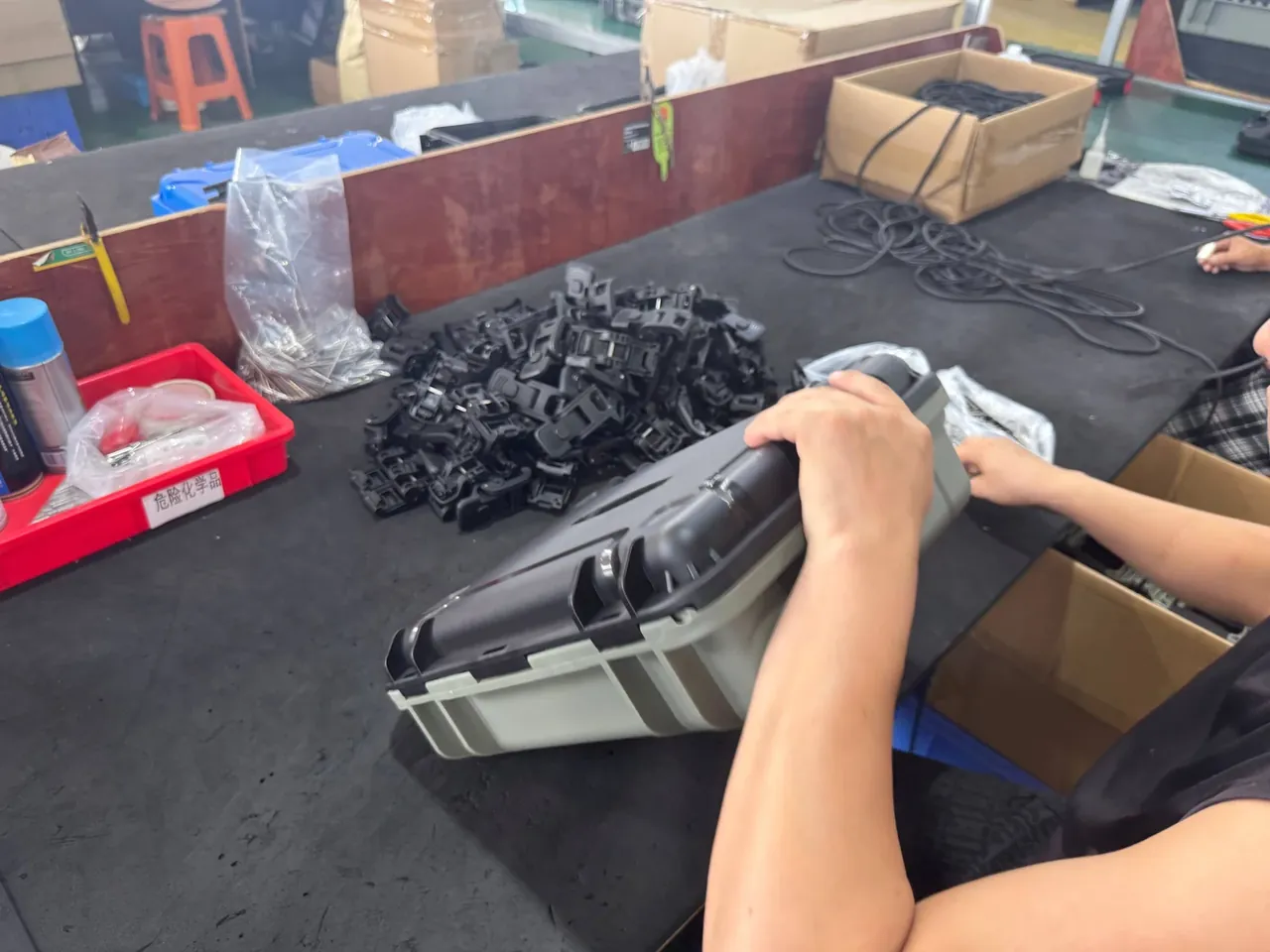
Quick answer: A Military Supply Case is accepted on three tests. Appearance covers sink marks, flash, colour and wall, read with a depth gauge and an ultrasonic meter. Seal covers pressure hold, immersion and IP rating, read by decay and bubbles. Drop covers corner, edge and face, read by height and count.
Table of contents
- Inspection Items and Sampling
- Appearance Checks
- Seal Checks
- Drop Checks
- Judgement and Disposition
- FAQ
1. Inspection Items and Sampling
Sampling comes before gauges. At inspection level II, a lot of 51 to 90 pieces draws 13 samples, a lot of 91 to 150 draws 20. Appearance runs at AQL 2.5, seal and drop at AQL 1.0, because a failure in either cannot be recovered downstream.
Samples are also split by cavity. Each cavity supplies half the sample, so drift cannot hide inside an average. One lot means one grade, one colour, one cavity and 24 hours of output.
| Lot size | Samples | Appearance AQL | Seal and drop AQL |
|---|---|---|---|
| 26 to 50 | 8 | 2.5 | 1.0 |
| 51 to 90 | 13 | 2.5 | 1.0 |
| 91 to 150 | 20 | 2.5 | 1.0 |
2. Appearance Checks
Appearance needs instruments; a visual pass is no verdict. Sink marks are measured with a depth gauge: none on a sealing face, up to 0.3 mm elsewhere. Flash above 0.15 mm at the parting line fails, since it props the gasket open and lets a pressure test pass falsely.
Colour difference is read under D65 and held to 1.2 within a lot. Wall thickness is checked by ultrasound at 2.8 mm plus or minus 0.15 mm, at eight points per case, four on long sides and two each at corners and rib roots.
| Item | Gauge | Accept line |
|---|---|---|
| Sink mark | depth gauge | 0 on sealing faces, else 0.3 mm |
| Flash | feeler gauge | 0.15 mm maximum |
| Colour | spectrophotometer, D65 | 1.2 maximum |
| Wall | ultrasonic, 8 points | 2.8 mm plus or minus 0.15 |
3. Seal Checks
Seal is the easiest item to fake, so the order is fixed: pressure hold, immersion, then IP rating if required. The case is charged to 20 kPa, valve closed, for 60 seconds; decay above 1 kPa fails.
Immersion is the cross-check: 100 mm under water for 30 seconds, seams watched for continuous bubbles. One bubble can be trapped air, a stream means a channel. IPX7 then runs one metre for 30 minutes.
| Method | Parameter | Pass criterion |
|---|---|---|
| Pressure hold | 20 kPa, 60 seconds | decay 1 kPa maximum |
| Immersion | 100 mm, 30 seconds | no continuous bubbles |
| IP rating | IPX7, 1 metre, 30 minutes | no visible water |
4. Drop Checks
Drop order is corner, edge, face, since a corner concentrates the most energy. Ballasted to rated load, the case drops 1.2 m on each of three bottom corners, 1.0 m on three bottom edges and 0.9 m once on the base, opened for inspection after every drop.
Cold conditioning is often skipped. Four hours at minus 18 °C and a drop within five minutes define a cold drop; impact strength there is roughly half the room value.
| Attitude | Height | Count | Pass criterion |
|---|---|---|---|
| Corner | 1.2 m | one per bottom corner | no through-crack |
| Edge | 1.0 m | one per bottom edge | no hinge set |
| Face | 0.9 m | one on the base | sealing face intact |
5. Judgement and Disposition
The three verdicts belong on one sheet of four columns: item, point, reading, verdict. One row per case. When a row fails, the first question is whether failures cluster in one cavity.
Disposition has three levels. Cosmetic defects are reworked and rechecked; seal failures trigger a top-up of 20 pieces, then rejection; a through-crack stops the cavity, since the crack usually sits on a weld line or cooling blind spot. Readings are recorded as numbers, never as the word pass.
Conclusion
Inspection of a Military Supply Case reduces to three actions: gauges for appearance, decay and bubbles for seal, height and attitude for drop. Sampling decides whether the sample speaks for the lot; disposition decides whether a failed unit returns. Fixed in that order, a Military Supply Case inspection stops depending on who is on shift.
This article discusses only the container (case body) side of specifications and design intent, and does not cover any handling, loading or use of the contents.
Related Reading
- Applications and structure of military supply transport cases
- Drop test methods for transport packages
- How to Choose a Military Firearm Case: Four Hard Metrics —…
- Military Rotomolded Case: Adapting Rotationally Molded Cas…
Related Products
- 8 Series — Gun Cases; Military Equipment Cases; Camera Equipment Cases; Drone Cases; Watch Cases; Knife Cases; First Aid Cases; Electronics Equipment Cases
- WL8-2812 PP Gun Case — model WL8-2812
- All protective cases and toolboxes: 7 series, 158 models