

Quick answer: The line is whether there is a cold source: an insulated box only slows warming, a temperature-controlled case pulls the temperature back. The first is cheap, light and powerless for short trips; the second costs more and needs power for long ones.
Table of contents
- The fundamental difference
- Short trips: the insulated box wins
- Long hauls and tight bands: only active works
- Failure modes: two different risks
- Combined solutions and a checklist
- FAQ
1. The fundamental difference
An insulated box delays: the wall slows heat transfer, but the internal temperature always drifts toward ambient. A temperature-controlled case maintains: beyond insulation it has a cold or heat source that pulls the value back and offsets leakage.

Short trips hide the difference between a temperature-controlled case and an insulated box. Two hours is served by insulation with phase-change panels; past eight hours or in extreme ambient the insulated curve crosses the limit while the controlled one holds. Judge by duration times differential, not by price.
| Dimension | Temperature-controlled case | Insulated box |
|---|---|---|
| Principle | actively maintains | passively delays |
| Power | required | none |
| Suitable duration | over 8 hours | 2 to 4 hours |
| Weight | higher | lower |
| Failure | fast excursion on power loss | slow drift across the limit |
2. Short trips: the insulated box wins
For two to four hours, an insulated box with preconditioned panels holds the band at a third to half the cost and less weight: urban delivery, in-hospital transfer, short sampling runs.
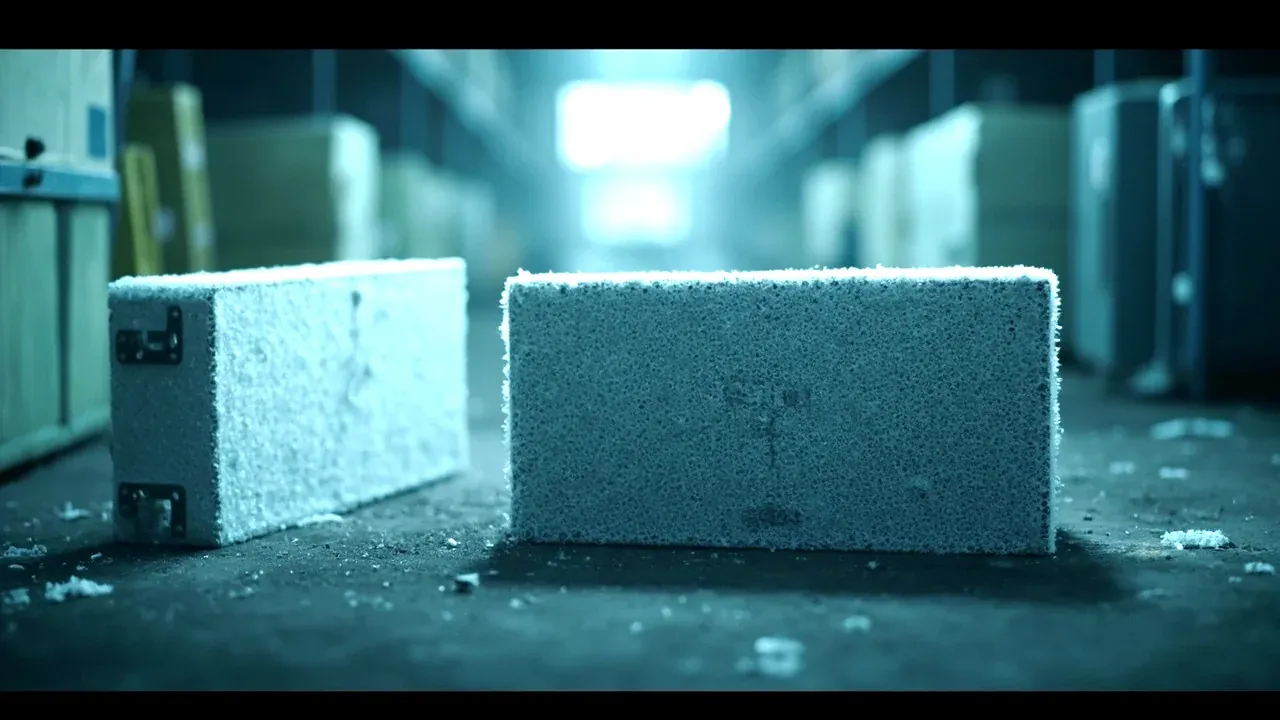
Preconditioning is the key. Panels need twelve hours or more to freeze or chill fully, and incomplete preconditioning is the first cause of short-trip excursions — not poor insulation.
3. Long hauls and tight bands: only active works
Past eight hours, or across minus twenty to thirty-five degrees, accumulated leakage exceeds panel latent heat and the curve must cross. Only active control sustains it, because it keeps adding cold or heat.

Tight bands such as plus or minus one degree also need active control: passive fluctuation depends on panel-to-payload match and typically runs beyond plus or minus three, and closing that gap with more panels trades stability for weight.
4. Failure modes: two different risks
A controlled case fails suddenly: after power loss the temperature moves quickly and can cross within hours, so alarms and backup power are part of the system.
An insulated box fails slowly: the curve rises gently and there is time to act, which in unattended transport is an advantage — the risk is visible rather than sudden.
5. Combined solutions and a checklist
Real routes combine: the active case carries the main leg and an insulated box covers the last two hours, or insulation with dry ice covers the frozen leg while the active unit handles the tight segment.
The checklist has four lines: duration, ambient range, band limits and whether anyone is attending. With those fixed, active or passive is rarely a debate; arguments come from unconfirmed duration and ambient.
One last point: the two options need different training. Active units need power-loss drills and alarm response; passive ones need preconditioning and packing sequence. Leave training out of selection and the failure appears at execution, where no acceptance sheet will catch it; one line in the procurement plan removes most of that risk.
Conclusion
One line: read duration against differential. Under four hours and mild, insulation with preconditioned panels is cheapest; past eight or in extremes, only active control holds. The failure modes differ too — sudden power loss against slow drift — and that visibility is itself a selection criterion.
This article covers container-side specifications and design implications only, not the handling, loading or use of the contents.
Related Reading
- Choosing a temperature-controlled case
- Medical Equipment Boxes & Instrument Boxes
- Case seal materials
- Case repair and spare parts
Related Products
- 8 Series — Gun Cases; Military Equipment Cases; Camera Equipment Cases; Drone Cases; Watch Cases; Knife Cases; First Aid Cases; Electronics Equipment Cases
- WL8-2812 PP Gun Case — model WL8-2812
- All protective cases and toolboxes: 7 series, 158 models