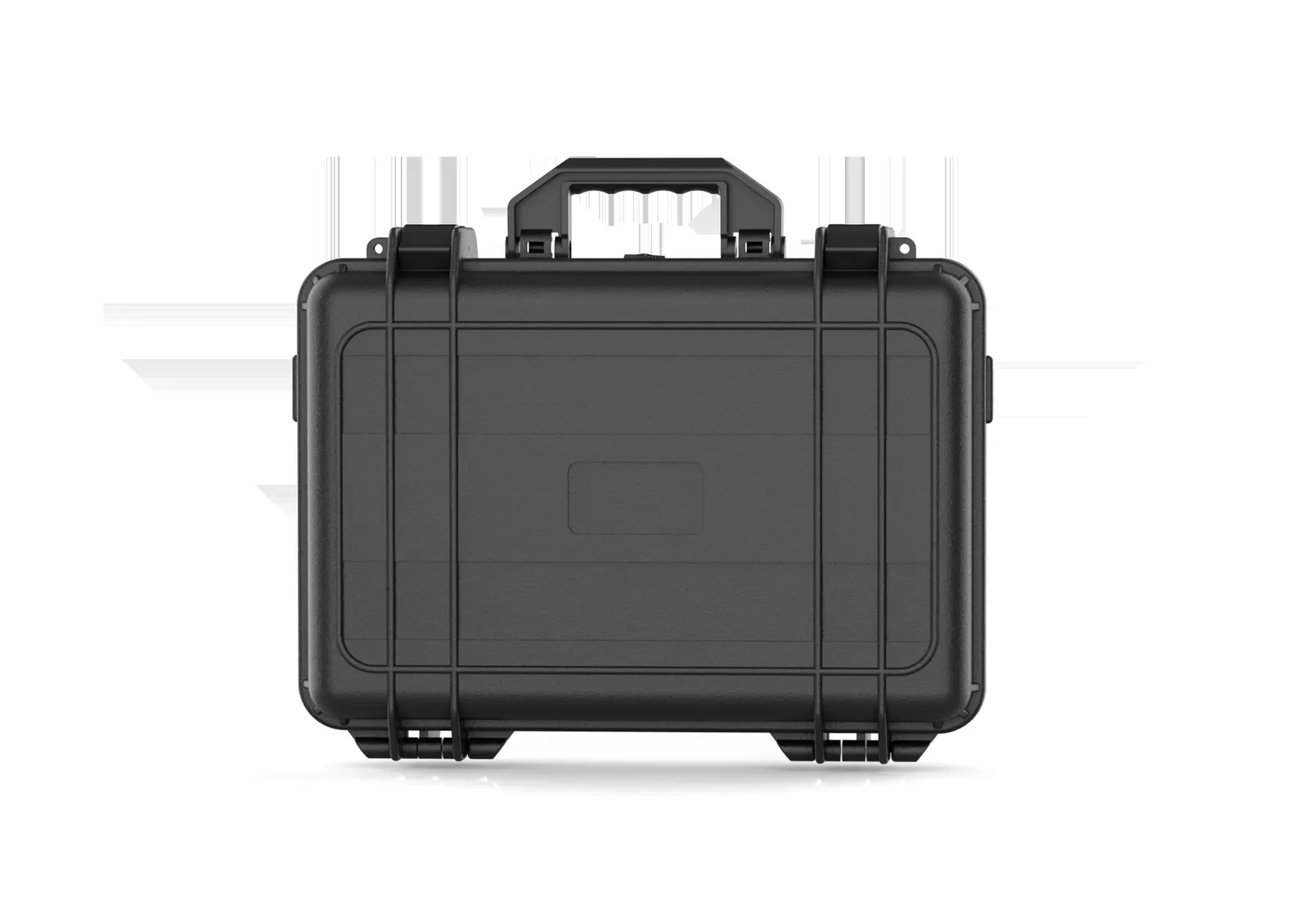
WL6-3912 ABS Knife Case
Specifications
| External Dimensions | 389*295*120mm |
|---|---|
| Internal Dimensions | 360*240*104mm |
| Lid + Base Depth | 30/74mm |
| Wall Thickness | 3.8mm |
| Material | ABS |
| Weight | 1600g |
| Packaging | Each piece packed in a poly bag; carton size: 625*405*635mm (10 pcs/carton) |
Need a custom case solution?
Tell us your requirements — OEM / ODM, logo printing, custom foam inserts.
Frequently Asked Questions
What are the exact outer and inner dimensions of WL6-3912?
The outer shell is 389 x 295 x 120 mm and the internal cavity is 360 x 240 x 104 mm. Externally the case occupies 389 x 295 mm of bench or shelf space while the usable floor inside is 360 x 240 mm, the difference coming from the wall section and the moulded closing geometry. Size a load from the inner dimensions, never from the outside, because outside figures overstate capacity. The 104 mm inner height is the maximum upright height available, and any lining you add reduces it further, so allow for that when the insert is designed.
How deep are the lid and the base?
The lid adds 30 mm of internal depth and the base adds 74 mm, giving 104 mm of combined inner height. A 30 mm lid over a 74 mm base gives a flat structure suited to blades and hand tools lying down, with a low and stable stacking centre, though it will not take long-handled tools standing up. When judging whether a body suits your contents, read the base figure first, because it sets how tall an item can stand, while the lid figure decides how much headroom remains above it. Only the sum of the two is usable height, and when measuring a part, include handles, connectors and bosses, or the lid will press on it once closed. If the lining is routed rather than flat, the pocket depth should be taken from the base side.
How many units are in one carton, and what is the carton size?
Each WL6-3912 ships in its own poly bag, with 10 pieces per export carton measuring 625 x 405 x 635 mm. Among the series blade cases this is a high pack density, suited to full-carton stocking and distribution. Bulk orders can be quoted by full carton or full pallet. Bear in mind that a larger carton does not automatically mean better packing efficiency: divide the carton volume by the piece count to get the transport volume per unit, then compare that against similar case formats, which makes the choice clearer on freight-sensitive projects. Packing breakdowns and pallet plans are available with the order.
What is the difference between WL6-3912 and WL6-3917?
Both share the 389 x 295 mm footprint and a 3.8 mm wall. This model measures 120 mm outside, 104 mm inside, weighs 1600 g and packs 10 per carton, while WL6-3917 measures 165 mm outside, 150 mm inside, weighs 1810 g and packs 8. The two models are not a step up from one another but a division of labour by content size: measure the height of the contents first, then the floor area, and confirm pack quantity and carton size last. Applying the same order when an insert is designed avoids reworking a lining because the case body was fixed too early.