

A7-2812 Protective Case: Full Walkaround
Sixty-one seconds, one unbroken take, no cut. The format hands the editing to footwork: the camera cannot hold still for long and cannot jump away, so it walks a lap and arrives where it should look at the moment it should look. That splits the film into three blocks of uneven density — shape at the front, mechanism in the middle, cavity at the end — and the information thickens as it goes. Whatever it shows in that minute, three things still need a sample and a bench test.
01One Take: Cuts Replaced by Footwork
Of the 61 s, roughly 20 s go to the exterior, 15 s to opening and closing, 26 s to the interior. Without a cut, no angle survives beyond 8 s to 12 s before the frame goes stale, so the camera keeps moving, and every transition stays in the film. Nothing is compressed, which is the honest part of the format and also its constraint.
The cost is blur in motion. To stop transitions dragging, the operator speeds up, and fast travel softens the frame edges, which is exactly where corners and latches live. If a feature only appears while the camera moves and never holds, treat it as atmosphere. Anything the lens settles on for three seconds is what the shot wants checked.
02Twenty Seconds of Exterior: Proportion, Not Size
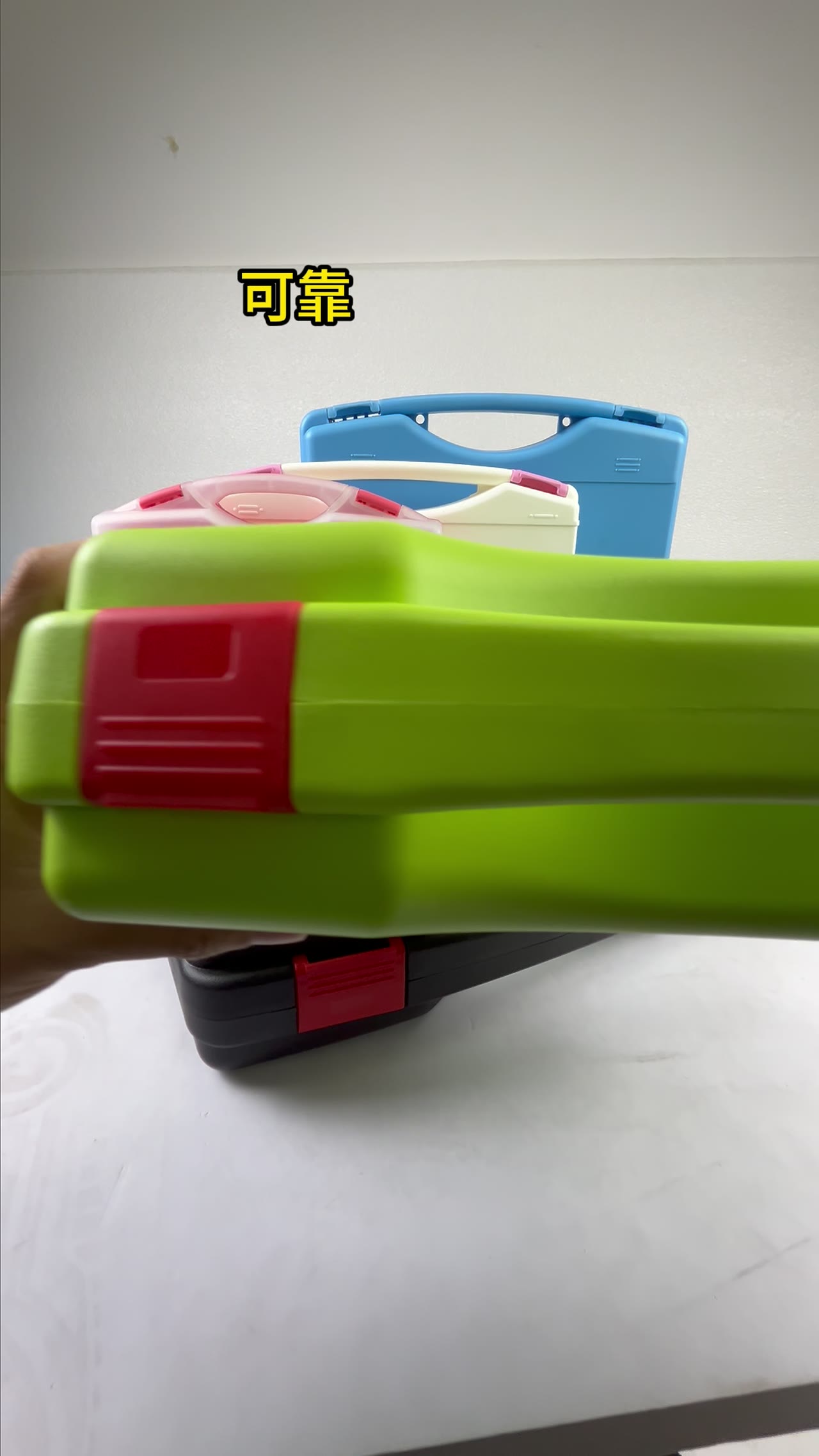
The exterior block reads proportion, not dimensions. A 9:16 frame gives up about 25% of the horizontal field against landscape, so length and width compress and the case looks squarer than it is. Use it to judge whether the height-to-width character fits your contents. Whether one specific item goes in belongs to a drawing or a sample.
Surface quality, though, is clearest here. Raking light exposes waves, sink and flow lines, and vertical video resolves detail to roughly 0.3 mm; anything shallower does not survive compression. Follow the highlight travelling across the shell. On a flat face it runs straight, and where it bends over a rib or a boss, there is sink behind it.
03Fifteen Seconds of Mechanism: All in the Hands
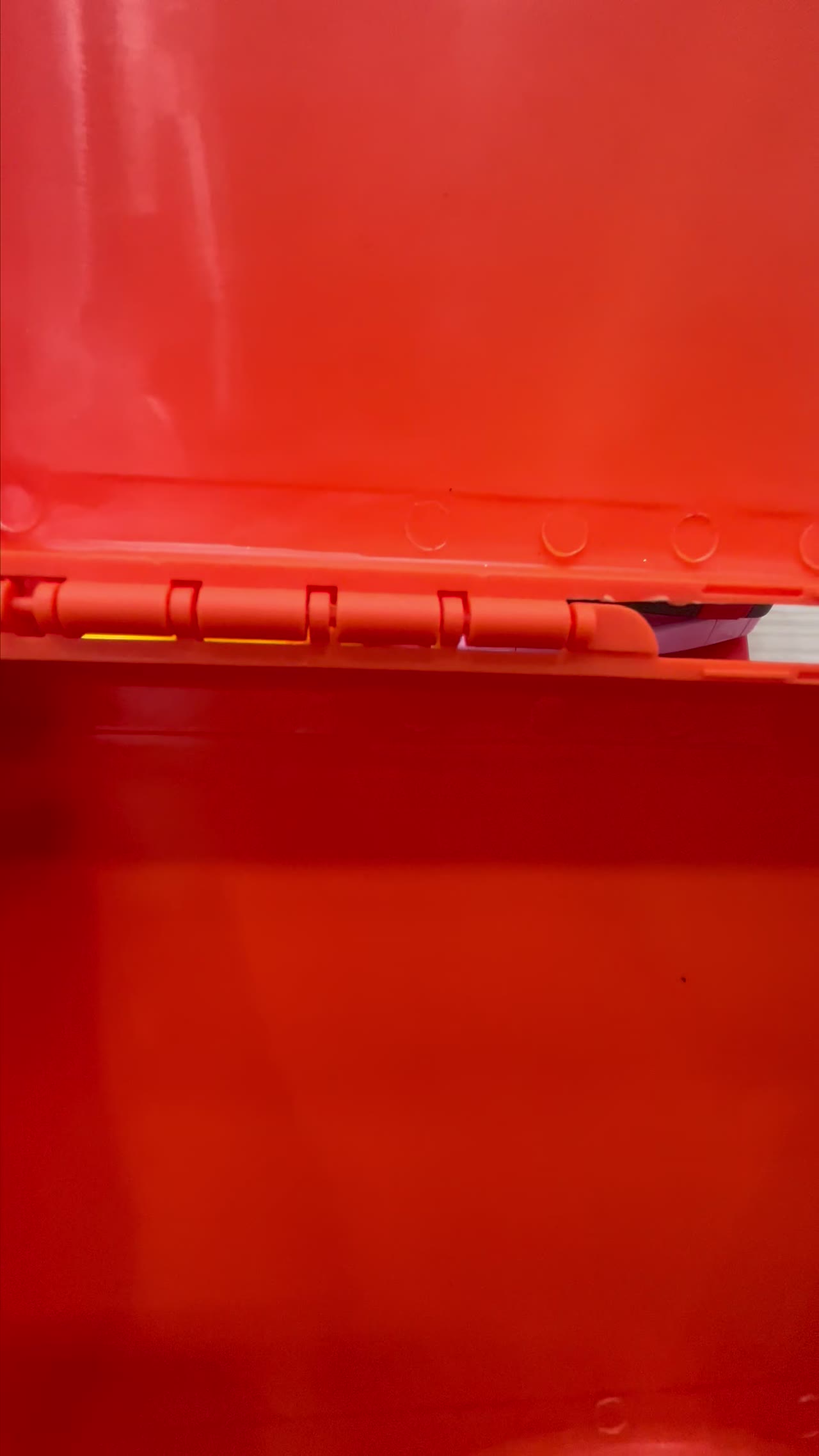
Fifteen seconds carry the densest signal: whether the hand moves smoothly, whether the lid wobbles once raised, whether it lands with a click or a dull thud. The thud is trapped air leaving, which means the gasket met the whole perimeter at once. What matters is not the latch profile but whether the lid wants to fall back halfway up.
Rebound lives in the same shot. A good lid closes without bouncing and without a palm pressed into each corner. If someone has to lean on a corner to seat it, stiffness or hinge placement is off and a person is supplying the missing force. Those moments last a second, so slow playback to half speed rather than rewatching the exterior.
04Twenty-Six Seconds Inside: Depth Ratio and Headroom
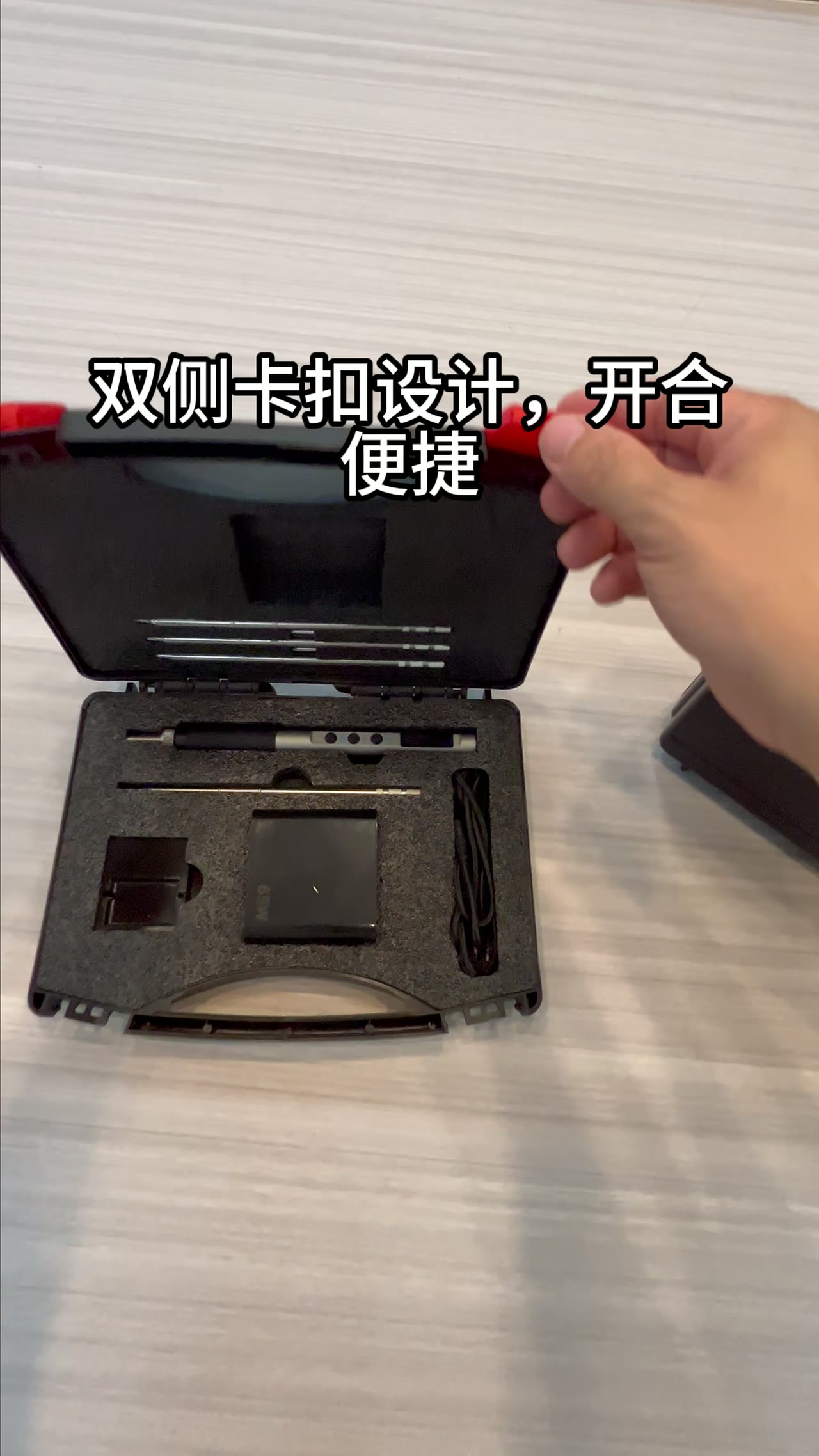
The interior gets the longest block because it carries the most. Read the depth-to-width ratio first: at equal volume, a deep narrow case stands tools upright while a shallow wide one lays them flat. Then follow the ribs on the floor. Where they crowd is a load path, and usually the hardest place for an insert to sit flat.
Partition headroom shows in two places: slots moulded into the walls, and steps in the floor. Slots mean dividers can be added later; without them, zoning depends on a fully moulded insert, and any change needs a new tool. If the camera sweeps the walls but never shows the floor, that area is either standard or deliberately avoided.
05Three Things the Lens Cannot Reach
Three items need a sample in hand: actual gasket compression, weight distribution at rated load, and insert fit against the walls. Compression is read with pressure paper after closing; footage only proves a gasket exists. Distribution needs the case loaded before you lift it, because empty tells you nothing. Insert fit shows at corners and ribs, where a finger finds voids fast.
So ask three questions once the film ends. What profile is the seal, and at what compression is it designed to run? With a full load, which side of the handle does the centre of gravity sit on? Is the insert moulded or cut and bonded, and what corner gap is allowed? Specific answers mean the supplier knows the product; vague ones mean the film was the best part.
| Runtime | 61 s |
|---|---|
| Exterior block | about 20 s |
| Open/close block | about 15 s |
| Interior block | about 26 s |
| Hold per camera position | 8–12 s |
| Horizontal field lost, 9:16 | about 25% |
| Resolvable detail | about 0.3 mm |
| Sample-only checks | 3 |
FAQ
Is an uncut take more trustworthy than an edited one?
It has fewer places to hide, but it is not more complete. With no cut the camera must keep moving, and those fast transitions are the blurriest frames. Trust the moments where it stops: anything held for three seconds is usually the point.
The case looks square on a phone. Is it?
Usually not. A 9:16 frame loses about 25% of the horizontal field, so length and width compress and the case reads nearer square. Judge proportion from a straight side-on pass, never from a high or 45° angle.
The seal is visible in the film. Why still ask for a sample?
You can see that a gasket exists, not how far it compresses. Compression is read on a closed case at eight to twelve points, and the film cannot give that number or show whether the cord thins at mid-span.
The interior block skips the floor. Does that matter?
It does. Floor ribs set the load paths and decide whether an insert can sit flat, so without them partition options are guesswork. Ask for a top-down interior photo, or whether the divider slots are moulded in or added later.