

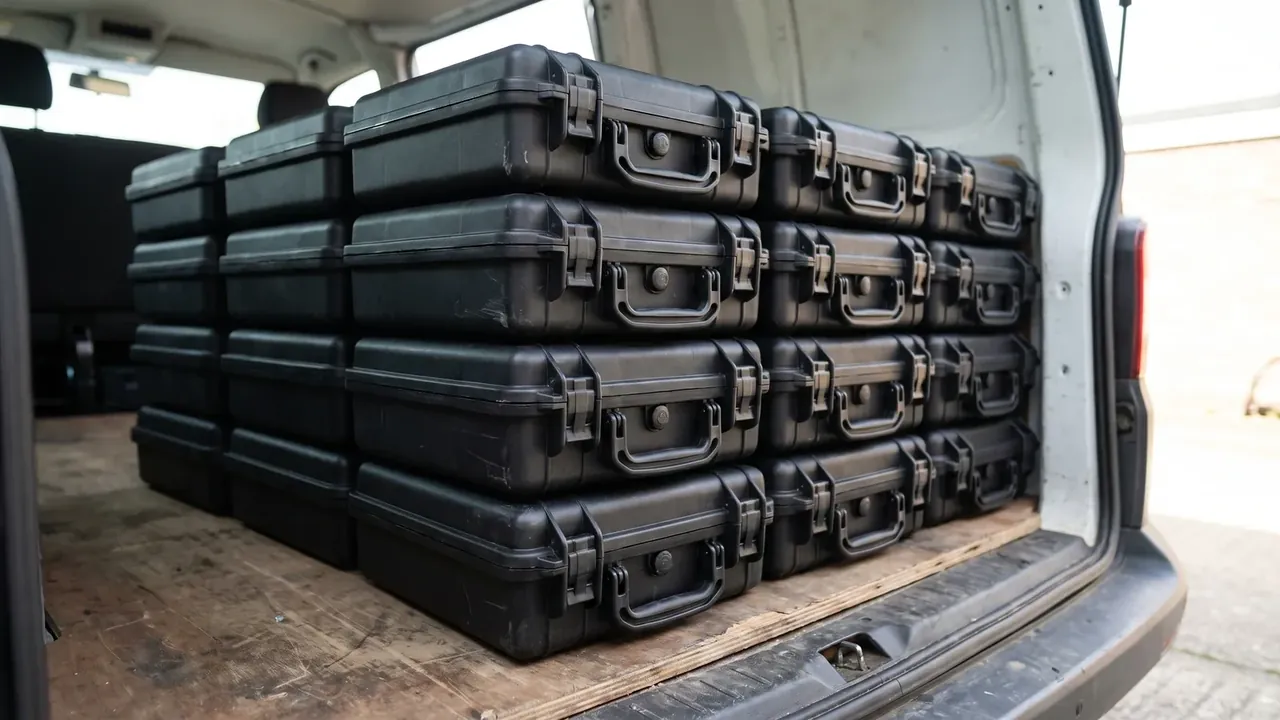
Quick answer: At one cavity of 800 by 600 by 400 mm and one 25 kg payload, an ammunition container differs from a steel box, a plywood crate, a paper-corner tote and a composite case in five numbers: 8.5 kg empty, five layers, IP67, 1,600 trips and 0.42 per trip. Steel carries more but weighs two and a half times as much.
Table of contents
- How to Set the Comparison Baseline for an Ammunition Container
- Self Weight and the Labour Behind Each Lift
- Stacking Layers and Warehouse Volume
- Sealing and Moisture Differences
- Cycle Life, Cost per Trip and Repair Rate
- FAQ
1. How to Set the Comparison Baseline for an Ammunition Container
A comparison holds only when variables are pinned: same cavity, same payload. Five metrics carry it: empty weight, layers, sealing class, trips and cost per trip.
Purchase price is the most misused. Prices spread fourteen times, cost per trip only seven, because the costly ones last twenty times as many trips. A crate at 180 becomes 3.00 per trip, the worst here.
| Option | Wall and structure | Empty weight | Even top load | Unit price |
|---|---|---|---|---|
| Ammunition container | 4.5 mm ribbed wall | 8.5 kg | 480 kg | 680 |
| Steel box, powder coated | 1.2 mm cold-rolled sheet | 21 kg | 620 kg | 520 |
| Plywood crate with steel strapping | 12 mm panels | 13 kg | 260 kg | 180 |
| Paper-corner tote | 7-ply corrugated | 4.2 kg | 90 kg | 46 |
| Composite case, glass-fibre resin | 3 mm laminate | 11 kg | 520 kg | 1,150 |
2. Self Weight and the Labour Behind Each Lift
Weight is trivial for one lift and decisive across a shift. At 8.5 kg against 21 kg the gap is 12.5 kg; two people moving 200 cases handle 2,500 kg more with steel.
Drop behaviour explains the rest. From 1.2 m onto six faces the rotomoulded body takes a pale scuff and the lid lip still engages, while the steel box dents 3 mm and cracks along the fold on the second drop. A paper tote at 4.2 kg bulges at layer two.
3. Stacking Layers and Warehouse Volume
Layer count follows from top load and floor pressure. Five loaded cases at 33.5 kg press 167.5 kg onto 0.48 square metres, or 349 kg per square metre, under the 500 kg limit common in storage buildings. Steel rated at six reaches 575 and is derated to five, so it never lands.
A 100 square metre block at 24 cases per pallet holds 620 in five layers against 340 in plywood. A 2 mm recess in the lid seats the upper case and stops the stack sliding.
4. Sealing and Moisture Differences
Sealing on an ammunition container is settled by numbers. Inflate to 30 kPa, hold five minutes, and the drop must stay under 1.2 kPa, which is IP67. The gasket sits at 25 percent compression in a 6 mm groove. Composite reaches IP66, limited by flange stiffness.
The steel box rusts at the weld, the rust lifts the gasket, and the same test a year later shows 4 kPa. Timber at 12 percent moisture in 80 percent humidity climbs to 68 percent inside within thirty days, while the rotomoulded body holds 45 percent.
5. Cycle Life, Cost per Trip and Repair Rate
Trip counts assume every repairable round trip. The ammunition container reaches 1,600, failing at gasket ageing and latch wear, both replaceable; steel 900 at dents, composite 1,100 where skins crack.
| Option | Trips | Cost per trip | Annual repair rate | End of life |
|---|---|---|---|---|
| Ammunition container | 1,600 | 0.42 | 1.8 percent | Shredded and recycled |
| Steel box | 900 | 0.58 | 6.5 percent | Sold as scrap |
| Plywood crate | 60 | 3.00 | 22 percent | Boards burnt |
| Paper-corner tote | 25 | 1.84 | 40 percent | Paper recycling |
| Composite case | 1,100 | 1.05 | 3.4 percent | Shredded and landfilled |
Repair rates are measured against the fleet. A gasket and latch set costs 18 per case, while steel work means beating and repainting. Cost per trip differs from steel by 0.16, but handling, stacking and sealing add thirty percent.
Conclusion
The ammunition container balances weight, stacking, sealing and cycle life and sits second on cost per trip at 0.42. Steel wins on load and loses on weight, timber wins on price and loses on trips. The answer is not the cheapest case quoted but the ammunition container where trip count and total cost cross.
This article discusses only the container (case body) side of specifications and design intent, and does not cover any handling, loading or use of the contents.
Related Reading
- Shell materials compared across five resins
- Wall thickness and stacking specifications
- How a rotomoulded case is formed
- Case hardware and fittings explained
Related Products
- 8 Series — Gun Cases; Military Equipment Cases; Camera Equipment Cases; Drone Cases; Watch Cases; Knife Cases; First Aid Cases; Electronics Equipment Cases
- WL8-2812 PP Gun Case — model WL8-2812
- All protective cases and toolboxes: 7 series, 158 models