

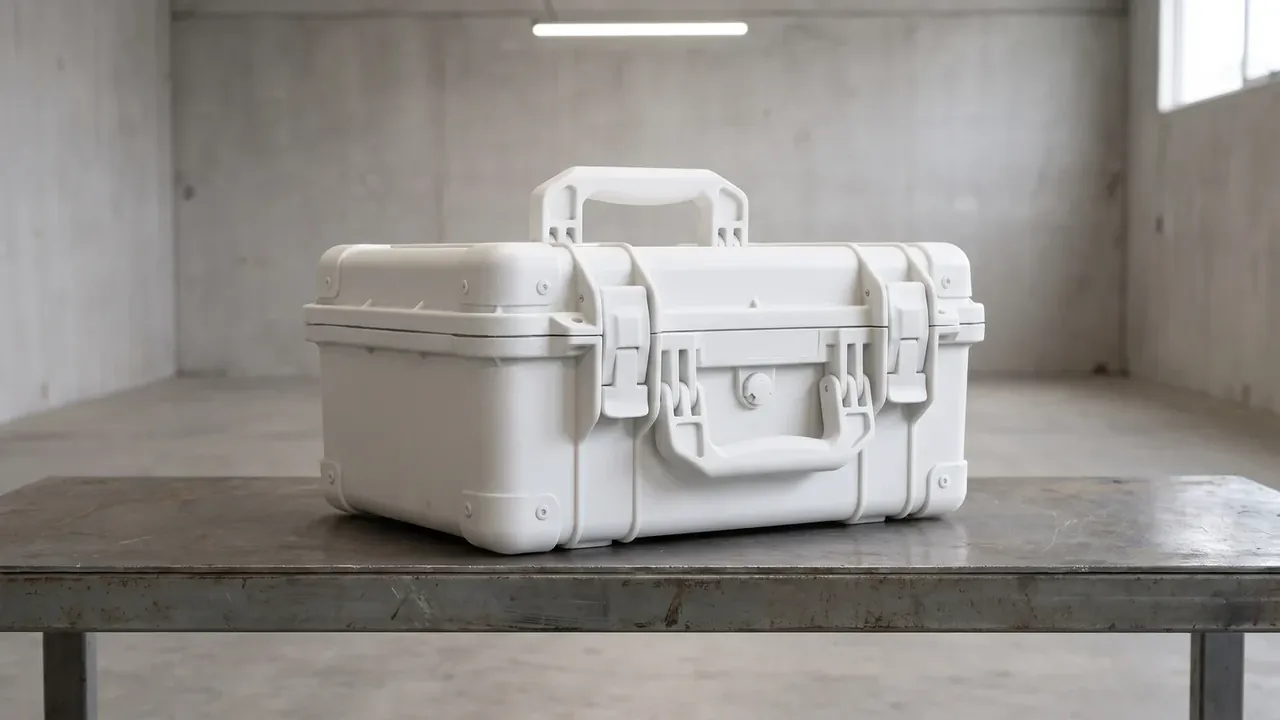
Quick answer: An ammunition container is five parts in one shell: upper and lower halves, the lid rebate, the seal groove, the ribs and the hardware. Bodies above 800 mm are usually rotomoulded, and thickness runs 3 to 6 mm with ribs carrying the load.
Table of contents
- What an Ammunition Container Body Is Made Of
- Rotomoulding or Injection Moulding
- How Thickness Is Distributed from 3 to 6 mm
- Ribs, Stacking Faces and Corner Geometry
- Hinges, Latches and Hardware Corrosion
- FAQ
1. What an Ammunition Container Body Is Made Of
An ammunition container looks like a single moulded shell, yet five elements work together: upper and lower halves, the lid rebate, the seal groove inside it, inner ribs, and hardware through moulded holes.
On an 800 mm body each half weighs about 3 kg and the rebate runs 8 to 12 mm deep. Too shallow and the lid shifts; too deep and it drags. The 6 mm groove leaves roughly 25 percent compression once the cord is in place.
2. Rotomoulding or Injection Moulding
Size, batch and complexity decide the process. Rotomoulding suits hollow shells above 300 mm, double walls and moulded-in inserts; injection moulding suits small, tight parts above 3,000 units.
The crossover sits near 2,000. A rotomould costs 30,000 to 80,000 yuan against 150,000 to 400,000 for an injection tool on a 650 to 1,300 tonne machine. Injection cycles run 40 to 70 seconds, rotomoulding 18 to 25 minutes.
| Item | Rotomoulding | Injection moulding |
|---|---|---|
| Tooling | 30,000–80,000 yuan | 150,000–400,000 yuan |
| Cycle | 18–25 minutes | 40–70 seconds |
| Wall tolerance | ±0.8 mm | ±0.5 mm |
| Economic batch | 300+ | 3,000+ |
Material splits the same way: LLDPE powder at 35 mesh for rotomoulding, nylon with 30 percent glass fibre for latches that stay tough at minus 20 °C.
3. How Thickness Is Distributed from 3 to 6 mm
In rotomoulding the wall forms as powder fuses against the hot mould, and gravity thickens the base. A body specified at 5 mm often measures 5.5 mm at the base and 4.5 mm at the side.
Injection moulding takes thickness from the cavity, so variation stays under half a millimetre, which lets such a part run at 3 mm while a rotomoulded one starts at 4 mm.
Thicker is not stronger. Past 8 mm, rotomoulded walls trap bubbles where powder fails to fuse. Judge thickness at the rib roots and base transition, keeping the thinnest reading above 3.5 mm. The lid rim runs half a millimetre thicker than the side wall, because the rebate is squeezed at every closure.
4. Ribs, Stacking Faces and Corner Geometry
Rib geometry follows three numbers: 8 to 12 mm tall, 60 percent of wall thickness wide, and a root fillet of at least 3 mm. Past 70 percent width, sink marks appear outside; without the fillet, the rib root cracks first.
Layout sets the load path. A rib grid spreads force to four edges and suits the base; single-direction ribs resist bending in one axis and belong on side walls. Stack five high and the bottom case carries four above it.
Stacking depends on contact area. Keep the top face flat within 1 mm, radius corners at 15 mm or more, and mould a 2 mm recess so the base above drops in. A domed top leaves a line of contact instead.
5. Hinges, Latches and Hardware Corrosion
Hinges are either a living hinge moulded with the shell, a stainless pin through moulded ears, or a separate metal hinge. An ammunition container body mostly uses the pin, since a living hinge tears on a thin wall.
Latches should hold at least 300 N and be moulded in glass-filled nylon, with load on a thickened boss.
| Hardware | Material | Finish | Salt spray |
|---|---|---|---|
| Hinge pin | 304 stainless, 4 mm | Passivated | 96 hours |
| Padlock lug | Plated steel | 8 µm zinc | 48 hours |
Corrosion risk sits at dissimilar contacts. A stainless pin in a plated bracket needs a plastic bush, or galvanic corrosion starts in damp air and the plated part fails first.
Conclusion
An ammunition container is five elements in one shell: body, rebate, seal groove, ribs and hardware. Process splits on size and batch, thickness from 3 to 6 mm is carried by ribs and fillets, and hardware survives on material pairing. Structure sets the service life of an ammunition container; process only delivers it.
This article discusses only the container (case body) side of specifications and design intent, and does not cover any handling, loading or use of the contents.
Related Reading
- Ammunition container specifications: walls and stacking
- How a rotomoulded case is formed
- Which case accessories exist
- Ammunition container material comparison
Related Products
- 8 Series — Gun Cases; Military Equipment Cases; Camera Equipment Cases; Drone Cases; Watch Cases; Knife Cases; First Aid Cases; Electronics Equipment Cases
- WL8-2812 PP Gun Case — model WL8-2812
- All protective cases and toolboxes: 7 series, 158 models