

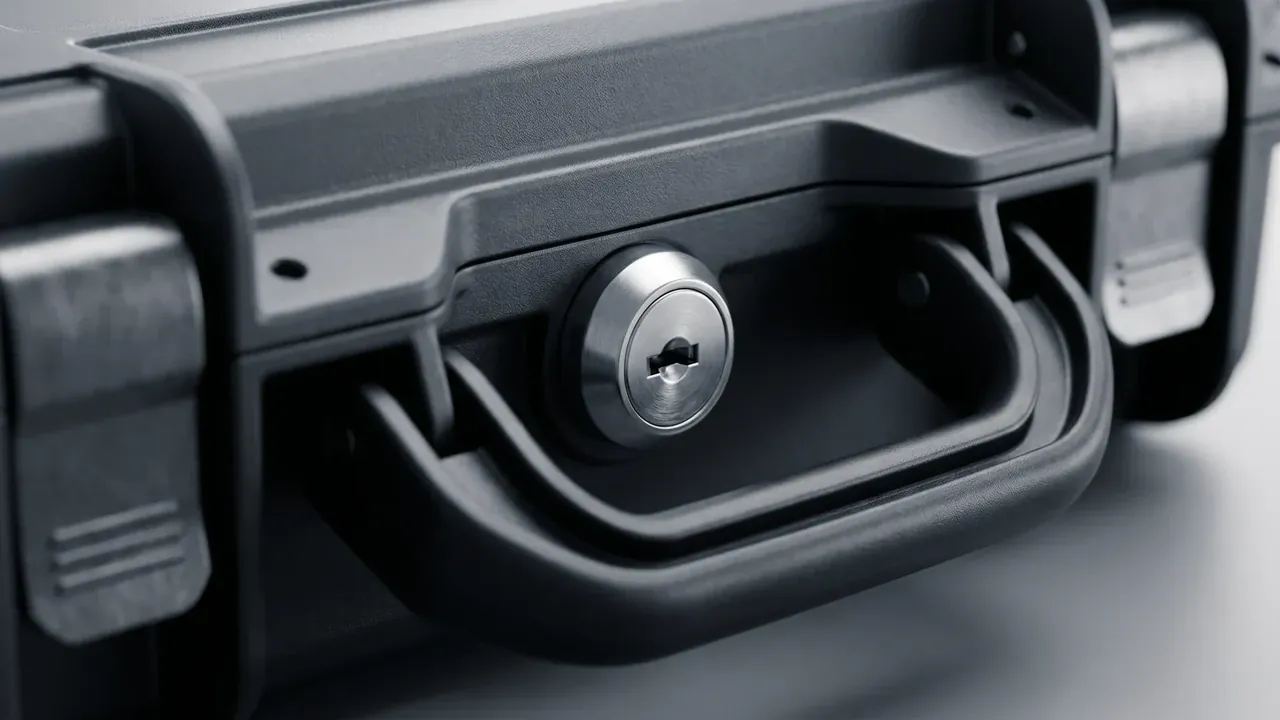
Quick answer: An ammunition container is accepted on four layers: appearance against numeric limits, dimensions against tolerance and a twelve-point wall survey, performance at 20 kPa of air and 300 mm of water, endurance at a 1.2 m drop, 500 kg of stacking and 48 hours of salt spray. Sampling follows batch size.
Table of contents
- Appearance Limits for an Ammunition Container
- Dimensions, Tolerances and Wall Thickness Points
- Pressure and Hold Time in Air and Water Tests
- Drop, Stacking and Salt Spray Verdicts
- Batch Traceability and Sampling Criteria
- FAQ
1. Appearance Limits for an Ammunition Container
Appearance is judged by light and distance, not feel. Two lamps rated CRI 80 or above hang over the bench, illuminance held at 800 to 1,000 lux, the eye 500 mm away for five seconds per side.
Cracks and through-scratches are hard lines: any separation of base material is rejected at any length. Sink marks gather behind ribs, so a straight edge spans the deepest point and a feeler gauge entering 0.5 mm fails the part. Colour is averaged over three points; a ΔE above 1.5 means mixed powder.
| Defect | Limit | Grade |
|---|---|---|
| Crack | rejected at any length | critical |
| Through-scratch | rejected | critical |
| Scratch | 30 mm long, 0.3 mm deep, two per face | minor |
| Sink mark | 0.5 mm deep, 20 mm long | minor |
| Flash | 0.5 mm, not sharp | major |
| Colour shift | ΔE 1.5 or less | major |
2. Dimensions, Tolerances and Wall Thickness Points
The method must be fixed, or two people differ. A tape with locating blocks reads the outer envelope, largest of three readings per axis: plus or minus 3 mm below 800 mm, plus or minus 5 mm above it. A feeler gauge at eight points around the closed lid must not pass 1.5 mm.
Diagonal difference is often missed. Above 4 mm between base diagonals, the case stands on three corners and stacking load lands on one. Wall thickness is read at twelve points: four on the base along the diagonals, one mid-height per side wall, four on the lid mirroring the base. No single point below 85 percent of nominal, no average below 95.
3. Pressure and Hold Time in Air and Water Tests
The air test plugs the vent and drain, closes and latches, then charges to 20 kPa. Stabilise for 30 seconds, hold 60, and keep the drop under 1 kPa. On failure, check seal seating first, then latch force, then porosity.
Water testing follows the use case. Immersion puts the ammunition container under 300 mm for five minutes, and the inside must show no trace. Rain runs at 12.5 mm per minute for thirty minutes with indicator paper in the four corners. Samples rest four hours at 15 to 30 °C, because a warm case expands and hides a drop.
4. Drop, Stacking and Salt Spray Verdicts
Drop tests run loaded. Up to 25 kg the height is 1.2 m, above that 0.9 m. One ammunition container takes ten drops, six faces, three base edges and one base corner, opened and checked after each impact.
A pass needs no through crack, no latch release, no seal out of its groove. Air is re-tested after the tenth drop and must hold under 1.5 kPa. Stacking load is the greater of 500 kg and three times the loaded weight, held 24 hours, then read after 30 minutes of rest: centre deflection under 2 mm. Salt spray runs 48 hours on the case and 96 on hardware, with zinc white rust under 5 percent of area.
5. Batch Traceability and Sampling Criteria
A batch is one mould, one material lot and one shift, capped at 2,000 units. The lot code is laser marked in a 40 by 10 mm field on the back. Three units are kept per batch for 24 months so walls can be cut open later.
Sampling of an ammunition container lot follows general inspection level II, with zero acceptance on critical defects, major AQL 1.0 and minor AQL 2.5.
| Lot size | Sample | Critical | Major accept | Minor accept |
|---|---|---|---|---|
| 281 to 500 | 50 | 0 | 1 | 3 |
| 501 to 1,200 | 80 | 0 | 2 | 5 |
| 1,201 to 3,200 | 125 | 0 | 3 | 7 |
Conclusion
Acceptance standards do not block shipments; they turn drawing promises into measurable numbers, from lux on the bench to the twelfth wall reading and the last of ten drops. Both sides then share one language, so every delivery of an ammunition container can be defended.
This article discusses only the container (case body) side of specifications and design intent, and does not cover any handling, loading or use of the contents.
Related Reading
- How to Read Ammunition Container Specifications
- Quality Control on the Assembly Line
- How Waterproof Hard Cases Are Sealed
- Corrosion Protection for Case Hardware
Related Products
- 8 Series — Gun Cases; Military Equipment Cases; Camera Equipment Cases; Drone Cases; Watch Cases; Knife Cases; First Aid Cases; Electronics Equipment Cases
- WL8-2812 PP Gun Case — model WL8-2812
- All protective cases and toolboxes: 7 series, 158 models