

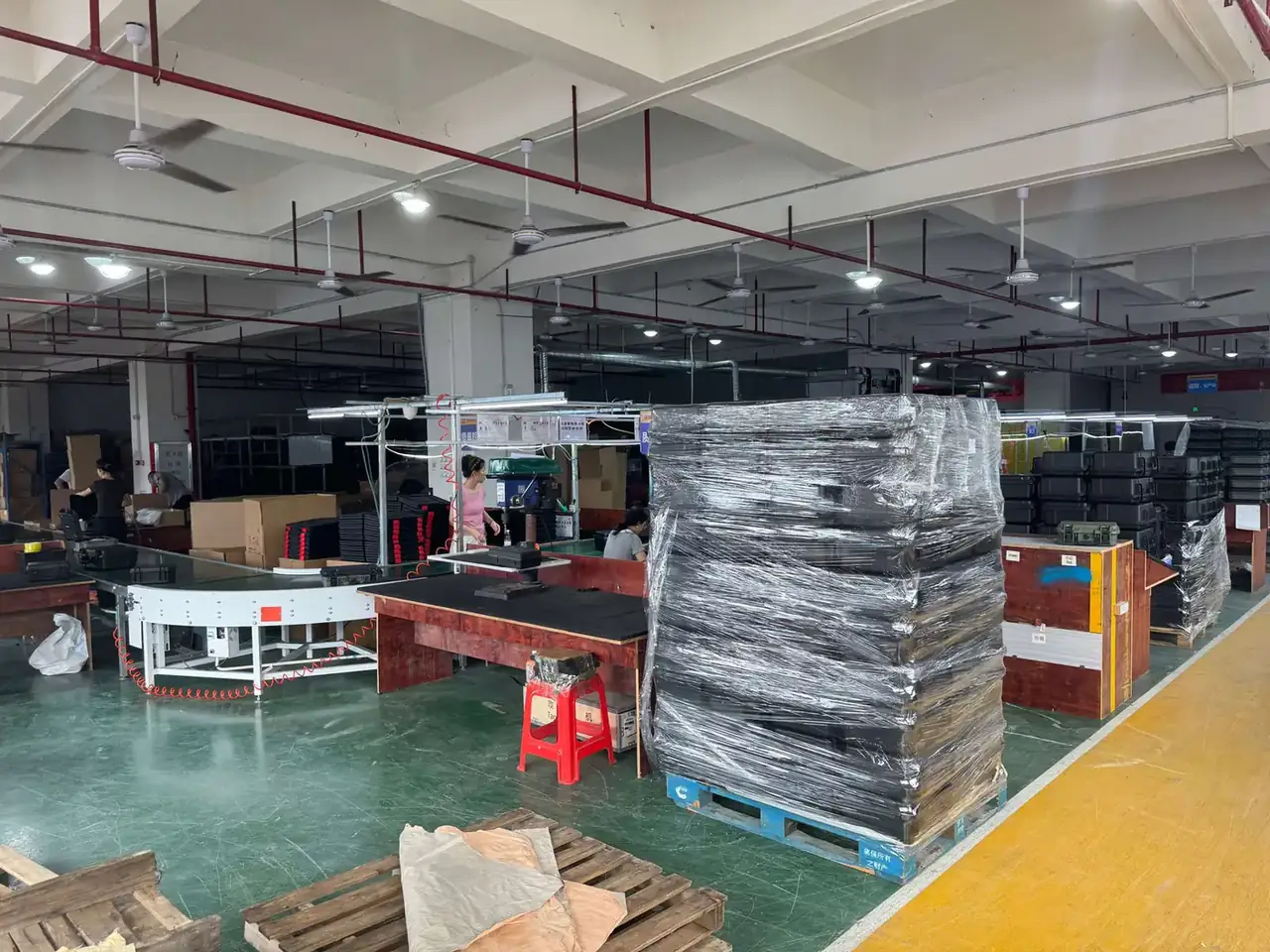
Quick answer: Case Assembly quality is closed out by three readings: screw torque, latch opening force and the mark left by the gasket. Torque proves the joint will not loosen, opening force proves the latch is usable, the seal mark proves compression happened. All three are taken after assembly, without opening the case.
Table of contents
- Three Measurable Values in Case Assembly
- Torque: Setpoint, Calibration and Recheck
- Latch Force: Measuring Opening Effort
- Seal Mark After Four Hours
- Sampling, Disposition and Line Stops
- FAQ
1. Three Measurable Values in Case Assembly
Visual checks catch scratches, not the defects that decide whether a case survives a trip. Case Assembly adds three instrument readings: clamp load in the joints, effort to open a latch, and the trace the gasket leaves in the rim. Measure torque first, latch force second, seal mark last, because opening the lid early destroys the evidence.
| Item | Gauge | Accept | Record |
|---|---|---|---|
| Screw torque | Preset torque wrench | At or above the low limit | 5 screws per lot |
| Latch opening force | Push-pull gauge and hook | 40 to 90 N | 5 percent per lot |
| Seal mark | Steel rule and loupe | Continuous, 2 to 4 mm wide | 3 cases per lot |
2. Torque: Setpoint, Calibration and Recheck
Most Case Assembly threads sit in plastic bosses or inserts, where the window is narrower than in steel. M5 screws take 2.5 to 3.5 N·m, M6 5 to 7 N·m, self-tapping screws into plastic 1.2 to 1.8 N·m. Below the low limit the joint relaxes after a few vibration cycles; above it the boss strips.
Calibrate the wrench each shift on a 20 N·m block at three points and retire it beyond 4 percent deviation; an impact driver is no substitute, drifting 30 percent with air pressure. Tighten latch bases in two diagonal passes, 60 percent then target. One pass to full value tilts the base on the first screw while the rest clamp nothing. A recheck below 90 percent of target rejects the lot.
3. Latch Force: Measuring Opening Effort
The criterion is peak force from closed to fully open: 40 to 90 N. Below 40 N the latch releases under transport vibration; above 90 N the lever feels dead and the plastic tab cracks first.
Hook the gauge on the lever end, pull perpendicular at 20 mm per minute, and clamp the case, since a hand-held one reads 10 to 15 percent low. Sample 5 percent of the lot, never fewer than three cases, testing all four latches. A spread above 25 N means the bases sit at different heights. After 2000 cycles, force may rise 15 percent and no latch may crack.
4. Seal Mark After Four Hours
Close the case, leave it 4 hours at 23 °C so the rubber relaxes, then open and read. Shorter waits leave a narrow mark; longer ones let it fade as the strip recovers.
Judge continuity around the whole rim, width between 2 and 4 mm, and corners no lighter than the straight runs. A break means low compression, usually debris in the groove, a thick liner or a warped shell. A mark wider than 4 mm is over-compression. Read with a steel rule and a loupe; on translucent strips, dust the rim with talc first.
5. Sampling, Disposition and Line Stops
Case Assembly sampling follows GB/T 2828.1, general inspection level II, AQL 1.5, normal single sampling. A lot of 501 to 1200 pieces uses code K, 125 samples, Ac 5 and Re 6; a lot of 91 to 150 uses code F, 20 samples, Ac 1 and Re 2.
| Lot size | Code | Sample | Ac | Re |
|---|---|---|---|---|
| 91 to 150 | F | 20 | 1 | 2 |
| 501 to 1200 | K | 125 | 5 | 6 |
Sampling accepts or rejects a lot; it does not prove stability. Stop rules sit alongside: one critical defect stops the line, three consecutive major defects stop it, or a shift major rate above 2 percent. Once a defect reaches packing, rework means stripping the liner at ten times the station cost.
Conclusion
Case Assembly quality control comes down to three numbers taken at three points: torque in the threads, force at the latch, mark on the gasket. Each reads with a hand tool and traces to a lot. Put calibration, sample size and stop rule on one sheet and quality stops being an opinion. Whether Case Assembly holds its standard shows in those three lines of recorded data.
This article discusses only the container (case body) side of specifications and design intent, and does not cover any handling, loading or use of the contents.
Related Reading
- Injection moulding and case tolerances
- Matching drop testing to case design
- Gasket selection and seating
- Wall thickness and case strength
Related Products
- 8 Series — Gun Cases; Military Equipment Cases; Camera Equipment Cases; Drone Cases; Watch Cases; Knife Cases; First Aid Cases; Electronics Equipment Cases
- WL8-2812 PP Gun Case — model WL8-2812
- All protective cases and toolboxes: 7 series, 158 models