

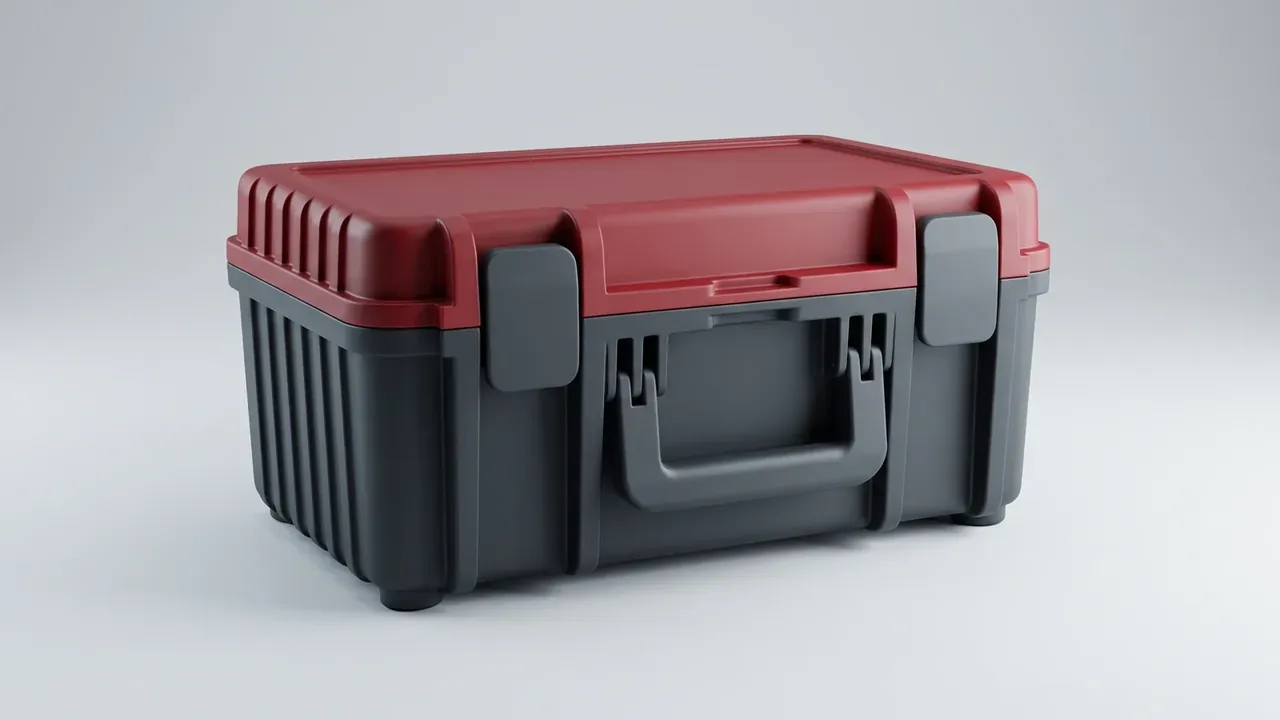
Quick answer: Automotive repair tool box plastic usually lands on six benches: dealer service bays, quick-lube chains, tyre and chassis shops, body shops, EV powertrain bays and rescue trucks. Size the body from the bench first, pick the compound from oil and heat second, then match latches to how often the case moves.
Table of contents
- Where an Automotive Repair Tool Box Plastic Is Used
- Sizing Tiers and Tray Layouts by Bench
- Compounds for Oil, Solvent and Heat
- Latches and Handles on Rescue Trucks
- A Scenario Checklist for Bulk Configuration
- FAQ
1. Where an Automotive Repair Tool Box Plastic Is Used
Automotive repair tool box plastic is easier to specify backwards from the bench than forwards from a datasheet, since one case may sit still for nine hours and then ride a van all day.
A bench beside a two-post lift is often 600 mm wide, so bodies past 450 mm will not sit square, and the 420 × 320 × 180 mm size dominates. Chassis work deepens the body to 220 mm with a 30 mm base lip.
| Scenario | Body (mm) | Load (kg) | Focus |
|---|---|---|---|
| Dealer bay | 420 × 320 × 180 | 18 | shallow trays |
| Tyre and chassis | 460 × 340 × 220 | 25 | base lip |
| Body shop | 400 × 300 × 170 | 12 | full gasket |
| Rescue truck | 500 × 360 × 240 | 30 | twin latches |
2. Sizing Tiers and Tray Layouts by Bench
Three sizes cover the trade: 300 mm carry, 420 mm bench and 500 mm vehicle cases. The tier follows the resting posture of the longest tool. A socket on an extension bar runs about 380 mm and needs a 400 mm cavity lying flat.
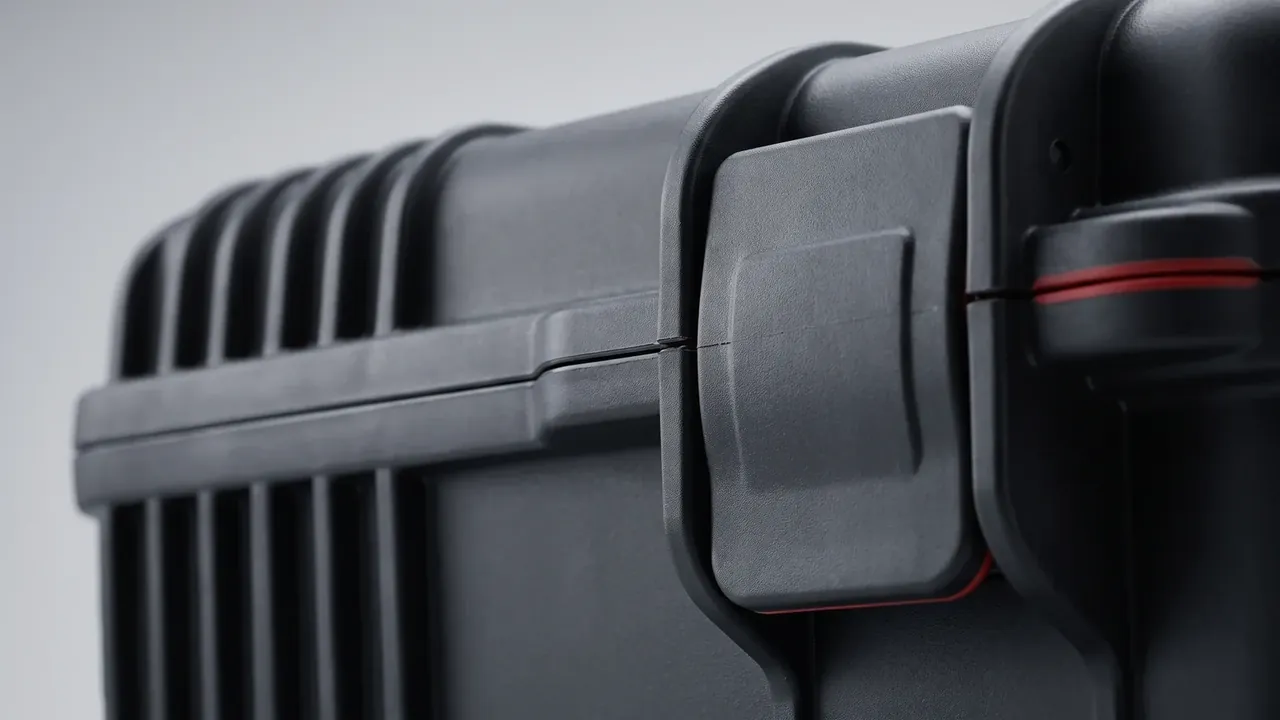
Trays draw more complaints than bodies. On a 420 mm case, three flat trays suit a bay; two deeper trays with a 40 mm well suit chassis work, where extensions pass 350 mm. Keep 1.5 mm between tray edge and wall so it drops in cleanly.
Lid liners come in 8 mm PE or 12 mm EVA, the thin one lighter, the thick one resisting point loads.
3. Compounds for Oil, Solvent and Heat
Three chemical families matter: engine oil, carburettor cleaner and brake cleaner. The first is harmless to PP; the third carries ketones and aromatics that bloom and embrittle the surface. A copolymer body with a modified skin costs about eight percent more and lasts twice as long.
Heat matters too. A bench beside a hot engine bay reaches 60 °C in summer, and four hours there cuts PP flexural modulus by some thirty percent, enough to sag a shallow tray. Vertical ribs at 40 mm pitch answer it.
Winter runs the other way. At −20 °C, PP keeps roughly forty percent of its impact strength, so drop tests run after four hours at −20 °C, one metre, six faces.
4. Latches and Handles on Rescue Trucks
On a rescue truck, automotive repair tool box plastic shifts from static load to dynamic retention. Potholes push acceleration to 3 g, so a 30 kg case pulls 90 kg through twin catches rated at 300 N each.
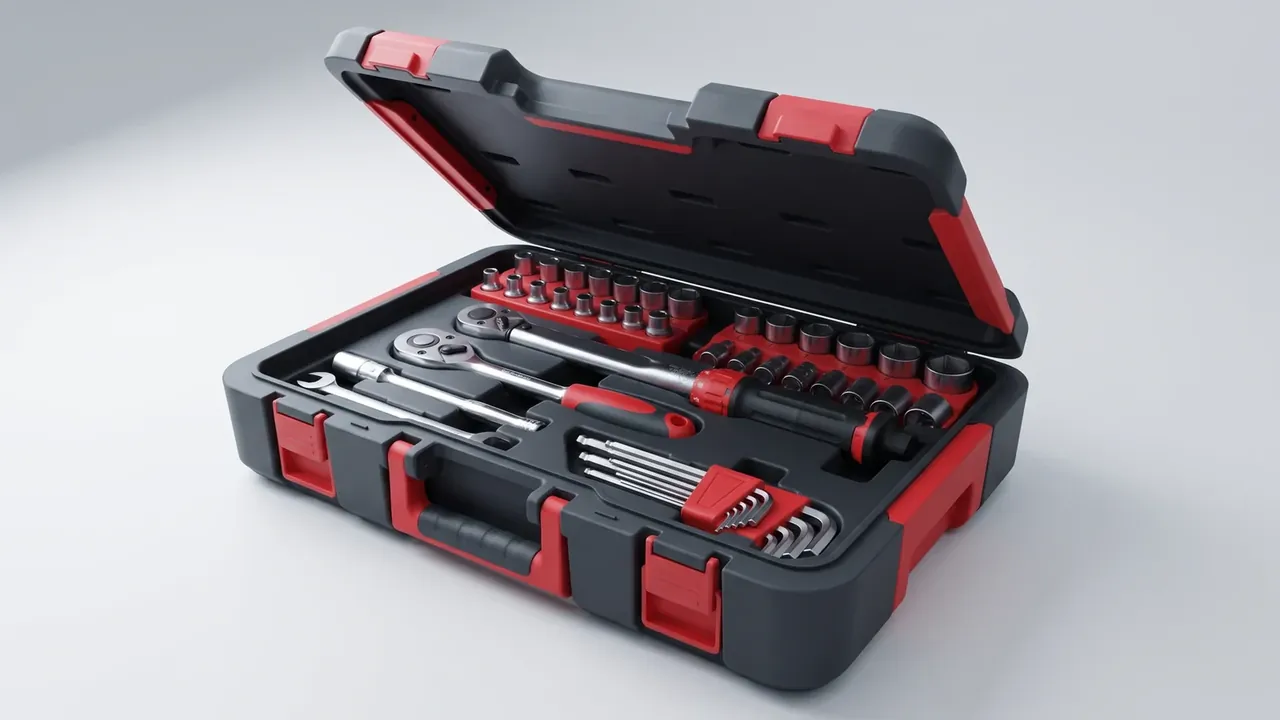
A folding handle saves depth; a fixed handle on a metal mount carries 40 kg. Handle screws are torqued to 1.2 N·m over a flat washer to limit creep.
Latch life is counted in cycles. A dealer bay opens the case 20 times a day, about 5,000 cycles a year; a rescue truck opens it six times, always under load.
5. A Scenario Checklist for Bulk Configuration
Bulk orders of automotive repair tool box plastic usually fail the same way: one case for every bench, and both ends complain. Split the order into three rows.
| Item | Service bay | Chassis bay | Rescue truck |
|---|---|---|---|
| Body | 420 × 320 × 180 mm | 460 × 340 × 220 mm | 500 × 360 × 240 mm |
| Tray | three shallow | two deep | two with lip |
| Latch | single catch | twin catches | twin with lock hole |
Three items are often left off the sheet: colour matching the workshop code, a clear area for labels, and salt spray hours. Catches take 48 hours of neutral salt spray; the body takes 96 hours of UV ageing instead. A 420 mm body runs on a 380 tonne press with a 25 minute changeover.
Conclusion
Automotive repair tool box plastic is configured from three numbers: bench width, carries per shift and the longest tool. Size follows those numbers, trays follow the size, and latches follow how often the case moves.
This article discusses only the container (case body) side of specifications and design intent, and does not cover any handling, loading or use of the contents.
Related Reading
- How vehicle and carry cases differ by scenario
- Moving a wheeled tool case around a workshop
- Tray layout inside a socket wrench set case
- Where a mechanics tool pouch stops
Related Products
- 8 Series — Gun Cases; Military Equipment Cases; Camera Equipment Cases; Drone Cases; Watch Cases; Knife Cases; First Aid Cases; Electronics Equipment Cases
- WL8-2812 PP Gun Case — model WL8-2812
- All protective cases and toolboxes: 7 series, 158 models