

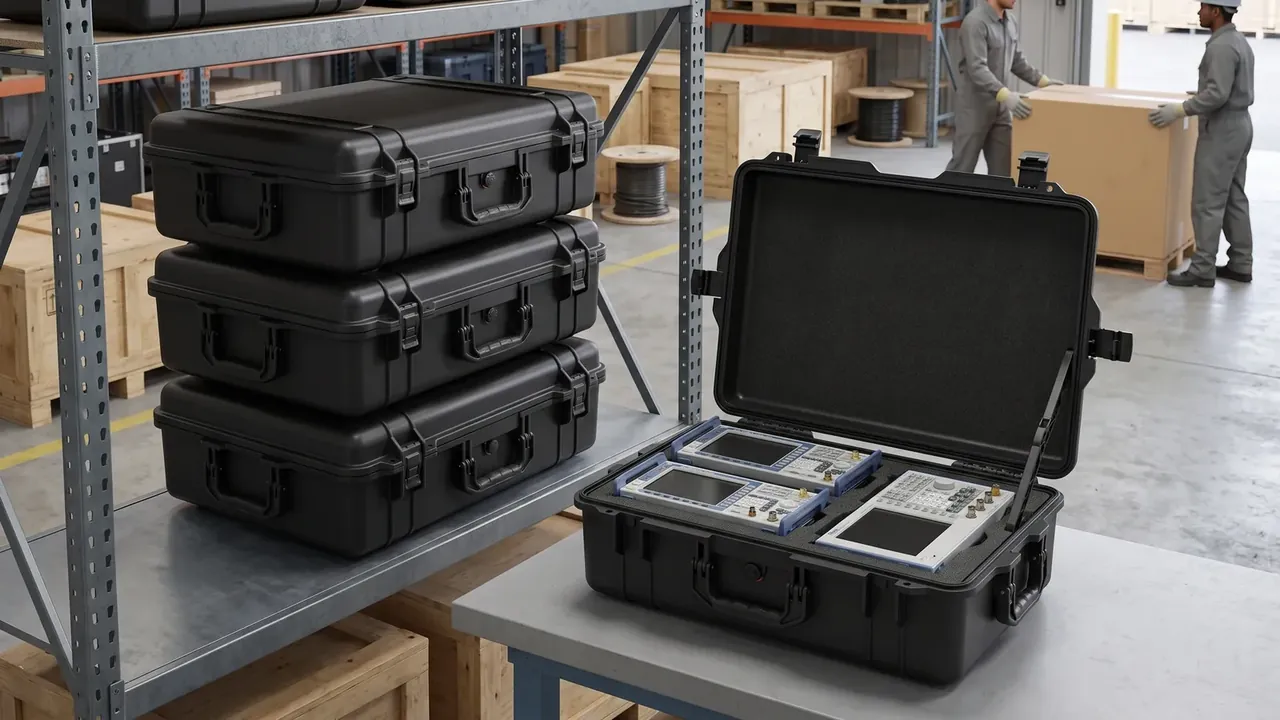
Quick answer: Broadcast handheld gimbal protective case at 480×380×220 mm outside, 425×325×175 mm inside, three floating pads at ≤50 N each over 25 mm EVA.
Table of contents
- Why the broadcast handheld gimbal protective case floats its load
- Three pads at 50 N each
- How 25 mm of EVA turns a 1.2 m drop into 35 g
- Five pockets and a 110° lid angle
- Two 350 N latches, a 320 N handle and IP67
- FAQ
1. Why the broadcast handheld gimbal protective case floats its load
The mass sits badly. Of 7.4 kg, most is in the handle and the battery, while the body is a thin frame whose weakest points are three motor shafts. Laid flat on a floor, the weight travels from the frame wall into the gimbal arms and loads those shafts in bending. The broadcast handheld gimbal protective case moves contact onto the frame rails instead.
Two pads underneath and one at the side define a single plane. Three can be shimmed, so tolerance never leaves a leg hanging; a fourth would fight the others and crack first in a drop.
Table 1: parts against support method
| Part | Can it take load | Support method |
|---|---|---|
| Frame rail | yes | two pads below, ≤50 N each |
| Handle root | yes, axial only | end cradle plus side stop |
| Motor shaft | no | 8 mm clearance, no contact |
| Front lens group | no | 3 mm axial gap |
| Battery base | yes | floor pad, 1 mm lateral |
Three points saves no material; it makes each leg calculable.
2. Three pads at 50 N each
At rest 7.4 kg splits 30/28/14 N, the first two near the centre of gravity, the third only stopping tip. The 50 N ceiling is dynamic: three times static, so a 90 N peak must compress EVA to 40 percent without bottoming.
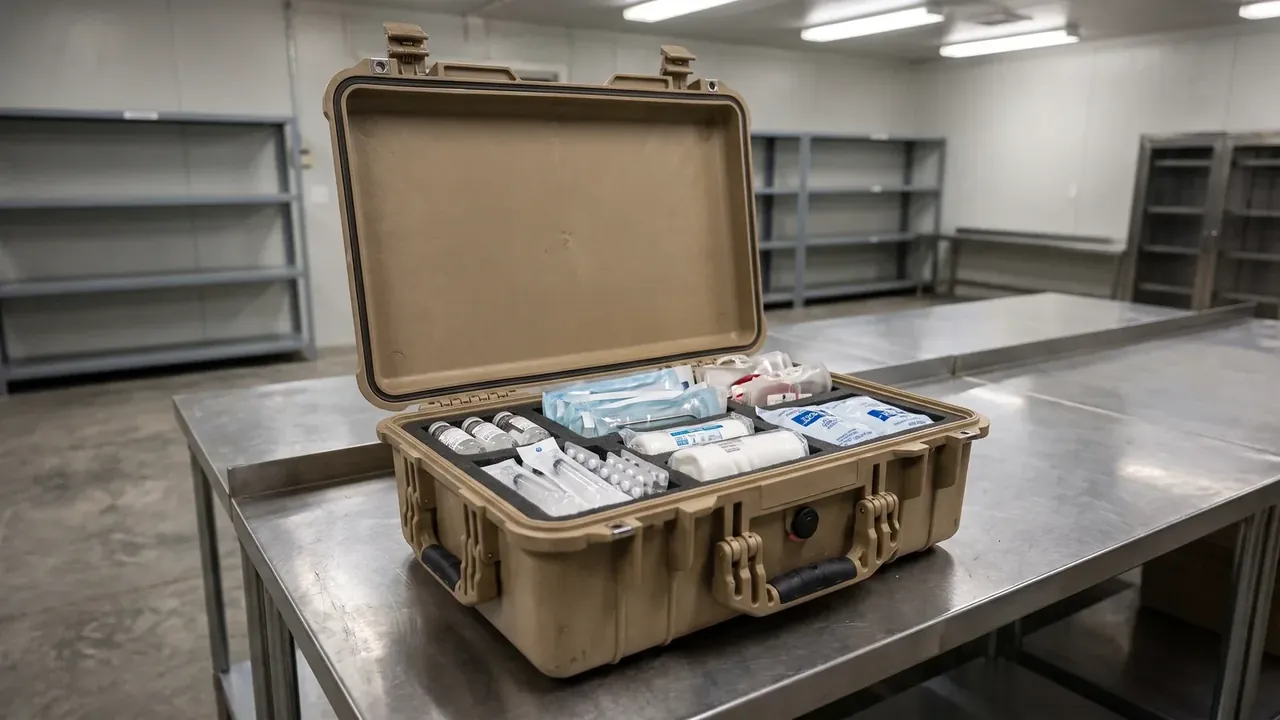
Pad positions follow the centre of gravity projection, and the triangle must contain it or the case rolls about an edge when it lands on its side. On this broadcast handheld gimbal protective case the projection falls 40 mm toward the battery, and the shortest side clears it by 25 mm. Leg stiffness must also match: one leg 10 percent softer drops to 20 N and throws the other two past 50 N.
Table 2: where load is allowed and where it is not
| Can it take load | Limit per point | Structure |
|---|---|---|
| yes, frame rail | 50 N | three floating pads, 25 mm EVA |
| yes, handle root | 50 N | half cradle wrapping 120° |
| no, motor shaft | 0 N | 8 mm air all round |
| no, front lens group | 0 N | 3 mm axial gap |
The side pad carries lateral load only, 15 N, enough to stop the unit sliding toward the lid.
3. How 25 mm of EVA turns a 1.2 m drop into 35 g
A 1.2 m fall on this broadcast handheld gimbal protective case arrives at 4.85 m/s. Taken directly, 25 mm of EVA at 60 percent compression gives a 15 mm stroke and 78 g, more than twice the target, so the energy has to pass two stages.
Walls are 3.5 mm and four corners thicken to 6 mm, cutting the speed reaching the cradle to 2.4 m/s, a 0.3 m equivalent. The same stroke then gives 192 m/s², about 20 g, and the 35 g limit keeps a factor of 1.75 for landing attitude.
Table 3: support methods against targets
| Support method | Material and thickness | Target |
|---|---|---|
| three floating pads | EVA 25 mm | ≤50 N per point, ≤35 g |
| floor cradle | EVA 25 mm | contact area ≥1800 mm² |
| side stops | EVA 10 mm | 3 mm lateral gap |
| lid pad | EVA 15 mm | 2 mm compression closed |
A corner landing gives up 5 mm of stroke. After six faces the pad falls from 25 mm to 22 mm, and that 3 mm has to sit in the preload or the third drop runs out of travel.
4. Five pockets and a 110° lid angle
Five pockets in the broadcast handheld gimbal protective case take the body, the handle, two batteries and an accessory bay. Each needs a finger notch 25 mm wide and 18 mm deep on the handle side, so the unit lifts without being turned over. Walls between pockets stay at 8 mm; thinner ones crush and the pockets merge.
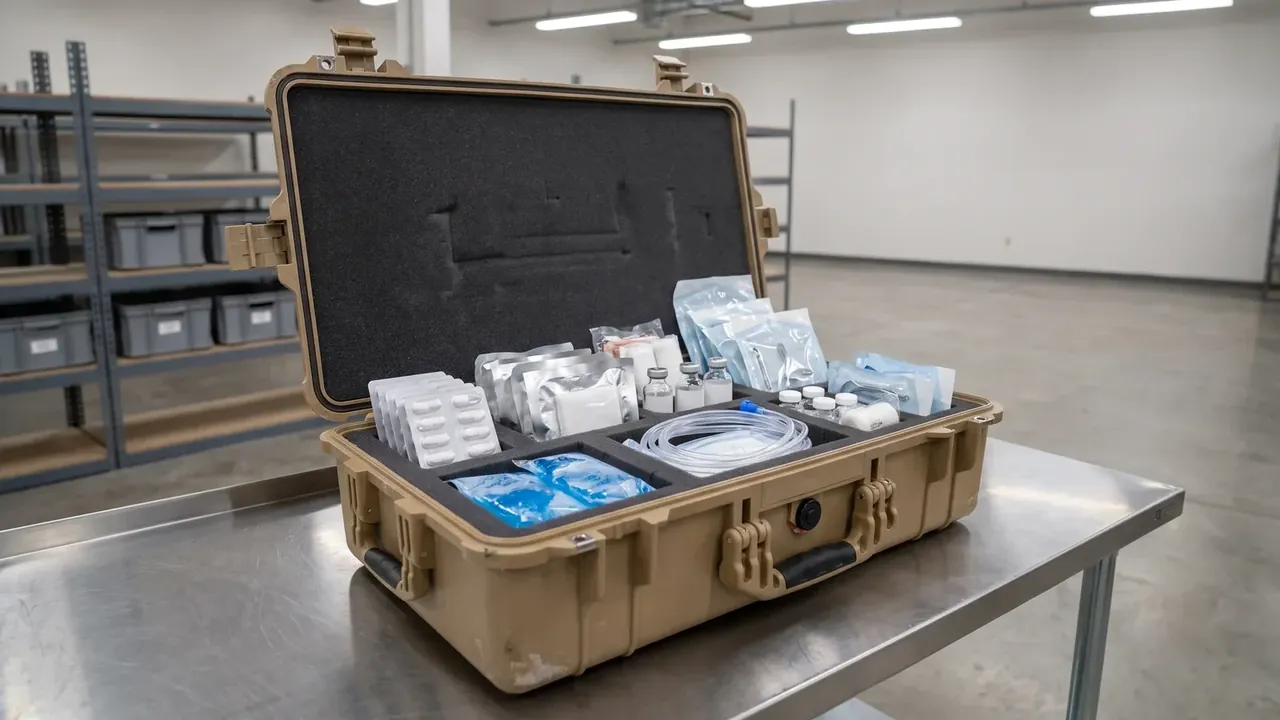
The 110° stop is a hinge block. Past 12 mm beyond the hinge line the lid falls on its own, and at 110° it still sits 8 mm inside, so a released lid stays up.
The 175 mm cavity and 220 mm height differ by 45 mm: 3.5 mm floor, 3.5 mm top and a 38 mm overlap at the rim, where the seal sits at 25 percent compression. That overlap is why the height stops at 220 mm.
5. Two 350 N latches, a 320 N handle and IP67
Empty at 4.6 kg and loaded at 7.4 kg, the broadcast handheld gimbal protective case weighs 12 kg and puts 118 N on the handle. The 320 N rating is a factor of 2.7, sized for the lateral component of a swinging case.
On the broadcast handheld gimbal protective case two latches at 350 N give 700 N on the 480 mm edge, and the 38 mm overlap is the second constraint, so latches clamp rather than carry bending.
IP67 means 30 minutes at 1 m, and it depends on that 25 percent compression. At −20 °C the EVA stiffens and returns slowly, costing 2 mm of stroke; at 60 °C the seal softens and compression set is re-checked over 72 h.
Conclusion
Every dimension in the broadcast handheld gimbal protective case serves one rule: load goes through the frame, never through a motor shaft. The 480×380×220 mm shell and 425×325×175 mm cavity buy 25 mm of EVA travel, three pads split 7.4 kg into 30/28/14 N below 50 N each, and two-stage absorption holds residual acceleration under 35 g from a 1.2 m drop. Two 350 N latches and a 38 mm overlap keep IP67, and the 110° stop keeps hands clear.
Related Reading
- Live broadcast case structure and internal zones
- Film and broadcast equipment cases under heavy loads
- Rotomolded protective case walls, ribs and impact
- Layered use of handheld plastic tool cases with trays
Related Products
- 8 Series — Gun Cases; Military Equipment Cases; Camera Equipment Cases; Drone Cases; Watch Cases; Knife Cases; First Aid Cases; Electronics Equipment Cases
- WL8-2812 PP Gun Case — model WL8-2812
- All protective cases and toolboxes: 7 series, 158 models