

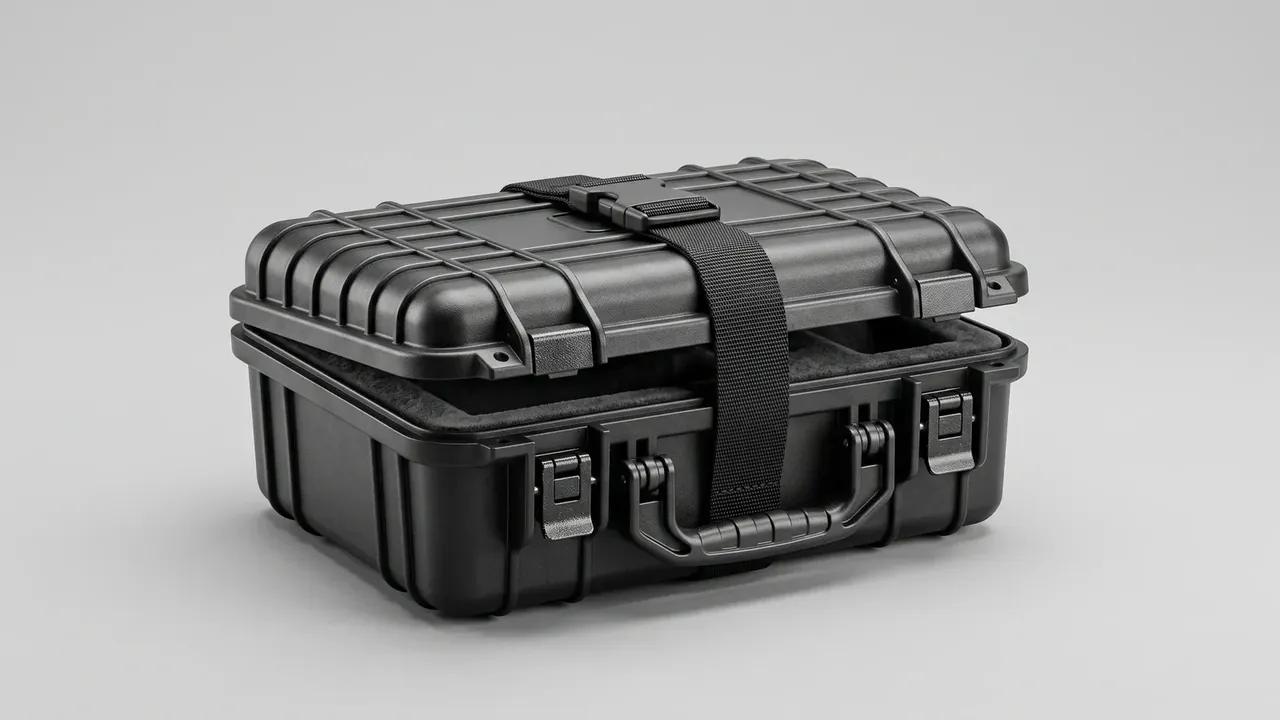
Quick answer: A handheld plastic tool case with tray lives on three numbers: how the tray splits from the bay, how tall the rim stands, which side frequent parts sit on. One sampling round, taking the rim from 16 mm to 11 mm, shows how pick-up motion sets all three.
Table of contents
- How a handheld plastic tool case with tray splits into tray and bay
- Tray load rating and rim height
- Why frequent parts sit on the near-hand side
- One-hand opening and the side buckle
- Three mistakes that only appear after loading
- The sampling day: 16 mm back to 11 mm
- FAQ
1. How a handheld plastic tool case with tray splits into tray and bay
A handheld plastic tool case with tray holds two levels: tray on top, bay below. Get the split wrong and every job starts by lifting the tray out.
The rule is pick-up frequency, not volume: frequent parts in the shallow front cells, heavy or rare items in the bay, reached through the gap the tray leaves. The tray indexes the layer beneath it.
| Zone | Suits | Motion | Limit |
|---|---|---|---|
| Front cells | Bits, screws, spanners | Thumb and forefinger | 48 by 32 mm, 18 mm deep |
| Rear slot | Long drivers, hex keys | Whole tool drawn out | 210 mm, 22 mm deep |
| Bay left | Drill, pliers | Tray out, two hands | 95 mm high |
| Bay right | Spares, tape | Reach in sideways | 120 mm wide |
A bigger bay is not better: an opening under 70 mm leaves heavy items poured out.
2. Tray load rating and rim height
The tray wall is 2.2 mm with four ribs, rated 3.5 kg distributed; one cell takes 0.6 kg, about seven M8 bolts before the floor bows. Once it bows, the tray jams.
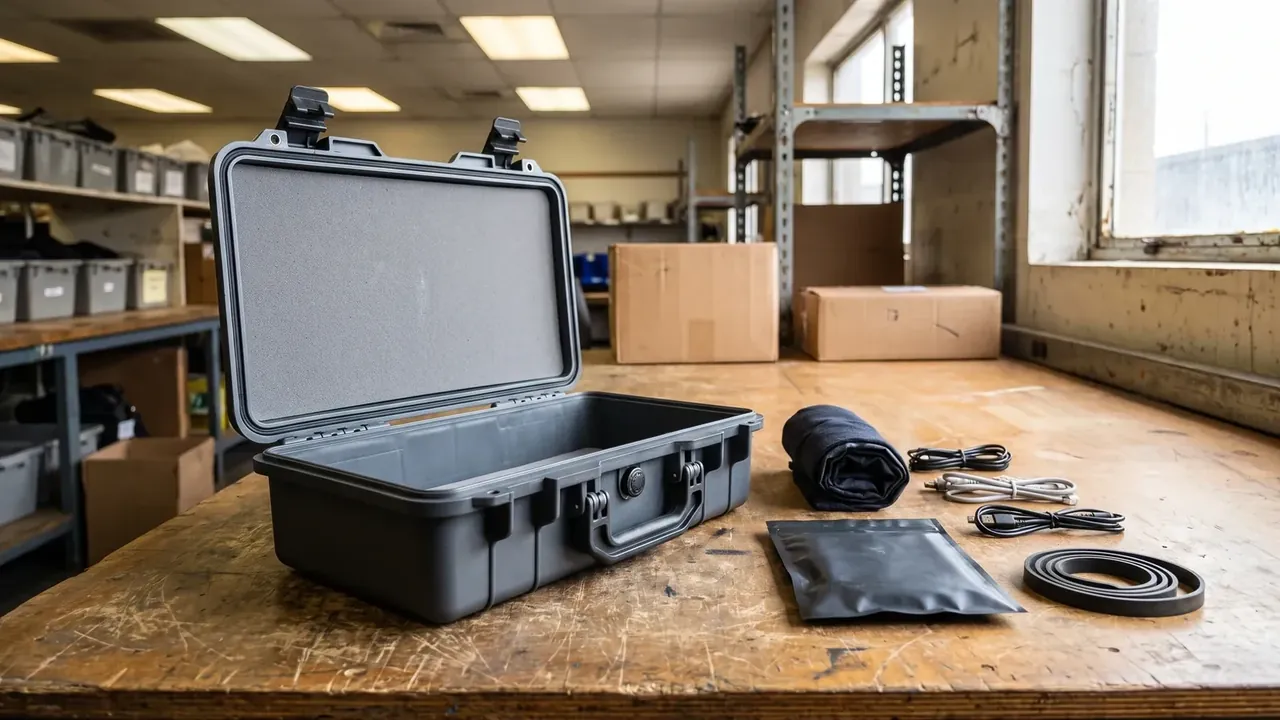
Rim height is the figure most often wrong. At 11 mm it stops nuts under 6 mm sliding out and lets a finger back pass. At 16 mm the knuckle hits the rim, the hand rotates and picks sideways, one motion becoming two.
The rim is not level all round: 8 mm on the handle side where the hand crosses first, 14 mm on the hinge side, which only blocks.
3. Why frequent parts sit on the near-hand side
The handle inner edge sits 62 mm from the tray front, the webbing space of an open hand: under 55 mm the palm rests on the front cells, over 70 mm the case tips in one-handed carry.
Near-hand means the side facing the carrying hand, not the body. A right-handed carrier picking left wants the left three cells, the reverse otherwise, so the tray mounts at 180 degrees.
Six cells run three high frequency, two medium, one low: no lid, half divider, deep well.
4. One-hand opening and the side buckle
Most actions on a handheld plastic tool case with tray are one-handed: brace, thumb the latch, lift with four fingers. Opening force sits at 28 N with 9 mm travel, loose enough for gloves, tight enough not to pop open in a truck.
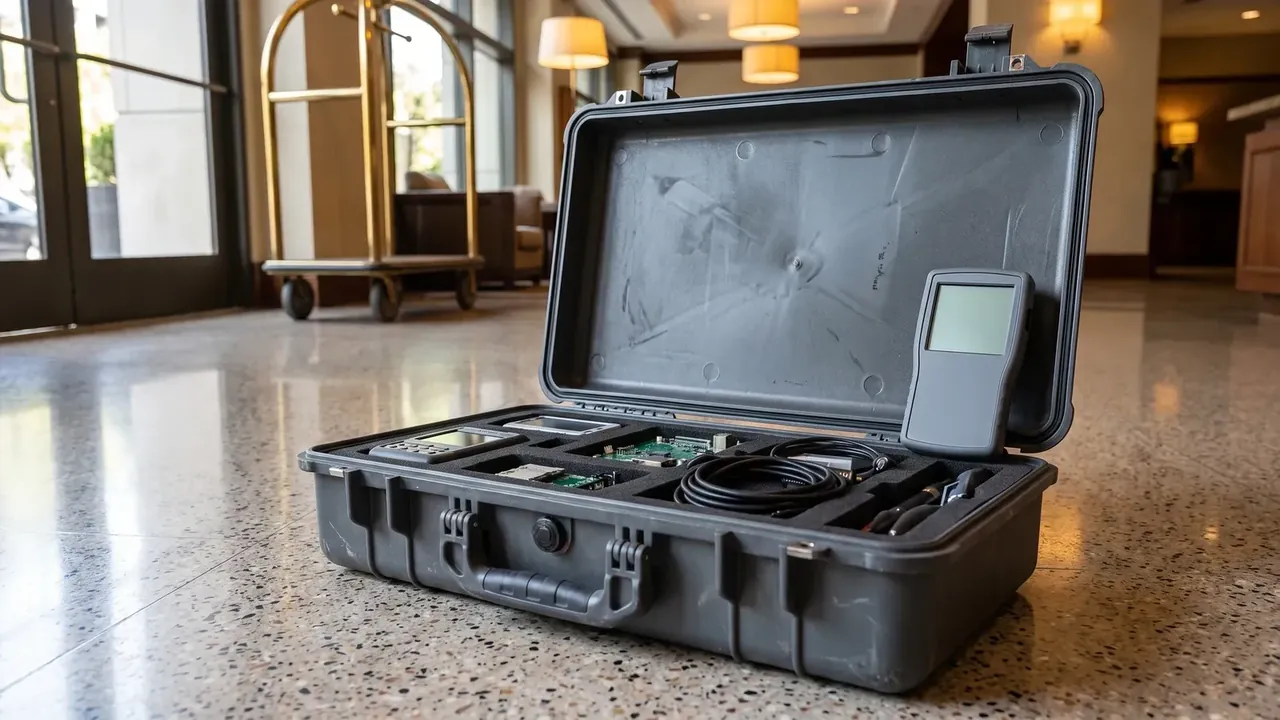
The latches must release separately: pressing both at once is awkward, and users open one side, lift a gap, then the other.
The hinge stops at 105 degrees, so the lid neither falls back nor hides the rear row. A side buckle above the tray front needs pushing aside at every open; at the mid-line the webbing hangs outside the palm.
5. Three mistakes that only appear after loading
A rocking tray comes first: 0.8 mm clearance is best, since under 0.5 mm shrinkage stops it entering, over 1.5 mm it shifts as the case tilts.
Cell migration is second: without dividers small parts slide to one corner; a 1.2 mm divider fixes it.
Lid interference is third: anything 11 mm above the rim gets pressed by the lid foam and takes a mark, so parts are chosen against the rim, not the bay depth.
6. The sampling day: 16 mm back to 11 mm
The first sample used a 16 mm rim against spillage. Loaded at realistic quantities, reaching a nut meant pushing a finger past the rim and curling down: 4.2 seconds a pick.
Dropping the rim to 11 mm and raising the front cell floors 4 mm cut that to 2.6 seconds, near five minutes saved over two hundred picks.
The 1.2 m six-face drop then had to hold: tray seated, parts in their cells. The 16 mm rim was no better, since retention comes from rim angle, not height. The second sample opened the front radius from R2 to R4, 2 mm on paper, a different hand feel.
Conclusion
The tray in a handheld plastic tool case with tray is the first stretch of a pick-up path, not a storage compartment: split by frequency, rim by finger, cells by carrying hand. That sample took the rim from 16 mm back to 11 mm and a pick from 4.2 to 2.6 seconds, the argument for deriving dimensions from motion, not fear of spillage. When buying a handheld plastic tool case with tray, check the tray comes out with one hand before discussing cell count.
This article discusses only the container (case body) side of specifications and design intent, and does not cover any handling, loading or use of the contents.
Related Reading
- Trolley case sourcing: molds against case formats
- Aluminium against stainless steel tool boxes
- Plastic tool boxes in automotive repair
- Tool case layout for aviation maintenance
Related Products
- 8 Series — Gun Cases; Military Equipment Cases; Camera Equipment Cases; Drone Cases; Watch Cases; Knife Cases; First Aid Cases; Electronics Equipment Cases
- WL8-2812 PP Gun Case — model WL8-2812
- All protective cases and toolboxes: 7 series, 158 models