

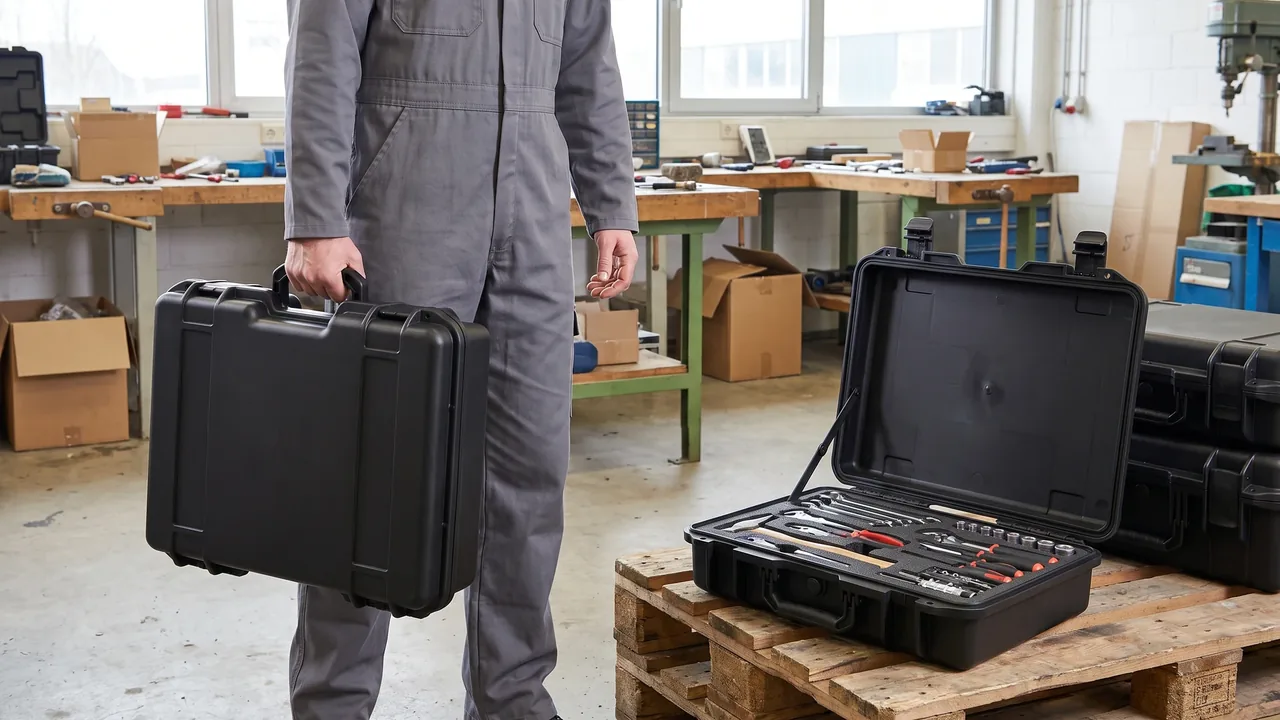
In aviation maintenance the traceability and on-site safety of tools are held to an exceptionally high standard, and a single missing wrench or socket left inside an engine bay can cause costly foreign object damage. Field practice shows that choosing a dedicated tool case with shadow-foam inserts and sealed compartments, and embedding a tool-inventory check into every open and close cycle, is the most direct way to lower FOD risk and meet the accountability requirements of line and base maintenance. This article focuses strictly on the container itself - its material, insert, sealing, shock control, latches, stacking, certification, customization and upkeep - and gives actionable selection and control methods for airline maintenance crews, MRO shops and general aviation repair stations.
1. Purpose and Use Cases
An aviation maintenance tool case is a hard protective container used to store, transport, inventory and manage line-maintenance tools. Its core job is not to repair aircraft but to let calibrated torque wrenches, micrometers, feeler gauges and safety-wire pliers move safely between the ramp, the hangar and the overhaul shop while their count and status are verified before and after every task. Unlike a household or ordinary workshop toolbox, the aviation context means a lost tool can become FOD, so the container must have closed compartments, a visible insert and anti-drop structure.
During line maintenance, technicians roll the case to the gate or the apron for preflight, postflight and transit checks. In base maintenance such as C and D checks, cases are issued per workstation and paired with a tool list and a sign-out log to achieve accountability. General aviation repair is distributed and often lacks a conditioned hangar, so the case must tolerate wider temperature and humidity swings plus dust and rain. MRO factories emphasize standardization: one aircraft type's tools are grouped into one case with uniform numbering to support cross-checks and audits.
It must be stated clearly that the case is only the carrier of tools and never replaces any maintenance procedure or airworthiness directive. What it provides is physical protection, visual inventory and a responsibility loop during transit. Before buying, write down the usage scenario (line, base, GA, field), the tool list (count, size, weight) and the inventory system, then decide case size, insert style and latch grade - never buy the case first and force tools to fit, which wastes space or weakens protection. For material trade-offs, compare the aluminum versus plastic case guide and the industrial versus household toolbox.
2. Shell Material and Structure
The shell material of an aviation maintenance tool case directly determines weight, strength and environmental resistance. The mainstream options are modified PP (polypropylene) injection cases, ABS engineering-plastic cases and aluminum-profile frame cases. PP cases balance impact resistance and low-temperature behavior with lighter weight, suiting frequent rolling transit. ABS cases are rigid and flat, good for printed labels and color coding. Aluminum cases offer the highest strength and stacking layers but cost and weigh more, typically for heavy tooling or fixed shops.
Structurally, watch wall thickness, reinforcement ribs and corner protection. Engineering-plastic cases usually use one-piece injection with internal longitudinal and transverse ribs; typical wall thickness runs 2.5 to 4.0 millimeters, and ribs spread local impact across the whole shell to avoid single-point cracking. The four corners should be thickened and rounded to lower impact stress and reduce scraping of people and equipment. The hinge should use metal inserts or steel pins so it stays tight over long use.
Material must match the environment. Coastal or high-salt-spray airports should prefer PP with UV stabilizer and check salt-spray resistance. Northern aprons in winter can reach minus thirty degrees Celsius, so confirm the material's low-temperature brittle point is below the service minimum. If the case travels in aircraft baggage or cargo holds, keep the outline free of protruding edges and reserve a mounting point for a pressure equalization valve. For light yet strong needs, see the aluminum versus plastic case guide and the industrial versus household toolbox.
Recyclability and compliance also matter for fleet buyers. Many PP and ABS shells are recyclable, and suppliers can provide RoHS and REACH declarations for the materials and additives, which some airlines require in their procurement specifications. When the case must sit near avionics or sensitive test equipment, ask whether the shell or insert carries any EMI shielding option, since a plain plastic case offers none. Weight budgeting is the final filter: a fully loaded case should stay within the single-person carry limit where possible, and where it exceeds that, wheels or a two-person lift plan must be specified so the case is actually usable on the line rather than left on a cart.
3. Shadow Foam Inserts and Tool Inventory
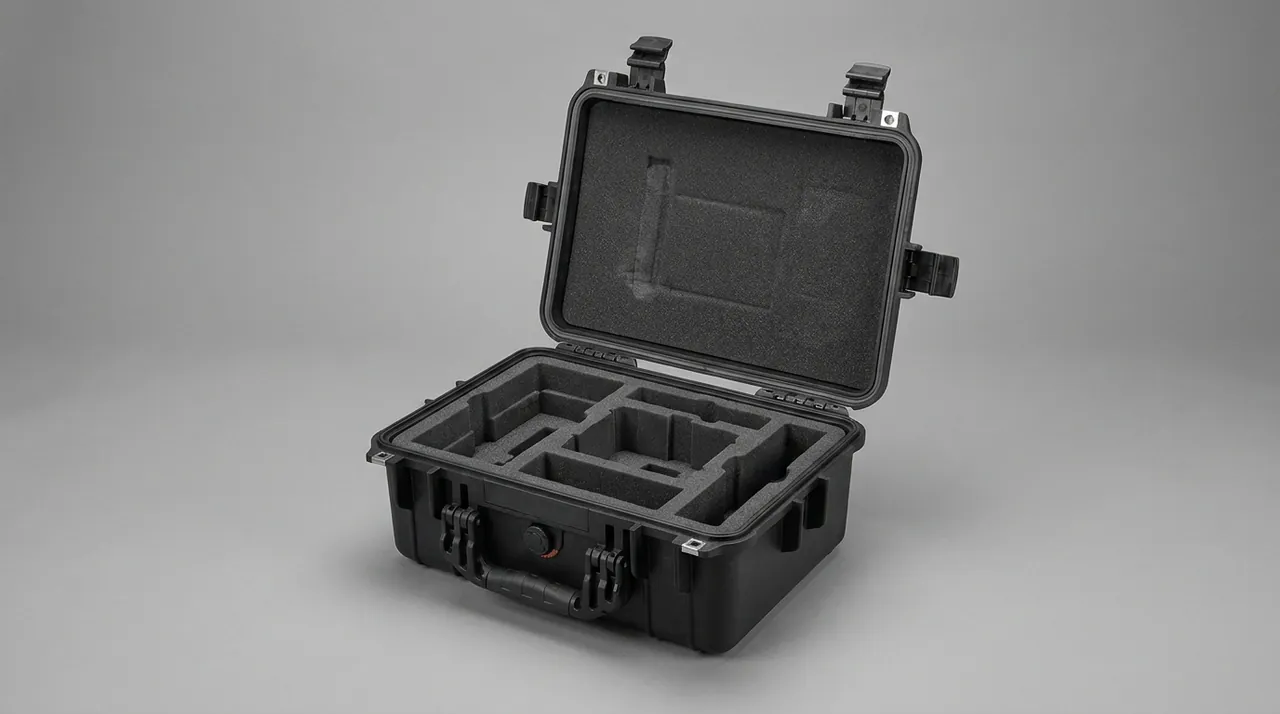
The insert is the soul of tool inventory in an aviation maintenance tool case. The most common is shadow foam: two layers of differently colored sponge are CNC or die cut to the tool outline, the top layer is hollowed to expose the tool and the bottom layer keeps its base color, so when a tool is removed a clear "shadow" remains and a missing item is spotted at a glance. This visualization sharply reduces missed counts at end of shift and is the foundation of FOD prevention.
There are two cutting methods. Pre-cut is produced by the factory from a supplied tool list and dimension drawing, ideal for standard kits. Pick-and-pluck provides a grid of tearable cubes the technician shapes by hand - flexible but less precise. For high-value, irregular or bladed tools, molded EVA is preferred; its closed-cell structure resists moisture and sheds no debris, and thermoforming hugs the tool curve. Insert density is typically 25 to 45 kilograms per cubic meter: too soft and heavy tools sink, too hard and removal is tiring.
Layout must serve inventory: group same-type tools nearby, put frequent items on the top layer visible at opening, keep heavy items at the bottom to lower the center of gravity, and separate sharpened items from measuring tools to avoid knocks. Every tool gets a number matching the list and the sign-out ledger. JUNZHIJIA, when customizing inserts, usually lays out the foam one-to-one against the customer's tool BOM and outputs a cut map and a number cross-reference table so each cavity maps to one line of the list for easy audit. For material trade-offs read the case foam material comparison and the foam lining guide.
4. Sealing and IP67 Dust and Water Protection
Hangar dust, rain and wash-down work can let debris into a tool case, contaminating gauges or causing small-part loss. The core of sealing is a continuous gasket seated in the lid flange channel. Common gasket materials are EPDM rubber, silicone and TPE; EPDM resists ozone and weathering, silicone tolerates a wide temperature range, and TPE rebounds fast and is recyclable. The gasket cross-section is usually a hollow rectangle or double-lip profile that, under compression, forms a continuous watertight line.
Protection grades follow IEC 60529 (China's GB/T 4208). Aviation maintenance cases commonly require IP67: protection against dust above 75 micrometers and immersion in one meter of water for thirty minutes without ingress. Reaching IP67 relies not only on the gasket but also on synchronized sealing at hinges, latches and the vent valve, plus a flat lid plane and even latch compression. A pressure equalization valve balances inside-outside pressure during altitude or temperature change so the gasket is not sucked flat or hard to open, and the valve itself must meet the same grade.
Note that an IP grade is a laboratory typical value; in daily use gasket aging or debris caught in the flange weakens performance, so seal inspection belongs in routine maintenance. Buyers can ask for a third-party or in-house IP67 immersion and dust test report - typical values are enough, no extreme numbers needed. For the standard read the IP rating guide and the IP67 protective case; for materials see case seal materials.
5. Shock Absorption and Impact Resistance
Tools suffer drops, bumps and stacking pressure in transit, and the damping structure protects gauge accuracy and case life. The hard shell resists external impact while the inner foam absorbs internal vibration, together forming a hard-outside soft-inside buffer. For micrometers, dial indicators and electronic torque wrenches, shadow foam alone is not enough; add an EPE or EVA pad between tool and wall.
Drop protection follows transit-test logic: a loaded case dropped from various heights onto a hard floor must keep latches and hinges functional and the insert not shifted. In typical experience a twenty-kilogram loaded case surviving a 1.2-meter drop depends on wall thickness, ribs and corner design. For vibration, long road or cargo-hold transit brings sustained random shaking; the insert must keep tools from leaving their cavities, so heavy items get extra straps or clips.
Stacking means the lower case bears the upper weight, and damping and load bearing are two sides of one problem: stack corners must carry vertical load, not press it onto the gasket or insert. If the case moves with a vehicle, consider tie-down points. For precision damping see the shockproof toolbox for precision tools; for stacking load see the protective case stacking guide.
6. Latches and Tool Accountability
Latches serve three functions: theft deterrence, accidental-open prevention and responsibility control. Aviation cases commonly use press latches, butterfly latches and TSA locks. Press latches open fast with one hand, suiting high-frequency access. Butterfly latches compress hard and evenly, suiting long transit. TSA locks let customs inspect during cross-border air freight without breaking the case. High-value kits can add a padlock hasp or a serialized lead seal, recording who opened the case.
Accountability is the core system of aviation maintenance, and the case is its physical node. Recommended practice: each case carries a unique number and a QR plate; before opening, scan to register the responsible person and check each item against the list; at end of shift re-check and photograph as a record; report and close any missing item immediately. Case number, insert number and list number stay consistent, compressing one check to minutes. JUNZHIJIA, in OEM/ODM projects, can pre-build numbered nameplates and QR slots and deliver a number cross-reference document, reducing the user's rework.
Latch life matters too. Metal parts should be anti-rust treated; plastic latch tongues need fatigue life; factory open-close cycle testing (typical thousands of cycles) is advisable. Latch distribution must compress the lid evenly; a case with one-sided latch stress easily shows gaps on the other side, letting water and dust in. For details see the case latch selection and the latch hardware material guide.
7. Stacking and Trolley Wheels
Hangar and shop space is precious, so cases are often stacked to save floor or fitted with wheels to roll on the apron. Stacking relies on top stack ribs and bottom stack grooves that interlock into a stable column and avoid slip. Design must carry stack load along the four corners, not onto the middle gasket; a typical experience is one case bearing several times its own weight, but allowed layers must follow the maker's stack test data.
Trolley and wheels solve the last kilometer. Wheels should be quiet, oil-resistant PU or TPE with brake lock so the case will not roll on a sloped apron; the trolley is a telescopic dual-tube with ergonomic grip height and the push center of gravity near the axle to reduce effort. Wheels and trolley are modular add-ons mounted on case sides or back; confirm load rating and rib matching when buying. For air freight the wheels should be quick-removable or foldable to stay within baggage outline.
Stacking and transit also need label visibility: the top stacked case should show its number and contents category for fast access. For multi-case teams, color-code by aircraft type or station (red for A320 line, blue for B737 line); see case color visual management. For wheel selection see the wheeled case buying guide and case wheels and trolley handle.
8. FOD Prevention and Color Coding
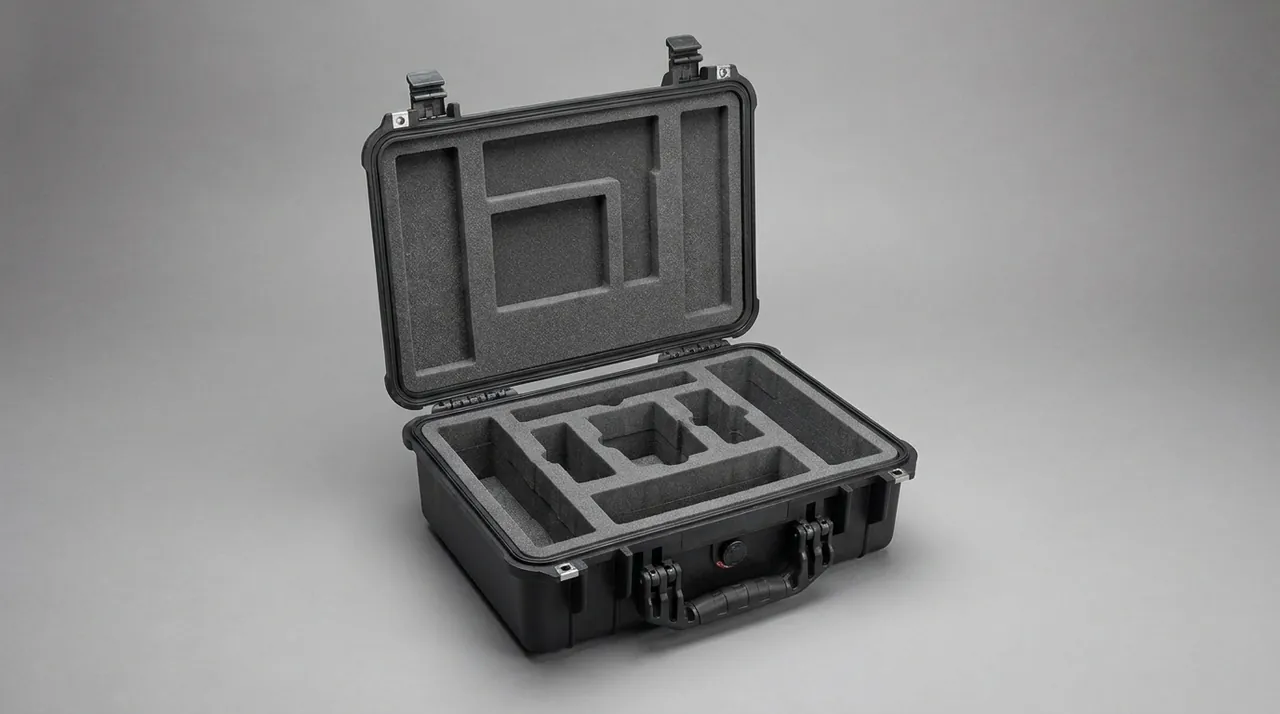
FOD (Foreign Object Damage) is among the top on-site risks in aviation maintenance; a dropped nut or broken safety wire can be ingested by an engine or jam a control surface. The case itself creates no safety, but through four actions - enclose, locate, count, record - it drives FOD risk to the minimum. Enclose means fully closed on lid-down; locate means every tool has a fixed foam cell; count means two checks per open-close; record means labels and photos are traceable.
Color coding is low-cost and high-return. Fluorescent edge strips or colored corners separate cases by aircraft type or station to avoid mix-up; light-base, dark-tool contrast in divider pages makes a missing item obvious. Small parts (safety wire, cotter pins, washers) deserve a transparent sub-compartment or magnetic tray to avoid scatter. Rolling-prone items get baffles or elastic straps in their cells. End-of-shift counting should keep tools in the case and name each cell against the list, which is more reliable than dumping everything out to count.
In management the case enters the tool-control ledger for periodic inventory, periodic gauge calibration and mandatory re-inspection at expiry. A case that has dropped, flooded or had latch trouble deserves a special check confirming insert and seal are intact before reuse. For container and process points see the industrial maintenance toolbox and the maintenance toolbox guide.
9. Certification Standards
Although an aviation maintenance tool case is not an aircraft part, procurement and audit often require evidence of environmental adaptation and transit reliability. Four standard families are common. First, IEC 60529 (GB/T 4208) defines IP dust and water grades; IP67 is the dust and short immersion ability above. Second, MIL-STD-810H is a US military environmental engineering test method covering drop, vibration, temperature, humidity and salt spray; many cases cite "passing relevant MIL-STD-810H procedures" as weather endorsement, but note it is a family of methods, not a single pass or fail. Third, the ISTA transit test series (such as 1A, 2A, 3A) simulates single, combined and air-express shipping vibration and drop, suiting cross-plant and cross-border reliability. Fourth, UL94 addresses shell material flame class (V-0, V-1, V-2), useful where hangar fire sources exist.
Buyers should require the supplier's test report or declaration for the relevant standard and distinguish "designed to a standard" from "tested to a standard" - the former is only a target, the latter is proof. Report values are typical or experience values; do not chase extremes, the key is covering the unit's real duty (temperature range, salt spray, drop height, stack layers). For harsh scenes see the GJB and military standard case; for test details see MIL-STD-810H explained and the ISTA test guide.
Beyond the four families, buyers in the EU or with EU-supplied aircraft often ask for RoHS and REACH declarations covering the shell, gasket and foam, to confirm restricted substances are controlled. Documentation discipline is as important as the test itself: keep the report, the lot number and the case serial in one file so a future audit can link a physical case to its evidence. Where the case carries calibrated tools, the calibration certificates of the tools are separate from the case certificate and must travel with the kit, not with the container paperwork alone.
10. Custom Inserts and OEM/ODM
Standard cases rarely fit each unit's tool list, so customization is common in aviation maintenance. Customization usually has three steps: first supply a tool BOM (name, count, outer size, weight, compartment need) and the maker lays out the insert and checks the center of gravity; then output a foam cut map and 3D preview for confirmation; finally sample, fit-test, sign-off and batch production. OEM means the factory applies the customer's brand and number; ODM develops structure and insert to the requirement.
JUNZHIJIA can offer one-stop customization from shell to insert: lay out shadow foam against the tool list, pre-build numbered nameplates and QR slots, match seals in the aircraft-type color, and deliver a number cross-reference table and typical test documents so the user plugs directly into the existing tool-control system. Define the delivery boundary - what the maker does versus what the user supplements, such as internal ledger fields - to avoid a responsibility gap. Mold and sample lead time, minimum order quantity and change cost should be written in the contract; see custom case MOQ and lead time and the custom foam lining guide.
Customization is not the more complex the better. Over-dense cut cells raise access time; too many compartments raise cost; balance clear inventory with operating efficiency. For frequently updated kits, use replaceable insert modules so one damaged cell is swapped, not the whole pad.
11. Maintenance, Cleaning and Seal Replacement
A case's value is long-term reliability, and upkeep decides its life. Daily maintenance has four jobs: cleaning, seal check, latch lubrication and insert renewal. Clean the shell with neutral cleaner and a soft cloth; avoid strong solvents that corrode PP/ABS or swell the gasket. Clean foam with a vacuum or low-pressure air, never wash and deform it. Inspect the gasket visually every quarter; replace it on hardening, cracking or lost rebound, and replace the whole ring with the same model and batch to avoid local leaks from mixing old and new.
Lubricate latches and hinges with dry lubricant to prevent rust and sticking; clean wheel bearings regularly and confirm brakes work. When foam sheds, deforms or loosens, its cushioning drops and it should be re-cut or replaced. After a drop, flooding or heavy crush, re-check function regardless of appearance: is the lid tight, is the insert shifted, are latches seated. Keep maintenance records with the case as audit and re-inspection evidence.
Seal replacement cycles depend strongly on duty: high-salt coastal air may age it in a year, a dry hangar lasts longer, with a typical replacement experience of two to three years, and a matched spare gasket list with a replacement guide is usually supplied at delivery so the user stocks by table.acement guide at delivery so the user stocks by table. For a systematic process see the protective case maintenance guide and seal aging and replacement.
12. Procurement Checklist and Acceptance
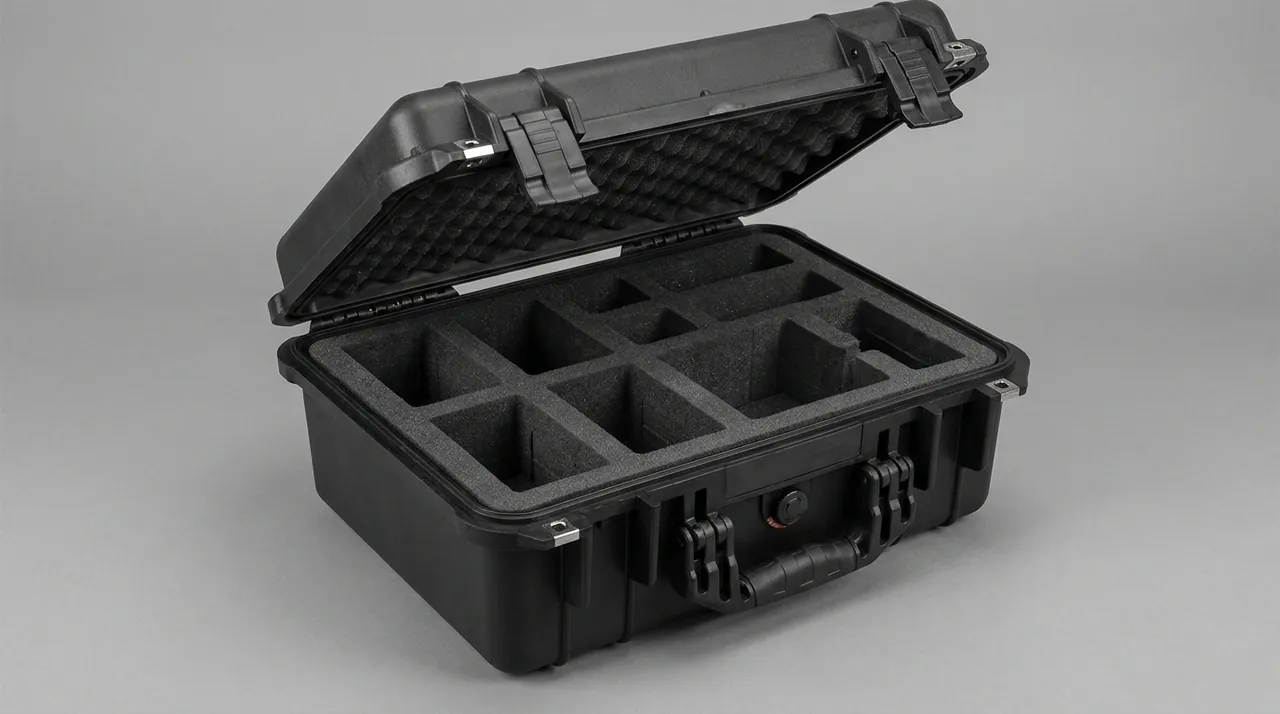
Turn the above into procurement with a checklist. First, define scenario and tool list: line, base, GA, field; total count, largest single size, total weight. Second, fix material and structure: PP, ABS or aluminum; wall thickness and ribs; stack layers. Third, fix insert: shadow foam or molded EVA; custom by BOM; number cross-reference supplied. Fourth, fix sealing and grade: IP67 target; pressure valve needed; salt-spray and low-temperature specs. Fifth, fix latches and control: press, butterfly or TSA; padlock hasp, QR. Sixth, fix wheels: load, brake, removable. Seventh, fix certification: which reports (IEC 60529, MIL-STD-810H, ISTA, UL94). Eighth, fix delivery: sample, MOQ, lead time, spares.
Acceptance has three steps: on arrival check appearance and accessory completeness and match case number to list; then functional sampling - lid seal, latch open-close, wheel rolling, insert fit; finally sample one IP and drop typical-value report to confirm it matches the spec. For large batches, agree an AQL sampling level and non-conformance handling; see custom case acceptance AQL and toolbox selection four parameters. For an overview see the protective case selection guide and the aerospace equipment case.
FAQ
Q: What is the core difference between an aviation maintenance tool case and an ordinary hardware toolbox? A: The core difference is not "can hold tools" but "can be inventoried, enclosed and traced." An ordinary hardware toolbox is usually an open rack or soft bag where, once a tool is taken out, it is hard to confirm at a glance whether everything is present, and it can drop parts in transit and offers no dust or water protection. An aviation maintenance tool case uses shadow-foam inserts to fix each tool in a visible "shadow cell," closes into a fully sealed IP67-rated enclosure, and pairs a unique case number, a QR plate and a tool list to achieve two checks per open-close and a responsibility record. This physical-plus-procedural combination directly serves FOD prevention and airworthiness audit, which an ordinary toolbox cannot replace. For units with high kit standardization, the insert and numbering can even be customized by aircraft type to further cut check time and lower human error. In practice, choosing a case with a rigid shell, interchangeable foam pads and a documented numbering scheme keeps that accountability stable even as the tool list evolves across airframes and shifts.
Q: How should I choose the density and cutting method of a shadow foam insert? A: Shadow foam usually uses closed-cell EVA or PE sponge with density in the range of 25 to 45 kilograms per cubic meter. Too low a density lets heavy tools sink and mislocate; too high makes removal tiring and costly. For cutting, standard kits prefer factory pre-cut from the tool BOM, which gives the best accuracy and consistency; on-site adjustments can use pick-and-pluck grids, though the cavity shape is rougher. Irregular or bladed high-value tools deserve thermoformed EVA molding that hugs the curve and sheds no debris. Either way, the tool should leave a clear shadow when removed and seat tightly when returned, with a number on the insert matching the list so inventory becomes "reading cells" rather than "counting pieces." Beyond density, check the foam's compression set and flame behaviour: a closed-cell pad that keeps its thickness after repeated compression holds tools better than a soft pad that slowly takes a set. For mixed kits, combine a dense base layer for heavy tools with a softer top layer for delicate gauges, and confirm the finished insert still lets the lid close flush without pressing the tools, which is the practical sign that the cut depth and the case interior height are correctly matched.
Q: What does IP67 mean for an aviation maintenance tool case, and how is it kept daily? A: IP67, defined by IEC 60529 (China GB/T 4208), means the case keeps out dust above 75 micrometers and survives immersion in one meter of water for thirty minutes without ingress. For a maintenance case it means gauges and small parts stay clean and present through wash-down, rainy aprons and dusty hangars. Keeping the grade depends on the gasket: inspect it every quarter, and on hardening, cracking or lost rebound replace the whole ring with the same model; clear debris from the flange channel before closing to avoid gaps; compress latches evenly, not one-sided. IP is a laboratory typical value, so daily care matters more than one test; related material and replacement methods are covered in the gasket topics. Because the seal is a wearing part, keep a matched spare ring in stock and replace it as a whole rather than patching a section, and store the case lid-open to let the gasket recover between missions. When the case is used near fuel, hydraulic fluid or cleaning agents, confirm the gasket material resists that specific chemistry, since a solvent-swollen ring loses its rebound and quietly fails the rating long before it looks damaged.
Q: How do I fold the tool case into an aviation maintenance accountability system? A: Accountability means "who handled it, who is responsible, and it is traceable." The practical step is to give each case a unique number and a QR plate, scan to register the responsible person before opening and check each item against the list, then re-check and photograph at end of shift, reporting and closing any missing item immediately. Case number, insert number and tool list stay consistent so one check finishes in minutes. High-value kits add a padlock hasp or serialized lead seal to record the open action too. Maker OEM services can pre-build nameplates and QR slots and deliver a number cross-reference document, reducing the user's rework. The system should also inventory periodically and re-inspect gauges at expiry, treating the case as an audit node. Keep a simple written rule so the system survives staff changes: only the registered holder opens the case, every removal and return is scanned, and any discrepancy is escalated the same shift. When several teams share a pool, add a colour or number band by aircraft type so a case always returns to the correct line, and review the ledger monthly to spot a tool that repeatedly goes missing, which usually points to a layout or process problem rather than carelessness.
Q: What load details must be watched during transit and stacking? A: Stack load should travel along the four corner stack ribs, not onto the middle gasket or insert, or long-term pressure will collapse the seal and damage tools. A typical experience is one case bearing several times its own weight, but allowed layers must follow the maker's stack test data, never guessed. For wheel transit choose braked PU or TPE wheels and lock them on sloped aprons; keep the trolley center of gravity near the axle for easier push. For air freight confirm wheels are removable or foldable within baggage outline; for cross-border use a TSA lock eases customs. After any drop or crush, re-check lid tightness and insert shift before reuse regardless of appearance. For long-haul road or sea legs, secure the case against the vehicle wall or a rack so it cannot slide and shear the stack ribs, and add corner protectors where the case meets hard edges. Confirm the rated stack height includes the wheels, because a trolley base changes the true contact pattern, and never count a case resting on its wheels as a full structural layer. When several cases travel together, load the heaviest at the bottom and match the row depth so no single case carries an off-centre load.
Q: When customizing an aviation maintenance tool case, how do I avoid cost overrun and responsibility gaps? A: To avoid cost overrun, write the requirement boundary first: tool BOM, insert style, numbering system and certification report list, then let the maker output a layout and 3D preview, sample and fit-test, sign off and batch produce. The contract should state mold cost, minimum order quantity, change unit price and lead time to avoid mid-course changes. To avoid responsibility gaps, define "what the maker does versus what the user supplements," for example who owns internal ledger fields and audit interfaces, and state it in the deliverables. Prefer replaceable insert modules so one damaged cell is swapped, not the whole pad. Commercial and sampling details are in the custom MOQ and foam lining guides to keep price, lead time and quality controllable. Keep one signed drawing as the master reference so a future reorder reproduces the same insert without renegotiation, and record the foam grade, colour and cut depth in that drawing. Where the kit may expand, reserve a spare cell or an empty bay so adding a tool later does not force a full redesign, which is cheaper than a second tooling round. If the unit runs several airframes, standardise the outer case and vary only the insert, so spares and wheels stay common across the fleet.
Q: Which certification reports are truly useful at procurement, and how to tell them apart? A: The four most useful reports are: IEC 60529 (GB/T 4208) IP grade testing for dust and water; MIL-STD-810H relevant environmental procedures (drop, vibration, temperature, humidity, salt spray) for weathering; ISTA transit tests (1A, 2A, 3A) for cross-plant and cross-border reliability; and UL94 flame class for shell material near fire sources. The key is to separate "designed to a standard" from "tested to a standard" - the former is only a goal, the latter carries a typical-value report. Procurement should require test files covering the unit's real duty (temperature range, salt spray, drop height, stack layers); chasing extreme numbers is unnecessary, matching duty is valid evidence. Also confirm the report names the actual model and production lot, because a same-category statement cannot support an airworthiness audit. Where the case sits near a heat source, ask for the UL94 class of the shell and insert, and where it crosses borders, keep the ISTA summary with the shipping papers so customs and logistics can trace the packing performance. Treat each report as a supporting document for a specific duty, not a blanket claim that the case is certified for every condition.
Q: After the insert is damaged or the gasket ages, what should be done? A: When the insert sheds, deforms or loosens, its cushioning and locating drop; assess whether it still holds tools, patch-cut if minor, or replace the whole pad if severe, and prefer replaceable modules for custom inserts to cut cost. Aged gasket (hardening, cracking, lost rebound) must be replaced as a whole ring with the same model and batch to avoid local gaps; after replacement do a lid airtight and immersion spot check. Coastal high-salt air ages faster, dry hangars slower, with a typical replacement experience of two to three years, though the real cycle should follow the unit's own inspection findings. Any case after drop, flood or crush deserves a function re-check before return to service, and maintenance records stay with the case as re-inspection and audit evidence. Set the inspection interval from real duty rather than a fixed calendar: a case used daily in a coastal or fuel-heavy environment should be checked more often than one stored in a dry hangar. Record each gasket and insert change against the case number so the maintenance history shows when performance started to drift, which helps decide whether to keep servicing a case or retire it. A spare insert and a spare gasket held in stock turn a potential grounding into a same-shift fix.